


 Login
 Blog
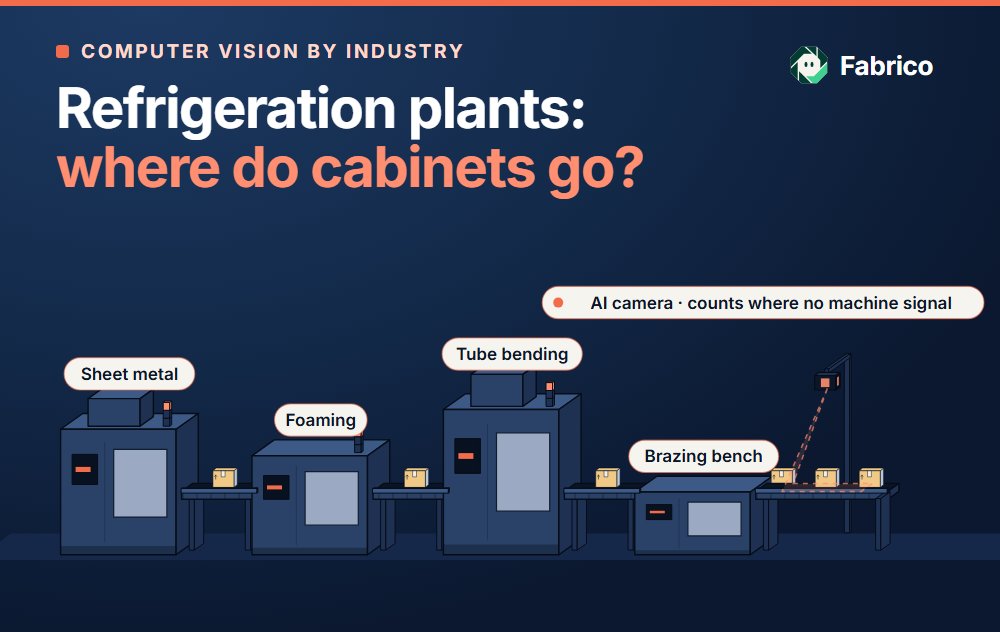
Computer Vision for Refrigeration Manufacturing: A Brazing Pilot That Finds Lost Cabinets

In short: computer vision in refrigeration manufacturing counts cabinets at manual stations, such as the brazing cell, where no machine logs output; a pilot proves the count.
- Inspection is a separate job: leak results stay with the leak tester and the quality team, charge weights with the charging machine.
- Pilot one station: the brazing cell between the foaming fixtures and the leak tester, both of which already log cabinets.
- Proof is three counts of the same cabinets: camera add-on, leak tester first tests and the hand tally, with each difference explained.
- Price lost cell minutes at the plant's margin per model, and only while orders are waiting.
- Stop, change or widen the pilot on events, never on a date.
A commercial refrigeration plant builds display cases, reach-in and walk-in coolers, ice machines, beverage coolers and refrigerated counters in many models and lengths. Some stations log each cabinet without help; the hand brazing cell leaves only a tally sheet. This pilot plan puts one camera add-on at that cell and judges it against records the plant already trusts.
Why the brazing cell, and not the foaming press, gets the first camera add-on
Self-contained cabinets carry their whole refrigerant circuit from the factory. The EPA final rule of June 2024 under the SNAP programme describes US stand-alone units as refrigerators, freezers and reach-in coolers whose circuit, for the smallest types, is "entirely brazed, welded, or uses threaded fittings", and says they are "charged with refrigerant at the factory". The EU F-gas Regulation defines a self-contained system as "a complete factory-made system" in which "no gas-containing parts are connected on site". So brazing, leak test and charge all happen in the plant, in that order, and each cabinet passes the brazing cell once.
That makes the cell the pilot station for three reasons:
- No machine signal. A brazing torch has no counter; the foaming PLC and the charge log sit on either side of a cell that leaves only a tally.
- A referee next door. The leak tester logs each test by serial and marks retests, an independent record to check the camera add-on against.
- It decides output. Kit shortages, gas cylinder changes and fixture changes stop the cell, and an unbrazed cabinet cannot be charged.
Pick the cell only if it is the constraint. The test is the queue: if foamed cabinets pile up in front of the cell while the leak tester waits, the cell sets the pace (theory of constraints in manufacturing explains why that matters). Write the queue check down before the Walk.
Explainer presented by Iris, Fabrico's AI-generated presenter: how an add-on camera counts output where a machine has no signal. Book a demo.
Plays from YouTube. Google may set cookies when you press play. Privacy policy.
What already logs a cabinet on a refrigeration line
Read the machines first; a camera add-on belongs only where nothing else gives a trusted count, and a plain counter is not OEE (production counter against OEE software). The example line's signal map:
| Station | What gives the count | Camera add-on? |
|---|---|---|
| Sheet metal, liner forming | Press and bender controllers | No |
| Foaming in fixtures | Fixture PLC, one cycle per cabinet or door | No |
| Cabinet fit-out | Paced conveyor, tally between stops | Later, if it starves the cell |
| Circuit brazing cell | Tally sheet only | Yes, the pilot |
| Leak tester | Test log by serial, retests marked | No, it is the referee |
| Evacuation and charging | Charge log by serial, weight per model | No |
| Run test | Pull-down log by serial | No |
| Doors, glass, electrical test | Safety tester log | No |
| Packing table | Tally sheet or label printer | Second camera, if the pilot widens |
The charge log also carries a rule. For US stand-alone units, the EPA rule records that UL 60335-2-89 limits a propane (R-290) charge to "13 times the LFL for open appliances (494 g)" and "eight times the LFL for closed appliances with doors and drawers (304 g)" (EPA SNAP Rule 26, Federal Register, 13 June 2024). An open multideck and a glass-door merchandiser run different charge recipes, and the charging machine already knows which model it filled.
In the EU, Annex IV of Regulation (EU) 2024/573 on fluorinated gases bans placing on the market refrigerators and freezers for commercial use, self-contained, "that contain HFCs with GWP of 150 or more" from 1 January 2022, and "other fluorinated greenhouse gases with a GWP of 150 or more" from 1 January 2025. Refrigerant and charge recipe are fixed per model.
One more record matters: the serial. If the leak tester, charging machine and run test log the same serial, their logs line up; if it is printed only at packing, the pilot needs a temporary label at fit-out.
Walk: trace one cabinet from foaming to the leak tester
The plan has seven named steps: Walk, Mark, Mount, Shadow, Reconcile, Price and Decide. The plant sets the pace: a step closes when its record exists, not on a date, and nothing in this plan is a delivery or project timescale.
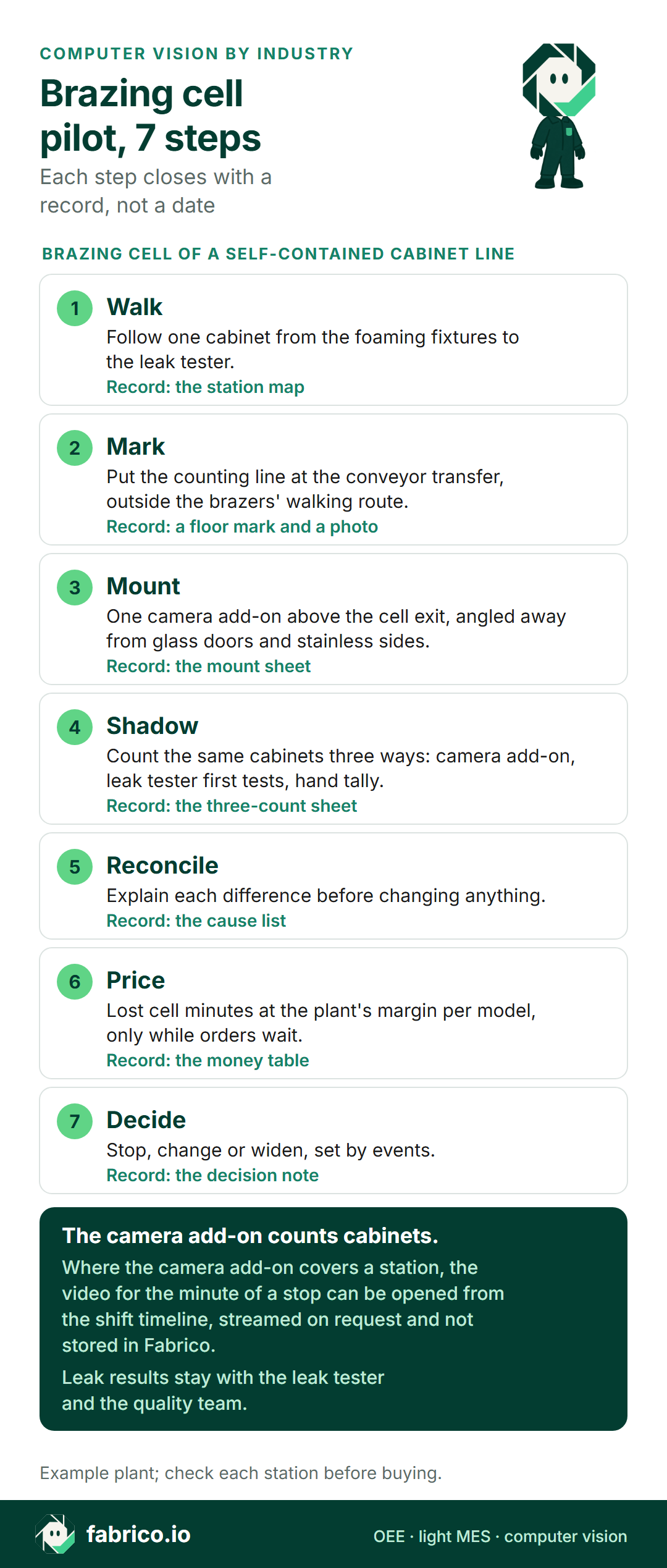
Text version of this infographic
- Brazing cell pilot, 7 steps. Each step closes with a record, not a date.
- Brazing cell of a self-contained cabinet line.
- 1 Walk: follow one cabinet from the foaming fixtures to the leak tester. Record: the station map.
- 2 Mark: put the counting line at the conveyor transfer, outside the brazers' walking route. Record: a floor mark and a photo.
- 3 Mount: one camera add-on above the cell exit, angled away from glass doors and stainless sides. Record: the mount sheet.
- 4 Shadow: count the same cabinets three ways: camera add-on, leak tester first tests, hand tally. Record: the three-count sheet.
- 5 Reconcile: explain each difference before changing anything. Record: the cause list.
- 6 Price: lost cell minutes at the plant's margin per model, only while orders wait. Record: the money table.
- 7 Decide: stop, change or widen, set by events. Record: the decision note.
- The camera add-on counts cabinets. Where the camera add-on covers a station, the video for the minute of a stop can be opened from the shift timeline, streamed on request and not stored in Fabrico.
- Leak results stay with the leak tester and the quality team.
- Example plant; check each station before buying.
Walk one cabinet's route with the cell lead and the process engineer, noting at each hand-over who touches it and what record it leaves.
In the example: fixture, fit-out, the brazing cell (two brazers join the circuit, a fitter sets the filter drier and capillary), a short buffer, the leak tester. Evaporator kits from the coil bay and condensing units from stock feed the cell.
The walk also fixes what a "model" means at this cell. US rules treat it narrowly: a basic model under 10 CFR 431 subpart C is equipment in one class "having the same primary energy source" with "essentially identical electrical, physical, and functional characteristics that affect energy consumption", and the energy limit for a solid-door self-contained reach-in refrigerator (class VCS.SC.M) is "0.05 × V + 1.36" kWh a day, where V is its volume. A longer or taller cabinet is a different model with a different limit, and it can need a different brazing time.
In the EU, the ecodesign Regulation (EU) 2019/2024 covers supermarket cabinets, beverage coolers, ice-cream freezers, gelato-scooping cabinets and refrigerated vending machines, each with a model identifier "which distinguishes a specific product model from other models". Pilot counts carry the same identifier.
DOE's 2013 technical support document for these standards notes that remote display cases are sold mainly "in 8-foot and 12-foot sections" and that self-contained versions "are commonly sold in 4-foot lengths". In the EU, Eurovent Certita Certification requires the display cabinets a participant promotes in its programme to be certified, and states: "This includes all models in modular ranges." The station map therefore lists ideal cell minutes per model, not one rate for the cell.
Record: the station map: stations, count sources, the serial point and ideal cell minutes per model. In the example, one-door glass cooler G1 at 5 cell minutes, two-door G2 at 8.
Mark: draw the counting line where no brazer stands
The camera add-on counts a cabinet when it crosses a line, so the line decides the count. Put it where cabinets move one at a time and people do not: the conveyor transfer out of the cell, not the cell floor.
People and identical cabinets are the hard case for any camera. A survey of deep learning in video multi-object tracking by Ciaparrone and colleagues (Universities of Salerno, Granada and Sannio) states: "The main difficulty in tracking multiple targets simultaneously stems from the various occlusions and interactions between objects, that can sometimes also have similar appearance." A row of identical white two-door coolers with a crew walking between them is that case, and glass doors and stainless panels add glare. So: one cabinet at a time across the line, no walking route through it, no glass facing the lens.
Mark the repair route too. If a leak-test failure came back past the cell exit, a repaired cabinet would count as new output. In the example layout the repair bay returns to the tester, never to the cell.
Record: a floor mark at the transfer, a photo from the planned camera add-on position, and the repair route drawn on the station map.
Mount: one camera add-on above the cell exit
Mount one camera add-on above the transfer, looking down at cabinet tops, not across the glass. One cell, one view, one counting line.
The mount sheet names what the camera add-on may see: cabinet tops crossing the line, not brazers' faces. The works council or staff representative signs it before the camera add-on goes up. Lighting belongs on the same sheet; camera placement and lighting on a production line covers angles, and in a refrigeration hall the risks are glass doors, polished stainless and the brazing flame.
Record: the mount sheet, signed by the cell lead, the safety team and the works council.
Shadow: three counts of the same cabinets on an example shift
Count the same cabinets three ways and keep the counts apart: the camera add-on at the transfer, the leak tester's first tests on serials that left the cell, and the hand tally. Read the tester log once the buffer has cleared.
Example inputs for the shift: early shift 06:00 to 14:00, two 15 minute breaks, 450 planned cell minutes. G1 from 06:00 until 09:21, a fixture change to G2 until 09:33, then G2 to the end. Stops: a brazing gas cylinder change of 10 minutes on G1, the 12 minute fixture change, evaporator kits 26 minutes late from the coil bay and 10 minutes of low nitrogen purge pressure on G2: 58 minutes. Slow running: 16 minutes on G1 while one brazer covered the fitter's work, a line balancing question, and 24 on G2 from the longer suction line.
| Count | G1 | G2 | Total |
|---|---|---|---|
| Leak tester first tests (referee) | 32 | 24 | 56 |
| Camera add-on at the transfer | 32 | 23 | 55 |
| Hand tally sheet | 34 | 24 | 58 |
| First-test leak fails | 2 | 1 | 3 |
The split by model comes from the order the cell was running, not from the camera add-on. All figures are example data; no counting figure for the camera add-on is claimed.
The arithmetic, from the referee: 392 run minutes (450 minus 58 of stops); 32 G1 at 5 minutes plus 24 G2 at 8 earn 352 minutes, so 40 minutes ran slow; the three leak fails take back 18 minutes (2 x 5 plus 8), leaving 334 good minutes. Availability 87.1% x performance 89.8% x quality 94.9% gives OEE 74.2%, which is 334 of 450. The bars sum: 334 + 18 + 40 + 58 = 450.
Quality here is first pass at the leak tester. The three repaired cabinets ship later, so they lower first pass yield and stay out of good count.
Reconcile: what counts as proof against the leak tester log
The three counts disagree, and that is the point of the shift. Explain each difference before changing anything:
- Tally 58 against 56. Two G1 cabinets were ticked twice at the 08:00 break. Booked as good, the tally shows OEE of 80.4% (362 of 450 minutes), 6.2 points better than the shift was.
- Camera add-on 55 against 56. At 12:40 the fitter stood on the counting line carrying a condensing unit while a G2 crossed. Fix the mark, not the tolerance: move the line behind the transfer guard.
- Leak fails. The camera add-on cannot see a leak and does not try. The three fails come from the tester log.
Proof is a rule the plant writes before the first shadow count, with a tolerance it sets itself: the camera add-on count matches the referee once the buffer has cleared, or each difference has a found and fixed cause. A count that drifts without a cause is not proof, however small the gap. The tally stays until the decision note is written; manual against automatic downtime tracking shows the same comparison for stop minutes.
Record: the three-count sheet and the cause list, signed by the cell lead and the quality lead.
Price: the brazing cell's lost minutes in euros, per model
A cell minute is worth the margin on the cabinet not brazed, but only while orders wait. No vetted public margin per cabinet model exists, so the example uses inputs the plant replaces: G1 at an ex-works EUR 1,800 and G2 at EUR 2,560, both at a 25% contribution, EUR 450 and EUR 640. For scale, the DOE engineering analysis lists a baseline two-door glass-door self-contained merchandiser (class VCT.SC.M) at a USD 1,749.80 production cost and a USD 2,546.52 selling price in 2012 dollars, a gap of 31%; 25% sits below it. Across US machinery makers, the NYU Stern margin data for January 2026 shows a 37.47% gross margin and a 15.86% pre-tax operating margin, and 25% sits between them.
Per ideal cell minute: EUR 90 on G1 (450 / 5), EUR 80 on G2 (640 / 8), each loss at the model running when it happened:
| Loss | Cell minutes | Example rate | EUR a shift |
|---|---|---|---|
| G1: gas cylinder 10, slow 16 | 26 | EUR 90 a minute | 2,340 |
| G2: kits 26, nitrogen 10, fixture change 12, slow 24 | 72 | EUR 80 a minute | 5,760 |
| Total, only while orders wait | 98 | 8,100 | |
| Three leak repairs at crew time | 60 crew minutes | EUR 38.2 an hour | 38.20 |
| Orders not waiting: 3 crew x 98 minutes | 4.9 crew hours | EUR 38.2 an hour | 187.18 |
The labour rate is the 2025 average hourly labour cost from Eurostat for the euro area, EUR 38.2, as an example; the plant uses its real crew cost. Pricing the 18 quality minutes as lost margin would add EUR 260 (2 x 90 plus 80), but repaired cabinets still ship, so they cost crew time only. And one cell rate hides that the G2 kit wait, 26 minutes or EUR 2,080, belongs to the coil bay, not to the brazers.
The money only counts if the queue check holds (how to identify manufacturing bottlenecks). In the example, foamed cabinets in front of the cell never dropped below six, so the cell was the constraint on that shift. Pricing only the constraint's minutes is the logic of throughput accounting.
Want to see the brazing cell's lost minutes priced per cabinet model? Book a demo.
Decide: stop, change or widen the pilot on events
Write these rules into the decision note before the first shadow count:
| Decision | Event that triggers it | What the plant does next |
|---|---|---|
| Stop | The leak tester log loses serials or stops marking retests | Fix the referee first; no referee, no proof |
| Stop | The counting line cannot be kept free of people or carts | Redesign the transfer before any second try |
| Stop | The mount sheet is not signed by the works council | No camera add-on goes up |
| Change | Camera add-on and referee differ in the same direction twice | Move the mark or the mount, not the tolerance |
| Change | A new model's ideal cell minutes are disputed | Process engineer re-times it; the station map changes |
| Widen | Counts reconcile through a model change, a kit shortage and a crew change | Second camera add-on at the packing table |
| Widen | The money table changes a decision at the coil bay or the cell | Connect the leak tester and charge logs to the timeline |
Scaling a computer vision pilot to the plant covers the traps of widening. A remote multideck line with custom lengths makes a good third station.
Record: the decision note, with the event that triggered it.
Questions for each vendor, and for the works council
Ask the same eight questions of each vendor and score the answers against the three-count sheet rather than a slide:
| Question | Why it matters in a cabinet plant |
|---|---|
| Can the counting line sit on a conveyor transfer with brazers working beside it? | The cell floor is never clear of people |
| How is a repaired cabinet kept from counting twice? | Leak fails return to the tester, sometimes past the cell |
| Can ideal minutes be set per model and per case length? | 4-foot, 8-foot and 12-foot sections braze at different rates |
| Can the leak tester and charge logs sit next to the camera add-on count? | They are the referee and the serial record |
| What does the camera need around glass doors, stainless and the brazing flame? | Glare decides the mount |
| How do brazers in gloves enter a stop reason? | Reasons come from the crew, on a tablet or phone |
| Is money priced from the plant's margin per model? | G1 and G2 minutes are not worth the same |
| What leaves the system, and how? | The controller and the ERP need the counts |
For the works council, three points cover the pilot: the camera add-on counts cabinets, not people; stop reasons come from the crew; and the video for the minute of a stop is streamed on request and not stored in Fabrico. The signed mount sheet records all three.
Where Fabrico fits on a cabinet line
OEE software is the core: Fabrico takes stops and counts from the machine signal, a fixture PLC or a counter, and the crew adds the stop reason on a tablet or phone. OEE, downtime and losses show by line and shift, priced from the plant's SKU price or margin. As a light MES it records which product the cell is running, so ideal minutes follow the model.
At the brazing cell and the packing table, where no machine counts, the camera add-on counts cabinets. Where the camera add-on covers a station, the video for the minute of a stop can be opened from the shift timeline, streamed on request and not stored in Fabrico. On Fabrico's roadmap, not live today: the camera add-on spotting a stop at the cell by itself and proposing a reason for the crew to confirm.
Leak results stay with the leak tester and the quality team, charge weights with the charging machine. The build plan stays in the ERP, APS or spreadsheet; Fabrico supplies the counts and rates it reads. Reports export to Excel, and Fabrico also has a REST API and webhooks.
Camera-based OEE software compares the approaches. Neighbouring plants: computer vision for HVAC equipment manufacturing (coil brazing) and computer vision for household appliance manufacturing (domestic refrigerators on paced lines).
What refrigeration plant teams ask before a camera pilot
Why not start the camera pilot at the foaming press?
The foaming fixtures already report cycles through their PLC, so a camera adds little there. No machine logs a finished circuit at the brazing cell, so the camera add-on goes at its exit.
Can the camera add-on tell a one-door cooler from a two-door cooler?
The camera add-on counts cabinets that cross the counting line. The model comes from the product the crew selects on the tablet for the run, so ideal times stay per model.
What happens to a cabinet that fails the leak test?
It goes to the repair bay and back to the leak tester, which logs the retest against the same serial. A repair route that avoids the cell exit keeps it out of new output.
What do the brazers see, and what does the camera add-on record?
The crew sees the cell's count and stops and adds stop reasons on a tablet or phone. The camera add-on counts cabinets, not people; the video for the minute of a stop is streamed on request and not stored in Fabrico.
When does a second camera add-on make sense?
When the decision note says widen: the cell's counts reconcile with the leak tester log through a model change, a kit shortage and a crew change. The packing table comes next, since no machine logs a packed cabinet.
Want to see a brazing cell's cabinets, stops and lost euros side by side? Book a demo.
Related articles








Real Fabrico tiles, sample data.