
Key Takeaways
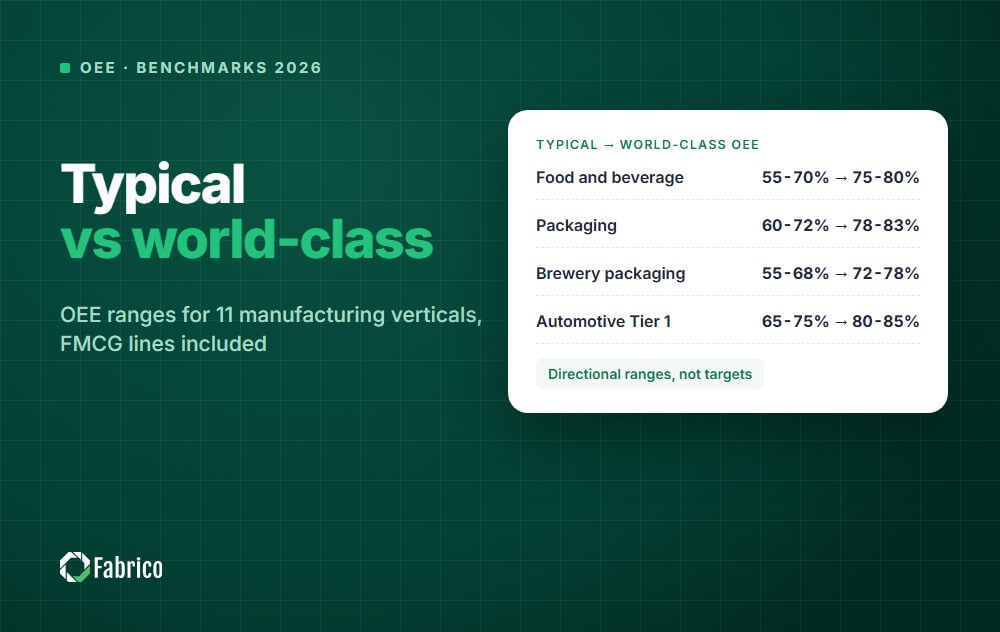
See how your OEE compares by industry.
The industry benchmark for world-class OEE is 85%, which is typically achieved through 90% Availability, 95% Performance, and 99.9% Quality.
Chasing the score is a losing battle. The score is a result, not the goal. The real goal is to build a "world-class system" for continuous improvement.
A world-class system is an integrated platform where real-time OEE data (the diagnosis) is seamlessly connected to a modern CMMS (the cure), enabling a rapid, repeatable process for solving losses.
Before we talk about strategy, let's answer the question you came here for. What are the numbers that define "world-class" OEE?
Based on decades of industry practice, these are the recognized benchmarks for discrete manufacturing:
The Overall Score: 85% OEE. This is the gold standard, the sign of a truly elite manufacturing operation.
The Breakdown: This 85% score is the product of world-class performance in three key areas:
90% Availability: This means your assets are running during 90% of their planned production time. Unplanned downtime is minimal.
95% Performance: This means that when your assets are running, they are running at 95% of their theoretical top speed. Minor stops and slow cycles are under control.
99.9% Quality: This is near-perfect production, where 999 out of every 1,000 parts produced are good the first time.
For many managers looking at their current score of 50% or 60%, these numbers can seem impossibly high.
That's because they are trying to achieve a world-class result with a second-class, disconnected system.
The 85% figure traces to Seiichi Nakajima's TPM benchmarks, where 90% Availability × 95% Performance × 99.9% Quality gives 85.4%. It is an industry convention from Total Productive Maintenance, not a figure defined by ISO 22400. For a sector-by-sector view and why the gaps persist, see OEE benchmarks by industry.
So, what does a system that naturally produces an 85% OEE score look like? It has three core characteristics.
World-class performers don't work from day-old spreadsheets. They have a single, unified system that automatically collects real-time data from every critical asset.
This system acts as a powerful diagnostic engine. It instantly and accurately identifies which of the Six Big Losses is hurting them the most right now. The diagnosis is fast, data-driven, and undeniable, ending the conference room debates about "what really happened."
This is the missing link in 90% of manufacturing operations. In a world-class system, the diagnosis is seamlessly and unbreakabley connected to the cure.
When OEE data exposes a critical equipment failure, it doesn't just update a chart on a TV screen. In a true world-class system, that event automatically triggers a high-priority work order in an integrated CMMS.
This is the Fabrico philosophy in action. OEE diagnoses, CMMS cures. This end-to-end process, from problem identification to maintenance execution, is the engine of rapid, sustainable improvement.
World-class Availability (90%) is impossible without a world-class maintenance strategy. You cannot "inspect your way" to elite performance.
A world-class system uses the rich historical OEE and downtime data to move beyond a simple calendar-based PM schedule.
It allows a Maintenance Manager like Mike to build a data-driven reliability program, focusing his team's limited budget and time on the assets and failure modes that cause the most significant production losses.
Paula, a COO, sets an ambitious corporate goal of 85% OEE for her plants. Her teams work incredibly hard, long hours, weekend meetings, constant firefighting.
Through sheer manual effort, one plant manages to hit the number for a single week. The next week, it crashes back down.
They are treating the symptom (the low score) instead of the disease (a disconnected, reactive operational process).
You don't get a world-class score with a second-class system. The score is a result, not the goal.
The path to world-class OEE is not about telling your team to "try harder." It's about giving them a better, smarter system to work with.
Fabrico was built on this exact philosophy. It is a single, unified platform that provides the real-time diagnosis and the integrated maintenance cure in one user-friendly package.
We provide the system that naturally produces the world-class result, moving your team from reactive firefighters to proactive problem-solvers.
Is 85% OEE a realistic goal for every industry?
While 85% is the benchmark for discrete manufacturing, the "world-class" number can vary. A complex process manufacturer might aim for a different target.
The key is to use the OEE framework to drive continuous improvement and consistently push your own benchmarks higher.
How long does it take to achieve world-class OEE?
The journey is a marathon, not a sprint. However, with an integrated system like Fabrico, you can often capture the "low-hanging fruit" and see a 10-20% improvement in the first few months.
Reaching a sustainable 85% is a longer-term strategic commitment to continuous improvement.
What is a typical OEE score for an average factory?
Most studies find that the average, unoptimized factory has an OEE score of around 60%. This shows that there is a massive opportunity for improvement in most manufacturing operations.
The conversation shouldn't be about how to hit an 85% score. It should be about how to build an 85% system.
Once you have the system in place, the score will follow.
Ready to see the integrated system that world-class manufacturers use to achieve their goals?
Want OEE captured straight from your machines, no manual logs?
Request a demo











 Login
Login
 Blog
Blog