


 Login
 Blog
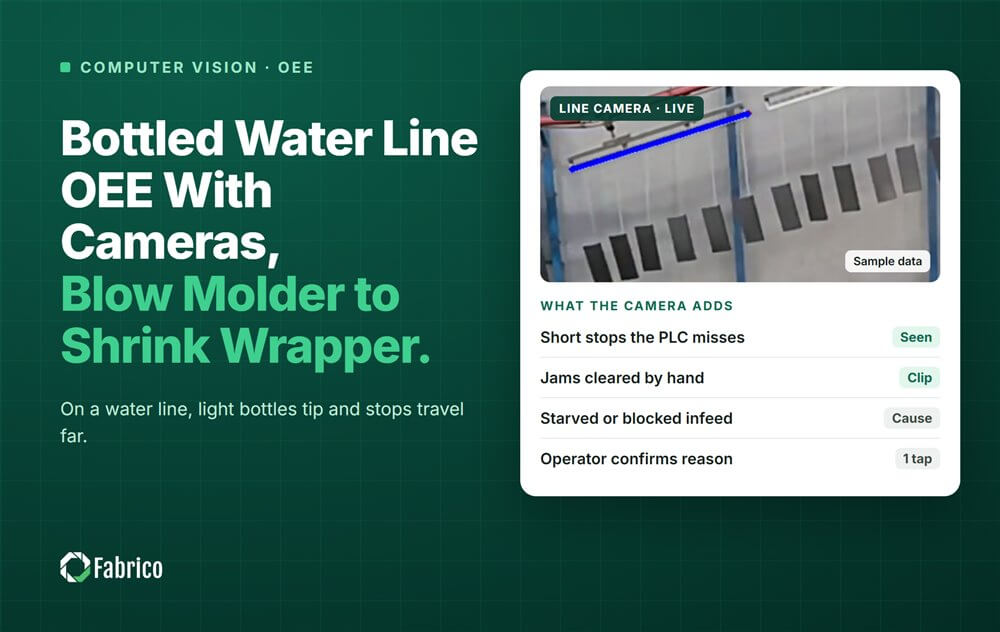
Bottled Water Line OEE With Cameras: Blow Molder to Shrink Wrapper

Key takeaways
- On a high speed water line, light PET (polyethylene terephthalate) bottles tip and jam at air conveyor exits and transfers, mostly for seconds.
- The line is long, so one stop shows up far away as starved or blocked time. Charge it to the machine that stopped first.
- Three camera views do most of the work: the air conveyor exit, the accumulation table and the shrink wrapper infeed.
- On a sample line, the filler lost 45 minutes a shift, and only 9 were its own. Film breaks at the wrapper cost the most: $252 a shift.
A bottled water line loses most of its minutes to small stops. A bottle tips, a transfer jams, the wrapper changes film. Each one spreads along the line as starved and blocked time. Cameras where bottles fall and back up give each stop a clip, so the minutes land on the machine where they started.
Fabrico is OEE (overall equipment effectiveness) and light MES (manufacturing execution system) software, with AI cameras as an add-on. The camera marks each stop and keeps a short clip, and the operator confirms the reason in one tap. For the wrapper's own OEE math, see our guide to shrink wrapper OEE.
Why is OEE on a high speed water line hard to read?
- Speed. The filler runs hundreds of bottles a minute, so a 20 second pause costs hundreds of bottles. Siemens puts a lost hour of unplanned downtime in fast moving consumer goods at $36,000 (True Cost of Downtime 2024).
- Light bottles. Empty PET bottles tip at air conveyor exits, dead plates and transfers. A bottle that slips off its neck guide jams the air conveyor.
- Length. Seven machines in a row, from blow molder to palletizer. A stop at one end shows up at the other minutes later.
Most water lines are built on a V-curve: the filler sets the pace, and its neighbors run about 10% faster so the buffers can refill. So the other machines stop and start all shift. Each PLC (programmable logic controller) says its machine waited, not what it waited for. Our guide to starvation and blocking shows how to charge that time.
Where do stops start on a bottled water line?
The machines know their own faults. What they miss is what happens between them.
- Good PLC data: the blow molder, the filler and capper, the labeler and the palletizer.
- Poor PLC data: the air conveyor exit, transfers and dead plates, the accumulation table and the wrapper infeed lanes. A tipped bottle there is often "running", "full" or nothing at all.
For the blow molder's own stops, see our guide to stretch blow molding OEE. For a camera on the filler infeed, see camera on a filling line.
Where should the cameras go on a water line?
- Air conveyor exit. Frame the spot where empty bottles leave the neck guide for the filler infeed. It shows a bottle off the guide, a tipped bottle or empties standing still.
- Accumulation table. Look down on the table before the shrink wrapper. A full table means the wrapper stopped; an empty one means a machine upstream stopped.
- Shrink wrapper infeed. Frame the lane dividers and the pack collation, with the film reel in view if you can. It shows a bottle down in a lane, a reel change or a film break.
Clear bottles on shiny steel are hard to see, and rinser spray wets lenses. Test each view in your own light; our guide to camera placement and lighting covers angles and glare.
How does a wrapper stop reach the filler?
Blocking travels backward. The wrapper stops on a film break and the table fills. The labeler cannot discharge and stops. Then the filler has nowhere to put bottles. Starving travels forward: a blow molder stop empties the air conveyor, and the filler waits.
Each buffer buys minutes: its free space divided by the rate that feeds it. A stop shorter than the buffer costs the filler nothing. A longer one costs the difference. So each stop raises two questions: where did it start, and did it outlast the buffer? The clip answers the first, and the line timeline answers the second.
Worked example: what does one shift on a sample water line lose?
Sample line (illustrative numbers, not a customer): a 0.5 liter still water line with a filler and capper rated at 900 bottles a minute. A stand-alone blow molder and an air conveyor feed it. A labeler, an accumulation table and a shrink wrapper follow. Planned production time is 450 minutes a shift.
The buffers: the air conveyor holds about 1 minute of empty bottles. The conveyor after the filler absorbs short labeler pauses. A wrapper stop needs 3 minutes to reach the filler.
The filler log showed 45 stopped minutes: 9 own, 16 starved and 20 blocked. The clips, confirmed by the operators, showed where each minute started:
| What the clip showed | Stops | Machine minutes | Filler minutes lost | Charged to | Cost a shift |
|---|---|---|---|---|---|
| Bottle off the air conveyor neck guide | 8 x 2 minutes | 16 | 8 | Air conveyor (starved) | $144 |
| Preform feed jam at the blow molder | 2 x 5 minutes | 10 | 8 | Blow molder (starved) | $144 |
| Cap chute empty at the capper | 3 x 3 minutes | 9 | 9 | Filler and capper | $162 |
| Tipped bottles at the labeler transfer | 30 x 20 seconds | 10 | 0 | Transfer guides | $0 |
| Bottle down in a wrapper infeed lane | 20 x 1 minute | 20 | 0 | Shrink wrapper | $0 |
| Film reel change at the wrapper | 6 x 4 minutes | 24 | 6 | Wrapper (blocked) | $108 |
| Film break or failed splice | 2 x 10 minutes | 20 | 14 | Wrapper (blocked) | $252 |
| Total | 71 | 109 | 45 | $810 |
- Filler Availability, all causes = (450 minus 45) / 450 = 90.0%. Own causes only = (450 minus 9) / 450 = 98.0%.
- Each 2 minute air conveyor jam outlasted the 1 minute buffer by 1: 8 filler minutes. Each 5 minute preform jam starved the filler for 4: 8 more.
- Each reel change cost 4 minus 3 = 1 filler minute. Each film break cost 10 minus 3 = 7.
- 45 filler minutes x 900 = 40,500 bottles a shift.
- At a contribution of $0.02 a bottle (or €0.02 in a euro plant), a filler minute costs $18. The shift lost $810, or $607,500 over 750 shifts a year.
Ranked by stop count, tipped bottles and lane jams lead with 50 of 71 stops, yet they cost the filler nothing: the buffers absorbed them. Ranked by money, the film breaks lead, then the cap chute, then the air conveyor and the blow molder.
So stage the next film reel and check the splice early, so a change fits inside the 3 minute buffer. Then check the neck guides and the bottles the blow molder sends. The money counts only if the line is sold out, or the lost bottles cost overtime to make up. Agree that rule with your controller first.
What can cameras on a water line not see?
- Inside the machines: oven heating, fill valves and servo alarms stay with each PLC.
- The whole line: each camera covers one field of view.
- Through spray, glare and bodies: wet lenses, shiny film and a person in front of the lens cause errors.
- The cause on its own: it suggests a reason, and the operator confirms it.
How do you keep the cameras on bottles, not people?
Frame the bottle path, not the walkways. Report OEE by line and shift, never by named operator. The clip defends the crew: it shows a bottle off a neck guide or a film break, not a "slow" person.
In Germany, the works council co-determines any equipment that could monitor performance, even a camera that records nothing. Our guide to production line cameras without surveillance covers the steps.
Where Fabrico fits
Fabrico is a computer vision enabled Manufacturing Performance Platform. OEE and light MES come first, and cameras are an add-on.
- Automatic downtime logging on each machine, with own, starved and blocked time kept apart.
- A camera clip as evidence for a stop, from the air conveyor, the table or the wrapper infeed.
- The operator confirms the reason in one tap, so a film break and a lane jam get different codes.
- Losses priced in money and ranked, so the stop that reaches the filler rises to the top.
Named result: ABB, a Fabrico customer, reports 20% less downtime. You start with a pilot on one line, with a baseline and a decision date agreed in advance. Devices are connected in about a month, and the full rollout takes 3 to 4 months.
There is no free plan and there are no tiers: each plant gets a quote. See the computer vision OEE and MES page.
Frequently asked questions
Should starved time count against the filler?
Show it in the filler's full OEE, because the line lost those bottles. Then charge it to the machine that stopped first: the blow molder, the air conveyor or a transfer. On the sample line, 16 of the filler's 45 lost minutes were starved time that started upstream.
How long can a shrink wrapper stop before the filler stops?
As long as the buffers between them last: their free space divided by the rate that feeds them. On the sample line that was 3 minutes. A reel change inside that window costs the filler nothing. A film break that lasts longer costs the difference.
Where should the first camera go on a water line?
Where stops are frequent and the PLC tells you least. On many water lines that is the air conveyor exit or the shrink wrapper infeed. The machines report their own faults well, so start between them. Add the accumulation table next, so a full or an empty table shows which machine stopped first.
Does a camera on the line watch the operators?
It should not. Frame the bottle path, keep faces out of the frame and report by line and shift. The camera marks stops and keeps a short clip; it does not track people. Agree in writing who sees the clips before the first camera goes up.
See your water line's stops in a demo
Bring one water line and a week of its filler downtime log. We will show where each starved and blocked minute started, and what it cost.
Latest from our blog



Real Fabrico tiles, sample data.