


 Login
 Blog
Pulp and Paper Industry Software: 5 OEE Tools for Paper Mills (2026 Review)

Pulp and paper industry software comes in four kinds: OEE and light MES software for the paper machine's losses, control and quality control systems (QCS) that run the process, process data analytics, and MES for roll, sheet and bale tracking. Fabrico makes OEE and light MES software: a cloud-based platform with maintenance (CMMS) built in. Connected machines report their own stops, including web breaks where the machine signal shows them, and the crew adds the reason, so the lost time and its cost show per line and shift.
Key Takeaways
Web breaks are availability loss: a break stops the sheet until the machine is threaded again, so the time from break to sheet on reel belongs in OEE availability.
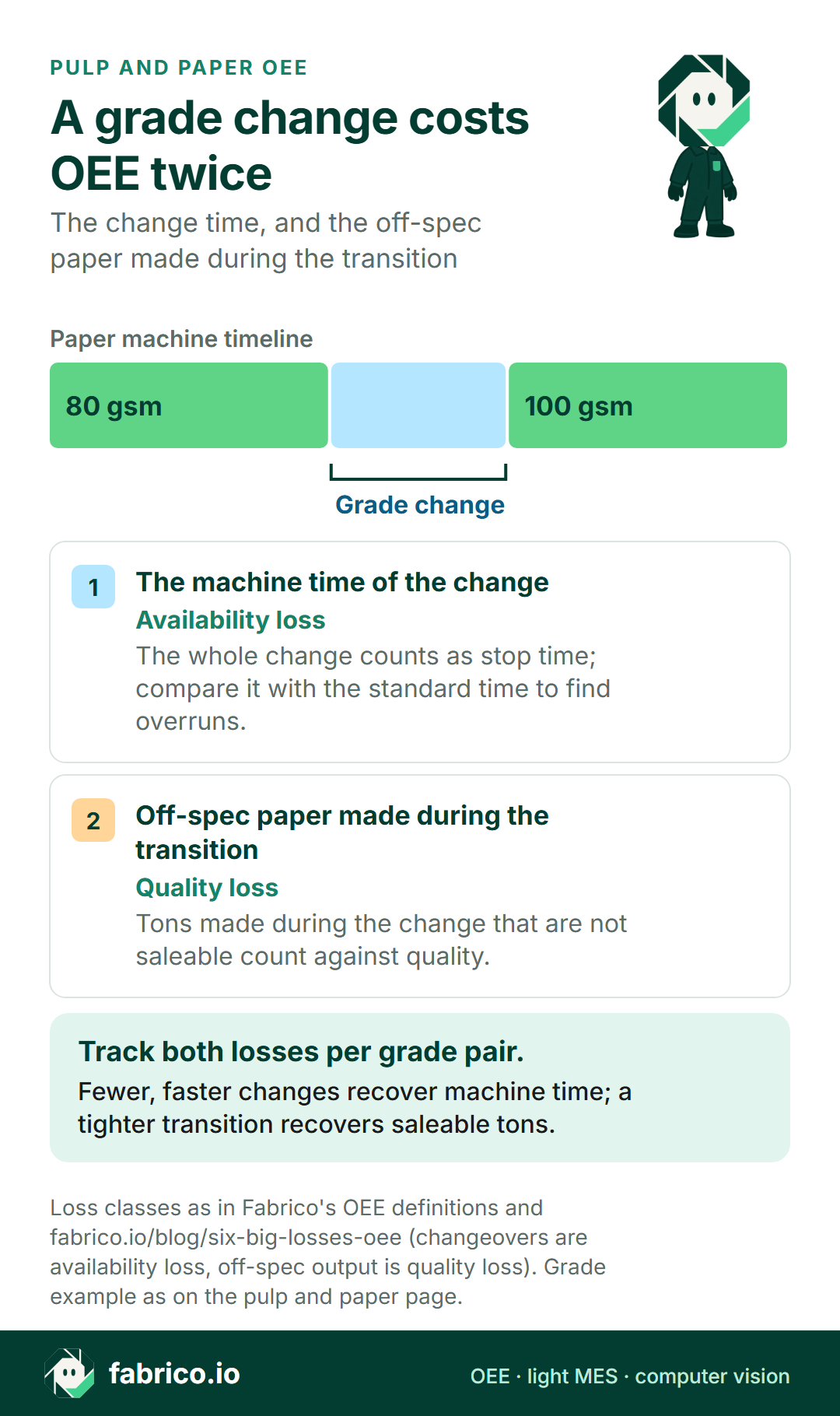
Grade changes are changeover loss: the transition time and the off-spec paper made between two grades are changeover losses, counted in OEE availability and quality.
What OEE software adds: OEE software shows how long the sheet stayed on the reel, at what speed and how much was saleable, next to the control and quality systems the mill already runs.
Tools in this review: Fabrico, ABB, Valmet DNA, Trimble Wedge and MAJIQ, each described from its own site where we could read it.
A paper machine is one continuous line from headbox to reel: a break anywhere sends the sheet to broke until the machine is threaded again. One stop costs the whole machine, so the software choice starts with where the mill loses time.
OEE (Overall Equipment Effectiveness) in pulp and paper is defined by Availability (sheet-on-reel time), Performance (running speed against rated speed) and Quality (saleable output, for example within the moisture and caliper limits).
General OEE tools are covered in our comparison of the best OEE software. A mill also runs control, quality control (QCS) and process history systems, so the first question is which layer you are buying.
Here are 5 OEE software and mill software tools for pulp and paper, and what each covers.
1. Fabrico (Best for Web Break Downtime and Paper Machine OEE)
Paper mills lose OEE to web breaks, grade changes and the slow restart after each one. Fabrico is a cloud-based OEE and light MES platform with maintenance (CMMS) built in. Connected machines report their own stops, including short stops too brief to log by hand, and the crew adds the reason on a tablet or phone.
Key features for pulp and paper:
Web break log: where the machine signal shows the break, it logs its start and duration, and the crew tags it from the mill's own reason list.
Cost of each loss: revenue at risk and profit impact per loss, in real time, so the team starts with the breaks that cost the most.
Grade changes: a stop for a grade change gets its own reason, so that time shows as its own cause; slower running during the change shows as performance loss in OEE.
Day against night: real-time OEE per line and shift shows whether one crew loses time to the same causes as another.
Data routes: machine data from the PLC, from a Fabrico IoT device with external sensors on older machines, or from AI cameras (an add-on) where there is no machine signal. More on machine connectivity.
Repairs: a work order is opened from the stop in one step, linked to the line.
Best For: mills focused on fewer web breaks and fewer lost machine hours.
2. ABB (Ability Manufacturing Execution) (Best for Quality & Control)
ABB's pages did not load for our check on 7 November 2026, so this section lists questions instead of ABB's own words.
Ask ABB:
How OEE is calculated from quality control (QCS) data, and whether off-spec tons made during a grade change count as quality loss.
Which machine and process signals feed the OEE view, and who sees it on shift.
How stops and their reasons are recorded and linked to maintenance work.
3. Valmet (DNA) (Best for OEM Integration)
How Valmet describes it: "Valmet DNA is a reliable and future-proof distributed control system with proven controls, advanced process controls, and asset performance management inside the same system." Valmet's automation offer also lists a "Quality control system (QCS)", and its site says it provides "future-proof automation solutions for pulp, board, paper, tissue, nonwovens, energy, marine and process industries."
Ask Valmet: how OEE and stop reasons are reported from Valmet DNA, and how the view works on machines from other builders.
Best For: mills that run Valmet DNA as their control system.
Sources: Valmet control systems and automation pages, checked 7 November 2026.
4. Wedge (by Trimble) (Best for Process Analytics)
How Trimble describes it: Trimble Wedge Process Diagnostics lets mills "Bring together quality data from every source, create custom process diagrams and dashboards, and instantly view your data." On data preparation it says: "Use cutting and filtering tools, dynamic process-delay compensation and automated refinement to cleanse and sharpen your data." One section of the page is headed "Diagnose dependencies and root causes".
Ask Trimble: which mill data sources connect, and how findings reach the crew on shift.
Best For: process engineers looking for the process causes behind breaks and quality swings.
Source: Trimble Wedge Process Diagnostics, checked 7 November 2026.
5. MAJIQ Elixir and Ether (Best for Roll Tracking & Trim)
How MAJIQ describes it: MAJIQ calls its software a "Pulp and Paper MES". "Elixir is designed specifically for the complex needs of roll, bale, and sheet production", and on trim MAJIQ says: "Reduce waste and improve machine utilization with optimized trim solutions designed to enhance net production and streamline operations." Ether is "A small-footprint MES designed specifically for execution and quality on the mill floor." MAJIQ adds: "Ether currently supports the manufacturing quality footprint (winder through wrapper)."
Earlier versions of this page named a Panther suite; we did not find that name on MAJIQ's pages, checked 7 November 2026.
Ask MAJIQ: which product fits your ERP setup, and how winder and sheeter downtime is reported.
Best For: the finishing, winding and shipping side of the mill.
Sources: MAJIQ home page, Elixir and Ether pages, checked 7 November 2026.
MES or OEE for a paper mill?
A pulp and paper MES usually means order and roll tracking: which grade ran, which reel became which customer roll, and where it went. OEE software answers a different question: how much of the time the sheet stayed on the reel, at what speed, and how much was saleable.
- Start with OEE if web breaks, grade changes and slow restarts are the main loss.
- Look at an MES if roll genealogy, trim and shipping are the daily pain.
- Run both if the wet end loses time and the dry end loses track.
We sell Fabrico, a light MES for machine data, OEE and downtime. Job dispatching, routings and genealogy stay in your ERP, and it does not do trim optimisation. For the general picture, read OEE vs MES.
What to check before you choose paper industry software
Which loss you are buying for: breaks and restarts (availability), running speed against rated speed (performance), or off-spec and broke (quality).
How a web break is recorded: from the machine signal or by hand, with what start and end, and who adds the cause.
How grade changes are counted: as planned changeover, as a stop with its own reason, or as off-spec output, and whether every crew counts them the same way.
What the system takes from QCS and process history: which signals, how often, and who sees them on shift.
Where roll and order tracking lives: in the ERP, in a mill MES, or in the new tool.
Older machines and drives: how they connect if the PLC is closed or there is none.
One machine first: agree the OEE definitions on one paper machine, compare them with the crew's own log, then extend.
Comparison: Wet End vs. Dry End
Which tool fits which part of the mill? This is what each vendor's own site says, in our words or quoted. A gap means only that we did not find it on the pages we read, so ask each vendor directly.
| Tool | Where it sits | OEE and grade changes, from its own site |
|---|---|---|
| Fabrico (ours) | OEE and light MES for the paper machine | OEE: real-time OEE per line and shift from machine data Grade changes: a stop for a grade change gets its own reason |
| ABB | Not checked: the pages did not load on 7 November 2026 | Ask ABB (questions above) |
| Valmet DNA | "distributed control system" with "asset performance management inside the same system" | OEE and grade changes: not stated on the pages we read |
| Trimble Wedge | Process data analytics: "Diagnose dependencies and root causes" | OEE and grade changes: not stated on the pages we read |
| MAJIQ (Elixir, Ether) | "Pulp and Paper MES"; Ether covers "winder through wrapper" | Trim: "optimized trim solutions" OEE and grade changes: not stated on the pages we read |
Conclusion: Keep the Sheet on the Reel
In pulp and paper, output is made when the reel is turning.
If your losses come from process chemistry or quality, look at the control, QCS and process analytics tools above, such as Valmet DNA or Trimble Wedge, and ask ABB the questions listed.
If your losses are in trim and finishing, look at a mill MES such as MAJIQ's.
If the machine keeps stopping for web breaks or other unexplained stops, Fabrico shows the stops with their reasons and cost as live OEE, so the crew can work on the biggest loss first.
Ready to reduce web breaks?
See how Fabrico measures web breaks, downtime and OEE on lines like yours: Book a demo or contact us.
See real-time OEE on lines like yours.
Book a demoRelated articles





Latest from our blog





Real Fabrico tiles, sample data.