


 Login
 Blog
Elementary Alternatives: AI Inspection, Machine Vision and OEE Cameras

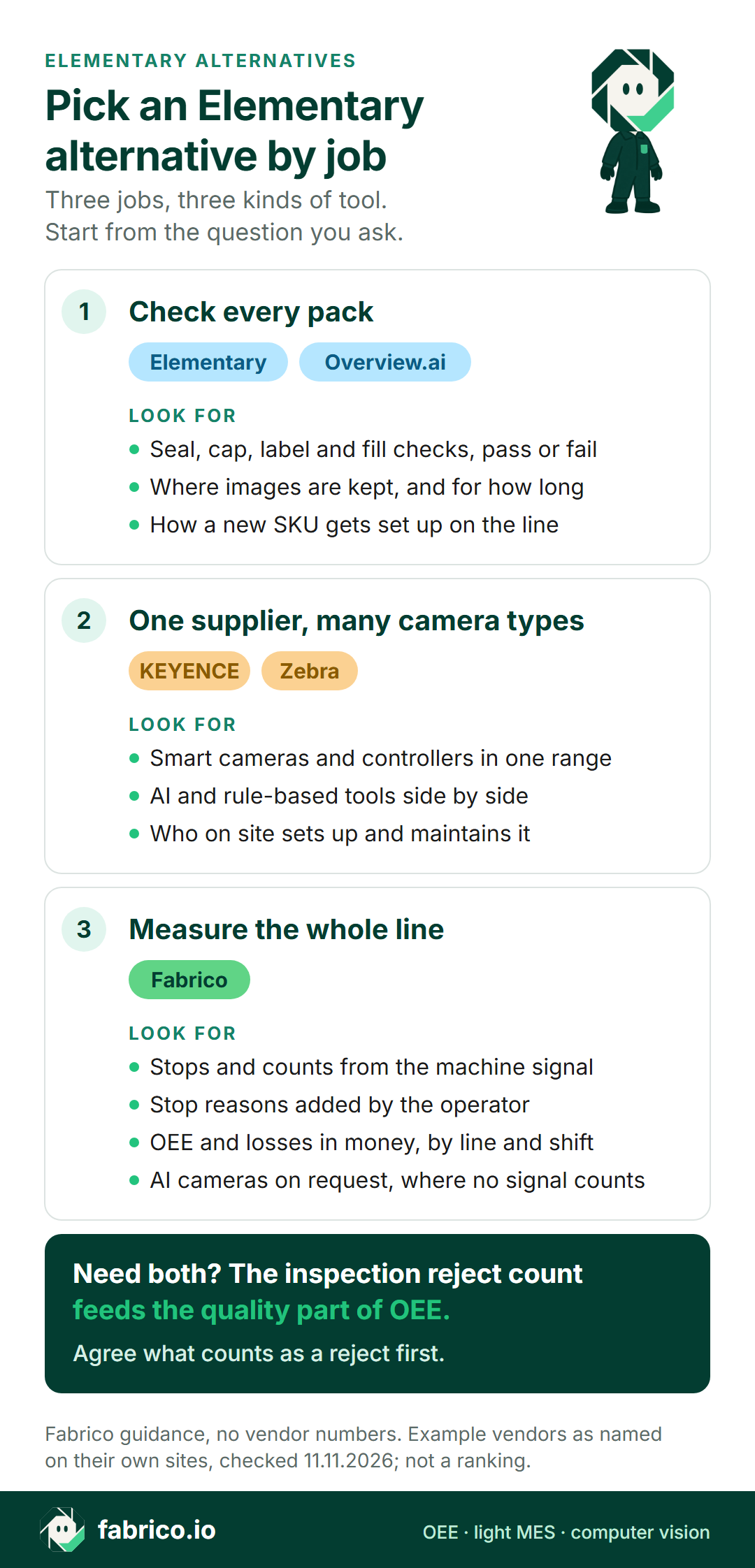
In short: the right Elementary alternative depends on the job. For AI inspection of seals, caps, labels and fill, look at other inspection systems such as Overview.ai, or at machine vision vendors such as Keyence and Zebra. To record stops and their reasons, and count output where no machine signal can, look at OEE software such as Fabrico, which adds AI cameras on request.
- Elementary sells AI vision inspection: its own cameras, lighting and AI controllers, VisionStream and VisionLink software, and the QualityOS cloud platform.
- Its food, beverage and consumer goods pages focus on seals, container integrity, labels, fill and foreign material.
- Inspection decides pass or reject for each pack. OEE measures time, speed and good output for the whole line. A plant can run both.
- The alternatives below are grouped by job: AI inspection, classic machine vision, and camera-based OEE.
- Vendor facts come from each vendor's own site, as of 11.11.2026, linked in place. No prices, no verdicts.
A shampoo line rejects bottles with a crooked cap or a skewed label, and the reject count looks normal. Yet the line made far fewer bottles than planned. Where did the rest go?
This page covers two cases: another way to inspect each pack, or an answer about stops and speed, which is a different job.
Below: what Elementary (elementaryml.com, formerly Elementary Robotics) sells according to its own site, when it is the right pick, and four alternatives grouped by job. Fabrico wrote this page and is one of the four, so read it as you would any vendor's page. For the wider field, see our visual quality control software guide.
What Elementary sells (as of 11.11.2026, per Elementary's site)
Elementary was founded in Pasadena in 2017 and later shifted to focus entirely on AI vision inspection, according to its about page. The same page names Rockwell, Toyota Ventures and Tiger Global among its investors, and lists hubs in South Pasadena, California, and Mexico City.
- Hardware. Its machine vision system is industrial lighting, cameras and controllers (elementaryml.com). The Vertex AI controller runs up to 8 vision sensors and lists EtherNet/IP, a Rockwell add-on profile, digital IO and Modbus TCP/IP (machine vision system).
- VisionStream. Self-learning AI that learns what good looks like from the live line, without manual image labelling, and processes images locally at the edge. The page says it adapts to frequent changeovers and large catalogues (VisionStream).
- VisionLink. Software that connects existing FTP-enabled vision cameras to Elementary's platform through an added edge device. It lists Cognex, Zebra, SICK, Keyence and Omron FTP cameras as compatible (VisionLink). Elementary announced worldwide availability on 20 May 2026 (news post).
- QualityOS. A cloud platform for traceability, alerts and line analytics. Its page says it monitors yield and throughput on every line and integrates with BI, MES and ERP systems (QualityOS). The homepage says data is stored in the AWS cloud.
- Food and consumer goods. Its CPG page covers seals, container integrity and labelling, with examples such as cap fitment and label placement on shampoo bottles (consumer packaged goods). Its food and beverage page lists fill and cap checks on bottles and says systems can be delivered washdown rated (food and beverage).
- Buying. The calls to action are a free demo and a 20 minute discovery call (homepage).
The site also shows accuracy and speed figures and customer case studies. Those numbers are vendor-reported, so we don't repeat them here.
Ask in the demo: how VisionStream handles a new SKU on your line, and how QualityOS passes reject counts to your MES or OEE system.
When Elementary is the right pick
Put Elementary on your shortlist if most of these are true:
- Each pack must be checked, and rejected if it fails. Seals, caps, labels, fill, codes or foreign material.
- You already have vision cameras on the line and want to add AI to them, which is the job of VisionLink.
- You run many SKUs and want models that learn on the live line during production.
- You want inspection images and results traceable across lines and sites in one cloud platform.
If that is your job, Elementary is built for it. The alternatives below fit when you want a different approach to inspection, or when your first question is about line time and output.
Inspection and OEE are different jobs
An inspection system looks at each pack and decides: pass or reject. OEE software looks at the line over the whole shift: how long it ran, how fast, and how much good output it made. Our page on label and code vision vs an OEE camera covers the split in depth.
| Question | Inspection system | OEE software |
|---|---|---|
| What does it watch? | Each pack, at one station | The whole line, all shift |
| What does it decide? | Pass or reject | Nothing about the pack |
| Main output | Rejects, defect images, yield | Stops, run time, counts, OEE |
| Who uses it daily? | Quality team | Shift leads, CI, plant manager |
| Where they meet | Sends a reject count or signal | Uses it for the quality part |
The link is the reject count: OEE software then knows how many packs were rejected, not why.
Comparison table: Elementary and four alternatives
Facts as of 11.11.2026, each from the vendor's own site and linked in its section below.
| Tool | Main job, per its site | Hardware | Industries it names |
|---|---|---|---|
| Elementary (for reference) | AI vision inspection, cloud traceability | Own cameras, lights, AI controllers; VisionLink for existing cameras | Food and beverage, CPG, automotive, more |
| 1. Fabrico | OEE and light MES | Machine signal; AI cameras on request | FMCG, automotive, electronics, more |
| 2. Overview.ai | AI inspection, trained on the camera | Own AI vision sensors and systems | Packaging, food, pharma, more |
| 3. Keyence | Vision inspection, AI and rule-based | Smart cameras, controllers; 2D, 3D, line scan | Automotive, food and medicine, more |
| 4. Zebra | Vision software, deep learning add-on | Smart cameras, fixed industrial scanners, Aurora software | Manufacturing and logistics |
Want to see the OEE side on one of your lines? Book a demo and bring one shift's downtime log.
1. Fabrico: OEE and light MES, with cameras where no signal counts
Fabrico wrote this page. It is a cloud OEE and light MES platform. Where Elementary starts from the pack, Fabrico starts from the line's time: when it stopped, for how long, why, and what that cost.
What it does today (fabrico.io):
- Stops and counts come from the machine signal: a PLC, a sensor or a counter. The operator adds the stop reason at the line, on a tablet or phone.
- OEE, downtime and losses by line and shift, with losses shown in money. On the web, iOS and Android.
- AI cameras, on request, count output where there is no usable signal, such as manual pack-out or an old wrapper. You can open the camera video for any moment on the shift timeline. In the standard setup, video is streamed on request, not stored in Fabrico.
- Your data leaves through a REST API, webhooks, or Excel and CSV export.
- Roadmap, not live today: cameras that detect stops on their own, jam zones, and a camera suggesting a likely stop reason for the operator to confirm.
- Not Fabrico: pack inspection.
A customer data point, with a disclosure first. Ficosota, a Bulgarian maker of hygiene, tissue and household products, is also an investor in Fabrico, as we said in the investment announcement. Across its 16 lines in Fabrico, between June and September 2026, its OEE went from 53.11% to 59.62%, monthly good output from 10.49 million to 12.92 million units, and unclassified time, the share of production time with no recorded reason, from 3.20% to 0.40%. The approved figures cover OEE, output and stop reasons; they make no claim about cameras. Read the Ficosota story.
Ask in the demo: how a camera count compares with a hand count on one of your stations, and how your inspection reject signal reaches the quality part of OEE.
Fits plants that want to know what downtime costs by line and shift, on lines that mix PLC machines, older machines and manual stations. Our OEE software guide lists what to compare.
2. Overview.ai: AI inspection that trains on the camera
Overview.ai sells AI machine vision systems with the software pre-loaded (overview.ai). What its site says, as of 11.11.2026:
- The range runs from the OV10i and OV20i AI vision sensors to the OV80i AI vision system and the OV Spark smart camera.
- AI training and inference run on the device, with no external compute. The site says your production data never leaves the factory floor.
- Each camera is a networked device you configure from a browser. The site lists EtherNet/IP, Profinet, Modbus, OPC-UA and MQTT among its connections.
- A synthetic defect tool generates rare defects to train on. The industries it names include packaging, food, pharmaceutical and automotive manufacturing.
Compared with Elementary: Elementary pairs edge inspection with a cloud platform for traceability and analytics across lines. Overview.ai's homepage puts the weight on training and running models on each camera, with data kept on site.
Ask in the demo: how a new SKU is trained on the camera, and how results reach your MES or OEE system.
Fits plants that want AI inspection trained and run on each camera, with production images kept inside the factory.
3. Keyence: vision systems from smart cameras to controllers
Keyence's vision lineup covers all-in-one smart cameras and modular controllers for 2D, line scan and 3D cameras, with AI and rule-based tools, according to its vision systems page. As of 11.11.2026, the page says:
- The VS Series smart camera sets up both AI and rule-based inspections, and names 25 megapixel AI inspection on the camera.
- The VS-G Series runs AI inspection on the controller and comes with dedicated storage for traceability.
- For food and medicine, it lists case count checks, OCR of lot codes, label placement, seal width and position, and defects in food trays, shrink wrap and cans.
- Vision Database software analyses inspection results together with their images, for traceability and system maintenance.
Compared with Elementary: both sell their own hardware with AI tools. Keyence's page spans smart cameras and controllers for 2D, line scan and 3D. Elementary's pages describe its Radian cameras, Vertex controller, VisionStream and QualityOS. Ask each which camera types your stations need.
Ask in the demo: who on your site sets up a new SKU, and how results reach your MES or OEE system.
Fits plants that want one hardware supplier across many inspection types, including lot code OCR, 3D and line scan.
4. Zebra: Aurora vision software and smart cameras
Zebra sells the Aurora family of machine vision software next to its smart cameras and fixed industrial scanners, according to its Aurora Deep Learning page. As of 11.11.2026:
- Aurora Focus sets up and runs Zebra's fixed industrial scanners and machine vision smart cameras.
- Aurora Design Assistant, formerly Matrox Design Assistant, is a flowchart-based environment for building vision applications. Aurora Imaging Library, formerly Matrox Imaging Library, is the kit for code-level work.
- The Aurora Vision Deep Learning add-on brings deep learning tools, including OCR and anomaly detection, to Aurora Vision Studio and Aurora Vision Library.
- The page says 20 to 30 image samples can help existing machine vision solutions detect objects, defects or features.
Compared with Elementary: Zebra's software runs from flowchart setup to code, for teams that build their own applications. Elementary's VisionLink page lists Zebra FTP cameras as compatible, so a plant could run both.
Ask in the demo: which Aurora product your application needs, and who trains and maintains the deep learning model.
Fits plants with their own vision engineers or an integrator, and plants that already read codes with Zebra hardware.
Which one fits your plant
- You want AI inspection with one cloud platform across lines, or AI on the vision cameras you already own: Elementary.
- You want AI training and inference on each camera, with data kept on site: Overview.ai.
- You want one hardware vendor across 2D, 3D, line scan and lot code OCR: Keyence.
- Your vision engineers want to build on a software family, from flowchart to code: Zebra.
- You want OEE and downtime by line and shift, with cameras counting where no signal can: Fabrico.
If you run one inspection tool and one OEE tool, agree first on what counts as a reject. Cognex is on VisionLink's camera list; for its smart cameras, see our Cognex In-Sight review. See also our computer vision OEE comparison and Cerrion alternatives.
Worked example: where one shift's lost output went
Sample data for one 8 hour shift on a sauce jar line, not a customer's line or a product screen. Planned time is 480 minutes at an ideal 120 jars a minute, so the shift could make 57,600 jars.
Stops took 60 minutes: a 30 minute changeover, 18 minutes of capper jams and 12 at the case packer. Availability is 420 of 480 minutes, or 87.5%.
In 420 minutes the ideal is 50,400 jars. The filler counted 46,200, so performance is 91.7%.
Inspection rejected 920 jars for label and cap faults, leaving 45,280 good, so quality is 98.0%. OEE is 87.5% x 91.7% x 98.0% = 78.6%, the same as 45,280 good of 57,600 possible.
Of the 12,320 lost jars, stops cost 7,200, slow running 4,200 and rejects 920. In this sample, inspection saw 7.5% of the loss. The other 92.5% is time and speed, the OEE side.
Neither system replaces the other: inspection keeps bad jars from shipping, and OEE shows where the other 11,400 went. Check any camera count against a hand count first; see how accurate camera OEE is.
Questions to ask any vendor on this list
Put the same questions to every vendor, us included, on one real line.
- Which job is it for? Pass or reject each pack, or time and output for the whole line.
- Whose cameras? Its own, yours, or both, and what lighting and mounting each station needs.
- What happens at a new SKU? Who sets it up, and how long the line waits.
- Where do rejects go? Ask how the reject count or signal reaches your MES or OEE system.
- Where are images and video kept? On the device, on site or in a cloud, for how long, and who can open them. Cameras at manual pack-out see people, so agree this with the works council first; see production line cameras without surveillance.
- What does the pilot prove? One line, a fixed period, and a hand count or defect log to compare against.
- What drives the quote? Lines, stations, cameras, mounting, network and training. Give every vendor the same list.
Our computer vision OEE pilot plan covers the OEE side step by step. For FMCG lines in general, see our FMCG industry page.
What people ask next
Is Elementary OEE software?
Elementary describes itself as AI vision inspection. Its QualityOS platform tracks yield and throughput and integrates with BI, MES and ERP systems, per its site. If you need OEE by line and shift with stop reasons, ask Elementary what QualityOS reports, and how its reject counts would reach the system that calculates your OEE.
Can Elementary use the vision cameras we already have?
Its VisionLink page says it connects existing FTP-enabled cameras through an edge device, and lists Cognex, Zebra, SICK, Keyence and Omron FTP cameras as compatible. Check your exact camera models with Elementary.
How is Fabrico different from Elementary?
Elementary sells AI vision inspection, per its site. Fabrico measures the line: stops and counts from the machine signal, reasons from the operator, OEE and losses in money by line and shift, and AI cameras that count where no signal can. Fabrico does not inspect packs.
Can inspection rejects feed OEE?
Yes, if the inspection system gives a reject signal or counter. OEE software uses that count for the quality part of OEE, while the defect detail stays in the inspection system.
What does Elementary cost?
Elementary's site asks you to book a demo or a 20 minute discovery call. For any vendor here, the quote depends on lines, stations, cameras, mounting, network and training, so give each one the same list.
Want to see the OEE side of a line like yours? Book a demo or contact us.
Related articles





Latest from our blog


Real Fabrico tiles, sample data.