


 Login
 Blog
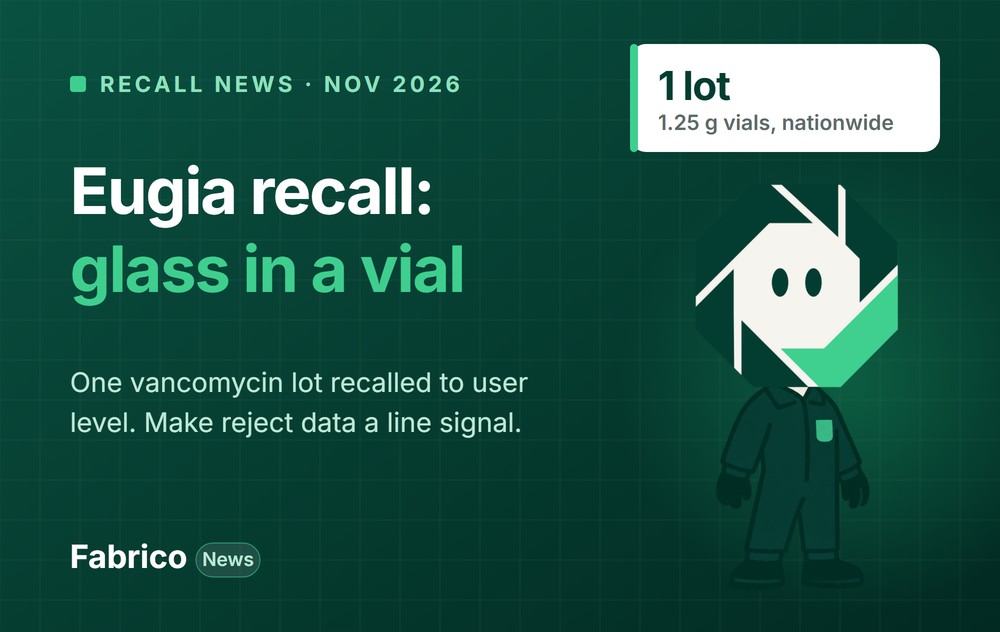
Eugia Recalls a Vancomycin Injection Lot Over a Glass Particle: Reading Reject Data

In short: Eugia US LLC is recalling one lot of Vancomycin Hydrochloride for Injection USP, 1.25 g per vial, to the hospital and user level after a glass particle was identified inside a vial, according to a company announcement posted by the FDA on 9 November 2026. No adverse events had been reported.
- The lot, 3VM26026A, was shipped to wholesalers nationwide from 2 to 15 September 2026.
- Particles in injectables are a quality and safety matter for inspection and the quality system. Reject data from those inspections is also a line signal worth watching.
- Below: what the notice says, what it means for a filling and inspection line, and three steps to make reject data useful.
News, 13 November 2026. Every news figure below comes from a linked source, and the full list is at the end.
What the recall notice says
The company announcement on the FDA's recalls page sets out the facts.
- Firm: Eugia US LLC, formerly AuroMedics Pharma LLC.
- Product: Vancomycin Hydrochloride for Injection USP, 1.25 g per vial, in a 30 mL single-dose vial.
- Scope: one lot, 3VM26026A, expiry July 2028, packed 10 vials per carton.
- Cause: particulate matter identified as a glass particle inside the vial.
- Distribution: shipped to wholesalers nationwide from 2 to 15 September 2026; the recall is to the hospital and user level.
- Dates: company announcement 6 November 2026, published by the FDA on 9 November 2026. No adverse events had been reported to date.
The notice does not say how the particle was found, at which site the lot was made, or how many units the lot holds, so we make no claim about any of them.
The numbers behind the news
The table lists every figure in the company announcement that the FDA published. The last row is our own count of days between two dates the notice gives.
| Item | Value | Unit or note |
|---|---|---|
| Strength | 1.25 | g per vial |
| Vial | 30 | mL, single-dose |
| NDC, vial / carton | 55150-471-01 / 55150-471-10 | product codes |
| Lot | 3VM26026A | one lot only |
| Expiry | July 2028 | month and year |
| Packing | 10 vials x 10 cartons x 1 shipper | 100 vials per shipper |
| Shipped to wholesalers | 2 to 15 September 2026 | nationwide, US |
| Company announcement / FDA publication | 6 / 9 November 2026 | dates |
| Adverse events reported to the company | 0 | to date |
| Last shipment to announcement | 52 | days (15 Sep to 6 Nov) |
Source: Eugia US LLC company announcement, published by the FDA.
The scope is narrow: one strength, one vial size, one lot. The 52 days between the last shipment and the announcement show how long product can sit in the supply chain before a recall reaches it, which is why the notice asks wholesalers, hospitals and pharmacies to pass it on to every account that received the lot.
The notice does not give the lot size, the number of vials shipped, the number of complaints or how the particle was found. It also does not say whether the glass came from the vial, the process or somewhere else. Any of those would change how a plant reads the event, so we do not fill the gaps.
Background: what the FDA expects on visible particles
The notice explains why a single glass particle is enough for a recall. It warns that glass particles in an injection can block blood vessels and cut off blood flow to vital organs, and can cause a blood clot in the lungs. It adds that neonates, infants and patients with weaker organ function may be more at risk. Vancomycin is used for serious infections, including septicaemia and endocarditis, in adults and children.
The FDA set out its thinking in a draft guidance on visible particulates in December 2021. It is still marked draft and non-binding. In it, the agency says each final container must be inspected for visible particles, followed by statistical AQL sampling of each batch. It says meeting a USP standard alone is generally not enough.
The guidance names glass vials, rubber stoppers and product contact equipment as possible sources of process-related particles. It asks firms to evaluate trends in reject data, to set in-process alert and action limits, and to investigate atypical trends even when a batch is within specification. It also says the agency does not recommend more than one reinspection to release a batch with atypical defect levels. For a plant, that turns reject data from a batch record entry into a process signal.
The product makes inspection harder than a clear liquid would. Its label on DailyMed describes a sterile lyophilized powder, marketed under ANDA 217401 since August 2023, that is reconstituted with 25 mL of sterile water for the 1.25 g vial. The FDA draft guidance names lyophilized powders among the opaque products that present obvious challenges to visual inspection, and says automated methods using other wavelengths and sensors can help.
Europe sets similar rules. Section 8.30 of the EU GMP Annex 1 (22 August 2022) says all filled containers of parenteral products should be inspected individually, that batches with unusual defect levels against trend data should be investigated, and that a defect library should be kept for training. Section 8.31 asks for manual inspectors to be qualified at least once a year. The USP's chapter <790> Visible Particulates in Injections sets the bar a batch must meet, which it calls "essentially free" of visible particulates. In the US, 21 CFR 211.188 and 211.192 require batch records that name the major equipment, lines and component batches used, and an investigation of any failure that extends to other batches, whether or not the batch has already been distributed.
What it means for a filling and inspection line
Visible particles in injectables are handled by the quality system: process controls, container handling and inspection of filled units, with sampling plans on top. Those decisions belong to quality and regulatory teams, and nothing here is regulatory advice.
From the line's side, the inspection machine produces something useful besides accepted and rejected vials: a reject count by reason, over time. A rise in particle or glass rejects on one line, one shift or one batch of containers is an early signal, often before any defect reaches a customer.
In many plants that data stays inside the inspection machine or in a batch report, and nobody looks at the trend. Rejected units are also a quality loss in OEE, so watching them serves both the quality team and the line.
We have no view of what happened in this case and make no guess about it.
Reading a reject trend: a worked example
Example data, not from this recall. An inspection machine after a vial filler, 40,000 vials a shift.
| Shift | Particle rejects | Reject rate |
|---|---|---|
| Monday early | 24 | 0.06% |
| Monday late | 28 | 0.07% |
| Tuesday early | 92 | 0.23% |
Rejects divided by units inspected give the rate: 24 / 40,000 = 0.06%, and 92 / 40,000 = 0.23%. A jump to almost four times the earlier rate is a reason for quality to look at containers, handling and the filler on that line, the same day.
Running filling lines with inspection machines? Book a demo and see rejects next to stops and output per line and shift.
What it means for plant, production and maintenance managers
Plant managers: supply, capacity and the cost of a held batch
For a sterile injectables plant, a particle event costs more than the recalled lot. Batches made around it may be held while quality investigates, and the inspection line may need hours for extra checks. If your plant makes a drug that hospitals rely on, a held batch can become a supply problem for customers, so plan buffer stock and inspection capacity with that in mind. The decision a plant manager owns is capacity in the inspection area: is there spare time on the automated inspection machine, and enough certified inspectors for manual checks, if a batch needs a closer look? Budget for that time before an event, not during one. If the plant uses several vial suppliers, the supplier qualification and incoming checks are worth a review with quality and purchasing, because a container problem can reach many batches before it shows.
Production managers: batches, container lots and reinspection
For a freeze-dried product, the filled vials also pass through the lyophilizer before stoppering and capping, so record which load and which shelf each batch used. Make sure every batch record ties the filled units to the container lots used, as 21 CFR 211.188 requires for component batches. When a glass trend appears, the first question is often whether it follows a vial lot, a line or a shift, and the answer is only quick if the link was recorded at the time. Schedule inspection as a step with its own capacity, not as something that happens after filling. If a batch needs reinspection, the FDA draft guidance warns against repeating it in the hope of release, so plan for one well-run pass. Keep the count honest: good units, rejects by defect class and AQL samples should add up to the units filled. Changes in staffing on the inspection booths, new inspectors or a new shift pattern belong in the same log as reject trends, because they can move the numbers too.
Maintenance managers: the vial path and the inspection machine
Glass particles can come from handling as well as from containers. Walk the whole vial path, from depyrogenation tunnel to infeed, star wheels, guide rails and capping, and look for points where glass meets metal or where vials can tip and collide. Worn or misaligned change parts can chip vials, so add them to the PM plan with a check after every format change. The draft guidance asks firms to set equipment life spans for product contact parts; agree those with quality and record them. The inspection machine needs its own care: after any maintenance on it, it should be checked with the plant's qualified test set before it returns to production. Keep a log of every intervention so that a reject trend can be read against what maintenance did that week.
Three steps to make reject data useful
- Bring reject counts out of the inspection machine. Rejects by reason, per line and shift, next to output and stops. For the trade-offs between sampling and full inspection, see AQL vs 100 percent inspection.
- Set a reaction rule with quality. For example, a reject rate above twice the four-week average on any shift triggers a check the same day. Where checks sit on the line matters too: see inline vs offline inspection.
- Track quality loss in OEE. Rejected units are output the line paid for and cannot ship. Our guide to OEE for aseptic filling lines covers how they count.
What to do this quarter
- Trend rejects daily by defect class. Glass, fibre, other particles and cosmetic defects on separate lines, per filling line and shift. Owner: QA with production.
- Set alert and action limits. Base them on at least three months of reject history per product and line, and write the response to each limit into a procedure.
- Link every batch to its vial lots. Make container lot numbers a required field in the batch record so a trend can be traced in minutes, not days.
- Audit glass-to-metal contact points. Maintenance checks star wheels, guide rails and transfer points on each filling line, with a re-check after every format change.
- Reconcile units on every batch. Good units, rejects and AQL samples must equal units filled; investigate any gap above an agreed tolerance.
- Re-check the inspection machine after work. No return to production after maintenance until it passes the qualified test set.
- Plan reinspection capacity. Know how many hours of automated and manual inspection are free each week, so one held batch does not stop the schedule.
Where OEE and light MES help
OEE puts rejected units next to stops and slow running, so quality loss is visible per line and shift, not only per batch. A light MES adds orders, products and the reasons operators enter, so a reject jump can be read alongside what changed on the line.
The OEE factor this event touches is quality. But quality in OEE moves slowly when rejects rise, so a line can look healthy while its reject rate climbs. That is why the reject rate needs its own chart.
Example data. A vial line fills 40,000 units in a shift, at 80% availability and 90% performance. With 600 rejects, quality is (40,000 - 600) / 40,000 = 98.5%, and OEE is 0.80 x 0.90 x 0.985 = 70.9%. If rejects rise to 1,400, quality is (40,000 - 1,400) / 40,000 = 96.5%, and OEE is 0.80 x 0.90 x 0.965 = 69.5%. OEE falls only 1.4 points, while the reject rate more than doubles, from 1.5% to 3.5%. Watch both: OEE for the loss, the reject rate by defect class for the signal.
In money (Example data). Assume each rejected vial costs $4 in materials, filling and lyophilization time. The extra 800 rejects (1,400 - 600) cost 800 x $4 = $3,200 a shift. At 40 shifts a month, that is $128,000 a month, before any investigation, reinspection or held batch. A trend rule that catches the rise in the first shift instead of the fortieth is worth that much.
How Fabrico does it
Fabrico is a cloud OEE and light MES platform. It shows OEE and losses by machine, line and shift from the PLC or a Fabrico IoT device, with the reasons operators add on a tablet or phone. Fabrico does not inspect vials or detect particles; that stays with your inspection equipment and quality system. We have no link to Eugia; the figures above are from the recall notice. On manual packing stations after inspection, AI cameras (an add-on) count output.
Want reject trends next to line performance? Book a demo.
What people ask next
What is being recalled by Eugia US in November 2026?
One lot, 3VM26026A, of Vancomycin Hydrochloride for Injection USP, 1.25 g per 30 mL single-dose vial, expiry July 2028, recalled to the hospital and user level, according to the company announcement published by the FDA on 9 November 2026.
Why is the vancomycin lot being recalled?
The notice gives the cause as particulate matter identified as a glass particle inside the vial. The lot was shipped to wholesalers nationwide from 2 to 15 September 2026, and no adverse events had been reported.
How can reject data help on a filling line?
Bring reject counts by reason out of the inspection machine, trend them per line and shift, and agree a reaction rule with quality. Rejected units also count as quality loss in OEE. See AQL vs 100 percent inspection.
What risk do glass particles in an injection pose?
The recall notice says glass particles can block blood vessels and cut off blood flow to vital organs, and may cause a blood clot in the lungs, permanent organ damage or death. Neonates, infants and patients with compromised organ function may be more at risk.
What should hospitals and pharmacies do with the recalled lot?
The notice asks them to stop using lot 3VM26026A, quarantine it, tell any accounts or locations that received it, and arrange return or replacement through the company's returns contractor named in the notice.
What does the FDA expect for visible particles in injectables?
In a December 2021 draft guidance, still non-binding, the FDA says each final container must be inspected for visible particles, followed by AQL sampling of each batch. It also asks firms to trend reject data and set alert and action limits.
Sources
All sources accessed on 14 November 2026. Dates are the publication dates shown on each page.
- US FDA, Eugia US LLC (fka AuroMedics Pharma LLC) issues voluntary nationwide recall of Vancomycin Hydrochloride for Injection (company announcement), 9 November 2026
- US FDA, Inspection of Injectable Products for Visible Particulates, draft guidance for industry, December 2021
- US National Library of Medicine, DailyMed: Vancomycin Hydrochloride for Injection, USP (Eugia US LLC) label, 5 August 2023
- European Commission, EudraLex Volume 4, EU GMP Annex 1: Manufacture of Sterile Medicinal Products, 22 August 2022
- United States Pharmacopeia, General Chapter 790, Visible Particulates in Injections, accessed 14 November 2026
- US Government Publishing Office, 21 CFR 211.188 and 211.192 (Code of Federal Regulations, 2025 edition), 2025 edition
Related articles




Latest from our blog




Real Fabrico tiles, sample data.