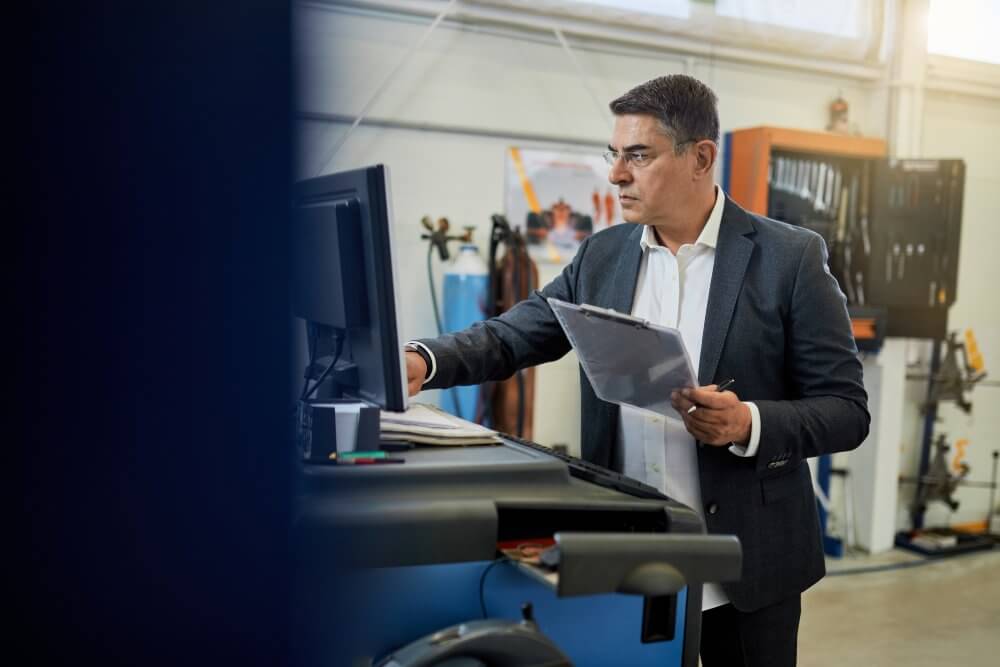

Most MES and OEE tools look similar in demos. They show utilization, scrap and a neat OEE dashboard. The real difference appears when something goes wrong on the line: a jam, a chronic microstop, a slow ramp-up after changeover, a quality drift. Some tools only tell you that you lost time. Others help you fix the problem and prevent it from coming back.
Fabrico captures production and downtime data directly from machines, calculates OEE and losses in real time, and, with built-in maintenance workflows, turns every loss into production and maintenance actions that teams can actually execute.
Many teams start with OEE and production monitoring, then realize later that the root causes are maintenance or reliability issues that sit outside the OEE tool. Before diving into the checklist, clarify what you need:
For a deeper comparison of these categories, see OEE vs MES: what belongs where.
Fabrico is designed as a cloud-based MES and OEE platform with a CMMS built into the same environment. Production and maintenance share one version of events: every downtime, slow cycle or defect can trigger actions for maintenance, production or both.
The way your MES collects data will define the reliability of every OEE number and loss report you see. Ask:
Fabrico connects to machines, captures cycle counts, states and alarms, and combines them with minimal operator input for reasons and context. The goal is to reduce manual typing while keeping the human context that pure machine data cannot provide.
OEE that updates at the end of a shift is a report, not a control. For day-to-day decision making you need:
Fabrico continuously calculates OEE and loss categories while the line is running. Teams immediately see if a change or intervention is improving or worsening the situation, rather than waiting for next-day reports.
This is the first big divider between a monitoring tool and a platform that also executes maintenance. Ask the vendor:
In Fabrico, every loss can generate tasks or maintenance requests without leaving the platform. A repeated microstop can trigger a standard work update for operators, a lubrication task for maintenance and a follow-up review, all connected to the specific machine and loss pattern.
Request a demo
Many MES and OEE tools add simple ticketing or basic work requests. That is not the same as having maintenance management as a core part of the platform. Explore:
Fabrico includes full maintenance management workflows inside the same MES and OEE environment. Work orders, task lists and asset histories sit directly on top of machine data, so planners and technicians act with full context.
If you are refining your maintenance requirements, this checklist may help: CMMS requirements checklist for manufacturing.
One of the main frustrations in plants is that production and maintenance work from different tools and different numbers. To avoid this:
In Fabrico there is a single event stream. An unplanned stop is logged once, enriched with cause and commentary, and then used by both operations and maintenance. When a technician finishes a corrective job, that action is visible in the production timeline and analytics.
A good MES should support structured problem solving, not just data browsing. Consider:
Fabrico highlights chronic losses and recurring patterns so teams can focus on the few issues that matter. Improvement actions can be created, assigned and followed through, always linked back to the data that justified them in the first place.
Request a demo
Maintenance is often treated as an interruption instead of a contributor to throughput. When evaluating MES solutions, ask:
With Fabrico, production and maintenance planning share one schedule view. Maintenance can schedule preventive work in low-demand windows, and planners can immediately see the impact on available time and OEE projections.
Plants differ by process, culture and maturity. You need flexibility without chaos. Validate:
Fabrico provides configurable reason structures, workflows and roles while still maintaining standardization across sites. Corporate teams can define core templates, and plants can refine them within defined boundaries.
Adoption in the plant stands or falls with the operators. If the system interrupts their work or feels like extra admin, it will quickly degrade. Ask vendors:
Fabrico is designed for operators first: quick reason selection, one-tap maintenance calls, and simple views of performance versus target. When operators can see their impact in real time, data quality and engagement improve.
Request a demo
An MES that works well on one pilot line but cannot scale is a risky investment. Evaluate:
Fabrico is cloud based and template driven. Once you configure a line, you can replicate structures across similar assets and sites and adjust only where needed, which helps achieve consistent practices without heavy local projects.
MES does not live alone. It should feed and be fed by ERP, planning, quality and corporate BI. Make sure:
Fabrico offers open interfaces so production and maintenance data can flow into your existing analytics stack. Event level histories enable deeper reliability and process analysis, not just high level KPIs.
MES and OEE projects are not one-off installs. They evolve as your plants and processes change. Clarify:
Fabrico works with manufacturers to refine configurations as they learn from their own data. Plants typically start with core OEE and downtime capture, then bring more maintenance processes and continuous improvement practices into the platform as adoption grows.
Request a demo
When you compare vendors, use these 12 questions as a simple scoring sheet:
Fabrico has been designed around these principles as a cloud-based MES and OEE platform with maintenance management built in. It captures production and downtime directly from machines, shows OEE and losses in real time, and turns those losses into coordinated actions for production and maintenance teams.
If you would like to explore how this approach could fit your plants, you can Request a demo or Contact us.




















Programați o întâlnire individuală cu experții noștri sau înscrieți-vă direct în planul nostru gratuit.
Nu este nevoie de card de credit!






 Login
Login
 Blog
Blog