
Semiconductor back-end assembly and test (also called OSAT. Outsourced Semiconductor Assembly and Test) covers die attach, wire bonding, encapsulation, solder ball attach, and final electrical test operations that convert singulated dies into finished packages.
This segment of semiconductor manufacturing is highly equipment-intensive, each bonding machine, die attach system, or test handler represents capital investment of $500K to several million dollars, making equipment utilization a critical financial metric alongside production throughput.OEE monitoring in semiconductor assembly faces the challenge of integrating with SECS/GEM (SEMI Equipment Communications Standard / Generic Equipment Model) protocols, the industry-standard interface that semiconductor equipment uses to communicate production data.
OEE platforms with native SECS/GEM connectivity can collect equipment states, lot tracking data, and production counts directly from bonding machines, die attach equipment, and test handlers without custom integration development, dramatically reducing the OEE implementation timeline in semiconductor environments.Yield management, tracking the ratio of good die or packages out to total input, is the quality dimension most critical to semiconductor assembly economics.
Die loss at attach, wire bond failures, encapsulation voids, and final test failures each represent different quality loss categories that OEE software should capture at the equipment and lot level.
The connection between OEE Quality data and yield management systems (which track lot genealogy and failure mode analysis) is the integration that creates the most operational value in semiconductor back-end operations.
Whichever OEE platform you shortlist, the decisive question is data quality. Sensors and manual logs miss the short stops, micro-stops, and idle time that quietly erode availability.
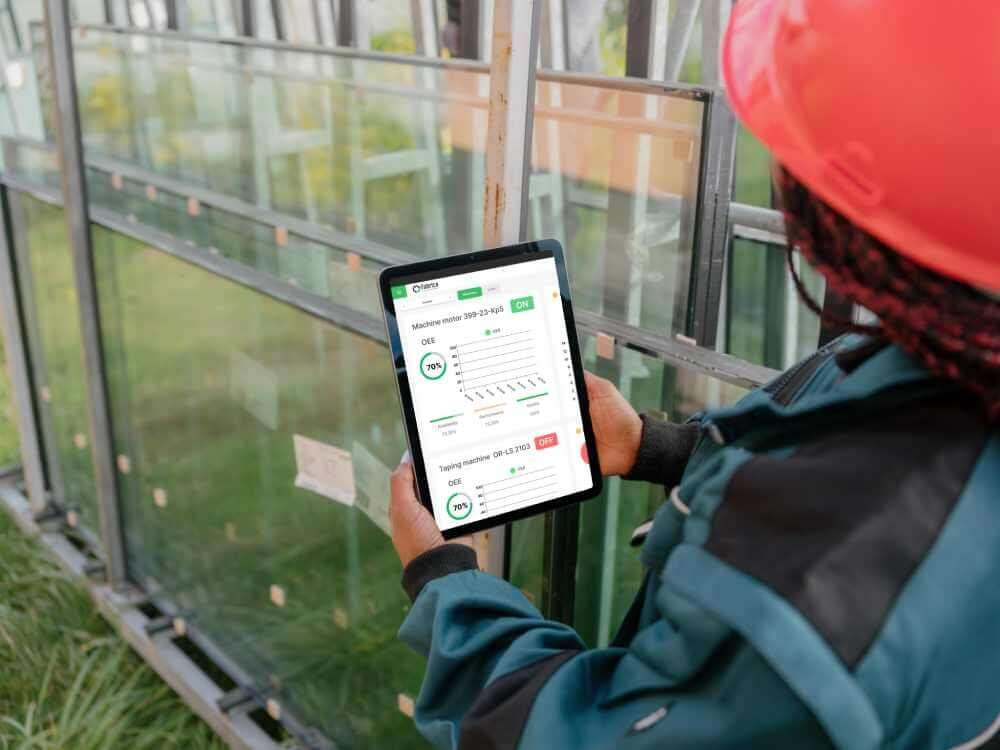
Fabrico is computer-vision-verified OEE plus closed-loop maintenance execution : cameras catch the losses other systems miss, and maintenance work orders close the loop from detection to fix.
See our guide to OEE for manufacturing and how to calculate OEE , or book a Fabrico demo to see it on your line.
Equipment utilization in semiconductor assembly is typically expressed as tool utilization, the percentage of available time a bonding machine or test handler is productively processing lots versus idle, in maintenance, or waiting for material.
OEE Availability analysis for semiconductor equipment distinguishes between scheduled PM (planned downtime for preventive maintenance), equipment-initiated downtime (alarms, sensor failures, consumable changes), and process-initiated downtime (waiting for lots, waiting for preceding process to complete, engineering holds).Wire bond throughput rate, units bonded per hour, is the Performance metric most directly linked to output volume in assembly operations.
Speed losses occur when equipment runs below rated UPH (units per hour) due to bond parameter adjustments for challenging die or substrate conditions, equipment wear affecting bond cycle time, or vision system calibration issues that slow automated placement.
OEE Performance tracking that captures UPH by equipment and product type enables engineering teams to identify which product-equipment combinations are underperforming and investigate whether the cause is equipment condition, process parameter optimization, or product design limitations.Test handler availability and test time efficiency are critical OEE metrics for final test operations.
Test time per device is product-specific, and performance losses occur when actual test times exceed the programmed test time (indicating handler issues or contact problems) or when handler downtime reduces the proportion of time test equipment is running tests versus idle.
OEE analysis of test operations helps test engineering identify opportunities to reduce test time (reducing cost per device) while maintaining test coverage and yield.
The most important capability requirement for OEE software in semiconductor back-end assembly is SECS/GEM compliance, the ability to connect to semiconductor equipment using standard GEM (SEMI E30) or GEM 300 (SEMI E116) protocols to collect equipment states, lot data, and production events without custom equipment programming.
SECS/GEM connectivity eliminates the manual data collection burden that is the primary barrier to OEE adoption in semiconductor environments, where equipment is too sophisticated and production volumes too high for operator-entered data to be practical.Lot-level OEE tracking, calculating OEE per production lot rather than just per shift, is a valuable capability for semiconductor assembly because yield and equipment performance vary by product, die type, and customer specification.
Lot-level OEE data enables engineering teams to identify which products have systematically lower yield or throughput, supporting pricing decisions and process improvement prioritization that lot-aggregated shift data cannot support.SEMI E10 compliance for equipment state classification, using the standardized state model (Productive, Standby, Engineering, Scheduled Downtime, Unscheduled Downtime, Non-Scheduled Time), is a best practice for semiconductor assembly OEE that enables meaningful benchmarking between equipment and facilities.
OEE software that supports SEMI E10 state classification natively allows semiconductor manufacturers to benchmark their tool utilization against industry standards and facilitates data exchange with customers who require SEMI-standard OEE reporting as part of their supply chain performance management.


















 Login
Login
 Blog
Blog