Hydrogen fuel cell and electrolyzer manufacturing is a high-growth sector where production lines are rapidly scaling from pilot to commercial volumes.
OEE software implementation at this stage of industry development is particularly valuable because production processes are still being optimized, and systematic OEE monitoring accelerates learning by providing objective data on where process losses occur rather than relying on operator intuition in a relatively new manufacturing environment.Membrane electrode assembly (MEA) manufacturing for PEM fuel cells combines precision coating processes (catalyst layer deposition
membrane application) with assembly steps (gas diffusion layer placement, sealing) that have tight tolerance requirements.
OEE Availability in MEA manufacturing is dominated by planned changeover between membrane specifications and unplanned stoppages from coating defects that require line restart.
Performance losses occur when coating speed is reduced below rated capacity to maintain coating thickness and uniformity.Electrolyzer stack assembly, whether for PEM or alkaline technology, involves bipolar plate inspection, cell assembly, stack compression, and leak testing steps that are primarily manual or semi-automated.
OEE monitoring for stack assembly focuses on process time adherence (actual assembly time versus standard time by stack configuration), quality failure rates at leak testing (which identify assembly process issues before stacks reach customers), and the handling damage rates that occur during stack manipulation before final pressure testing.
Whichever OEE platform you shortlist, the decisive question is data quality. Sensors and manual logs miss the short stops, micro-stops, and idle time that quietly erode availability.
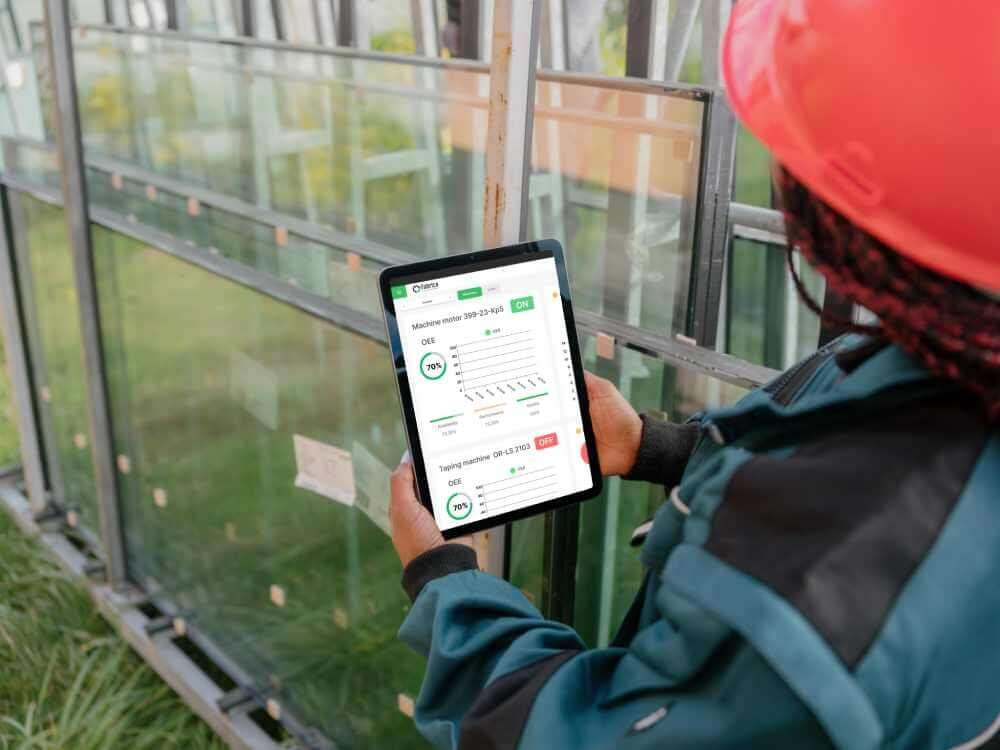
Fabrico is computer-vision-verified OEE plus closed-loop maintenance execution : cameras catch the losses other systems miss, and maintenance work orders close the loop from detection to fix.
See our guide to OEE for manufacturing and how to calculate OEE , or book a Fabrico demo to see it on your line.
MEA yield, the proportion of MEAs passing electrical and physical quality checks, is the most important quality metric for PEM fuel cell manufacturers.
MEA manufacturing involves expensive materials (platinum group metal catalysts, perfluorosulfonic acid membranes) where each rejected MEA represents significant material cost in addition to production time loss.
OEE Quality tracking that captures MEA rejection rates by defect type (coating thickness, catalyst loading deviation, membrane damage, pinhole detection) enables targeted process improvement that reduces material waste alongside productivity improvement.Stack power density performance, the ratio of actual power output per unit stack volume to the specification target, is a quality outcome that feeds into the Quality component of OEE for stack assembly operations.
Stacks that pass leak testing but perform below power density specification represent a quality loss that only appears at end-of-line performance testing.
OEE software that captures this end-of-line quality outcome alongside in-process defect rates provides a complete quality picture that supports root cause analysis for performance shortfalls.As hydrogen manufacturers scale production, cycle time consistency becomes increasingly important.
OEE Performance tracking that captures the distribution of assembly times around the standard reveals which operations have high variability, and high variability in assembly time is typically associated with training gaps, tooling inconsistency, or process specification ambiguity that needs to be resolved to sustain throughput at higher production volumes.
This insight is most valuable during ramp-up phases, where early OEE data informs process standardization investments before variability compounds across multiple lines.
Hydrogen technology manufacturers are typically operating at production scales where purpose-built OEE software is just becoming cost-effective, transitioning from manual tracking in Excel or simple production logs to structured OEE monitoring.
This transition point is where OEE software selection decisions have the highest long-term impact: the platform chosen now will be the one scaling with the business to 10× production volume, and a system that requires extensive reconfiguration as production processes mature is a significant operational cost.Flexibility in OEE calculation configuration is particularly important for hydrogen manufacturers whose production processes are still evolving.
The ability to redefine planned cycle times as process improvements are made, add new downtime cause categories as new failure modes are discovered, and adjust quality metrics as specifications are refined, all without vendor involvement
is a critical capability for companies where process engineering is moving faster than a vendor's implementation or configuration service can keep up with.Integration with quality management and traceability systems is a near-term requirement for hydrogen manufacturers targeting utility-scale and industrial customers who will require component traceability and production quality documentation as part of supply agreements.
OEE software that maintains production records with sufficient granularity to support traceability queries, connecting specific stacks to their MEA batches and the coating process conditions under which they were made, positions manufacturers to meet future customer traceability requirements without a separate system investment.

















 Login
Login
 Blog
Blog