

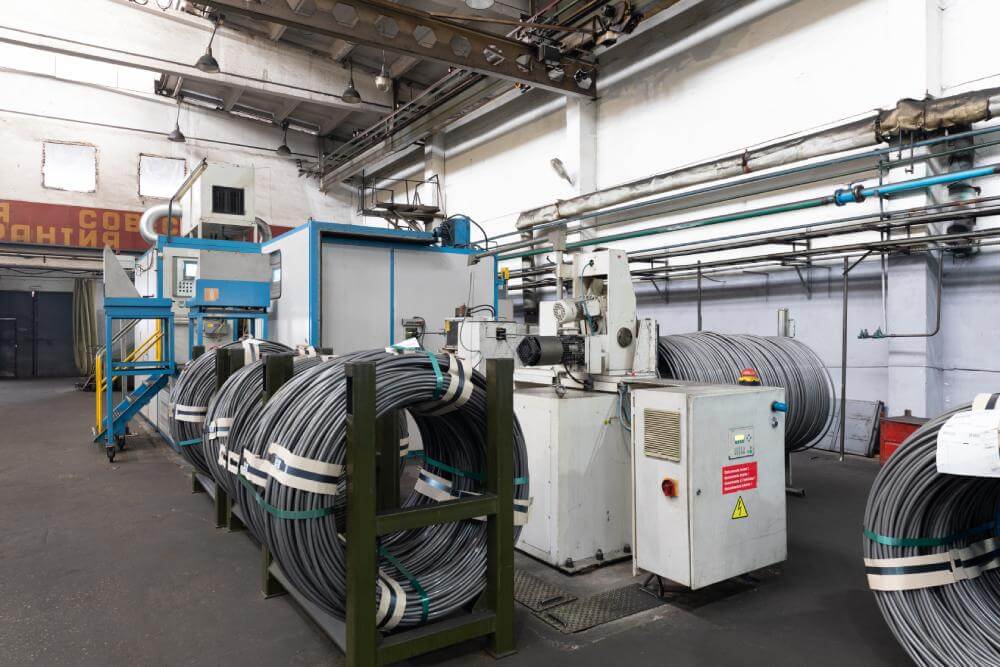

Cable and wire manufacturing is a continuous process industry where production efficiency is measured by metres produced per hour across extrusion, stranding, insulation, and coiling lines.
Unlike discrete manufacturing where OEE is calculated per production cycle, cable and wire OEE is fundamentally about line speed efficiency, the ratio of actual line speed to the maximum rated speed for the product being produced, combined with quality loss from out-of-specification lengths or electrical test failures.Extrusion lines in cable manufacturing are the critical production bottleneck.
Extruder availability determines line output, any material change, die cleaning, or mechanical stoppage that takes the extruder offline stops production completely.
OEE Availability for extrusion lines needs to capture both planned changeover time (material changes, colour changes, diameter changes) and unplanned stoppages (extruder faults, material blockages, cooling system failures) with sufficient granularity to distinguish between well-managed changeovers and problem events that indicate process instability.Product changeover complexity is a significant OEE driver in cable plants producing wide product variety.
Switching between wire gauges, insulation materials, or jacket compounds requires extruder purging, die changes, and speed recalibration that can take 30-120 minutes per changeover.
OEE software that tracks actual changeover duration against standard changeover time targets, and identifies which changeover types most frequently exceed targets, gives production engineers the data to systematically reduce changeover time through better tooling, process standardization, or scheduling improvements that batch similar products together.
Whichever OEE platform you shortlist, the decisive question is data quality. Sensors and manual logs miss the short stops, micro-stops, and idle time that quietly erode availability.
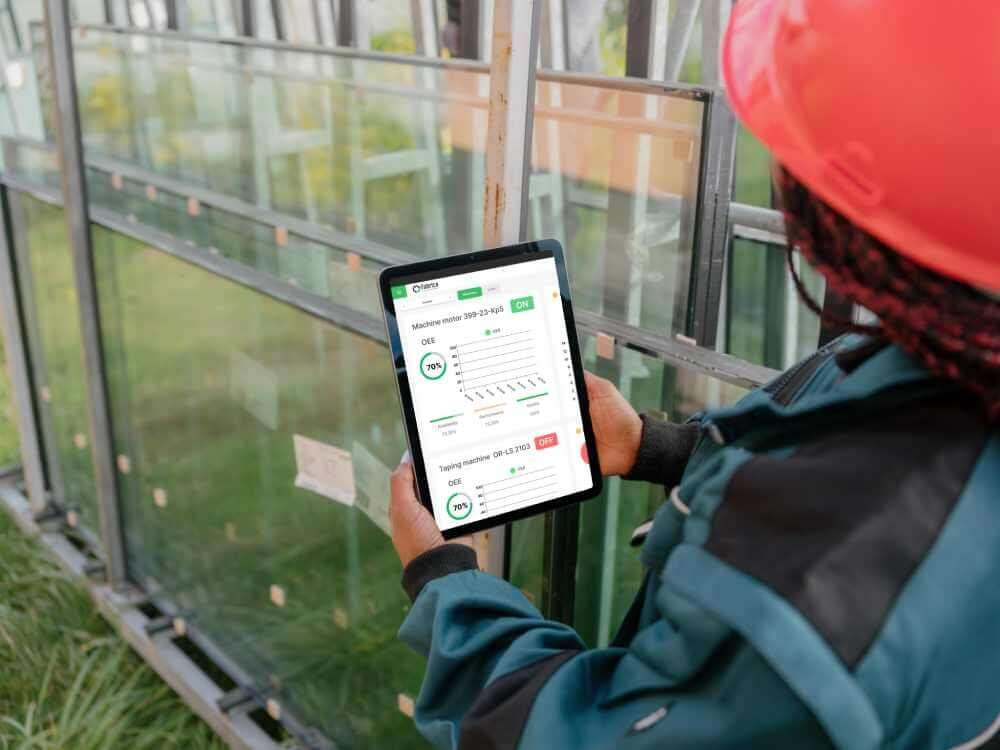
Fabrico is computer-vision-verified OEE plus closed-loop maintenance execution : cameras catch the losses other systems miss, and maintenance work orders close the loop from detection to fix.
See our guide to OEE for manufacturing and how to calculate OEE , or book a Fabrico demo to see it on your line.
Performance rate monitoring is especially critical in cable and wire manufacturing because speed losses in continuous extrusion directly translate to lost metres output per shift.
OEE Performance calculation for extrusion lines compares actual line speed (metres per minute) to the standard speed for the product grade being produced.
Speed losses occur when operators run lines below standard speed to manage process instability, when extruder output pressure variations force speed reduction, or when downstream equipment limitations (cooling tank capacity, take-up reel speed) constrain the extruder speed.Material yield
the ratio of cable produced at specification to raw material input, is the quality dimension most directly linked to profitability in cable manufacturing, where raw materials (copper, aluminium, insulation compounds) are a high proportion of product cost.
OEE Quality rate tracking that captures both electrical test failures (conductor resistance, insulation resistance, spark test failures) and dimensional failures (diameter out of tolerance, concentricity failures) gives quality engineers the data to identify which production conditions generate the highest scrap rates and target process control improvements accordingly.Coiling and reeling performance is an often-overlooked OEE component in cable plants.
Coiler speed limitations, reel change time, and coiler fault events all appear as Availability and Performance losses that reduce line output without any extruder-side problem.
OEE software that monitors coiling equipment alongside extrusion lines gives operations managers the complete downstream picture of where production efficiency is being lost, rather than focusing exclusively on extruder uptime.
Cable and wire manufacturers require OEE software that handles high-speed continuous process data, sampling line speed, production counts, and quality measurements at rates of seconds rather than minutes.
This high-frequency data requirement demands an OEE platform with edge computing capability or a high-throughput data pipeline that can ingest process historian data without performance degradation.
Systems designed primarily for discrete manufacturing with shift-level data models are typically inadequate for continuous wire extrusion environments.Length-based production counting (metres produced) rather than piece counting is a specific capability requirement for cable and wire OEE.
The platform needs to convert extruder output data (line speed × time) into length measurements that can be compared against production order targets, and it needs to handle reel and spool changes that reset the length counter without losing production continuity in the OEE calculation.Integration with electrical test equipment is a valuable capability for cable plants where in-process spark testing and end-of-reel electrical qualification determine product acceptance.
OEE software that receives electrical test results alongside production efficiency data enables correlation analysis, identifying which line speed ranges, temperature profiles, or material batches produce the highest electrical test failure rates.
This correlation analysis closes the loop between production efficiency decisions (running fast to hit output targets) and quality outcomes (electrical failures that require rework or scrap of finished reels).



















 Login
Login
 Blog
Blog