





 Login
 Blog
CNC tool life: tool change policy and the cost of a breakage

In short
- There is no universal part count: change the cutting edge after a part count measured in your own shop, below the edge's average life. Adjust the limit by the breakages you see.
- Three policies: by time, by part count with the tool life counter in the CNC control, and on condition with a wear check. For series turning the counter is the simplest place to start.
- A breakage costs far more than the insert: in the example below one breakage costs 73 EUR, a planned edge change 3.75 EUR.
- A little more speed costs many parts: with carbide inserts, 10% more speed takes 25-32% of the parts off each edge.
- A planned change and a breakage are different stop reasons: record them apart, or OEE cannot show which one costs more.
How often should you change tools on a CNC lathe or machining centre? Change the cutting edge after a part count you have measured in your own shop, and keep that count below the edge's average life.
Do not wait until you "hear it": identical edges vary widely in life, and some of them break early.
One unplanned breakage costs far more than the insert itself. In the example below it costs 73 EUR: the stopped machine, a scrapped flange, rework, lost edges and a damaged seat. A planned edge change costs 3.75 EUR.
Written for managers of machine shops and metal parts suppliers: tier 2 automotive, hydraulics, flanges. It covers three tool change policies, a failure-mode table and Taylor's tool life equation in plain arithmetic.
It also works one example through in euros and shows how to record tool stops so they show up in OEE.
In Bulgaria, 868 machining firms (NACE C25.62) employed 8,604 people in 2024, about 10 per firm.
Each hour worked produced 17.35 EUR of value added, while staff costs were 9.36 EUR an hour, or 54% of it (Eurostat, sbs_ovw_act, accessed 27.11.2026). At that ratio, every hour that a machine with open orders stands still shows up in the result.
This page is about CNC tool life: the life of the cutting tool itself. If the machine stops because of the tool changer, see troubleshooting the automatic tool changer.
Three tool change policies
Clause 8.1 of ISO 3685:1993 notes that in practical workshop situations, useful tool life usually ends when the tool stops producing parts of the desired size and surface quality (ISO 3685:1993, accessed 27.11.2026).
That standard covers tool-life testing with single-point turning tools. For face milling, tool-life testing is covered by ISO 8688-1 (ISO 8688-1:1989, accessed 27.11.2026).
The shop, however, decides when to stop earlier so the edge never reaches a breakage. There are three main ways to do it:
| Policy | How it works | Upside | Risk | Fits |
|---|---|---|---|---|
| Fixed interval | Change every X minutes of cutting, or at the start of every shift | Simple, easy to audit | Ignores the parts actually made, wastes edges | Uniform batches, cheap inserts |
| Counted parts | The control's tool life counter counts parts per tool and warns or stops at the limit | The change is planned, no guessing | A limit taken "from the catalogue", a counter left unchanged after new cutting data | Series parts, robot loading, shifts without a setter |
| On condition | Check the edge (loupe, roughness, size) every N parts and change at a set limit | Uses the edge almost to the end | Depends on people, a breakage can land between two checks | Costly drills and mills, small batches, new material |
The King Saud University course notes give three production signs of tool condition. They are a change in the cutting sound, a worse surface finish and a change in chip shape. Complete failure of the edge is usually not recommended as a criterion (KSU, Tool wear and tool life, accessed 27.11.2026).
Why average life is not a safe limit
The ME-215 course at NJIT describes tool life as a random variable with a log-normal distribution and a large coefficient of variation (NJIT, ME-215, chapter 21, accessed 27.11.2026). With that kind of distribution, more than half of the edges fail before the average life.
So the counter goes below the average. Start at about 75% of the measured average part count: in the example below that is 45 parts when the mean is 60. Then move the limit based on what the edges you take out look like.
Robot loading and unmanned hours
A study from the Technical University of Gabrovo looks at lathes with robotic loading. It notes that tool life should be set as a multiple of the robot station's capacity. That way tool changes happen when the parts magazine is reloaded, and the work cycle gets shorter (Kolev, Alexandrova, Metev, UNITECH'24, accessed 27.11.2026).
The same holds for a second shift without a setter. If a breakage stops the machine at 11 pm, it waits until morning. A control with a sister-tool function can switch to a spare tool in the magazine at the limit. A counter plus that sister tool costs less than one night of downtime.
How shops combine them
- Counter plus a look: at every change the operator looks at the edge coming out. Barely worn: raise the limit by a few parts. Chipped or with built-up edge: lower it and find the cause.
- A separate limit per material: one limit for C45, another for stainless steel or castings, because life changes with the material.
- New cutting data, new limit: whoever raises the speed also resets the counter. The Taylor arithmetic below shows why.
What one breakage costs: failure modes, effects, first check
A planned change is 2 minutes and one edge. Tool breakage downtime is a chain.
It starts with a scrapped part, a stopped machine and a search for the setter. Then come a check of the holder and seat, a new tool offset and a first-off check. Sometimes the spindle takes a hit as well.
The table links the five main failure modes to their effect and to the first thing to check. The modes follow the same KSU course notes; the effects and first checks are a floor checklist, not a quote from the course.
| Failure mode | What you see | Effect | First check |
|---|---|---|---|
| Breakage | Part of the insert missing, sometimes with a bang | Scrap, machine stop, damaged holder or seat, new offset, first-off | Parts made on that edge against the limit, insert clamping |
| Chipping | Small fragments broken off the edge | Rough surface, rework, can lead to breakage | Interrupted cuts (holes in the flange), vibration, long tool overhang |
| Built-up edge | Work metal welded onto the edge | Size drifts, rough surface, rework | Cutting speed too low, coolant concentration |
| Flank wear | An even wear land below the edge | Part slowly drifts out of size, breakage if changed late | Speed against the recommendation, counter limit |
| Crater wear | A hollow on the rake face behind the edge | Weakened edge, sudden breakage | Heat in the cutting zone: speed, coolant, grade |
The course names two main causes of chipping: mechanical shock and thermal fatigue. Crater wear grows with the temperature at the tool-chip interface and with the chemical affinity between the tool and work materials.
So on flanges with bolt holes and interrupted cuts, check the shock first. On continuous high-speed turning, check the heat first.
One note on the standard: ISO 3685 deals only with testing where the tool wears. Testing where the edge fractures or deforms plastically is left for further study, so the standard gives no method to predict a breakage.
After a hard crash, do not restart with just a new insert. Check the holder, the seat and the spindle: see the CNC spindle maintenance guide.
Safety when an insert breaks or is changed
What the texts say, as they read on 27.11.2026.
In Bulgaria, Ordinance No 7 of 1999 sets minimum health and safety requirements at workplaces and in the use of work equipment. Its Article 191(1) requires maintenance of work equipment to be carried out with the equipment stopped.
Where that is not possible, all necessary protective measures are taken (Ordinance No 7, lex.bg, accessed 27.11.2026). The duty sits with the employer (Article 2).
Regulation (EU) 2023/1230 on machinery applies from 14 January 2027 and binds the machine's manufacturer, not the shop. As point 1.3.2 of Annex III reads, the instructions for use name, where appropriate, the parts subject to wear and the criteria for replacing them.
Parts that may rupture are mounted or guarded so that their fragments are contained (EUR-Lex, 2023/1230, accessed 27.11.2026).
Neither text says after how many parts to change an insert: that is the shop's decision. How Article 191 applies to an insert change on your machine is a question for your safety specialist or the labour inspectorate.
Taylor's tool life equation in the shop: what 10% more speed does
The link between cutting speed and tool life is credited to F. W. Taylor around 1900. The KSU course writes it as:
v · Tn = C
- v is the cutting speed in m/min.
- T is the edge life in minutes of cutting to the chosen criterion.
- n and C are found by testing for each tool and work material pair.
Typical values of n are 0.10-0.15 for high-speed steel, 0.20-0.25 for carbides and 0.6-1.0 for ceramics (Materials, 2022, DOI 10.3390/ma15227994, accessed 27.11.2026). The smaller n is, the more tool life reacts to speed.
The arithmetic
New life equals old life times (old speed / new speed)1/n. For 10% more speed on carbide inserts:
| n | Calculation | Life in minutes | Parts per edge | 60 parts become |
|---|---|---|---|---|
| 0.25 | 1 / 1.14 = 0.68 | -32% | -25% | 45 |
| 0.20 | 1 / 1.15 = 0.62 | -38% | -32% | 41 |
Parts per edge fall less than minutes, because at the higher speed each part takes about 9% less cutting time. The counter counts parts, so the fourth column is the one to watch.
It works the other way too. At 10% less speed, life in minutes grows 1.5 times with n = 0.25 and 1.7 times with n = 0.20.
ISO 3685 shows the same sensitivity from another angle. In clause 7.3 it recommends that, in a test, each step in cutting speed gives roughly a doubling of tool life. As a guideline for carbide tools it gives a ratio of 1.12 between speeds, which is about 12% apart.
The rule that follows
Whoever raises the speed resets the counter. In the example below the limit is 45 parts against an average life of 60. After 10% more speed the average life drops to 41-45 parts: the old limit now sits at the average, and the breakages come back.
The Gabrovo study adds a second lesson. With carbide inserts, 42CrMo4 steel and a roughness criterion of Ra 2.0 µm, depth of cut had the strongest effect on tool life, not speed.
The takeaway: n and the limit are measured for your material, operation and criterion, not copied from a table.
How long an edge should last for maximum output
The KSU course works out the edge life that gives the most parts per hour: T = (1/n - 1) × the tool change time.
With n = 0.25 that is 3 times the change time. A 2-minute change gives 6 minutes of cutting per edge. A 10-minute change with a first-off check gives 30 minutes. The faster the change, the faster you can afford to cut.
The formula ignores insert price and breakage risk, so treat it as a direction, not a setting. The direction is clear though: cut the change time with offline tool presetting.
Worked example: two lathes, two shifts, steel flanges
These numbers are an example, not a customer's data. The shop turns steel flanges on two CNC lathes. The calculation covers only the roughing insert, the one changed most often in this example.
- 2 lathes, 2 shifts of 8 h, 21 working days a month.
- 100 flanges per shift per lathe at a 4.2 min cycle: 8,400 flanges a month.
- Insert 9 EUR with 4 edges: 2.25 EUR per edge.
- Average life today: 60 flanges per edge (0.4 min of cutting per flange, 24 min per edge).
- Machine time: 45 EUR/h, so 0.75 EUR/min. Both lathes have open orders, so minutes stopped are lost output.
- Planned edge change: 2 min.
The cost of one breakage in this example
| Item | Calculation | EUR |
|---|---|---|
| Downtime, including waiting for the setter and the first-off | 50 min × 0.75 | 37.50 |
| Scrapped flange | 1 × 14.00 | 14.00 |
| Rework | 2 flanges × 6.00 | 12.00 |
| Unused edges on the broken insert | 2 × 2.25 | 4.50 |
| Seat (shim), on every third breakage | 15.00 / 3 | 5.00 |
| Total per breakage | 73.00 |
A planned edge change costs 2.25 EUR for the edge plus 2 min × 0.75 = 1.50 EUR of machine time, 3.75 EUR in total. In this example one breakage costs as much as almost 20 planned changes.
Policy A and policy B
- A, change when needed: the operator changes the edge when the sound changes, the surface looks poor or a size goes out. On average 60 flanges per edge and 6 breakages a month.
- B, counter at 45: a limit of 45 flanges per edge, about 75% of the average, plus a look at every edge taken out. The example assumes 1 breakage a month.
| Per month | A: when needed | B: counter at 45 |
|---|---|---|
| Edges used | 140 | 187 |
| Inserts (2.25 EUR per edge) | 315.00 EUR | 420.75 EUR |
| Planned edge changes | 134 × 2 min = 268 min | 186 × 2 min = 372 min |
| Machine time for them (0.75 EUR/min) | 201.00 EUR | 279.00 EUR |
| Breakages (73 EUR each) | 6 = 438.00 EUR | 1 = 73.00 EUR |
| Total | 954.00 EUR | 772.75 EUR |
| Minutes stopped for tooling | 568 min | 422 min |
Edges: 8,400 / 60 = 140 under A, and 8,400 / 45 = 186.7, so 187 under B. Planned changes are the edges minus the broken ones: 140 - 6 = 134 and 187 - 1 = 186. Minutes stopped are the planned changes plus 50 min per breakage.
In this example policy B saves 181.25 EUR a month, about 2,175 EUR a year, if the drop to 1 breakage a month holds.
Per shift (both lathes, 42 shifts a month) the cost falls from 22.71 to 18.40 EUR. Tool stops shrink by 146 min a month, which at a 4.2 min cycle is about 35 more flanges of capacity.
When policy B does not pay
B uses more edges and more planned changes: 105.75 EUR of inserts and 78.00 EUR of machine time a month. Those 183.75 EUR only come back from the 5 avoided breakages if one breakage costs more than 36.75 EUR.
Say a breakage is cheap in your shop, because the part is cheap and the setter stands next to the machine. Then a limit of 45 is too low: raise it and watch the breakages.
If a breakage stops the machine for a whole night, run the numbers with the real minutes: the limit may need to go lower still.
How to record tool stops so they show in OEE
In OEE both the planned edge change and the breakage reduce availability. The difference is what you do with them. A planned change has a standard time, and you track whether it is met. A breakage has no standard time: it has a cause, scrap and a cost.
In the example, tool stops under policy A take 568 min a month. Planned time is 40,320 min a month (2 lathes × 2 shifts × 21 days × 480 min). That is 1.4% of planned time, small enough to disappear into "other" if it has no reason of its own. With the inserts, policy A costs 954 EUR a month.
| Stop reason | Type | Standard time | Also record |
|---|---|---|---|
| Planned edge change by counter | Planned | 2 min | Tool number |
| Change for wear before the limit | Unplanned | 2 min | Tool, parts on that edge |
| Tool breakage | Unplanned | None, measure it | Scrap, holder, seat |
| Waiting for setter or tool | Unplanned | None | Shift and time |
| First-off check after a change | Planned | 5 min | Pass or fail |
- The reason is chosen when the machine stops, at the machine, in a few taps. Filled in at the end of the shift, it is a memory, not data.
- Scrap from a breakage is recorded as scrap with the reason "broken tool" and the product. That way the quality factor in OEE carries this loss too.
- A planned change is measured against its standard time. When 2 min turn into 6, check first for a missing prepared insert or key, before skill.
- The first-off after a change is its own reason. The rules are in the guide to first-off approval after changeover.
- Once a week, review tool stops by minutes and by money, per machine and shift. Compare breakages on the first and second shift: the gap in minutes shows what waiting for a setter costs.
If you are choosing software for this, the comparison of OEE software for CNC machine shops lists what to ask. For the wider sector, see OEE in metalworking.
When tool monitoring pays and when a counter plus discipline is enough
Tool monitoring systems track indirect signals. A review of these systems in turning lists heat, acoustic emission, vibration, cutting forces and motor current (Kuntoğlu et al., Sensors, 2021, accessed 27.11.2026).
A 2025 study shows how simple the input can be. A current sensor clamped onto the motor cable, with no change to the machine, detected breakage within 1-3 seconds after the event (Lai et al., Sensors, 2025, accessed 27.11.2026).
The authors also note that their data came from a single machine under fixed cutting conditions. The signal features have to be tuned for each machine and set of cutting data. Someone in the shop has to own that work.
Detecting a breakage after it happens does not save the edge. It saves the next parts, the holder and sometimes the spindle. So it pays where the machine would otherwise keep running with a broken tool.
The spending ceiling in this example
Suppose monitoring removed the last breakage under policy B and allowed a limit of 55 instead of 45 parts. The monthly cost in this example would fall from 772.75 to 573.75 EUR. That is 199 EUR a month, about 2,388 EUR a year for both lathes, if the gain holds.
That is the ceiling: if a system for the two lathes costs more per year, including fitting, tuning and upkeep, the counter and discipline win. The ceiling is optimistic, because detection after a breakage does not remove every loss.
Which policy suits whom
- Counter plus a look at the edge: series turning, cheap inserts, a setter nearby, a breakage that costs only a little more than a planned change.
- On-condition changes: costly solid drills and mills, small batches, a new material with no measured life yet.
- Tool monitoring: unmanned hours and robot loading, expensive parts, deep holes and threads where a broken tool stays in the part, crashes that put the spindle at risk.
What drives the cost
- The cost of one breakage: minutes stopped, scrap, rework, the holder.
- The spread of tool life: the wider it is, the lower the limit has to be.
- Unmanned hours: a breakage at 11 pm with no setter costs the whole night.
- Part value: on an expensive part, one scrap pays for many edges.
- Tools per part: every tool has its own limit and its own risk.
Questions for the tool supplier
- What edge life was measured for this material and cutting data, and by which criterion: wear, roughness or size?
- How widely does tool life spread, and what was the shortest life measured, not only the average?
- What is n for this grade and material, or how much life is lost at 10% more speed?
- Which grade handles interrupted cuts better, such as the bolt holes in a flange?
- Can a trial run on a machine in the shop, with parts counted on every edge?
- What does the wear that comes before a breakage look like on this grade?
- What is the price per edge at the shop's annual volume?
Where Fabrico fits
Fabrico is an OEE platform and light MES. For a stand-alone CNC machine it shows live OEE by machine and shift. Operators add the stop reason in a few taps. Planned and unplanned stops are kept apart, so an edge change and a breakage never blur together.
Scrap is recorded by product and reason, losses are priced in money and stops are ranked by financial impact. Data comes from the machine control or a Fabrico IoT device. The tool life counter and wear checks stay in the control and with the tool supplier. More on downtime tracking.
A tool change policy in 6 steps
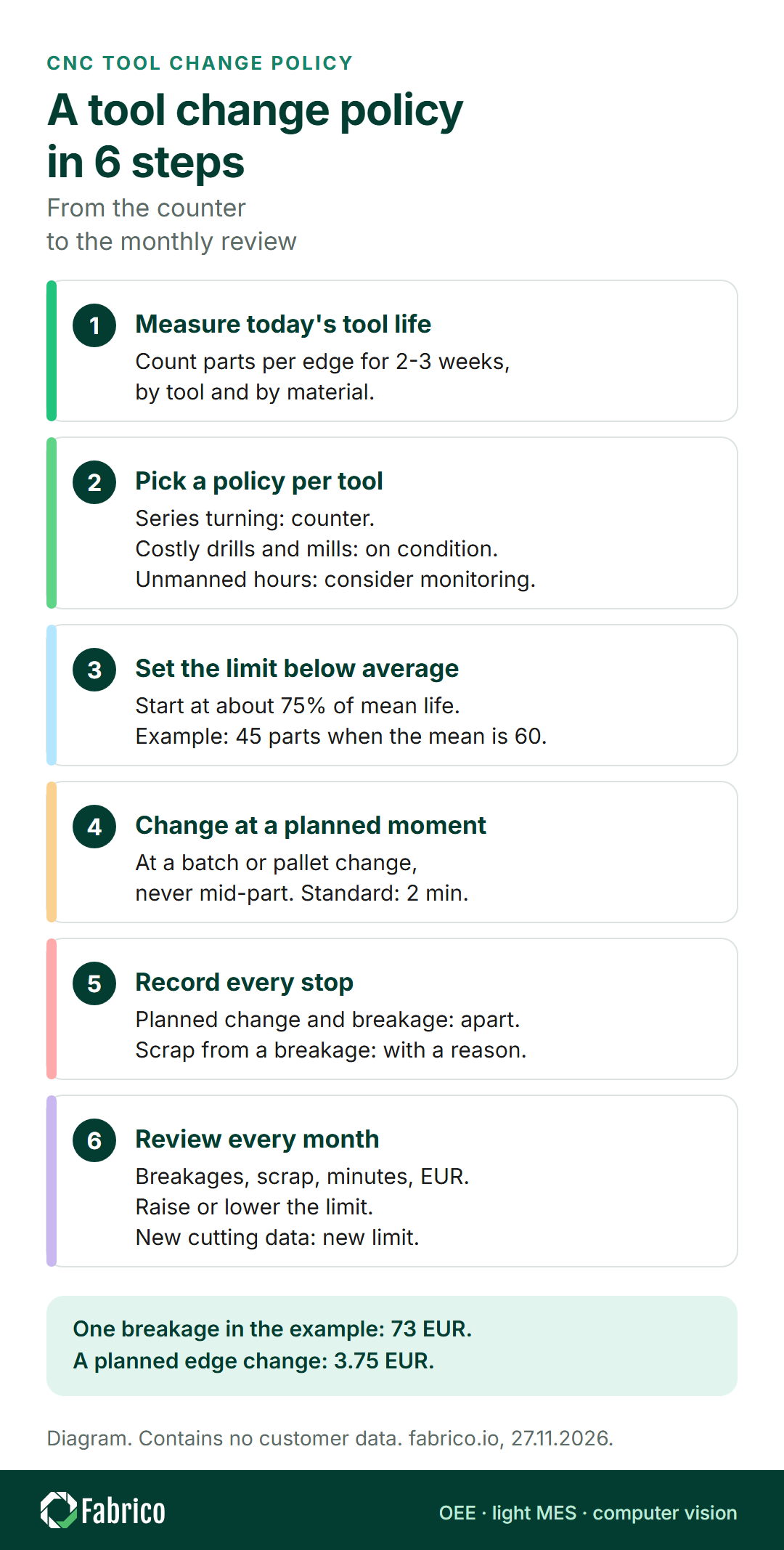
Text version of the diagram
- Measure today's tool life: count parts per edge for 2-3 weeks, by tool and by material.
- Pick a policy for each tool: a counter for series turning, on-condition changes for costly drills and mills, monitoring considered for unmanned hours.
- Set the limit below the average: start at about 75% of mean life, for example 45 parts when the mean is 60.
- Change at a planned moment: at a batch or pallet change, never mid-part, against a standard time of 2 min.
- Record every stop: planned changes and breakages apart, scrap from a breakage with its reason.
- Review every month: breakages, scrap, minutes and euros; raise or lower the limit, and set a new limit for new cutting data.
Frequently asked questions
How often should a CNC lathe insert be changed?
After a measured number of parts, set below the edge's average life for that material and cutting data. Start at about 75% of the average and adjust the limit by the breakages and by the condition of the edges you take out.
How do you set a tool life counter limit on a CNC control?
Count parts per edge for two to three weeks, by tool and by material. Set the limit below the average, and change it whenever the speed, feed or material changes.
How much does a tool breakage cost?
Add the minutes stopped at your machine-hour rate, the scrapped and reworked parts, the lost edges and any damaged holder or seat. In this article's example that comes to 73 EUR, against 3.75 EUR for a planned edge change.
How is a tool change counted in OEE?
As a stop that reduces availability. Planned changes and breakages should be separate reasons, and scrap from a breakage is recorded as scrap with the reason "broken tool".
How much does tool life drop at a higher cutting speed?
For carbide inserts with n between 0.20 and 0.25, 10% more speed cuts life in minutes by 32-38% and parts per edge by 25-32%. The exact figure is measured in the shop.
When is a tool monitoring system worth it?
With unmanned running, expensive parts and breakages that damage the holder or spindle. In this article's example the ceiling is about 2,388 EUR a year for two lathes, if the gain holds.
Does the machine have to be stopped to change an insert?
In Bulgaria, Article 191 of Ordinance No 7 of 1999 requires maintenance of work equipment with the equipment stopped. Where that is not possible, it is done with all necessary protective measures. For your specific machine, check with a safety specialist or the labour inspectorate.
See what tool stops cost on your machines. The demo shows OEE by machine and shift, stops with reasons, scrap by reason and losses in euros.
Latest from our blog








Real Fabrico tiles, sample data.