

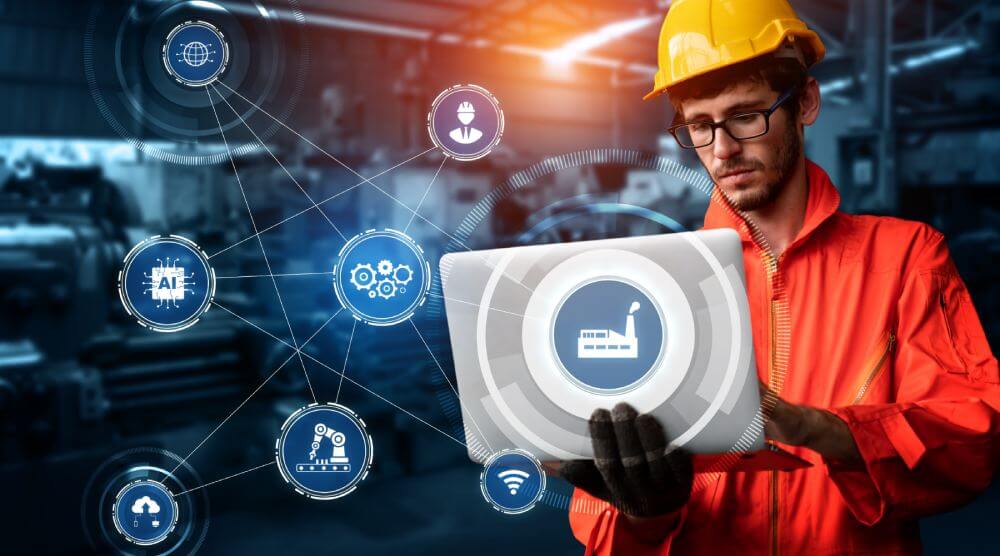

Beyond Prediction: Predictive maintenance uses math to say "Failure Likely." Cognitive maintenance uses reasoning to say "Failure likely because of X, and here is the manual on how to fix it."
The Three Cognitive Traits: True cognitive software must possess Perception (Computer Vision), Knowledge (Reading Manuals), and Reasoning (Scheduling Logic).
Turn downtime into a number your team can actually act on.
Get a demoHuman-Centric AI: Cognitive systems don't replace humans; they converse with them. The interface shifts from dashboards to natural language chat.
The Fabrico Vision: Fabrico is building the cognitive layer of the factory, combining the Fabrico Assistant (Knowledge) with Inefficiencies Zoom-In (Perception) to create a thinking partner for your team.
We are witnessing a shift in industrial software that happens only once every 20 years.
Era 1 (1990s): Digitization (CMMS). The software records what you type.
Era 2 (2010s): Prediction (IoT). The software calculates sensor data.
Era 3 (2026): Cognition. The software understands, reasons, and learns.
Cognitive Maintenance Software moves beyond "If/Then" rules. It mimics human cognitive processes to solve complex, unstructured problems.
It reads manuals like a human. It watches video like a human. It plans schedules like a human, but faster, and without bias.
For the Innovation Director, "Cognitive" is the roadmap to the Self-Optimizing Factory. Here is what that looks like in practice with Fabrico.
Traditional software is blind. It relies on text. Cognitive software "sees."
The Technology: Computer Vision.
The Application: Fabrico’s "Inefficiencies Zoom-In."
The Cognitive Leap: Instead of just logging a "Stop," the system perceives the physical reality. It watches the video buffer. It identifies that "Product A is misaligned." It provides the context that sensors miss.
Traditional software stores documents. Cognitive software reads them.
The Technology: Large Language Models (Generative AI).
The Application: The Fabrico Assistant.
The Cognitive Leap: It ingests your OEM manuals, safety guides, and historical logs. When a technician asks, "Is it safe to open the panel?", the system doesn't search for a PDF; it understands the safety protocols and answers: "Only after LOTO Procedure #4 is applied. Here is the diagram."
Traditional software follows static rules. Cognitive software weighs trade-offs.
The Technology: Agentic AI (Optimization Algorithms).
The Application: The Fabrico Agent.
The Cognitive Leap: Scheduling maintenance is a trade-off between Production Needs, Technician Skills, and Part Availability. The Agent reasons through these constraints to propose the optimal path: "I suggest delaying the PM to Tuesday because production is ahead of schedule and the senior electrician is available then."
Predictive Maintenance (PdM) is powerful, but it is narrow. It tells you that a bearing will fail.
But it doesn't tell you:
Do we have the part?
Is it safe to fix it now?
Who is the best person for the job?
Cognitive Maintenance takes the Prediction and wraps it in Context.
It connects the "Signal" (Bearing failing) to the "World" (Inventory, Safety, People).
The most visible change in Cognitive Software is the user interface.
Dashboards are for analysis. Chat is for problem-solving.
Fabrico is moving toward a future where the primary interaction is conversational.
Tech: "Fabrico, show me the history of this pump."
System: "This pump replaced 3 times in 2025. Main cause: Seal failure due to high pressure. Suggest checking the relief valve."
This turns the software from a tool you use into a colleague you consult.
You cannot buy a brain for a body that has no nerves.
Nervous System (Data): Use Fabrico to connect PLCs and digitize workflows.
Memory (History): Capture structured failure codes and video evidence to train the system.
Cognition (AI): Deploy the Fabrico Assistant (roadmap) to leverage that memory for problem-solving.
The factory of the future doesn't just run; it thinks.
By investing in Cognitive Maintenance Software capabilities today, you are building a manufacturing environment that learns from every cycle, every stop, and every repair.
Upgrade your factory's IQ.
[Request a Demo] and see Fabrico’s intelligent features in action.
See how Fabrico unifies OEE and maintenance in one platform.
Book a demo

















 Login
Login
 Blog
Blog