





 Login
 Blog
Colour change in injection moulding: cost, purging and sequencing

In short
- A colour change costs three things: kilograms of purge, transition parts until the colour is clean, and minutes without good output. In the example below one colour change costs from EUR 35.92 to EUR 141.52.
- Direction decides the cost: going darker is easy, going lighter is hard, above all into white or natural. In this example a hard change costs almost 4 times an easy one.
- Sequence first, buy later: run light to dark and 9 colour changes a week become 6, while hard changes drop from 4 to 1. In this example that saves about EUR 20,379 a year, if the gain holds.
- Purging compound is for the hard changes: in this example it adds EUR 2,836 a year, if the gain holds. It pays as long as it costs less than about EUR 27.69/kg.
- Measure colour changes on their own: a separate changeover type with a standard time, scrap under the reason "colour change", and minutes and kg per change, by shift.
What does a colour change cost in injection moulding, and how do you cut it? The sum is simple. Take the kilograms of purge and transition parts at the material price. Add the minutes without good parts at what a minute is worth.
On a 220-tonne press running a 16-cavity mould for PP closures, 9 colour changes a week cost about EUR 37,465 a year in the example below.
Most of that loss goes away without buying anything: sequence the orders from light to dark. A purging compound pays mainly on the hard changes into a lighter colour.
Below: the losses one by one, the four methods, the worked example, a transition matrix, an 8-step checklist and how to measure it.
Where the kilograms and minutes go
Every colour change has four losses. Two are measured in kilograms, two in minutes. If you only log total changeover time, you cannot see which one is the big one.
| Loss | What it is | How to measure it |
|---|---|---|
| Purge material | Melt pushed out through the nozzle until the barrel runs clean: the purge lumps | Kg, on a scale next to the press |
| Transition parts | Closures moulded until the colour is clean | Number of shots × shot weight |
| Changeover time | From the last good part in the old colour to the first approved part in the new one | Minutes, from the stop record |
| First-off approval | Waiting for quality to sign off colour, size and function | Minutes, logged apart from the change itself |
Why does colour hang on? Old melt clings to the barrel wall, the screw flights, the check ring, the nozzle and the hot runner. Every slow-flow spot feeds old colour back for shot after shot.
A team at the Budapest University of Technology and Economics describes colour changeover as a poorly controlled procedure. It eats material and keeps the press down for a long time. The design of the injection unit, static or dynamic mixers and the mould's hot runner make it harder still (Török et al., Polymer Testing, 2022, accessed 27.11.2026).
PP made up 15.6% of European plastics production in 2024 (54.6 Mt), the largest single share in Plastics Europe, Plastics the Fast Facts 2025 (accessed 27.11.2026).
In 2024, plastics products manufacturing in Bulgaria had 1,390 enterprises and 24,613 persons employed, 18 people per enterprise on average (Eurostat, table sbs_ovw_act, NACE C22.2, accessed 27.11.2026). At that size every kilogram and every hour of downtime shows up in the result.
Purge lumps and transition closures: what Bulgarian waste law says
Purge kilograms do not disappear. Bulgaria's Waste Management Act (ЗУО), as it reads on 27.11.2026 (last amended in State Gazette No. 99 of 30.10.2026; lex.bg, accessed 27.11.2026), says three things that matter on the moulding floor:
- The Act covers production waste (Art. 2(1)(2)). That is waste generated by the production activity of individuals and companies (§ 1, item 32 of the additional provisions).
- A plant cannot declare its own by-product. A substance is a by-product rather than waste only if 4 conditions are all met (Art. 4(1)). The status is set case by case, by a reasoned decision of the Minister of Environment and Water or an official the minister authorises. It can also be set by criteria in a European Commission act or a Council of Ministers ordinance (Art. 4(2)).
- Prevention comes first in the hierarchy (Art. 6(1)(1)). A kilogram never purged ranks above any recycled kilogram.
The Act does not say whether clean transition closures, ground and fed back into the same process, are waste. That depends on the facts of the case and on § 1, item 17. There, waste is a substance or object the holder discards, intends to discard or is required to discard.
This is a reading of the text, not legal advice: check with a lawyer or the regional environment inspectorate (РИОСВ).
Four ways to change colour, compared
The methods do not exclude each other. A sensible mix is the next resin for easy changes, a compound for hard ones and a procedure of its own for the hot runner.
| Method | When it fits | Cost drivers | Weak spot |
|---|---|---|---|
| Purge with the next resin | Easy changes to a darker colour, same polymer | Kg of resin and masterbatch, transition shots, minutes | Going lighter, it burns a lot of material and time |
| Mechanical purging compound | Hard changes, black specks, polymer changes | Price per kg, kg per change, base resin to flush it out | Must be fully flushed; not every grade suits a hot runner |
| Chemical or foaming compound | Stubborn pigments, deposits, slow-flow areas | Price per kg, soak time, temperature | Soaking stops the press; more sensitive to temperature |
| Hot runner and manifold flushing | Multi-cavity moulds with a manifold | Hot runner volume, dead spots, number of drops | In bad cases, strip and clean by hand for hours |
The next resin looks free, but it is not. From white to black it is the right choice. From black to white it burns the most kilograms and shots, because a dark residue shows in a light part for a long time.
Mechanical compounds scrub residue out with high viscosity or a filler. Chemical and foaming compounds loosen deposits by reaction or expansion and may need to soak in the barrel.
A study of two purging compounds in PP injection moulding found that processing temperature affects how they perform.
In that study, the mechanical compound gave shorter purging times and lower specific energy use at every temperature tested (Carrasco et al., Journal of Manufacturing and Materials Processing, 2023, accessed 27.11.2026). That is a result for two compounds, not a rule for all of them.
The hot runner hides colour longest: in the manifold, around the nozzle tips and in dead spots. How many shots it takes depends heavily on its design. Ask the mould maker for a colour change procedure and measure it like any other.
How is the result judged? In industry, purge performance is usually judged by eye on the extrudate. That is why a master's dissertation at the University of Pretoria built a method that measures residual pigment in film with a spectrophotometer instead (Govender, University of Pretoria, 2006, accessed 27.11.2026).
On a blown film line the question is the same: how many kilograms and metres until the colour is in tolerance.
If the closures are for food and drink
For beverage closures, purge residue is a compliance question, not only a cosmetic one. Three EU regulations touch it. Here is what they say, as they read on 27.11.2026:
- Regulation (EC) No 1935/2004, Article 3(1): food contact materials must be made under good manufacturing practice. Under normal or foreseeable use, they must not transfer their constituents to food in quantities that could endanger health. Nor may the transfer bring an unacceptable change in its composition or spoil its taste and smell (organoleptic characteristics) (EUR-Lex, accessed 27.11.2026).
- Regulation (EU) No 10/2011, Article 5(2)(b) and Article 6(2): the Union list covers additives excluding colorants, and colorants may be used under national law. Under Article 15(3), the declaration of compliance must be renewed when substantial changes in composition or production change migration (EUR-Lex, accessed 27.11.2026).
- Regulation (EC) No 2023/2006 on good manufacturing practice: it applies to all sectors and all stages of manufacture, processing and distribution, except the production of starting substances (Article 2). It requires an effective, documented quality assurance system (Article 5) and quality control that monitors GMP (Article 6). It also requires documentation on paper or in electronic form (Article 7) (EUR-Lex, accessed 27.11.2026).
What they do not say. None of the three regulations describes how to purge a barrel, how many transition parts to discard or which compound is acceptable. The procedure and its records are the plant's job, inside its GMP system.
With a new compound or masterbatch, ask the supplier for a written statement on use in presses making food contact parts. Also check whether your declaration of compliance needs renewing. This is a reading of the text, not legal advice: check with a lawyer and with your customer's requirements.
Worked example: 220 t, 16 cavities, 9 colour changes a week
The numbers are an example, not a customer's. Put in your own: the arithmetic stays the same.
The press makes PP closures for a juice and soft drinks bottler. The customer uses six closure colours and orders weekly.
| Input | Value in this example |
|---|---|
| Press and mould | 220 t, 16 cavities, hot runner |
| Closure | PP, 3.5 g; shot weight 56 g |
| Cycle time | 7.2 s: 500 shots/h, 8,000 closures/h, 28 kg/h |
| Coloured material | 98% PP at EUR 1.30/kg + 2% masterbatch at EUR 6.30/kg = EUR 1.40/kg |
| Purging compound | EUR 8.00/kg |
| Margin after material | EUR 12.40 per 1,000 closures - EUR 4.90 material = EUR 7.50 |
| Running time | 15 shifts a week (3 × 8 h, 5 days), 48 weeks a year |
What a minute is worth. The press is fully booked: everything it makes is sold. So a minute is worth the lost margin: 8,000 closures/h × EUR 7.50 per 1,000 = EUR 60/h, or EUR 1.00/min. More on this sum: the cost of downtime per minute.
The cost of one change
| Change | Purge | Transition shots | Minutes | EUR |
|---|---|---|---|---|
| Easy (to darker) | 5 kg | 50 (2.8 kg) | 25 | 35.92 |
| Medium (other hue) | 10 kg | 150 (8.4 kg) | 45 | 70.76 |
| Hard (to lighter) | 20 kg | 300 (16.8 kg) | 90 | 141.52 |
| Hard with compound | 3 kg compound + 4 kg resin | 100 (5.6 kg) | 45 | 82.44 |
How the hard change adds up: 20 kg × 1.40 = EUR 28.00 of purge; 300 shots × 56 g = 16.8 kg × 1.40 = EUR 23.52 of transition closures; 90 min × 1.00 = EUR 90.00 of time. Total EUR 141.52.
With compound: 3 kg × 8.00 = EUR 24.00; 4 kg × 1.40 = EUR 5.60 of resin to flush the compound out; 100 shots × 56 g = 5.6 kg × 1.40 = EUR 7.84; 45 min = EUR 45.00. Total EUR 82.44. The minutes include first-off approval.
The week today
Batches run in order-book order: white, orange, white, red, yellow, black, white, green, red. The last batch of the week before was red too. That gives 9 colour changes: 4 hard, 4 easy and 1 medium.
- Hard: red → white, orange → white, red → yellow, black → white.
- Easy: white → orange, white → red, yellow → black, white → green.
- Medium: green → red.
The week adds up to 4 × 141.52 + 4 × 35.92 + 1 × 70.76 = 566.08 + 143.68 + 70.76 = EUR 780.52. That is 505 minutes, 7.01% of the 7,200 minutes of running time a week, and 24,800 transition closures.
The week with sequencing and compound
The same 9 batches, run light to dark: white, yellow, orange, red, green, black. The three white and two red batches now run back to back, so colour changes drop to 6. One hard change is left: black → white at the start of the next week.
Sequencing only: 141.52 + 4 × 35.92 + 70.76 = EUR 355.96 a week. With compound on the one hard change: 82.44 + 143.68 + 70.76 = EUR 296.88.
| Scenario | Colour changes (hard) | Min/week | Kg/week |
|---|---|---|---|
| Today | 9 (4) | 505 | 196.8 |
| Sequenced | 6 (1) | 235 | 86.4 |
| Sequenced + compound | 6 (1) | 190 | 62.2 (3 kg of it compound) |
| Scenario | EUR/shift | EUR/month | EUR/year |
|---|---|---|---|
| Today | 52.03 | 3,122.08 | 37,464.96 |
| Sequenced | 23.73 | 1,423.84 | 17,086.08 |
| Sequenced + compound | 19.79 | 1,187.52 | 14,250.24 |
Week × 4 = month, month × 12 = year (48 weeks). Shift = week / 15.
What you gain in this example, if the gain holds:
- Sequencing alone: EUR 424.56 a week, EUR 28.30 a shift, EUR 1,698.24 a month, EUR 20,378.88 a year.
- Compound on top: another EUR 59.08 a week, EUR 2,835.84 a year.
- Together: EUR 483.64 a week, EUR 32.24 a shift, EUR 1,934.56 a month, EUR 23,214.72 a year.
- Material: 134.6 kg less a week, about 6.5 t a year (6,460.8 kg).
- Time: 315 minutes a week, 252 hours a year, room for 2,016,000 more closures.
What if the press is not full?
Then a minute is not worth lost margin, only the setter's time. The average employee cost in Bulgarian plastics products manufacturing was EUR 8.14 per hour worked in 2024 (Eurostat, table sbs_ovw_act, accessed 27.11.2026).
In this example, material and compound cost falls by EUR 168.64 a week: from EUR 275.52 today to EUR 106.88 after the change. That is EUR 8,094.72 a year.
Freed setter time adds 252 h × EUR 8.14 = EUR 2,051.28. Total EUR 10,146.00 a year, if the gain holds. Sequencing is still step one, but the gain is less than half of the full-press figure.
Light to dark: the transition matrix
The rule is old and it works. A light residue vanishes into a darker colour; a dark residue shows in a light one. So the week runs from natural and white to yellow, orange, red, green, blue and black, with one return to light.
| From \ to | White | Yellow | Red | Black |
|---|---|---|---|---|
| White | - | easy | easy | easy |
| Yellow | hard | - | easy | easy |
| Red | hard | hard | - | easy |
| Black | hard | hard | hard | - |
Easy: to a darker colour. Medium: similar lightness, different hue, for example red → green. Hard: to a lighter colour, and hardest into white and natural, where every speck shows.
How many colour changes you save
The simple rule: after sequencing, colour changes equal the number of colours in the cycle, and hard changes equal the number of cycles. In the example, 6 colours in one weekly cycle give 6 changes and 1 hard change instead of 9 and 4.
The condition: orders must allow a weekly cycle, and the warehouse must hold a few days of white closures. If the customer wants white every day, the cycle splits in two and hard changes rise to at least 2. For product order in the general case, see SKU changeover sequence optimization.
One sheet next to the press. Print the transition matrix with your colours and the minutes for each class. The planner sees the cost of a sequence before releasing it, and the setter knows when to reach for the compound.
A colour change in 8 steps: the floor checklist
Before the stop
- Prepare the new colour off the press. Resin and masterbatch are ready, and dried if needed. The dosing unit is set to the new ratio, and the colour master sample sits by the press. Everything that can happen while the press still runs happens then: that is the idea behind SMED.
- Run the hopper down on time. Stop feeding so the last shots in the old colour use up what is in the hopper and the screw. A full hopper dumped on the floor is the most expensive purge there is.
- Choose the method by the change. Easy: the next resin. Hard: compound, per the supplier's sheet. The decision comes from the transition matrix, not from the shift's habit.
During the change
- Clean the material path. Hopper, throat, dosing unit, vacuum conveying and dryer: one pellet of the old colour is enough for a speck in a white closure.
- Purge the barrel with the nozzle retracted. With a compound, keep to the temperature, screw speed and soak time on the supplier's sheet. Then flush the compound itself out with base resin.
- Weigh and count. Purge kilograms on the scale by the press, transition shots from the counter. Without those two numbers you cannot compare this change with the last one.
After the change
- Accept the colour by a criterion, not by eye. Compare with the master under standard light or with a spectrophotometer, against a ΔE limit agreed with the customer. The CIEDE2000 colour-difference formula is defined in ISO/CIE 11664-6:2022 (CIE, accessed 27.11.2026). Then follow first-off approval after changeover: colour, size and function.
- Log the change. Type of change, minutes, purge kilograms, transition shots and scrap under "colour change". Keep clean transition closures apart from purge lumps.
How to measure colour changes
If a colour change is logged as a general "changeover" or as "other", nobody manages it. Three rules are enough.
1. A separate changeover type with a standard time
Give colour changes their own changeover type and a standard time for each class. In the example that is 25 min for easy, 45 for medium and 90 for hard. The standard comes from your own data, for example the median of the last 4 weeks, not from a supplier's brochure.
The clock starts at the last good part in the old colour and stops at the first approved part in the new one. That way first-off approval is part of the change, instead of vanishing into "waiting for quality".
2. Scrap under the reason "colour change"
Purge kilograms and transition parts are logged as scrap under the reason "colour change", apart from defect scrap. The cost of colour does not blur into the overall scrap rate, and defects stay visible on their own.
3. Minutes and kg per change, by shift
Compare the same change across shifts. If the night shift does black → white in 120 minutes and the day shift in 80, the gap is the method, not the material. That is the fastest improvement there is, and it costs nothing.
In OEE, colour change minutes go to availability or to planned stops, by the plant's own rule. What matters is one rule for every press. Transition parts go to quality.
Software for downtime tracking shows minutes by changeover type, and OEE software for plastics injection moulding puts them next to scrap by reason.
A 15-minute weekly review:
- The three most expensive changes of the week in EUR, and whether they were planned.
- How many hard changes happened against the number planned after sequencing.
- Kg per colour change by press: if the number creeps up, check the check ring and the dead spots.
- Minutes against the standard, by shift.
Compound, sequencing or a dedicated press: when each pays
The order is clear. Sequencing comes first, because it costs nothing but planning discipline. Then a compound for the hard changes that remain. A dedicated press only when one colour fills a press.
| Option | When it pays | Cost drivers | Who should pick it |
|---|---|---|---|
| Light-to-dark sequencing | Whenever orders allow a weekly cycle | A few days of stock and planning discipline; in this example EUR 424.56 a week, if the sequence holds | Any shop where one press runs several colours |
| Purging compound | On the hard changes sequencing cannot remove | Price per kg × kg per change; in this example it pays up to about EUR 27.69/kg on a full press and EUR 14.73/kg on a press with spare time | Shops running white, natural or clear after dark colours |
| A dedicated press for one colour | When the volume of one colour fills a press | A free press and mould, or new investment | Plants with several identical presses and a big share of one colour |
The compound threshold in the example: the hard change costs EUR 141.52 without compound, and EUR 58.44 with compound before paying for the compound itself (5.60 + 7.84 + 45.00). The gap of EUR 83.08 divided by 3 kg gives about EUR 27.69/kg.
With spare time on the press, time is worth EUR 8.14 an hour and the threshold drops to about EUR 14.73/kg.
A dedicated press does not pay in this example. After sequencing and compound, one hard change a week remains, at EUR 82.44, about EUR 3,957 a year. That does not pay for a press, unless one is standing idle anyway.
What drives the sum
- What a minute is worth: lost margin on a full press, labour only on a press with spare time.
- Shot weight: 16 cavities × 3.5 g = 56 g. With 32 cavities every transition shot costs twice as much.
- Barrel and hot runner volume: the more melt sits inside, the more you throw away.
- Hard changes left after sequencing: this decides whether a compound has work to do.
- Coloured material price: dark and special colours make each purge kilogram more expensive.
7 questions for a purging compound or masterbatch supplier
- How many kg of compound does a barrel of a given shot volume with a 16-drop hot runner need, and how was that measured?
- Is the compound mechanical or chemical, does it need to soak, for how long and at what temperature?
- Is it suitable for the hot runner and valve gates, or only for the barrel with the nozzle retracted?
- How many kg of base resin and how many shots does it take to flush the compound itself out?
- Is there a written statement or declaration for use on presses making food contact parts under Regulation (EU) No 10/2011?
- For the masterbatch: what let-down ratio, which pigments, and can the colour range share one base so transitions are shorter?
- Can a trial colour change be run on the press with kilograms, shots and minutes measured, and who pays for the trial material?
Where Fabrico fits
Fabrico is an OEE platform and light MES. On a stand-alone moulding press it shows live OEE by machine and shift. Changeovers are tracked against a standard time, and operators add the stop reason in a few taps.
Scrap is recorded by product and reason, such as "colour change". The Financial impact module prices losses in money per product and ranks stops by financial impact. That way the weekly colour change review comes out of the data. More: OEE software and light MES.
A colour change on one page
The card below packs the checklist into 6 steps. Print it for the board next to the press.
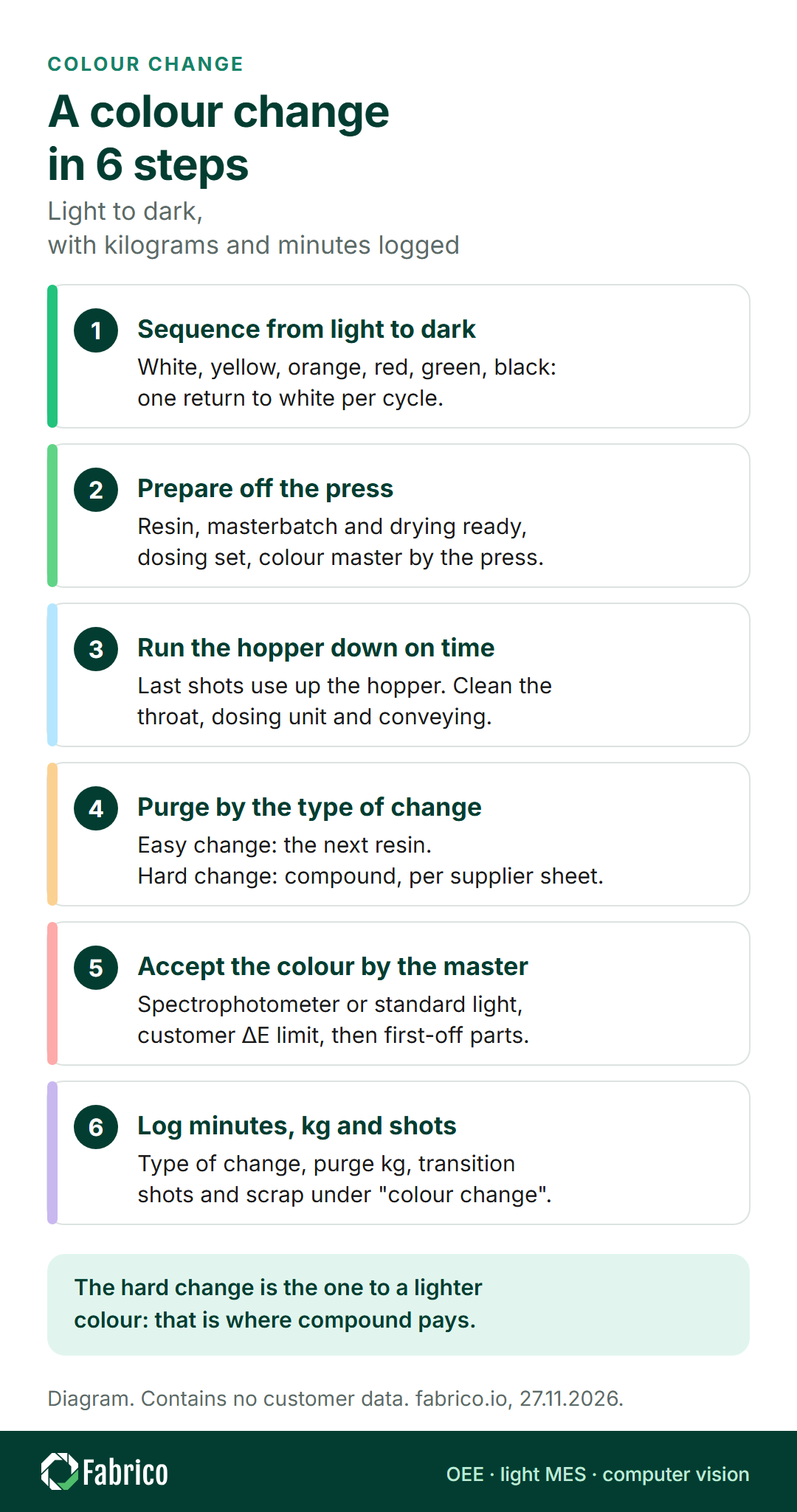
Text version of the diagram
- Sequence from light to dark: white, yellow, orange, red, green, black, with one return to white per cycle.
- Prepare off the press: resin, masterbatch and drying ready, dosing set, colour master by the press.
- Run the hopper down on time: the last shots use up the hopper; clean the throat, dosing unit and conveying.
- Purge by the type of change: the next resin for an easy change, compound per the supplier's sheet for a hard one.
- Accept the colour by the master: spectrophotometer or standard light, the customer's ΔE limit, then first-off parts.
- Log minutes, kg and shots: type of change, purge kg, transition shots and scrap under "colour change".
Frequently asked questions
How much does a colour change cost in injection moulding?
It is the kilograms of purge and transition parts at the material price, plus the minutes without good parts at what a minute is worth. In the 16-cavity example at EUR 1.00/min it costs from EUR 35.92 for an easy change to EUR 141.52 for a hard one.
How do you purge the screw for a colour change?
With the nozzle retracted, using the next resin when going darker or a purging compound when going lighter. With a compound, keep to the temperature, screw speed and soak time on the supplier's sheet, then flush the compound out with base resin.
When does a purging compound pay for itself?
When the kilograms, shots and minutes it saves on a hard change are worth more than the compound. In the example it pays up to about EUR 27.69/kg on a full press and EUR 14.73/kg on a press with spare time.
Why is changing from a dark to a light colour harder?
A little dark residue shows clearly in a light part, while light residue disappears into a dark one. The residue hides in the screw flights, around the check ring, in the nozzles and in the dead spots of the hot runner.
How many shots does it take until the colour is clean?
There is no general number: it depends on the hot runner's volume and design, the pigment and the method. Measure it for each class of change and stop against the master and a ΔE limit agreed with the customer, not by eye.
How much material is lost in a colour change on a film line?
The logic is the same: kilograms from the moment the hopper changes to film in tolerance, plus the minutes. Measure residual colour with an instrument rather than by eye, and sequence colours from light to dark.
Are there special purging rules for beverage closures?
Regulations (EC) No 1935/2004, (EU) No 10/2011 and (EC) No 2023/2006 set no purging procedure. But they do require good manufacturing practice, a documented quality system and a declaration of compliance. Ask the compound supplier for a statement on use with food contact parts, and check with a lawyer.
See what colour changes cost on your presses. The demo shows OEE by machine and shift, changeovers against a standard time and scrap by reason, priced in EUR.
Latest from our blog







Real Fabrico tiles, sample data.