








 Login
 Blog
TeepTrak Alternatives, and Fabrico vs TeepTrak, From Each Vendor's Own Words (2026)

TL;DR
The TeepTrak alternatives worth comparing include Fabrico, FourJaw, MachineMetrics and Tulip, and each gets machine data in a different way and covers a different scope after the stop. Fabrico is our product, so it is not ranked. It fits plants that want OEE and a light MES with maintenance built in, in one system, and the table below shows what each vendor's own site says next to TeepTrak.
- TeepTrak is OEE software built around plug-and-play sensors and an operator tablet. In its words, it "captures every stop on every machine, lets operators qualify the cause in two taps, and gives the whole plant one OEE number to trust."
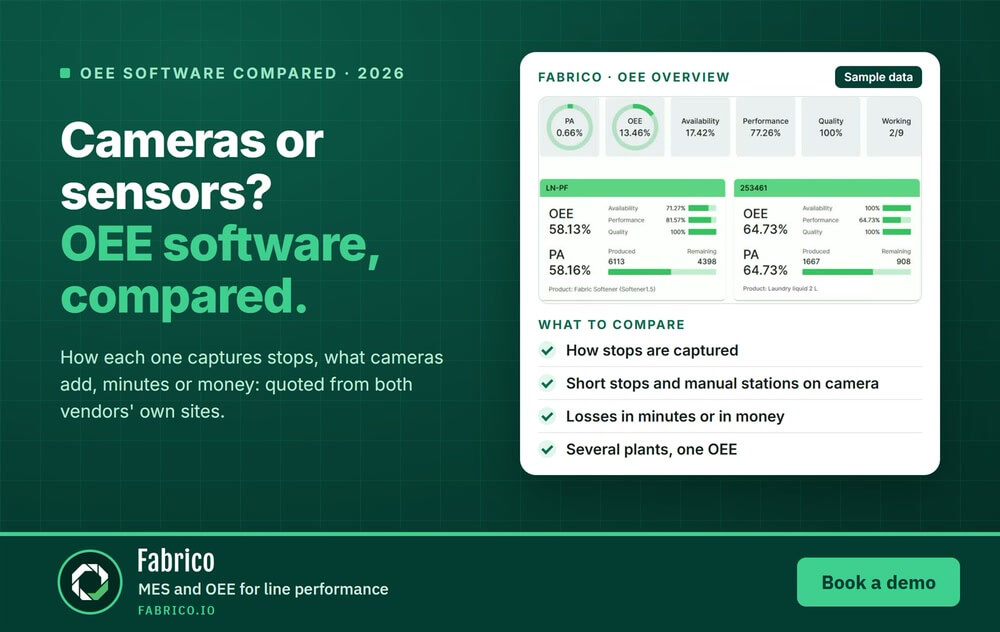
- Fabrico (our product) is a cloud-based OEE and light MES platform where PLC connections, IoT devices and AI cameras (an add-on) feed one OEE calculation, every loss is priced in money, and the same OEE runs in every plant of a group.
- The biggest differences are how a stop is captured (from the machine signal or added sensors, with AI cameras (an add-on) counting output at stations with no signal), whether a loss is shown in minutes or in money, and whether the repair happens in the same system. TeepTrak connects to the maintenance system you already have; in Fabrico, maintenance is built in.
- Every TeepTrak statement below is quoted from teeptrak.com, checked on 28 October 2026, with links. Fabrico is our product.
- Start on one representative line and ask both vendors to show you where that line loses capacity.
Do you know where your lines lose capacity, and what each lost hour costs? Both TeepTrak and Fabrico are built to answer that question, and both start from the machine instead of a spreadsheet. They differ in how much of the line they see, and in what the number means once you have it.
TeepTrak publishes its own page on Fabrico alternatives. This page is the other side of that question: a factual comparison built from both vendors' own words, with the trade-offs left in. For the camera side of OEE, read our guide to computer vision for OEE.
What TeepTrak does, in its own words
TeepTrak is a Paris company whose homepage headline is "See what your machines are really doing". It describes itself as "OEE-first, with JEMBA AI for root cause analysis trained on 700+ factories" (source).
- Data capture: "Plug-and-play sensors connect any make or model in under an hour. No PLC work, no production stop." Its product page lists "Any machine, any age, PLC signal, sensor or OPC UA, no PLC changes" (PerfTrak).
- Stop reasons: "Operators tag the cause in two taps on the workstation tablet, using your own loss tree."
- AI: "JEMBA AI analyzes stop patterns to point teams to the root causes behind lost OEE, and MoniTrak gives leadership a consolidated multi-site view" (source).
- Several plants: "The platform consolidates indicators from multiple lines and plants into multi-site dashboards" (FAQ).
- Speed: "Plants typically see live data within 48 hours of installation." and "Full multi-line deployment usually completes within 2 to 4 weeks" (source).
- Scope: "OEE software focuses on measuring and improving equipment effectiveness. Many plants start with OEE software to get fast, objective data on losses, then connect it to an MES or ERP later."
TeepTrak alternatives compared
This table shows what each vendor's own site says, in our words, checked on 4 November 2026. It is not a rank: we sell Fabrico, so it is not ranked. Something missing from a site says nothing about what a product can do, so ask each vendor directly.
| Vendor | Per its own site | Source, checked 4 November 2026 |
|---|---|---|
| TeepTrak (for reference) | Stops: plug-and-play sensors; a PLC signal, an external sensor or OPC UA; operators tag the cause in two taps on the workstation tablet Several plants: multi-site dashboards After the stop: stop events and machine signals can feed a CMMS To start: a 90-day guided pilot on one line | PerfTrak, FAQ, pilot |
| Fabrico (our product) | Stops: the PLC or a Fabrico IoT device with sensors; short stops included; the reason on a tablet or phone; AI cameras (an add-on) count output at stations with no machine signal Several plants: a group view of all plants, with cross-plant reports After the stop: maintenance built in; a work order is opened from the stop in one step, linked to the line; each loss shown in lost revenue and profit To start: a demo with a Fabrico consultant | Machine connectivity, multi-site |
| FourJaw | Stops: its own Machinelink hardware, a sensor clipped around a cable, without needing PLC access; the reason picked from a predefined list Several plants: every machine, shift, line and site from one connected system After the stop: alerts on downtime periods that allow proactive maintenance actions To start: a demo with its sales team | fourjaw.com, downtime, alerts, demo |
| Evocon | Stops: sensors and inputs from production; units counted through its IIoT device and/or a PLC; operators log downtime events with categories Several plants: centralised, real-time monitoring across all factories After the stop: shares data with ERP, CMMS and other systems through its API | evocon.com, production monitoring, downtime, enterprise |
| MachineMetrics | Stops: from machine controllers, or sensors and IO adapters on older equipment; detected with no operator input and no minimum duration; reasons assigned by a rules engine Several plants: every plant in one live view After the stop: feeds a CMMS to create work orders automatically, with Fiix and MaintainX integrations To start: a demo with its team | Connect, downtime, CMMS, demo |
| Tulip | Stops: native OPC UA and MQTT connections and edge devices, inside no-code apps Several plants: scale across lines and sites, with the instance segmented by site After the stop: equipment logbooks where the next preventive work order opens on its own when due To start: a custom platform demo, or a virtual tour | OEE tracking, scalability, logbooks, demo |
Which alternative fits which plant
Read each vendor's own pages, then test the one or two that fit on a real line. As a first sort:
- Machine data with no PLC work: FourJaw and TeepTrak both lead with clip-on or plug-and-play sensors.
- CNC controllers and discrete shops: MachineMetrics connects directly to machine controllers.
- Building your own apps and work instructions: Tulip is a no-code platform.
- OEE, light MES and maintenance in one system, with every loss in money: Fabrico.
What Fabrico does
Fabrico is a cloud-based OEE and light MES platform, with computer vision as an add-on. It shows where your lines lose capacity, live by line and shift, with stops and the causes operators tag.
- OEE: availability, performance and quality per machine, line and shift, on a real-time OEE dashboard. Every plant uses the same OEE calculation, so lines and sites can be compared like for like.
- Data capture: Fabrico reads PLCs, adds IoT sensors or uses AI cameras (an add-on) to count output where sensors can't reach. Which option fits each machine, a PLC connection, an IoT device or an AI camera (an add-on), is agreed with the Fabrico team before installation. One plant can mix all three.
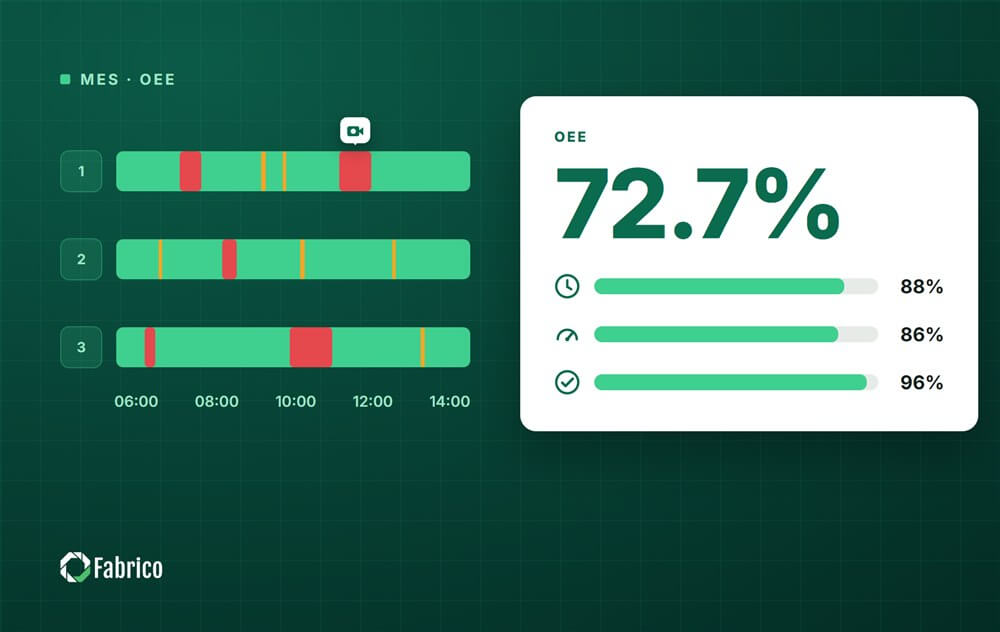
- Cameras: AI cameras (an add-on) count output at stations with no machine signal, and you can open the camera view for any moment on the timeline; in the standard setup, the video is streamed, not stored in Fabrico. Details on the computer vision page.
- Money: each downtime event, slowdown, changeover and reject is valued in lost revenue and lost profit, in real time, with your own prices and margins.
- Light MES: machine data collection, production monitoring, OEE and downtime analytics, and a connection to SAP or another ERP that can be scoped per customer. Job dispatching, BOMs, routings and genealogy stay in your ERP. Read more in our guide to light MES.
- Groups: each plant keeps its own view and head office sees all of them together.
- Maintenance: maintenance management (CMMS) is built into the same platform, so a stop that needs a repair becomes a work order on the same machine record.
- Rollout: installing and connecting the devices on your machines takes about one month. Configuration, data checks and training follow, and the full rollout is complete in 3 to 4 months.
Fabrico and TeepTrak at a glance
| TeepTrak | Fabrico | |
|---|---|---|
| Built around | OEE measurement with plug-and-play sensors and JEMBA AI | OEE and light MES, with every loss priced in money |
| How stops are captured | Clip-on sensors, PLC signal or OPC UA, plus an operator tablet | PLC connection, IoT device or AI camera (an add-on) per machine, mixed in one plant |
| Cameras | Its product pages describe sensors, PLC signals, OPC UA and the operator tablet; one TeepTrak comparison article lists "vision-based cycle counting" | AI cameras (an add-on) count output at stations with no machine signal; the camera view opens for any moment on the timeline |
| Stop reasons | Operator taps the cause on the tablet | Operators tag reasons in a few taps; where AI cameras (an add-on) are installed, you can open the camera view for that moment |
| How losses are shown | OEE points and time; money in its ROI calculator and case results | Each loss in lost revenue and lost profit, live, with your own prices and margins |
| Several plants | Multi-site dashboards (MoniTrak) | Group view, same OEE calculation in every plant |
| MES scope | OEE software that can feed an MES or ERP | Light MES next to the ERP |
| Time to data | "Live data within 48 hours of installation" | Devices installed and connected in about one month, full rollout in 3 to 4 months |
| Maintenance (CMMS) | Its modules integrate with most ERP, MES, CMMS and Power BI applications; stop events and machine signals can feed a CMMS | Built in: a technician opens a work order from the stop, on the same machine record |
Cameras: counts where there is no machine signal
Sensors see whether a machine runs. They do not always see a line that is switched on but not producing, a short stop that never reaches the shift report, or a packing station with no machine signal at all.
On the TeepTrak product pages we checked, data comes from sensors, PLC signals, OPC UA and the operator tablet. One TeepTrak comparison article lists "vision-based cycle counting" among its sensor options, and its article on computer vision describes vision as a separate, targeted "vision-based defect detection investment" on the lines with the highest quality losses (source).
In Fabrico, AI cameras (an add-on) count output at stations that give no machine signal, such as manual assembly or packing, so those stations get counts and OEE too. Stops and their duration come from the machine signal where there is one, and operators add the reason. For any moment on the timeline you can open the camera view to see what happened; in the standard setup, the video is streamed, not stored in Fabrico.
Losses in minutes, or in money
TeepTrak frames results in OEE points, for example "Gains depend on the starting point, but improvements of 10 to 30 points are documented on lightly instrumented lines" in its FAQ, and turns them into money in its ROI calculator, which asks for a "Cost per machine-hour". Its FAQ advises justifying the investment with "the measured OEE, the quantified losses and the recoverable capacity, translated into financial value."
Fabrico prices the loss itself. Each downtime event, slowdown, changeover and reject is valued in lost revenue and lost profit as it happens, and losses are ranked by recoverable value, each with evidence, an owner and a next action. Every closed action is checked against production data, so recovered output and profit are measured, not assumed.
Several plants, one OEE
TeepTrak offers multi-site dashboards through MoniTrak; in its words, "MoniTrak delivers this visibility for groups of 2 to 200+ sites in real time" (source).
Fabrico is built for groups: each plant keeps its own view, head office sees all of them together, and cross-plant reports compare machines and lines between sites. Because every plant uses the same OEE calculation, a group can compare lines like for like and see the financial impact of every improvement effort across all sites.
Where maintenance fits
Once a stop is found and priced, someone has to fix it. TeepTrak states its approach itself: "Integrates with existing CMMS platforms via API, maintenance alerts from JEMBA can trigger work orders in your existing CMMS (SAP PM, IBM Maximo, UpKeep, Limble, etc.)" (source). That is a sound design if your plant already runs a maintenance system it wants to keep.
In Fabrico the stop and the repair sit in one record. When a stop needs a repair, a technician opens a work order from the stop, on the same machine record, and the repair time counts toward that machine's MTTR and MTBF. A plant that already has a maintenance system can still start with the MES and OEE module; how the two exchange data is confirmed by the Fabrico team.
How TeepTrak describes Fabrico
TeepTrak's own summary: "Fabrico ties OEE to a built-in CMMS for maintenance execution; TEEPTRAK leads with non-invasive OEE measurement, AI analytics and cross-plant benchmarking" (source).
The built-in maintenance part is right. What that summary leaves out is where Fabrico starts: production. Fabrico leads with OEE by availability, performance and quality, live by line and shift, with the stop reasons operators tag, AI cameras (an add-on) that count output where sensors can't reach, and the same OEE calculation in every plant of a group. Maintenance is the part that closes the loop.
Which one fits your plant
- TeepTrak fits a plant that wants a sensor box on each machine and a tablet at each workstation quickly, and that plans to keep a separate maintenance system. In its own words, where maintenance execution is the priority, "TEEPTRAK complements it rather than replacing it."
- Fabrico fits a plant or group that has short stops, slow running or manual stations sensors do not see; that wants each loss priced in money and compared across plants; that wants a light MES next to its ERP without a full MES project; and that wants the stop, its cause, its cost and the repair in one system.
How to start: one line, four questions
Whichever vendor you talk to, test it on one representative line and ask the same four questions:
- Where does this line lose capacity? Availability, performance and quality, by shift.
- Show me on our own data. Not a sample dashboard: this line, this week.
- Walk the line with us. A gemba walk with the data in hand, at the machine.
- Name the root cause and what it costs. The stop, the reason, the money, and who fixes it.
FAQ
How does Fabrico measure OEE?
OEE = availability x performance x quality, per machine, line and shift, on a real-time OEE dashboard. Data comes from a PLC connection, an IoT device or an AI camera (an add-on), and every plant uses the same calculation.
Does Fabrico use cameras?
Yes, where they fit: AI cameras (an add-on) count output at stations with no machine signal, and you can open the camera view for any moment on the timeline; in the standard setup, the video is streamed, not stored in Fabrico. Which option fits each machine, a PLC connection, an IoT device or an AI camera (an add-on), is agreed before installation.
Is Fabrico a full MES?
Fabrico is a light MES: machine data collection, production monitoring, OEE and downtime analytics, and a connection to SAP or another ERP that can be scoped per customer. Job dispatching, BOMs, routings and genealogy stay in your ERP.
Can TeepTrak work with our maintenance system?
Yes, in its own words: its modules integrate with most ERP, MES, CMMS and Power BI applications, and the stop events and machine signals it reports can feed a CMMS (source).
Can Fabrico work with the maintenance system we already have?
Yes. A plant that already has a maintenance system can start with the MES and OEE module; how the two exchange data (REST API, webhooks or a custom integration) is confirmed by the Fabrico team.
How can we see Fabrico?
In a demo with a Fabrico consultant, on a demonstration plant with lines like yours. There is no trial account.
What are the main TeepTrak alternatives?
Fabrico, FourJaw, MachineMetrics and Tulip all describe OEE or production monitoring on their own sites. They differ in how machine data gets in and in what happens after a stop; the table above sets them side by side.
Which TeepTrak alternative has maintenance built in?
Fabrico has maintenance (CMMS) built in, on the same machine data. Tulip describes equipment logbooks where the next preventive work order opens when due, and MachineMetrics feeds a CMMS to create work orders, with Fiix and MaintainX integrations.
Which TeepTrak alternatives work without a PLC connection?
FourJaw clips a sensor around a cable without PLC access, and MachineMetrics connects older equipment through sensors and IO adapters. Fabrico fits a Fabrico IoT device with external sensors, or uses AI cameras (an add-on) to count output on manual stations.
Sources
TeepTrak pages, all checked on 28 October 2026:
- teeptrak.com/en/ (homepage)
- teeptrak.com/en/perftrak/
- teeptrak.com/en/faq/
- teeptrak.com/en/best-oee-software-2026/
- teeptrak.com/en/teeptrak-vs-tractian-2026/
- teeptrak.com/en/tractian-alternative-2026/
- teeptrak.com/en/redzone-alternative/
- teeptrak.com/en/teeptrak-vs-tractian-oee-predictive-maintenance/
- teeptrak.com/en/maintainx-alternative-oee-software-2026/
- teeptrak.com/en/ai-ml-defect-detection-computer-vision-2027/
- teeptrak.com/en/best-fabrico-alternatives-2026/
Fabrico: MES and OEE solution overview, computer vision, light MES.
See where lines like yours lose capacity. Book a demo or contact us.
Related articles




Latest from our blog




Real Fabrico tiles, sample data.