





 Login
 Blog
Humidity and temperature in the packing hall: do they stop the line?

In short
- Test first, buy cooling later: 4 weeks of a temperature and humidity logger at the machine, one reading every 15 minutes, next to stop minutes for every hour.
- When the gap is real: at least 2 more stop minutes per hour in the hot hours, in 3 of 4 weeks. The gap rises with temperature and is absent in the same hours of a cool month.
- Count or duration: if the number of stops rises, look at material and glue. If each stop lasts longer, look at people and breaks.
- Example in EUR: 5.6 extra stop minutes per hot hour on a case packer cost 604.80 EUR a day, 13,305.60 EUR a month and about 39,900 EUR a summer.
- Price ceiling: each fix (glue, material conditioning, board grade, zone cooling) is worth at most what it removes from that sum.
Heat and humidity can stop a packing line, but not always and not on every machine. Before you pay for air conditioning, test it for 4 weeks. You need a logger for temperature and relative humidity at the machine, one reading every 15 minutes, and stop minutes by hour.
If the machine stops clearly more in the hot hours, and not in the same hours of a cool month, the climate is the cause. Then put a price on it in EUR, and only then ask for quotes.
The method fits food, confectionery, snack and FMCG lines: cartoners, case packers, flow wrappers and labellers. It also covers the opposite problem: dry air in a heated hall in winter.
Which materials and machines react to heat and humidity
The climate does not stop a machine on its own. It changes the material, the glue or the product. The machine stops because feeding, folding or gluing no longer match settings that were made in a different climate.
| Material or unit | What changes | What you see on the line |
|---|---|---|
| Corrugated cases | Absorb moisture, lose strength, warp | Blank feed jams, cases out of square, crushed bottom layers |
| Folding cartons | Warp when store and hall humidity differ; crack at the creases in dry air | Magazine misfeeds, cartons that fail to open |
| Hot-melt glue | Stays open longer in heat; sets too early on cold board | Flaps pop open after compression, cases for rework |
| Film | Builds static charge in dry air | Film clings, print out of register, crumbs in the seal |
| Chocolate and fat-based fillings | Soften in a warm hall | Smearing on guides and pushers, jams |
| Labels | Paper curls, adhesive grabs differently | Creased or missing labels |
| Drives and control cabinets | Cabinet cooling falls short | Fault trips in the afternoon |
How much strength a case loses in humid air
The strength values on a case specification are measured at 23 °C and 50% relative humidity. That is the standard atmosphere for testing paper and board under ISO 187:2022 (current standard per the BSI catalogue, accessed 26.11.2026). Your store in July may not be at those conditions.
A climate-chamber study of six corrugated board grades (Mrówczyński et al., Applied Sciences, 2024, accessed 26.11.2026) shows how fast edge crush strength (ECT), the main input to box strength, falls. For E-flute board at 20 °C it is:
- 98% of the standard value at 50% humidity;
- 85% at 70%;
- 64% at 80%;
- 36% at 90%.
The authors found ECT the most sensitive of the properties tested: across the chamber range (10-60 °C, 30-90% humidity) it varied from about 20% to 140% of the standard-atmosphere value. The plant takeaway is simple: a case that spent the night in an unheated store at 85% humidity is not the case on the specification.
Static in dry air
The EOS/ESD Association table of typical charge levels (accessed 26.11.2026) shows the humidity effect. A polyethylene bag picked up from a bench reaches about 20,000 V at 10-25% relative humidity and about 1,200 V at 65-90%.
Winter delivers exactly that dry air. Outdoor air at 0 °C and 80% humidity, heated to 20 °C inside the hall, drops to about 21% relative humidity. That is why film and labels cause trouble in January too, when heat is not the issue.
Glue, chocolate and labels
There is no general table for these: it depends on the glue grade, the recipe and the paper. Ask the supplier for the data sheet and check two lines. First, how long the glue stays open at your hall temperature at 3 pm. Second, at what board temperature that open time was measured.
For chocolate and fat-based products, compare the product temperature at infeed with the temperature at which the machine was set up. If the settings date from March and it is now July, the guides and pushers are handling a different product.
How to log the hall climate properly
A hall without cooling follows the season. In Bulgaria, mean monthly temperatures in towns were mostly 4-10 °C in March 2026 and 18-26 °C in July 2026.
In Plovdiv the July mean was 25.2 °C and the maximum 35.9 °C (NIMH monthly bulletin for July 2026 and for March 2026, Bulgaria's National Institute of Meteorology and Hydrology, accessed 26.11.2026).
The hall average says little, though. What matters is the temperature where the material and the glue do their work, in the hour the machine stops.
Where to put the loggers
- At the machine: about 1.5 m high, near the material infeed or the glue head, in the shade and at least 1 m from a hot cabinet or motor.
- In the material store: where cases and film wait before the line. This shows the moisture the material carries with it.
- Outdoors (optional): in the shade, on the leeward side of the building, at least 2 m from the wall and 1.5 m high. That is how the Bulgarian microclimate ordinance measures outdoor temperature. Data from the nearest weather station can replace it.
Keep loggers away from the dock door, direct sun through a window and the outlet of a cooling unit. Otherwise you measure the door, the sun or the cooler, not the spot where the machine works.
Every 15 minutes, on the right clock
- 15-minute interval: 4 readings an hour are enough for an hourly mean and maximum. Over 4 weeks that is about 2,700 readings per logger.
- Check before you start: put the loggers side by side for a day. If they disagree by more than 1 °C or 5% humidity, replace one.
- The clock: match it to the clock your stop log uses. Many loggers stay on winter time or UTC: a 1-3 hour offset shifts the whole analysis.
What else to note
- Batch and supplier of cases, cartons and film, and when each pallet entered the hall.
- Open dock doors, washdowns, oven or cooling tunnel start-ups and shutdowns.
- The product and the crew for every hour.
- Breaks and operator swaps in the hot hours.
The logger serves a production decision. In Bulgaria, the official workplace microclimate measurement uses instruments that meet the Measurements Act. It is done at least 3 times a day on 2 consecutive days, in both the warm and the cold season. One does not replace the other.
How to join the climate with stops by hour
The goal is one table: for every running hour, temperature, humidity and stop minutes for one machine. It can live on paper, in a spreadsheet or in a stop-tracking system.
If the line already runs MES for snack food manufacturing or another system that logs stops with start and end times, half the work is done.
- Pick one machine. The one that stops most in summer. Do not measure the whole line at once.
- Collect 4 weeks in the warm season and 1-2 weeks in a cool period. The cool period is your control. A cool spell in the same month works too: the NIMH bulletin for July 2026 lists 22-25 July as relatively cold, after the warm spell of 15-21 July.
- Remove time that is not production. Planned stops, changeovers, cleaning and no-order time are out. Keep only the hours when the machine was meant to run.
- Calculate stop minutes per running hour. For each hour: unplanned stop minutes divided by running hours. Note the number of stops separately.
- Put each hour in a band. By mean logger temperature: below 24 °C, 24-26, 26-28, 28-30 and above 30 °C. By humidity: below 35%, 35-55%, 55-70% and above 70%.
- Draw the heat map. Rows: days. Columns: hours from 6 am to 10 pm. Each cell holds stop minutes, shaded from green to red. Next to it, the same grid shaded by temperature. If the red patches overlap, you have a lead.
- Compare hot hours with cool hours. More important: compare July's hot hours with the same clock hours in the cool month. That strips out the afternoon crew, the 2 pm washdown and the products that run in the afternoon.
When the gap is real
The rules below belong to this method. They stop you from buying cooling because of one bad week.
- Size: at least 2 more stop minutes per hour in the hot hours, or double the cool-hour figure.
- Repeat: the gap shows in at least 3 of 4 weeks.
- Step by step: minutes rise with each hotter band instead of jumping in just one.
- Control: the gap is absent in the same hours of the cool month.
- Reasons: in the hot hours, the share of 1-2 reasons tied to material, glue or product grows.
- Volume: at least 30 running hours in each band. Otherwise one long stop skews the whole cell.
Count or duration: material or people
Split stop minutes into two parts: stops per hour and average minutes per stop. They point to different causes.
- The count rises: the machine stops more often. Look at the material, the glue, the product.
- The duration rises: stops are as frequent as before but take longer to clear. Look at people: fatigue, breaks with no relief, one operator covering two machines.
Both can rise. Then the fix is twofold too: material and glue for the count, climate and break planning for the duration. Short stops have their own article on micro-stops.
Traps that fake a link
- The logger runs on winter time and the hot hours are shifted by one.
- A new batch of cases arrived in the same week the heatwave started.
- Different products run in the afternoon, for example the chocolate lines.
- The 2 pm crew change and the washdown fall right in the hot hours.
- A major repair or a new operator in July that the control month did not have.
Worked example: a case packer, July vs March
These numbers are an example, not customer data. A biscuit line: a flow wrapper at 180 packs per minute, 24 packs per case, cases closed with hot melt.
Two shifts, 6 am to 2 pm and 2 pm to 10 pm, 22 working days a month. The case packer is last in line with a small buffer: when it stops, the line follows soon after.
The logger shows above 28 °C at the machine between noon and 6 pm on every working day in July, about 30 °C on average in those hours. In March the hall sits at 18-22 °C all day.
| Measure | March, 12-18 h | July, 12-18 h | Gap |
|---|---|---|---|
| Temperature at the machine | about 21 °C | about 30 °C | +9 °C |
| Stops per running hour | 1.0 | 2.0 | +1.0 |
| Minutes per stop | 3.4 | 4.5 | +1.1 |
| Stop minutes per hour | 3.4 | 9.0 | +5.6 |
| of which: glue, flaps open | 0.4 | 3.4 | +3.0 |
| of which: blank feed | 0.5 | 2.4 | +1.9 |
| of which: other reasons | 2.5 | 3.2 | +0.7 |
The checks pass. In July's cool hours (6 am to noon and 6 pm to 10 pm) the machine stops 3.5 minutes per hour against 3.1 in March. A 0.4 minute gap is noise.
The 5.6 minute gap sits only in the hot hours and grows with each band above 28 °C. Almost all of it falls in two reasons, glue and blank feed. Both the count and the duration rise.
Blank feed points to the store, not the hall. The store logger shows 75-85% humidity at night: the cases take up moisture, and in the hot, drier hall the top blanks warp.
The sum in EUR
Value of a minute: 180 packs × 0.10 EUR margin per pack = 18 EUR per minute of lost output. To work out your own, see cost of downtime per minute.
- Extra minutes per hot hour: 9.0 - 3.4 = 5.6 minutes.
- Shift 1 (2 hot hours, noon to 2 pm): 2 × 5.6 = 11.2 minutes × 18 EUR = 201.60 EUR per shift.
- Shift 2 (4 hot hours, 2 pm to 6 pm): 4 × 5.6 = 22.4 minutes × 18 EUR = 403.20 EUR per shift.
- Per day: 33.6 minutes = 604.80 EUR.
- Per month: 33.6 × 22 days = 739.2 minutes × 18 EUR = 13,305.60 EUR.
- Per summer: July and August as in the example, June and September at half, 3 months in total × 13,305.60 EUR = 39,916.80 EUR. The other months show no gap, so this is also the yearly figure.
The same sum by reason:
- glue costs 3.0 × 6 hours × 22 days × 18 EUR = 7,128 EUR a month;
- blank feed 1.9 × 6 × 22 × 18 = 4,514.40 EUR;
- other reasons 0.7 × 6 × 22 × 18 = 1,663.20 EUR.
The total is again 13,305.60 EUR. These three figures are the ceilings for the fixes in the next section.
For how these minutes feed availability and the machine's overall OEE, see case packer OEE. The line itself has its own article on OEE for biscuit production lines.
The fixes side by side: cost and ceiling
Every fix has a cost and removes only part of the gap. Compare the cost with the ceiling: what the reason it removes is worth. If a quote is above the ceiling, the fix does not pay, however good it sounds.
| Fix | What you pay | Ceiling in the example | Pick it when |
|---|---|---|---|
| Slower case packer in the hot hours | Nothing if it is faster than the line; otherwise lost output | Up to 7,128 EUR a month | First step, 1-week trial |
| Different hot melt or glue settings | The glue price difference | 7,128 EUR a month | The gap is in "flaps open" |
| Material conditioning | Floor space near the line, strict first in, first out, pallets wrapped until use | 4,514.40 EUR a month | The gap is in blank feed, the store is humid |
| Stronger board grade | A premium per case | 0.032 EUR per case | Cases sit above 80% humidity |
| Zone cooling at the line end | The quote plus power: 241.12 EUR a month | About 39,000 EUR for the first summer | Above 28 °C daily, count and duration both rise |
| Sensitive products in the cool hours | More changeovers | The share of those products | Chocolate and fat-based products |
How the ceilings are worked out
- Slower machine: lower speed gives the glue more time under compression. If the case packer is the slowest machine on the line, each 1% of speed costs output. Over the 6 hot hours that is 6 × 60 × 1% = 3.6 minutes of output a day, or 64.80 EUR. If it runs faster than the line, the cut is free.
- Stronger board: the line fills 7.5 cases a minute, about 140,000 cases a month at about 19,000 running minutes. The blank-feed ceiling is 4,514.40 / 140,000 = 0.032 EUR per case. If the new board removes the whole gap, the ceiling is 13,305.60 / 140,000 = 0.095 EUR.
- Zone cooling: say the contractor offers 40 kW of cooling capacity with an efficiency ratio of 3 (check it in the quote). The unit draws about 13.3 kW. For 6 hours × 22 days that is 1,760 kWh a month × 0.137 EUR = 241.12 EUR.
- Power price: 0.137 EUR/kWh excluding VAT for non-household consumers in Bulgaria using 2,000-19,999 MWh a year, first half of 2026 (Eurostat, nrg_pc_205, accessed 26.11.2026). Use the price on your own bill.
- Cooling payback: power for 3 months is 723.36 EUR. If cooling removes the whole gap, a quote below 39,916.80 - 723.36 = 39,193.44 EUR pays back in one summer. If it removes half, the ceiling halves.
The order follows the cost: free first (speed), then cheap (glue, storage), then expensive (board, cooling). Every cheap fix that works lowers the ceiling for the expensive ones.
The people side: what the law requires in Bulgaria
Heat is also a people problem. At 31 °C an operator reacts more slowly, breaks come more often and the line waits. That is why climate and breaks belong in the same sum.
Limits under Ordinance No. RD-07-3 of 2014
Bulgaria's Ordinance No. RD-07-3 of 18.07.2014 on minimum requirements for workplace microclimate (lex.bg, accessed 26.11.2026) sets:
- Optimal in the warm season (air-conditioned rooms): 22-25 °C for light and 20-23 °C for moderate physical work, humidity 40-60%.
- Maximum at a permanent workplace: 28 °C for light and moderate work, 26 °C for heavy work.
- On hot days (light and moderate work): when it is above 25 °C outdoors at 2 pm, the maximum rises by 3 °C, capped at 31 °C, in rooms with low heat load. With high heat load, it rises by 5 °C, capped at 33 °C.
- Summer humidity: 30-55% when the room is above 28 °C and 30-75% at 24 °C or below.
A case packer operator stands, walks and carries up to 10 kg. Under the ordinance that is moderate physical work. The 28 °C threshold in the example is also the legal maximum for that workplace on an ordinary summer day.
Measures and breaks
When the limits are not met, the employer must act: air conditioning, ventilation, screens, breaks of suitable frequency, rest areas and enough drinking water. If that is not enough, physiological work and rest regimes follow under Ordinance No. 15 of 31.05.1999 (lex.bg, accessed 26.11.2026):
- total break time up to 10-15% of working time under moderate load;
- at least 2 breaks in an 8-hour shift;
- each break no shorter than 5-10 minutes and no longer than 30 minutes;
- frequent short breaks are preferred to rare long ones.
For the line the conclusion is direct: plan relief cover for breaks in the hot hours. Otherwise every break stretches the stops and raises the duration in your analysis.
The European Agency for Safety and Health at Work (OSHwiki, accessed 26.11.2026) notes that heat lowers concentration and productivity and raises the risk of workplace injuries, indoors as well.
Among the measures the agency lists: insulating or separating heat-producing machinery, shading windows, cool drinking water (10-15 °C) close to the work area and planning heavy work for cooler hours.
Summers are not getting easier. The Copernicus European State of the Climate report for 2024 (Copernicus, ESOTC 2024, accessed 26.11.2026) counted 66 days of strong heat stress (feels-like temperature of 32 °C or more) in southeastern Europe, against an average of 29. It also counted 23 tropical nights, against an average of 8.
Decision: what to pick and what to ask
After the 4 weeks you are in one of four cases.
- No real gap: the climate is not the cause. Do not buy cooling for the line. Go back to the biggest reasons in your stop table.
- Gap in 1-2 material or glue reasons, the count rises: first a slower machine in the hot hours, glue and material conditioning. They are cheap and can be checked in a week.
- Gap mainly in duration: relief cover for breaks, ventilation or spot cooling at the workplace, a break regime.
- Above 28 °C daily, count and duration both rise, the sum is large: zone cooling at the line end plus material conditioning. Get quotes and hold them against the ceiling.
Questions for the cooling contractor
- What temperature and humidity will the machine see, not the hall average, at 3 pm on a 38 °C day?
- Did you count heat from the machines, the oven and the people, or only from the building?
- Will the unit dry the air or only cool it? What humidity will the zone have?
- How many kWh will it use in the 6 hot hours on the plant's shift pattern, and what does maintenance cost a year?
Questions for the case and glue supplier
- What is the case ECT at 23 °C and 50%, and at 80-90% humidity?
- How should the pallets be stored, and how many hours before use should they enter the hall?
- What is the glue open time at 30-35 °C, and is there a grade for hotter conditions?
The diagram: the 4-week test on one card
The diagram puts the method into 6 steps. Give it to the engineer who places the loggers and to the shift lead who logs the stops.
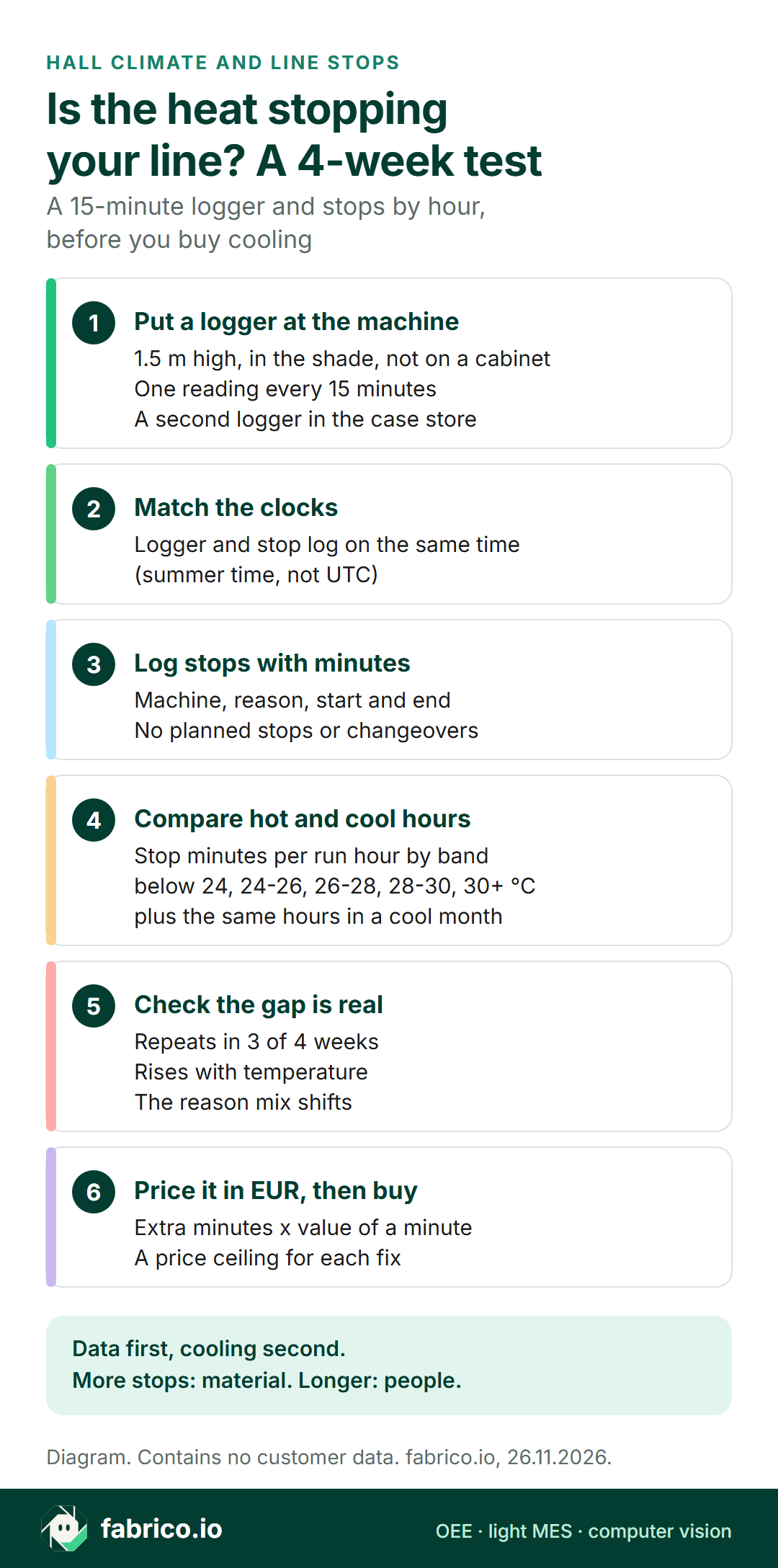
Text version of the diagram
- Put a logger at the machine: 1.5 m high, in the shade, not on a cabinet; one reading every 15 minutes; a second logger in the case store.
- Match the logger clock to the clock of your stop log (summer time).
- Log stops with minutes: machine, reason, start and end; leave out planned stops and changeovers.
- Compare hot and cool hours: stop minutes per running hour by band below 24, 24-26, 26-28, 28-30 and above 30 °C, plus the same hours in a cool month.
- Check the gap is real: it repeats in 3 of 4 weeks, rises with temperature, and the reason mix shifts.
- Price it in EUR before you buy: extra minutes times the value of a minute; a price ceiling for each fix.
Where Fabrico fits
Fabrico is an OEE platform and light MES. It logs stops by machine and reason, shows stop minutes split by hour, shift and day, and ranks stops by financial impact in EUR. Output comes from the line PLC, a Fabrico IoT device, or a camera where a machine has no signal.
In this method the hall temperature and humidity come from a separate logger, and the comparison is made by matching the logger's hours with the stop minutes for each hour. See availability tracking and equipment downtime tracking software.
Frequently asked questions
At what hall temperature do line stops start to rise?
There is no general threshold: it depends on the glue, the board and the product. That is why you find it with a logger and stops by hour. In the example the gap starts above 28 °C at the machine, which is also the legal maximum in Bulgaria for moderate work on an ordinary day.
How long does the logging need to run to be sure?
At least 4 weeks in the warm season plus 1-2 weeks in a cool period as a control. The gap should repeat in 3 of 4 weeks, with at least 30 running hours in each temperature band.
Which matters more, temperature or humidity?
It depends on the material. Humidity decides for corrugated cases and folding cartons, temperature for hot melt and chocolate, and dry air for film and static. The logger measures both, so you do not need to choose in advance.
Will air conditioning help if the cases take up moisture in the store?
Only in part. The case brings the store's moisture with it. Condition the material first: storage near the line, pallets wrapped until use and strict first in, first out.
What is the maximum workplace temperature in summer in Bulgaria?
Under Ordinance No. RD-07-3 the maximum at a permanent workplace is 28 °C for light and moderate work and 26 °C for heavy work. For light and moderate work, when it is above 25 °C outdoors at 2 pm, it rises to 31 °C or 33 °C depending on the room's heat load.
Why does the line also stop more in winter?
A heated hall has very dry air: outdoor air at 0 °C and 80% humidity, heated to 20 °C, drops to about 21%. In dry air film builds static and folding cartons crack at the creases. The method is the same, with bands by humidity instead.
See your line's stops hour by hour. The demo shows how Fabrico displays stop minutes by machine, reason and hour and ranks them by loss in EUR.
Latest from our blog







Real Fabrico tiles, sample data.