





 Login
 Blog
Injection moulding defects: causes, scrap and OEE loss

In short
- Eight defects, four cause families: short shots, flash, sink marks, warpage, burn marks, silver streaks, weld lines and ejector marks. Each comes from the process, the mould, the material or the machine.
- "Scrap 3%" tells you nothing to do: log the defect, the cavity, the shift and the material lot.
- The pattern in the data shows where to start: one cavity on every shift points to the mould. One shift on every cavity points to the process, and a new lot everywhere points to the material.
- In this example: an 8-cavity mould for PP cups on a 250 t press loses 16,625.52 EUR a year to scrap at cost. If night-shift flash halves and the gain holds, that saves 3,479.76 EUR, or 7,776 EUR when the press is fully booked.
- Start-up scrap gets its own code: otherwise the day of a mould change looks like your worst shift.
This guide covers eight injection moulding defects: short shots, flash, sink marks, warpage, burn marks, silver streaks, weld lines and ejector marks. Each one traces back to a cause family: process, mould, material or machine. Each one hits OEE through quality, and several also cost speed or availability.
Below is a table with the first check for each defect and a way to log scrap that shows the cause. Then comes a worked example in euros for an 8-cavity mould on three shifts. Last, a matrix shows when to start with the process, the mould or the material.
This matters to a lot of plants. According to Eurostat (accessed 27.11.2026), plastics products manufacturing in Bulgaria counted 1,390 enterprises and 24,613 people employed in 2024. That is about 18 people per enterprise. In a plant that size, one press with a bad night shift shows up in the profit.
The margin pressure is real too. According to Plastics Europe (accessed 27.11.2026), Europe's share of global plastics production fell from 22% in 2006 to 12% in 2024. With competition like that, every point of scrap is margin someone else keeps.
The eight defects: what they look like, where they come from, what they cost in OEE
The table is for the first 15 minutes after a defect appears. It tells you where to look first, not what the cause is. The cause is confirmed by the cavity and shift data in the next section.
| Defect | What it looks like | Cause family | OEE loss | First check |
|---|---|---|---|---|
| Short shot | Incomplete part, at the end of flow or on a thin edge | Process (shot size, speed, pressure), mould (venting, cold gate), material | Quality; after a stop it is start-up scrap | The melt cushion and which cavity it is in |
| Flash | Thin excess fin on the parting line or around ejector pins | Process (pressure, speed), mould (worn parting line), machine (clamp force) | Quality; rework (trimming); downtime for cleaning | Pressure against the approved process sheet, and which cavities flash |
| Sink marks | Dents over thick sections, ribs and bosses | Process (hold pressure and time), mould and part (wall thickness, gate) | Quality; speed, if fixed with a longer cycle | Hold time against the gate freeze point |
| Warpage | Part is not flat or goes oval, the lid does not fit | Mould (uneven cooling), process (mould temperature), material | Quality; speed with longer cooling | Temperature of both mould halves |
| Burn marks | Dark or black spots at the end of flow | Mould (trapped air), process (injection too fast) | Quality; downtime to clean vents | The vents on the affected cavity |
| Silver streaks | Silvery lines in the direction of flow | Material (moisture, volatiles), process (overheating, air drawn in) | Quality; downtime if material waits for drying | The resin and masterbatch lot, and how they are stored |
| Weld lines | Visible line where two flow fronts meet | Mould and part (gate, holes), process (cold melt, low speed) | Quality (appearance or strength) | Melt and mould temperature in that area |
| Ejector marks | Glossy or dented circles, white spots | Process (short cooling, harsh ejection), mould (polish, draft) | Quality; speed with longer cooling | Cooling time and ejection speed |
Short shots and flash are the two edges of one window. A study from The Ohio State University defines a process window as a set of operating conditions that produce an acceptable moulded part.
Too much injection pressure makes the part flash. A fill that takes too long gives a short shot, because the melt cools on the mould walls.
The same paper notes that low packing pressure leads to sinks, warpage and short shots (O'Leary et al., Polymers, 2025, accessed 27.11.2026). That is why "turn the pressure up" cures a short shot but pushes the process towards flash. The night shift in the example below does exactly this.
Sink marks come from shrinkage inside the part. The outer skin is already solid while the core keeps shrinking and pulls the surface in. A study at Tomas Bata University in Zlín shows that a higher and longer packing phase reduces the volume change.
The same study finds that a larger gate cross-section gives a shallower sink mark. Sink depth also grows with wall thickness (Vanek et al., Polymers, 2024, accessed 27.11.2026). If hold time already runs to gate freeze, the next step is in the mould, not in the settings.
The OEE loss is bigger than the scrap count. Every rejected part lowers quality. But the fix can cost speed: longer cooling to stop warpage stretches the cycle. Cleaning vents or a parting line is downtime. So log how the defect was fixed, not just how many parts were scrapped.
Scrap by reason and shift: why one number does not help
"Scrap 2.9% today" is true and useless. The same figure can be flash in one cavity, short shots in every cavity or start-up scrap after a mould change. Each of those has a different owner and a different cost to fix.
The injection moulding lecture from IIT Roorkee on the NPTEL platform lists the defects and says they can be eliminated by choosing the right process parameters (NPTEL, Lecture 4.5, accessed 27.11.2026).
On the shop floor that only holds when the cause is in the process. When it sits in the mould or the material, the settings just hide it until someone changes them back.
The minimum record for every rejected part
- Defect: a code from a list of 8-10 defects, not free text. If "other" keeps growing, the list is incomplete.
- Cavity: the number is engraved in the part. Without it you cannot tell the mould from the process.
- Shift and time: when the defect started, not just when it was counted.
- Lot: of the resin and of the masterbatch.
- Start-up or running: scrap after a mould change or a long stop gets its own code.
Once the data is logged this way, shift reports show the differences on their own. For what such reports should give you, see shift analytics and reporting. The general approaches are collected in strategies to reduce manufacturing scrap.
A Pareto for one week
One week from the example below: 6 days, 3 shifts, 648,000 cups and 18,576 rejects. Flash and short shots are 62.8% of the scrap, and the top three defects are 73.3%.
The cavity × shift grid
The Pareto tells you which defect. The grid tells you where to start. Here is the flash for the same week by cavity and shift, in cups:
| Cavity | Morning | Afternoon | Night |
|---|---|---|---|
| Cavity 3 | 170 | 284 | 2,896 |
| Cavity 6 | 130 | 220 | 2,300 |
| Each of the other 6 | 58 | 96 | 430 |
| Total | 648 | 1,080 | 7,776 |
Two things stand out at once:
- Cavities 3 and 6 flash 2 to 3 times more than the others even on the day shifts, and more still at night. That is the mould: a worn parting line or vents around those two cavities.
- At night even the trouble-free cavities flash about 7 times more than in the morning. That is the process: the night shift has raised pressure or speed to get rid of short shots. Short shots at night are indeed the lowest: 0.2% against 0.4% during the day.
The conclusion: the night process can be fixed today, at almost no cost. Cavities 3 and 6 go to the toolroom the next time the mould comes out as planned.
Some difference between cavities is normal. A study of a geometrically balanced 8-cavity mould shows that cavities fill differently because of the high melt shear rate at the sprue. Some cavities end up packed more than others (Chien et al., Polymers, 2024, accessed 27.11.2026).
A gap of 2 to 3 times on every shift, mornings included, is a signal from the mould.
If you are choosing OEE software for injection moulding, check that it logs scrap by product and reason and shows shifts side by side. Without that, someone builds the grid by hand in a spreadsheet every Friday.
Worked example: PP cups on a 250 t press over three shifts
The numbers are an example, not a customer's data. Put in your own press, cycle and prices, and the method holds.
- Mould: 8 cavities, hot runner, 150 ml PP cups for dairy desserts, 8 g each.
- Press: 250 t, 6.0 s cycle, so 600 cycles and 4,800 cups an hour.
- Time: 3 shifts of 8 h, of which 7.5 h is real running time: 36,000 cups a shift. 25 working days a month, 300 a year.
- Material: PP with masterbatch at 1.30 EUR/kg: 8 × 1.30 / 1,000 = 0.0104 EUR a cup.
- Machine hour: 36 EUR (press and mould depreciation, energy, maintenance, operator share, overheads): 36 / 4,800 = 0.0075 EUR a cup.
- Cost of one rejected cup: 0.0104 + 0.0075 = 0.0179 EUR.
For reference: employee costs in Bulgarian plastics products manufacturing were 8.14 EUR per hour worked in 2024, from the same Eurostat table. An operator who runs two presses costs 8.14 / 2 = 4.07 EUR an hour per press.
| Shift | Scrap | Rejected cups | EUR per shift |
|---|---|---|---|
| Morning | 1.5% | 540 | 540 × 0.0179 = 9.67 |
| Afternoon | 1.9% | 684 | 684 × 0.0179 = 12.24 |
| Night | 5.2% | 1,872 | 1,872 × 0.0179 = 33.51 |
| 24 hours | 2.87% | 3,096 | 55.42 |
In this example, per month: 3,096 × 0.0179 × 25 = 1,385.46 EUR. Per year: 3,096 × 0.0179 × 300 = 16,625.52 EUR. The OEE quality rate is 98.5% in the morning, 98.1% in the afternoon and 94.8% at night.
Night scrap is 5.2%: flash 3.6 points, short shots 0.2 and other defects 1.4. In the morning flash is 0.3 points, in the afternoon 0.5.
If the press is fully booked and you sell everything it makes, scrap costs more. The cycle is spent either way, and the good cup is never sold. Then every rejected cup costs its selling price, in this example 0.040 EUR.
In this example that is 3,096 × 0.040 = 123.84 EUR a day, 3,096 EUR a month and 37,152 EUR a year.
In this example scrap is not reground and fed back to the press. If you do regrind it, the material part of the cost drops, but the machine time stays.
If night-shift flash halves
Night flash is 3.6 points. Half of it is 1.8 points: 36,000 × 1.8% = 648 cups a night. Night scrap drops from 5.2% to 3.4%, and the quality rate rises from 94.8% to 96.6%.
| Saving in this example | At cost (0.0179 EUR) | Press fully booked (0.040 EUR) |
|---|---|---|
| Per night (648 cups) | 11.60 EUR | 25.92 EUR |
| Per month (25 nights) | 289.98 EUR | 648 EUR |
| Per year (300 nights) | 3,479.76 EUR | 7,776 EUR |
These amounts come from the example and hold only if the gain lasts. On one press that is thousands of euros, not tens of thousands. But the grid shows that half of the flash can be fixed with the approved process sheet on the night shift, with no investment.
What the sum leaves out: the customer claim. If the dairy returns a lot because flash on the rim stops the lid from sealing, the loss is sorting, freight and the customer's trust. Then the whole calculation changes.
Start-up scrap after a mould change
After a mould is mounted, the first cycles are not good until the mould and the melt reach working temperature. That scrap is the cost of the changeover, not of the shift that happened to do it.
- In this example the mould comes out once a week for preventive maintenance: 4 times a month, 48 times a year.
- The first 150 cycles are scrapped: 150 × 8 = 1,200 cups, and 1,200 × 0.0179 = 21.48 EUR.
- The press waits 20 min for first-off approval: 20 / 60 × 36 = 12 EUR.
- Total: 33.48 EUR per mould change, 133.92 EUR a month and 1,607.04 EUR a year.
The amount is small. The risk is in the record. Those 1,200 cups are 3.33% of one shift. If they go into the general "scrap" bucket, the morning shift on maintenance day looks almost as bad as the night shift. Then the analysis chases the wrong people.
Log it under a separate "start-up scrap" code, with the number of cycles to a stable process. For how to separate it from running scrap, see start-up loss vs reduced yield loss. For how to cut the wait, see first-off approval after a changeover.
The process window in short
Scientific moulding sets the process from measurements, not habit. For scrap by shift one thing matters: the approved process sheet must sit in the middle of the window, not on its edge. Then no shift can "fix" one defect by creating another.
- Viscosity curve. Run the part at several injection speeds and work out relative viscosity: peak pressure times the time to peak. Pick a speed where the curve is flat. A study at National Cheng Kung University arrives this way at 75% of maximum speed (Tseng et al., Polymers, 2025, accessed 27.11.2026).
- Cavity balance. Fill the mould partly, with no hold, and weigh the parts by cavity. The cavity that fills first will flash first. The one that fills last will be the first to short.
- Gate freeze study. Raise hold time in steps and weigh the parts. When the weight stops rising, the gate has frozen. Set the hold time a little past that point. In the Cheng Kung study the part weight levels off at 19 s of hold.
- The window. Find the lower limit (short shot) and the upper limit (flash) for pressure and temperature. The working point sits in the middle, not next to either edge.
- A small designed experiment (DOE). 2-3 factors at 2 levels, for example hold pressure, mould temperature and speed. The Ohio State researchers recommend a DOE to select the parameters that most affect defects.
- The approved process sheet. Write the settings down and lock them. Every change on a shift is logged with the time and the reason.
BS EN ISO 294-1:2017 (accessed 27.11.2026) is the standard for moulding test specimens. It aims to describe the main process parameters in the same way and to set a uniform practice for reporting moulding conditions.
It covers test specimens, not your part. The discipline is the same, though: one mould on one press has one recorded set of conditions.
One more point: as the standard reads, the moulding conditions for test specimens are set in the material standard or agreed between the parties. Properties measured on such specimens do not promise the same behaviour in your mould.
Process, mould or material: where to start
The decision comes from the pattern in the data, not from who is on duty. The matrix gives the first step for each pattern.
| Pattern in the data | Likely cause | Start with | Who decides |
|---|---|---|---|
| One shift, every cavity | Process: settings, people | The shift's settings against the approved sheet | Process engineer and shift lead |
| Every shift, 1-2 cavities | Mould | Vents, gate, hot runner nozzle, cooling of that cavity | Toolroom |
| Every shift and cavity, from a new lot | Material | MFR and moisture of the lot, certificate, masterbatch | Quality and purchasing |
| Every shift and cavity, slow decline | Machine | Cushion, screw check ring, heater bands, clamp force | Maintenance |
| One shift and 1-2 cavities | A mould weakness the process has exposed | The process today, then the mould at the next planned removal | Process engineer and toolroom |
What each route costs in this example
- Process: reviewing the night settings against the approved sheet costs engineer hours. A small DOE with 8 combinations of 50 cycles each is 3,200 cups (25.6 kg, 33.28 EUR of material). Add about 4 h of press time (144 EUR), and the total is about 177 EUR.
- Mould: the repair is quoted by the toolroom. On top of that, the press stands idle without its mould: 16 h is 76,800 cups. On a fully booked press that is 3,072 EUR of lost sales, or 576 EUR at the machine-hour rate.
- Material: a resin that costs 0.05 EUR/kg more adds 259,200 kg × 0.05 = 12,960 EUR a year in this example. That is close to the whole year's scrap at cost (16,625.52 EUR).
The rule: process first, because it is the cheapest and fastest. Then the mould, at a planned removal. Material comes last, and only with data by lot. The exception: if the defect starts exactly with a new lot on every cavity and shift, start with the material.
Repair history by cavity is easier to track when every mould has its own record. For the options, see tool and mould management software.
Tolerances and limit samples
Before you call warpage scrap, check what the drawing says. ISO 20457 sets out possible manufacturing tolerances for moulded plastic parts. Its 2018 edition states that surface imperfections such as sink marks are not covered (BS ISO 20457:2018, BSI, accessed 27.11.2026).
BSI lists that edition as withdrawn on 11.08.2026, so check with the customer which edition the contract refers to. For sink marks, silver streaks and weld lines, agree limit samples: a good part and a reject, signed by both sides.
Food packaging: what the regulation asks for
Regulation (EC) No 2023/2006 covers good manufacturing practice for food contact materials. As its Article 2 reads, it applies to all sectors and all stages of manufacture, processing and distribution of those materials. Only the production of starting substances is excluded. That includes moulding dessert cups.
As Article 6 reads (accessed 27.11.2026), the business operator establishes and maintains an effective quality control system. It monitors whether good practice is achieved and identifies measures to correct any failures.
Article 7 requires documentation, on paper or electronic, of specifications, manufacturing formulae and processing. The regulation sets no acceptable scrap rate and does not require records by cavity.
The cavity × shift grid is a practical way to show the control and the corrective measures. Check the specific duties with a lawyer or the competent authority.
Who owns each fix
- Process engineer: the approved sheet, the DOE and the window.
- Shift lead: no change outside the sheet without a record of time and reason.
- Toolroom and maintenance: the mould (vents, parting line, hot runner) and the machine (cushion, check ring, clamp force).
- Quality and purchasing: lots, certificates and the claim to the supplier.
- Plant manager: investments (a new mould, a dryer, a resin change) based on the euro figures.
Questions for the mould maker
- What vent depth was designed for PP on each cavity, and when should the vents be checked for wear?
- How is the hot runner balanced, and what nozzle temperatures by cavity are recommended at start-up?
- What clamp force does the mould need, and how much margin is left on a 250 t press?
- After how many cycles is parting line maintenance recommended, and what repairs have been done on each cavity?
Questions for the material supplier
- How much does the melt flow rate (MFR) vary between lots, and is the value for each lot on the certificate?
- Under what conditions were the data sheet test specimens moulded, and what conditions are recommended for thin-wall parts?
- Can the masterbatch bring in moisture or volatiles, and how should it be stored and dried?
Where Fabrico fits
Fabrico is an OEE platform and light MES. For a stand-alone press like the one in the example:
- It shows live OEE by machine and shift, with output per hour against the ideal rate.
- Operators add the stop reason in a few taps. Planned and unplanned stops are kept apart.
- Scrap is recorded by product and reason, and mould changes are tracked against a standard time. Analytics split by hour, shift, day, week and month.
- The Financial impact module prices losses in euros and ranks stops by financial impact.
Fabrico does not inspect parts or spot defects: the operator records the scrap and its reason. Presses connect through the machine PLC or a Fabrico IoT device.
From defect to cause in 6 steps
Print the card and keep it at the press, next to the scrap sheet. The steps run from the cheapest check to the most expensive.
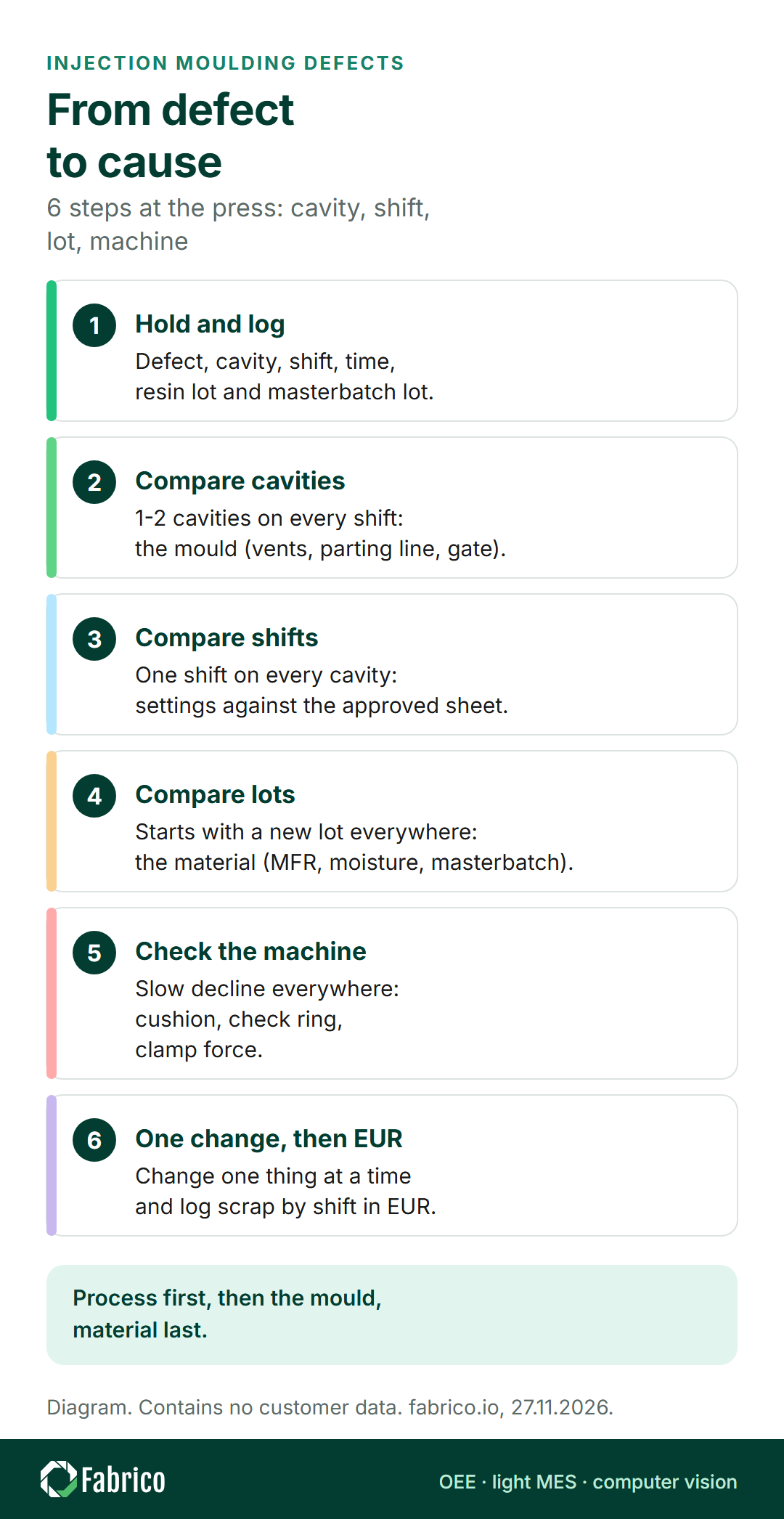
Text version of the diagram
- Hold and log: defect, cavity, shift, time, resin lot and masterbatch lot.
- Compare cavities: if 1-2 cavities show the defect on every shift, check the mould (vents, parting line, gate).
- Compare shifts: if one shift shows it on every cavity, compare its settings with the approved process sheet.
- Compare lots: if the defect starts with a new lot everywhere, check the material (MFR, moisture, masterbatch).
- Check the machine: if everything is slowly getting worse, check the cushion, the check ring and the clamp force.
- Change one thing at a time and log scrap by shift in EUR. Process first, then the mould, material last.
Frequently asked questions
What causes flash in injection moulding?
Too much injection pressure or speed, a worn parting line or not enough clamp force. If the flash sits in 1-2 cavities on every shift, the cause is in the mould. If it shows on every cavity on one shift, it is in the settings.
Why does an injection moulded part come out short?
The melt freezes before the cavity is full: shot too small, speed or pressure too low, a cold gate or blocked vents. Check the melt cushion first, and whether the short shot is always in the same cavity.
How do you fix sink marks in injection moulding?
Extend hold time up to gate freeze and check the hold pressure. If that is not enough, the wall thickness or the gate has to change in the mould.
What scrap rate is normal in injection moulding?
There is no single figure that fits every part and every mould. Compare shifts and cavities with each other and with your own week with the least scrap. The gap between the shift with the least and the most scrap is the fastest target.
How is the cost of injection moulding scrap calculated?
Material plus the machine time of the rejected part. If the press is fully booked, every reject costs its selling price, because the good part was never made. In this example that is 0.0179 and 0.040 EUR a cup.
Does start-up scrap count in OEE?
Yes, in quality. Log it under its own code so it does not mix with the shift's running scrap and distort the comparison between shifts.
When is a designed experiment (DOE) worth it?
When the defect comes back after every correction and is not concentrated in one cavity. A small DOE with 2-3 factors is cheap: about 177 EUR of material and press time in this example.
See your scrap by shift in euros. The demo shows how operators record scrap by product and reason, how OEE is shown by machine and shift, and how losses are priced in euros.
Latest from our blog








Real Fabrico tiles, sample data.