





 Login
 Blog
How to increase line speed: a step trial without excess rejects

In short
- Faster is not more good product: each step up adds micro-stops and rejects. At some point the line makes fewer good bottles per hour, not more.
- Raise speed in 5% steps: a 5-shift baseline, then at least one shift per step, hourly logging and stop rules written down before you start.
- Stops are counts, and counts are noisy: in one shift at 10 micro-stops an hour, only a rise above about 34% is clearly real.
- In the worked example a 0.5 L PET juice line peaks at 13,800 bottles/h: +1,030 good bottles an hour. At its rated 14,400 bottles/h it makes 629 fewer than at 13,800.
- Above rated speed only with the builder's agreement: a change the builder did not foresee can count as a "substantial modification" under Regulation (EU) 2023/1230, which applies from 14 January 2027.
The owner says: "Run it faster." The right answer is a controlled line speed trial. Raise the set speed in steps of 5% and run each step for at least one shift. Every hour, log good bottles, rejects and micro-stops by machine.
Stop the trial when rejects cross the quality limit or when good bottles per hour stop rising. The goal is not a bigger number on the filler's screen. The goal is more good product per hour, with no new risk to people.
Below are the six checks before the trial, the step protocol and how long each step must run. After that come the stop rules and a worked example in euro on a PET juice line.
Why "just run it faster" can give less
Speed on the screen earns nothing. Good bottles do. So the trial has one measure:
Net good per hour = set speed × share of the hour the line runs × share of good bottles. Example: 12,000 × 55/60 × 0.992 = 10,912 good bottles an hour.
All three factors react to speed. That is why a higher set speed does not automatically give more.
- Micro-stops multiply. Faster transfers, star wheels and cap feeds jam more often. Each stop also costs more bottles, because the line loses more units per minute while it stands.
- Rejects rise. Fill level, cap torque and label position have less time to land in spec. The rejected bottles eat part of the gain.
- The bottleneck moves. Machines after the filler are chosen to run faster than it, so they can clear the conveyor after a stop. Raise the filler's speed and that margin shrinks. The labeller starts to block the filler, and the stops are logged at the filler even though the cause sits elsewhere.
Micro-stops are not a detail. In a published case from beverage bottling lines, short downtime under 15 minutes made up 57% of the inefficiency on the least efficient line (Zennaro et al., 2018, International Journal of Quality & Reliability Management, accessed 26.11.2026).
That is one case, not a benchmark. But it shows where the minutes go on fast lines.
Performance indicators for manufacturing operations are described in ISO 22400-2:2014 (accessed 26.11.2026). But a paper in IFAC-PapersOnLine notes that the standard defines its KPIs at a high level of abstraction. That makes them harder to use directly (Varisco et al., 2018, accessed 26.11.2026).
For a trial the lesson is simple: write down in advance what you count. Which bottle is good, which minutes belong to the hour, and at which machine the count is taken.
If you are still looking for where speed is lost, start with rate loss on high-speed lines. The difference between slow running and short stops is covered in reduced speed loss vs minor stops. This guide starts where the decision to raise speed is already on the table.
Before the trial: 6 checks
A trial is only as good as its baseline. Do these six things before you touch the speed.
- A known bottleneck. Which machine sets the pace? In the example below it is the filler. If you are not sure, run a bottleneck analysis first. More speed on a machine that is not the bottleneck only adds jams.
- A 5-shift baseline. Same product and format, current set speed. Log net good bottles per hour, rejects by reason and micro-stops per hour by machine. At 10 micro-stops an hour, 5 shifts give about 400 stops. The noise on that count is √400 = 20, or 5%.
- Rated speed per machine. Write down the rated speed for this format on every machine: from the nameplate, the manual or the builder. Check it against the ideal cycle time used in your reports. Work out the margin of each machine after the bottleneck: how much faster than the bottleneck it can run.
- Quality limits. Set a maximum reject rate per hour (1.5% in the example). List the critical parameters: fill level, cap torque or leak test, label position, a readable batch code. Decide who checks them and how often.
- Guards and safety. Walk the line with maintenance and the safety lead: guards closed, interlocks working, emergency stops tested. Nobody clears a jam with a guard open to save time. Ask the builder whether a higher speed lengthens the machine's stopping time.
- Who may stop the trial. Write down the names for each shift. Any operator stops for a safety risk. The shift leader or QA steps the speed back for a quality problem. The trial lead may step back without calling the owner.
If one of the six checks is missing, postpone the trial. A trial without a baseline produces opinions, not data.
The protocol: steps of +5%
At each step, raise the speed by 5% of the starting set speed. Five percent is a small step: if something goes wrong, stepping back is quick and the loss is small.
| Step | Speed | Duration | Stop if | Log |
|---|---|---|---|---|
| 0: baseline | current | 5 shifts | normal running | good bottles, rejects by reason, micro-stops by machine, every hour |
| 1 | +5% | at least 1 shift | a rule in the stop table | the same, plus a quality sample every 30 min |
| 2 | +10% | at least 1 shift | the same | the same |
| 3 | +15% | at least 1 shift | the same | the same |
| 4 | +20% or rated speed | at least 1 shift | the same | the same |
| Confirmation | the step with the most good per hour | 5 shifts | the same | the same, compared with the baseline |
- One change at a time. No changeover, new material lot or new crew in the middle of a step. If a changeover or a long breakdown happens, that time stays out of the count.
- The first 15 minutes do not count. The line needs time to settle after every speed change. Counting starts after that.
- Same conditions. If the baseline comes from day shifts, run the steps on day shifts. If that is not possible, log the crew and compare shift with shift.
- A ceiling. The last step is the bottleneck's rated speed for this format. Going above it needs the machine builder's written agreement.
- Stepping back. If a step breaks a rule, go back to the previous step, not to the starting speed.
- Confirmation. The step with the most good bottles per hour runs for 5 more shifts. Only if the gain holds does it become the new set speed.
At 240 bottles a minute an hourly paper log falls behind and misses short stops. Automatic data from the machines helps here. If you are choosing a system for that, see OEE software for high-speed packaging lines.
How long each step must run
Micro-stops are counts. The number of events in a given time interval follows the Poisson distribution. Its mean is λ and its standard deviation is √λ (NIST/SEMATECH e-Handbook of Statistical Methods, section 1.3.6.6.19, accessed 26.11.2026). In practice, the noise on a count is about its square root.
So 12 stops in one hour and 10 in the next mean nothing. The same handbook gives a control chart for counts (c chart). Its upper limit is c + k√c, where k is usually set to 3 (NIST/SEMATECH, section 6.3.3.1, accessed 26.11.2026).
The international guide to these charts is ISO 7870-2:2023 on Shewhart control charts (accessed 26.11.2026).
Applied to the trial: the expected number of stops at the baseline rate, plus 3 times its square root, is the limit. More stops than that over a step means a real rise, not chance.
| Step length at a baseline of 10 an hour | Expected stops | Limit c + 3√c | Smallest rise you can see |
|---|---|---|---|
| 1 hour | 10 | 19.5 | 95% |
| 2 hours | 20 | 33.4 | 67% |
| 4 hours | 40 | 59.0 | 47% |
| 1 shift (8 h) | 80 | 106.8 | 34% |
| 2 shifts (16 h) | 160 | 197.9 | 24% |
| 3 shifts (24 h) | 240 | 286.5 | 19% |
A quick rule: to see a rise of r, a step needs about (3 / r)² stops at the baseline rate. For a 30% rise that is 100 stops, for 20% it is 225, for 50% it is 36.
- A line with many micro-stops (20 an hour): one shift gives 160 expected stops and shows a rise above about 24%.
- A line with few micro-stops (4 an hour): one shift gives 32 and shows only a rise above about 53%. Run each step for 2-3 shifts.
Three caveats. First, the rule assumes stops are independent. If one cause throws a burst of 10 stops in 5 minutes, look at the hour-by-hour chart as well as the total.
Second, a small difference in good bottles between two neighbouring steps can be inside the noise. That is why the chosen speed gets a 5-shift confirmation. Third, this is a shop-floor working rule, not a statistical test for a journal.
Worked example: a 0.5 L PET juice line
The numbers are an example, not a customer's data. The arithmetic is simple: swap in your own.
- Line: juice in 0.5 L PET bottles. Filler with capper, labeller, shrink wrapper for 6-packs and palletiser.
- Rated speed for the format: filler 14,400 bottles/h (240 a minute), labeller 15,800 bottles/h. The filler is the bottleneck.
- Current set speed: 12,000 bottles/h, which is 83% of the filler's rating.
- Micro-stop: 30 seconds (0.5 min) on average, restart included.
- Limits: rejects up to 1.5% in any hour. Micro-stops: 20 or more in two hours in a row, because at a baseline of 10 an hour, 10 + 3√10 = 19.5.
- Steps: +5% of 12,000, so 600 bottles/h each. Each step counts 8 running hours, after the 15 settling minutes.
| Step | Micro-stops per hour | Rejects | Net good per hour | Gain |
|---|---|---|---|---|
| 0: 12,000/h | 10 (3) | 0.8% | 10,912 | baseline |
| 1: 12,600/h | 11 (3) | 0.8% | 11,353 | +441 |
| 2: 13,200/h | 12 (4) | 0.9% | 11,773 | +861 |
| 3: 13,800/h | 15 (7) | 1.1% | 11,942 | +1,030 |
| 4: 14,400/h | 24 (12) | 1.8% | 11,313 | +401 |
In brackets: the micro-stops per hour caused by the labeller. "Gain" is the change in net good bottles per hour against the baseline.
The arithmetic for step 3: 15 micro-stops × 0.5 min = 7.5 lost minutes an hour. Then 13,800 × 52.5/60 = 12,075 bottles produced an hour. Finally 12,075 × (1 - 0.011) = 11,942 good.
What the trial shows
- Steps 1 and 2: 88 and 96 micro-stops in the shift, under the 8-hour limit of 106.8. No real rise. Good bottles grow almost in step with speed.
- Step 3: 120 micro-stops, above 106.8. The rise is real and comes from the labeller: from 3 to 7 an hour. Good bottles still rise and rejects stay under 1.5%, so the trial goes on.
- Step 4: rejects are 1.5% in the first hour and 2.1% in the second. Micro-stops are 22 and 26. Two rules are broken and the step ends after 2 hours. Good bottles per hour drop by 629 against step 3.
- The bottleneck has moved. At 14,400 bottles/h the labeller has only 9.7% margin (15,800 / 14,400); at 12,000 bottles/h its margin is 31.7%. It can no longer clear the conveyor after a stop, and it blocks the filler.
The decision: 13,800 bottles/h goes into a 5-shift confirmation. The set speed rises by 15%, good bottles by 9.4%. The difference goes into micro-stops and rejects.
The trial costs almost no output. In this example even step 4 makes more good bottles per hour than the baseline: 11,313 against 10,912. The real cost of the trial is the crew's attention.
What the gain is worth
In this example the gain is +1,030 good bottles an hour. In normal production a shift has 7 running hours after breaks, changeovers and cleaning. The line runs 2 shifts, 21 days a month. The money depends on one thing: can you sell the extra bottles?
| A: everything sells | B: demand stays the same | |
|---|---|---|
| How it is worked out | 1,030 × 7 = 7,210 bottles a shift × 0.10 EUR contribution | Same volume in fewer hours: 76,384 / 11,942 = 6.396 h instead of 7 |
| Per shift | 721 EUR | 36.2 minutes less |
| Per month (42 shifts) | 30,282 EUR | 25.36 h × 48 EUR = 1,217 EUR |
| Per year | 363,384 EUR | 14,606 EUR |
The contribution of 0.10 EUR a bottle is the price minus variable costs: juice, bottle, cap, label. In scenario B a line hour is valued only at the labour of 4 operators at 12.0 EUR an hour.
That rate is the average hourly labour cost in Bulgaria in 2025, according to Eurostat (accessed 26.11.2026). Energy and overheads are left out.
Every amount here comes from this example and holds only if the gain holds in the confirmation run. The gap between 363,384 and 14,606 EUR a year is the main lesson. A higher speed pays off well only if the extra bottles have a buyer.
When to stop the trial
Write the rules before the first step and post them at the operator panel. When a rule is broken, nobody negotiates on the spot.
| Signal | Limit (example) | Action |
|---|---|---|
| A guard is opened to clear a jam; a near miss; an operator cannot keep up safely | Any case | Stop now, go back to the previous step |
| A critical parameter out of spec: fill level, cap torque, leak, batch code | One confirmed deviation | Stop now, hold product back to the last good check |
| Rejects | Above 1.5% in one hour | Go back to the previous step |
| Micro-stops per hour | 20 or more two hours in a row | Go back to the previous step |
| Micro-stops over the whole step | Above the limit c + 3√c | Finish the step, log the causes by machine |
| Net good per hour | Lower than the previous step | End the trial, return to the step with the most good |
| A machine after the bottleneck blocks the line | More than half the micro-stops come from it | Go no higher, fix that machine first |
| Unusual noise, vibration, crushed bottles, crooked labels | Operator or maintenance judgement | Stop, inspect, decide with maintenance |
The two micro-stop limits do different jobs. The hourly one catches a sudden problem. The whole-step one catches a slow rise that no single hour shows.
Raise the speed, or remove micro-stops first?
The trial gives you data for a decision. The table shows which decision follows from which result.
| What the trial shows | Decision |
|---|---|
| Micro-stops and rejects stay flat | Raise speed to the step with the most good bottles and confirm it |
| Micro-stops rise, but good bottles rise too | Raise to that step, then remove the new micro-stops at the new speed |
| Micro-stops rise faster than speed, good bottles stay flat | Remove micro-stops at the current speed first, then repeat the trial |
| Rejects cross the quality limit | Do not raise; fix the reject cause: fill level, cap, label |
| A machine after the bottleneck has almost no margin | Fix or replace that machine, or add buffer, before the next trial |
| The extra bottles have no buyer | Raise only if the hours saved have value: overtime, a Saturday, a third shift |
What one micro-stop an hour is worth
In this example, at 13,800 bottles/h, one micro-stop an hour fewer gives 13,800 / 60 × 0.5 × 0.989 = 113.735 good bottles an hour. Over 3,528 running hours a year that is 401,257 bottles and 40,126 EUR at a 0.10 EUR contribution, if the bottles sell.
If demand stays the same, the same micro-stop saves about 30 hours and 1,462 EUR a year. In this example, and if the effect holds, that is what removing it is worth per year. Compare it with the quote for new guides, sensors or a machine repair.
Who decides what
- Line manager: runs the trial and decides on the steps by the written rules.
- Maintenance: removes micro-stops machine by machine and sets the machines up for the new speed.
- QA: sets the reject limit and critical parameters; signs off the confirmation run.
- Plant manager: approves the new set speed if the extra bottles sell, and any investment in a machine or buffer if the bottleneck has moved.
If the micro-stops come from the filler and capper, start with filler and capper stops. For data across the whole line, see MES for beverage manufacturing.
Questions for the machine builder before running above the set speed
- What is the rated speed for this format (bottle, cap, label), and under which conditions: product temperature, fill level tolerance?
- Is a speed of X bottles/h within the limits stated in the instructions for use? Can that be confirmed in writing?
- Does a higher speed lengthen the machine's stopping time, and are the current guard distances still enough?
- Are new guards, or a change to the safety control system, needed at this speed?
- Which parts wear faster at this speed (star wheels, guides, capping heads, valves), and how do the maintenance intervals change?
- Which recipe parameters change at the new speed, and who is allowed to change them?
- How fast must the machines after the filler run to clear the conveyor after a stop?
Safety and "substantial modification"
This section is a reading of the rules, not legal advice. Check your own case with a lawyer or your national labour inspectorate (in Bulgaria, the General Labour Inspectorate). Check the technical side with the machine builder.
What it says. The definition is in Article 3, point 16 of Regulation (EU) 2023/1230 on machinery (accessed 26.11.2026). As it reads, a "substantial modification" is a modification of machinery, by physical or digital means, after it has been placed on the market or put into service, which:
- is not foreseen or planned by the manufacturer;
- affects safety by creating a new hazard or increasing an existing risk;
- requires new guards or protective devices whose processing needs a change to the existing safety control system, or additional protective measures for the machine's stability or mechanical strength.
Under Article 18, the person who carries out a substantial modification is considered a manufacturer and takes on the manufacturer's obligations for that machine.
If the machine is part of an assembly, the obligations cover the affected machine, as shown in the risk assessment. They include conformity assessment and a declaration under their own responsibility.
From when. The Regulation applies from 14 January 2027 (Article 54). Until then Directive 2006/42/EC applies, and it is repealed from that same date (Article 51). The text of Directive 2006/42/EC contains no definition of "substantial modification" (accessed 26.11.2026).
What it does not say. The definition does not mention speed. Running within the limits the manufacturer foresaw is not a modification under this definition.
Not every higher risk is a substantial modification. The definition requires new guards with a change to the safety system, or measures for stability and strength.
A reading for the trial. Steps up to the rated speed for the format, within the instructions, stay inside what the manufacturer foresaw. A speed above the rating is a change the manufacturer did not foresee.
Say a speed above the rating lengthens the stopping time or raises the risk of ejected parts. If that needs new guards with a change to the safety system, it may count as a substantial modification. The plant then takes on a manufacturer's obligations for that machine.
The employer's duty always applies. Under Article 3 of Directive 2009/104/EC (accessed 26.11.2026), the employer takes the measures needed so that work equipment is suitable for the work and can be used safely. Where that cannot be fully ensured, the employer takes measures to minimise the risks.
That holds for a speed within the rating too. The trial goes through the plant's own risk assessment, even when it is not a modification of the machine.
The method. ISO 12100:2010 (accessed 26.11.2026) sets out the principles of risk assessment and risk reduction for machinery. It is written mainly for designers, but the method also works for assessing the faster line.
The steps match Annex III, Part B, point 1 of the Regulation. They cover the machine's limits and intended use, the hazards, risk estimation, deciding whether risk reduction is needed, and protective measures. As of 26.11.2026 the ISO page notes that the standard is due to be revised.
Where Fabrico fits
Fabrico is an OEE platform and light MES. For a speed trial that means:
- Output per hour is compared with the ideal rate for the product and line, so speed loss shows up for every step.
- Analytics split by hour, shift, day, week and month, so each step can be compared with the baseline hour by hour.
- Live OEE by line and shift; on a linked line it is read at the core machine, here the filler.
- Operators add the stop reason in a few taps, and a top-20 stoppages table shows frequency and average duration. Short stops under the threshold set for the line (up to 10 minutes) are not logged as downtime; they count as speed loss.
- Scrap is recorded by product and reason, and the Financial impact module prices the losses in euro.
More on OEE software. Pricing is one quote per plant, by machines and modules: pricing.
The trial on one card
Print the card and post it at the filler's operator panel for the length of the trial.
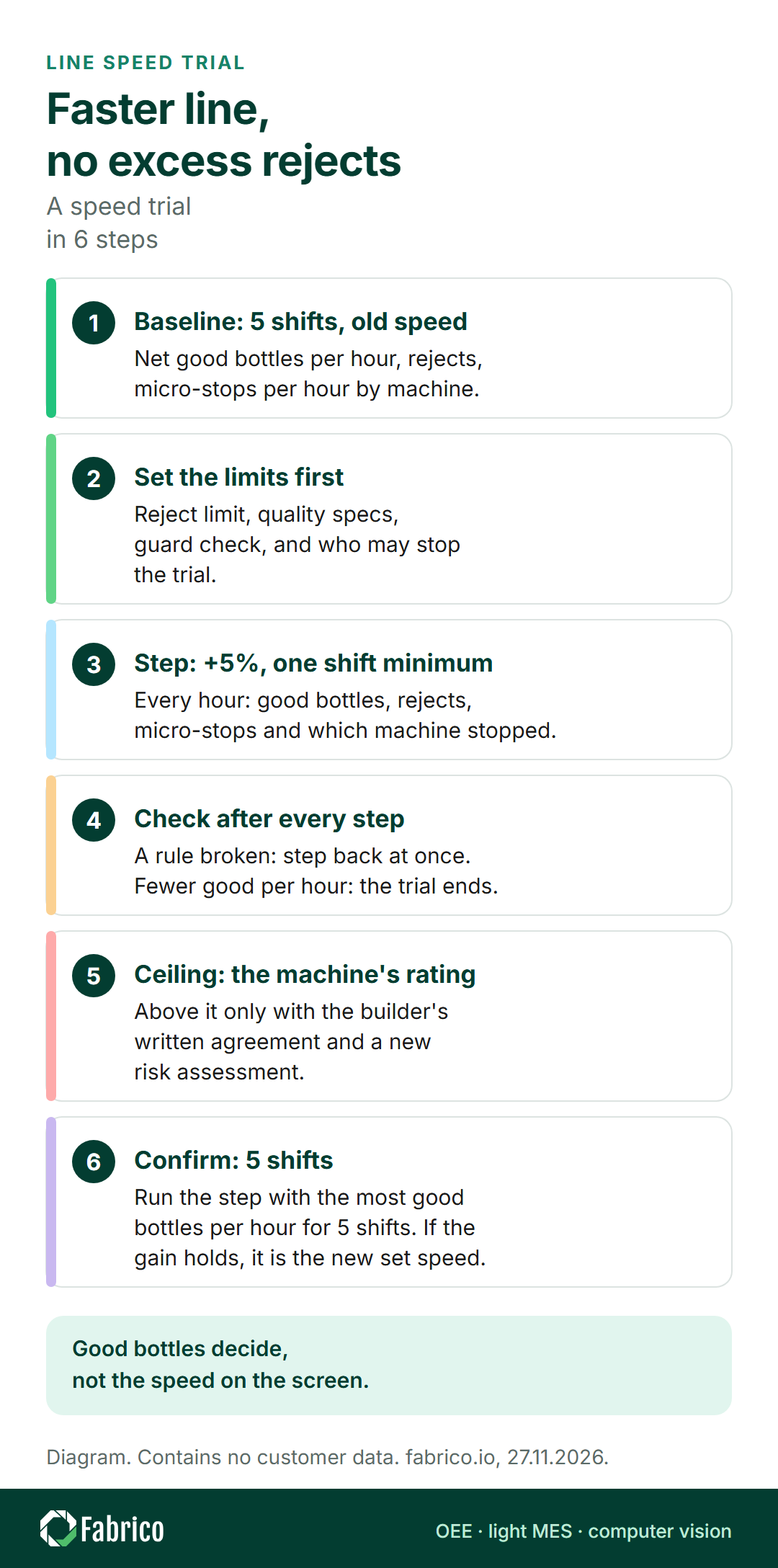
Text version of the diagram
- Baseline: 5 shifts at the current speed; log net good bottles per hour, rejects and micro-stops per hour by machine.
- Set the limits before the first step: reject limit, quality specs, guard check, and who may stop the trial.
- Step up by 5% for at least one shift; every hour log good bottles, rejects, micro-stops and which machine stopped.
- Check after every step: if a rule is broken, step back at once; if good bottles per hour fall, the trial ends.
- Ceiling: the machine's rated speed; above it only with the builder's written agreement and a new risk assessment.
- Confirm: run the step with the most good bottles per hour for 5 shifts; if the gain holds, it becomes the new set speed.
Frequently asked questions
How long should each step of a line speed trial run?
At least one shift, and long enough to expect about 80-100 micro-stops at the baseline rate. At 10 an hour, one shift is enough to see a rise above about 34%. With few micro-stops, run each step for 2-3 shifts.
How much can line speed be raised in one step?
About 5% of the starting set speed. A small step does not jump past the top of the curve, and if something goes wrong, stepping back is quick and cheap.
Can a line run above the filler's rated speed?
Not without the builder's written agreement and a new risk assessment. A speed the manufacturer did not foresee can count as a substantial modification under Regulation (EU) 2023/1230, which applies from 14 January 2027.
Why do rejects rise at a higher line speed?
Fill level, cap torque and label position get less time and less margin for error. That is why the reject limit is written before the trial and checked every hour.
How is net good output per hour calculated?
Set speed × share of the hour the line runs × share of good bottles. In the example at 13,800 bottles/h: 13,800 × 52.5/60 × 0.989 = 11,942 good bottles an hour.
Does the trial have to be repeated for every product?
For every format that behaves differently: another bottle size, cap, label, or a carbonated versus still product. Products in one format can share a trial if their baselines are close.
Which pays more: raising line speed or removing micro-stops?
It depends on the trial result. If micro-stops rise faster than speed and good bottles stay flat, remove the micro-stops first. If good bottles rise as well, raise the speed and then remove the new micro-stops.
See every step in good bottles per hour. The demo shows output per hour against the ideal rate, OEE by line and shift, and stops with their reasons, split by hour.
Latest from our blog






Real Fabrico tiles, sample data.