







 Login
 Blog
OEE for Parallel Machines: When Two Fillers Feed One Packer

Key takeaways
- Work out each twin's OEE with its own rated speed first.
- For the station: station OEE = total good units / (planned time x sum of the rated speeds).
- In the worked example the station is 75.5%, while the plain average of the twins says 76.9%.
- When one twin stops, charge the downstream machine's starved time to that twin.
Fabrico, OEE and light MES (manufacturing execution system) software with AI cameras, logs stops automatically on each machine and prices each loss.
Below: the three levels of OEE on a line with twin machines and a worked shift with two fillers. Then what to do when one twin stops.
Where do parallel machines show up?
Many food and drink lines double a slow or critical machine. Two fillers feed one labeller, two flow wrappers follow one oven, two cup fillers feed one case packer. The twins share the machine downstream, and often a buffer.
That gives three different questions:
- Machine OEE: how well did each twin use its planned time?
- Station OEE: how well did the pair use its combined capacity?
- Line OEE: how much good product left the line, against what it could make?
Our guide on OEE for multiple machines covers aggregation in general. Twins need one extra step, because the station's capacity is the sum of two different speeds.
How do you calculate OEE for two machines side by side? A worked example
Sample line (illustrative numbers, not a customer): filler F1 is rated at 200 bottles a minute and filler F2 at 300. Both feed a case packer that can take 600 a minute. Planned time is 450 minutes, and rejects are 1% on both.
| Figure | F1 | F2 | Station |
|---|---|---|---|
| Run time | 400 min | 330 min | |
| Bottles filled | 76,000 | 95,700 | 171,700 |
| Good bottles | 75,240 | 94,743 | 169,983 |
| Availability | 88.9% | 73.3% | 79.6% |
| Performance | 95.0% | 96.7% | 95.9% |
| Quality | 99.0% | 99.0% | 99.0% |
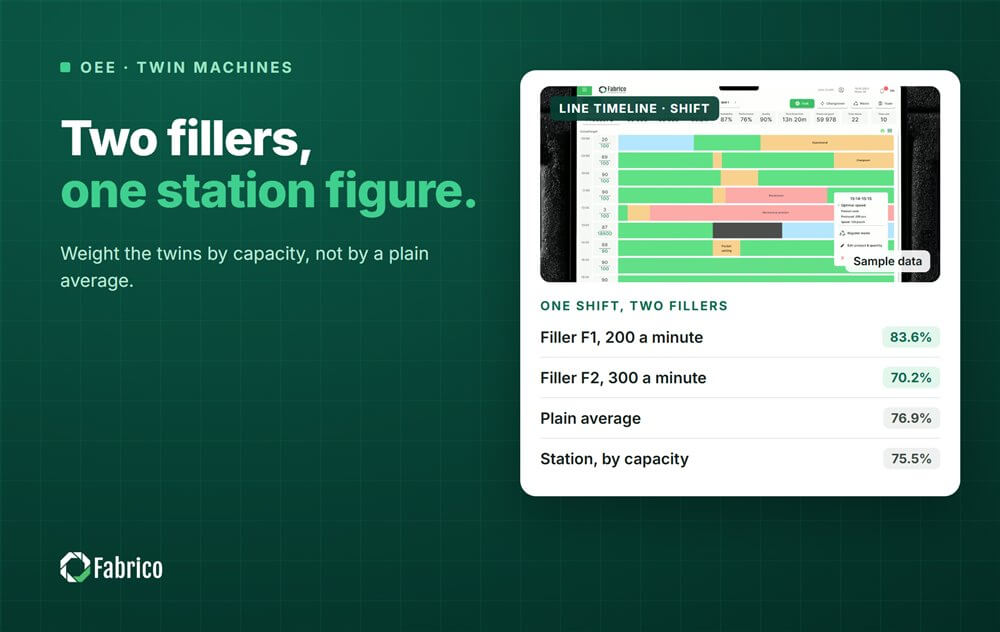
| OEE | 83.6% | 70.2% | 75.5% |
- F1: 75,240 good / (450 x 200 = 90,000 possible) = 83.6%.
- F2: 94,743 good / (450 x 300 = 135,000 possible) = 70.2%.
- Station: 169,983 / (450 x 500 = 225,000) = 75.5%.
- Station factors, weighted by capacity: 79.6% x 95.9% x 99.0% = 75.5%. The method checks out.
- Plain average of 83.6% and 70.2% = 76.9%.
The figures differ because the bigger machine was the weaker one. Weighting by machine hours also gives 76.9% here, because both twins had 450 minutes. The volume weighting in our multiple machines guide gives 76.1%.
76.9% says how well the two machines used their hours. 75.5% says how much of the station's bottle capacity reached the packer.
For twins that feed one packer, weight by capacity: the bottles each twin could have made, 90,000 and 135,000. That is what the packer could have received, so report 75.5%.
Why is the plain average misleading for twins?
Because the twins do not carry the same weight. A point of F2's OEE is 1.5 times as many bottles as a point of F1's. A plain average treats them as equal.
The safe rule is to add what you can count, good units and capacity, and divide once. That is the count method of OEE, applied to the station.
What happens downstream when one twin stops?
Once the buffer between them runs out, only F1 feeds the packer, at up to 200 bottles a minute. The packer loses 300 of its normal 500 bottles a minute. Those minutes are charged to F2.
The packer's spare 100 bottles a minute are built in on purpose, so it can catch up. They are not F2's loss.
- Record the packer's state: running, starved, blocked or down on its own fault.
- Charge starved minutes to the machine that stopped first, here F2.
- Report the packer's OEE two ways: all causes, and its own causes only.
Our guide to finding the real constraint on linked packaging lines covers starved and blocked time.
Where should you count output on twin machines?
Count each twin before the merge. After two streams join one conveyor, a counter only sees the total, and a weak twin disappears inside it.
- A counter at each twin's outfeed, in the same unit.
- Rejects counted per twin, so Quality belongs to the right machine.
- The station total checked once a shift against the counter after the merge.
Which rated speed does the station use?
The sum of the twins' rated speeds, here 500 a minute, as long as the machine downstream can take it. If the downstream machine is slower, it becomes the constraint and sets the line's rate. Our ideal cycle time guide explains how to set each machine's rate.
What mistakes do plants make with parallel machines?
- Using the plain average of the two OEE figures for the station.
- Giving both twins the rated speed of the faster one.
- Charging the packer for minutes a stopped twin starved it.
- Counting only after the merge, so nobody knows which twin made what.
Where Fabrico fits
Fabrico is a computer vision enabled Manufacturing Performance Platform. OEE and light MES come first. Automatic downtime logging on each machine and OEE live by line and shift keep a weak twin in view.
- Automatic downtime logging on each twin, so each logged stop sits on the twin that caused it.
- The operator confirms the reason in one tap, at the twin that stopped.
- Losses ranked by money, so the twin that costs the line most comes first.
Read what a light MES covers in our light MES guide. You start on one line, with a baseline and a decision date agreed in advance. There is no free plan and there are no tiers: each plant gets a quote.
Frequently asked questions
Do I calculate OEE per machine or per station?
Both. Machine OEE shows which twin needs work. Station OEE shows how well the pair used its combined capacity, and line OEE shows what left the line. Report all three, because a weak twin can hide inside a station figure that looks fine at first sight.
Can I average the OEE of two parallel machines?
A plain average works only if both twins have the same rated speed and planned time. Otherwise add good output and capacity, then divide once. In the worked example the plain average reads 76.9%, while 75.5% of the station's bottle capacity reached the packer. The faster twin was the weaker one.
What rated speed should the station use?
The sum of the twins' rated speeds, as long as the machine downstream can take that rate. If the downstream machine is slower than the pair, it is the constraint. Then line OEE should use its rate, and the twins' spare speed is not a loss.
How do I handle starved time on the machine downstream?
Show it in that machine's full OEE, but charge the minutes to the twin that stopped. Judge the downstream machine on its own causes. Only count the bottles it really missed, not the spare speed it was built with to catch up after a stop.
What if the twins run different products?
Give each twin the rated speed of its own product. Then add capacity in a common unit, such as bottles or cases. Without a common unit, the station figure mixes two different kinds of work and the result means very little to anyone on the line.
See your twin machines in a demo
Bring one line with parallel machines and a week of counts. We will show each twin's OEE, the station figure and what each stop cost.
Related articles











Real Fabrico tiles, sample data.