
Key Takeaways
Selecting the best OEE software for shift supervisors is the absolute fastest way to eliminate shift handover chaos and missed daily targets.
Standalone dashboards only show your shift leaders that a machine is failing without providing the tools to summon immediate maintenance support.
Shift supervisors require a unified system of action that connects live machine telemetry directly to frontline operator workflows and maintenance work orders.
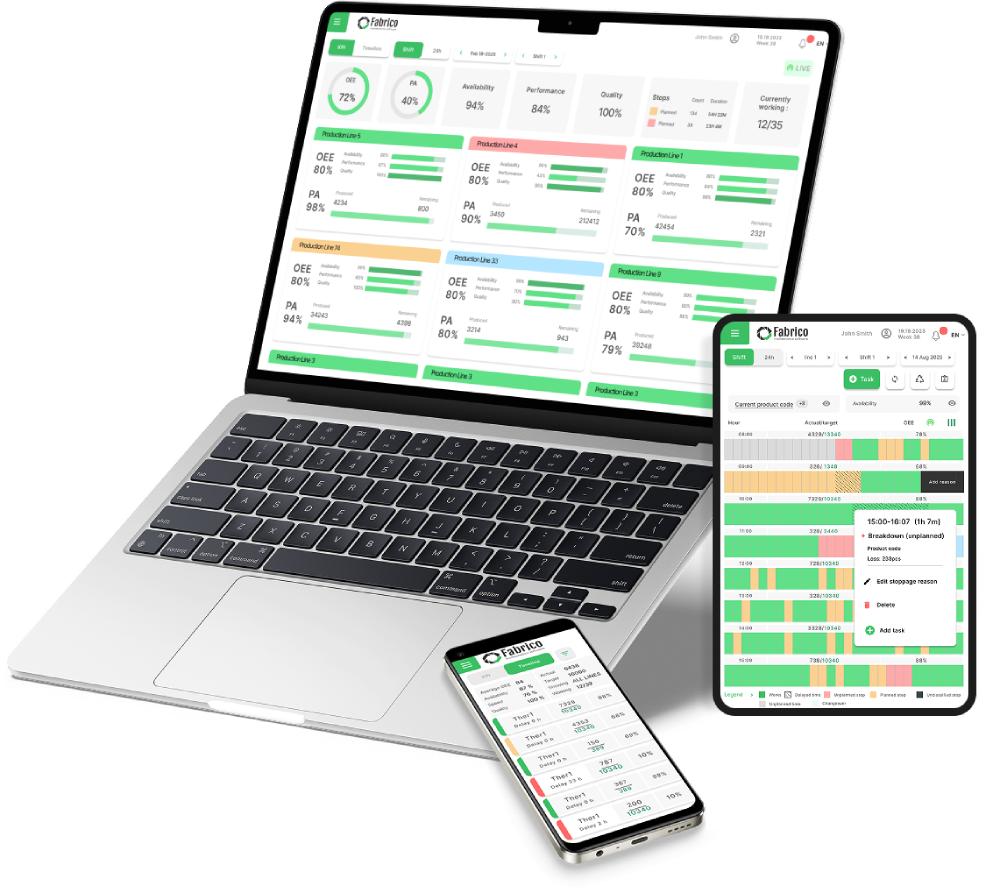
Fabrico eliminates the classic divide between production and maintenance by natively integrating real-time OEE tracking with a field-ready mobile CMMS.
By automating downtime escalations and digitizing autonomous maintenance checklists, you eliminate guesswork and drastically reduce your mean time to repair during critical shifts.
Shift supervisors operate on the absolute front lines of manufacturing profitability.
You cannot hit your hourly production targets if your operators are busy writing downtime reasons on paper clipboards while a machine sits idle.
When a critical packaging line goes down, standard monitoring tools record the failure but completely fail to alert the maintenance department.
This forces shift supervisors to waste valuable time hunting down mechanics and arguing about when the breakdown actually occurred.
To achieve true operational excellence, you must stop treating production monitoring and maintenance execution as two separate silos.
You need a platform that automatically translates machine faults into immediate technician action.
OEE software for shift supervisors is a digital platform that captures live manufacturing data to monitor shift performance and automate operator workflows.
It bridges the gap between machine availability metrics and actual frontline execution.
This allows shift leaders to manage micro-stops, enforce standardized work, and instantly escalate mechanical issues to the maintenance department without leaving the floor.
In the daily reality of a manufacturing plant, the shift handover is the most vulnerable fifteen minutes of your entire operation.
If you rely on a passive whiteboard with scribbled notes to pass information between shifts, you are practicing reactive firefighting.
If your oncoming operators rely on verbal warnings to know which machine is acting up, you are wasting valuable working capital on unrecorded downtime.
Fabrico tackles both of these inefficiencies by giving the frontline a shared OEE and work-order view on a single mobile app.
When integrated with machine controllers (PLC, OPC-UA, or runtime data feeds), Fabrico tracks cycle counts and operating hours on critical assets. For lines without controller integration, Fabrico can also run computer-vision OEE off a single camera.
When a shift ends, the supervisor can pull up a shift summary showing micro-stops, maintenance interventions, and active work orders. It is not a cross-functional eLogbook (no permit-to-work, no standing orders), but it gives the maintenance and operations sides a shared timeline.
This ensures complete transparency and drastically accelerates the time it takes for the new shift to reach maximum production speed.
Fabrico is an OEE and CMMS platform with a mobile-first work-order layer. It suits shift supervisors who run cross-functional teams and need a single place to see what the line did on the previous shift and what is still open.
It unifies live equipment telemetry with a field-ready CMMS in one app. Other platforms in this list do parts of this; Fabrico's differentiator is the computer-vision OEE option for lines without a PLC.
When an asset begins to experience micro-fluctuations in performance, Fabrico captures the fault instantly and generates a prioritized work order.
Operators simply scan a QR code on the machine housing to pull up digital autonomous maintenance checklists and instant escalation protocols.
Furthermore, Fabrico utilizes a Computer Vision zoom-in module to record the exact moment a visual defect or mechanical jam occurs.
This gives shift supervisors undeniable video evidence of the root cause, which completely eliminates "No Fault Found" disputes with the maintenance team.
Looking to the future, Fabrico is developing advanced artificial intelligence capabilities to assist your shift leaders.
The Fabrico Agent is an optimization engine currently on the roadmap that will soon analyze historical downtime data to suggest automated schedule refinements.
Redzone is a highly popular production system focused heavily on frontline worker engagement and lean coaching methodologies.
It excels at providing real-time communication tools and digital high-fives to boost operator morale across the shift.
However, Redzone relies heavily on manual operator input and requires the purchase of expensive continuous improvement coaching services.
When a machine suffers a catastrophic mechanical failure, it lacks the deep native architecture needed to manage spare parts and assign maintenance labor.
To achieve a full closed-loop reliability system, you are forced to integrate it with a third-party maintenance application.
Parsable is an excellent connected worker platform designed to digitize complex paper forms and standard operating procedures.
It is a fantastic tool for standardizing daily operator walk-arounds and pre-shift safety inspections.
However, Parsable operates entirely separate from the physical reality of your manufacturing equipment.
It cannot autonomously pull actual cycle counts from a controller or detect that a machine's line speed has dropped by ten percent.
To achieve zero-defect manufacturing, you need a system that translates machine data directly into maintenance execution without relying on manual human observation.
Vorne XL is a highly recognizable hardware scoreboard that mounts directly above your production line to display basic shift metrics.
It is an incredibly simple way to show operators their current target versus actual output in real time.
Unfortunately, a hardware scoreboard is completely useless to a shift supervisor trying to execute a root cause analysis or dispatch a mechanic.
Vorne XL cannot manage your spare parts inventory, host your digital standard operating procedures, or generate mobile work orders for your maintenance team.
It is a basic visual tool that entirely lacks the software depth required to actually improve your equipment reliability.
MaintainX delivers a highly popular mobile application designed to digitize paper forms and streamline communication between operators and technicians.
Its chat-based architecture is perfect for an operator who needs to quickly flag a strange vibration coming from a drive motor.
However, MaintainX operates entirely separate from the physical reality of your manufacturing equipment.
It cannot autonomously pull actual cycle counts from a controller or detect that a machine's line speed has dropped by ten percent.
To achieve true data-driven manufacturing, you need a system that translates machine data directly into maintenance execution without relying on manual human observation.
| Feature/Platform | Fabrico | Redzone | Parsable | Vorne XL | MaintainX |
| Native PLC & Vision Triggers | Yes (Built-In) | No (Operator Led) | No (Manual) | No (Basic Sensors) | No (API Required) |
| Mobile CMMS Execution | Excellent (Offline Ready) | Basic | Audit Only | None | Excellent |
| Computer Vision (Visual RCA) | Yes (Zoom-In Module) | No | No | No | No |
| Digital Shift Handovers | Yes (ISO Compliant) | Yes | Yes | No | Yes (Basic) |
| Best Use Case | Unified Operations | Lean Coaching | Digital SOPs | Hardware Scoreboards | Digital Checklists |
1. Eradicating the Hidden Factory of Micro-Stops
Standalone dashboards often miss the brief micro-stops and manual inefficiencies that erode your daily throughput.
Fabrico utilizes a powerful Computer Vision module to record video clips of these invisible downtime events for visual root cause analysis.
This allows your shift supervisors to recover hidden capacity without relying on subjective operator memory.
2. Automating Maintenance Escalations
Relying on a production operator to walk across the factory floor to find a mechanic is a massive waste of valuable labor time.
By synchronizing your machine usage data with an integrated CMMS, Fabrico ensures that critical alarms are routed instantly to the correct technician's mobile device.
This proactive approach prevents catastrophic bottlenecks while keeping your operators focused entirely on running the machine.
3. Mastering the Digital Shift Handover
Every minute your supervisors spend deciphering illegible whiteboard notes extends your mean time to recovery during a shift change.
By deploying field-ready mobile workflows, Fabrico empowers your supervisors to execute digital shift handovers with absolute data integrity.
This rapid transfer of operational knowledge is the ultimate driver of manufacturing profitability and equipment uptime.
Your shift supervisors are the ultimate defenders of your manufacturing capacity and daily profit margins.
You cannot expect them to hit their targets using disconnected paper checklists and passive digital scoreboards.
Fabrico provides the unified operational intelligence required to bridge the gap between actual machine run data and rapid frontline action.
By transitioning to an integrated system of action and empowering your team with a world-class mobile app, you eliminate the threat of chaotic shift handovers.
If your shift supervisors are bridging OEE data and maintenance execution today via paper, Fabrico is built for that gap. If your binding constraint is cross-functional eLogbook handover (permit-to-work, standing orders, multi-discipline control-room narrative), pair Fabrico with a dedicated handover platform like j5 IndustrialIT or ShiftConnector.






















 Login
Login
 Blog
Blog