





 Login
 Blog
Waiting for an OEM service technician: stages, contract, cost

In short
- Waiting is the bigger part: in the example below, 26.5 of the 38 hours until restart are waiting. The repair itself takes 7 hours.
- The part sets the pace: if the part ships from abroad, even the fastest technician waits with the shift. Critical spares on site remove the longest stage.
- The contract sets the hours: response time by severity, remote diagnosis first, spare parts availability in years, prices, language, escalation and documentation.
- Remote access without new risk: off by default, switched on per session, with a named account, multi-factor authentication and a log. NIS2 and national law may cover the plant.
- The bill in this example: three seamer breakdowns cost 163,072 EUR a year, and 36,815 EUR with preparation, if the shorter times hold.
A key machine built abroad has stopped, and the line will not run again without the builder's technician. In the example below, the bigger share of the lost hours is not repair but waiting: for a call back, for remote access, for a spare part, for a flight.
There, the seamer on a beer can line is down for 38 hours. Of those, 26.5 hours are waiting and the active repair takes 7.
The wait gets shorter before the breakdown, not during it. It takes spares on site, remote access set up in advance, a trained local technician, a proper stop log and a contract with a written response time.
Read this if your food or beverage plant runs a filler, seamer, labeller or case packer built abroad. Whether the builder's dashboards are enough to monitor the line is a separate question, covered in line builder dashboards vs OEE software. This page is about the wait for service.
Anatomy of the wait: 7 stages from stop to restart
Every breakdown that needs the builder goes through the same stages. Some are work, others are waiting. The difference matters, because each is shortened by different measures.
A review of maintenance and repair times by Idaho National Laboratory (INL/EXT-12-27734, 2012, accessed 27.11.2026) draws the same line. Mean down time (MDT) runs from the failure to the return to service. MTTR there usually means only the active repair time, when people are working on the machine.
INL calls everything in between logistic delay. It covers spare parts procurement, and also the work order and the safety reviews, which can take days.
The European maintenance terminology standard EN 13306:2017 gives time its own clause (clause 9). It also has an annex on maintenance times, Annex D (contents of DIN EN 13306:2018, accessed 27.11.2026). If you write an internal breakdown procedure, use its terms.
| Stage | What happens | Hours in the example | Type of time |
|---|---|---|---|
| 1. Detect and stop | The operator stops the line and calls the shift technician. | 0.5 | Work |
| 2. First local try | The local technician checks against the breakdown instructions, resets, swaps the obvious. | 2 | Work |
| 3. Call and ticket | Hotline, ticket number, waiting for a service engineer to call back. | 3 | Waiting |
| 4. Remote session | 1.5 h waiting for IT to open access, then 2 h of diagnosis with the engineer. | 3.5 | 1.5 waiting, 2 work |
| 5. Part shipping | The part is not in stock. Courier from the builder's warehouse abroad. | 22 | Waiting |
| 6. Technician travel | Flight and car, in parallel with stage 5. The technician lands an hour before the part. | (21) | In parallel |
| 7. Repair and restart | Fitting, set-up, double seam check, first cans. | 7 | Work |
| Total to restart | 38 | 26.5 waiting, 11.5 work |
Stages 5 and 6 run in parallel, so the hours of stage 6 are not added to the total. The part decides the downtime. Had the part been in stock, the technician would have become the new bottleneck: 21 hours of travel.
For comparison, when no better data are available, INL suggests 24 to 72 clock hours for a rush order of a part from a vendor. For normal delivery, it suggests 168 to 240 clock hours.
The review covers technological facilities in the US, not beverage lines. The order of magnitude still helps with planning.
How to calculate and track the repair time itself is covered in the guide to mean time to repair (MTTR). This page is about the hours around it.
The first local try has limits
The pressure to restart the line is strongest in the first hours. According to EU-OSHA (OSHwiki, accessed 27.11.2026), an estimated 15-20% of all accidents in Europe are related to maintenance, depending on the country. For fatal accidents, the share is 10-15%.
The basic rules are simple. Only authorised people do repairs. Energy is isolated and locked out. When an unforeseen problem shows up, work stops, even under time pressure. The local try follows the breakdown instructions. It is not improvisation.
The builder's technician who comes from outside also gets a site induction. EU-OSHA notes that contractor workers are usually less familiar with the plant layout and need specific instructions.
Worked example: a beer can line with a seamer built abroad
The numbers are an example, not a customer's data and not any machine builder's prices. Replace them with your own: the arithmetic stays the same.
- Line: beer in 0.5 L cans, 24,000 cans/h nameplate and an average of 20,000 cans/h when running.
- Breakdowns: the seamer was built abroad. Three breakdowns a year need the builder's technician: 30, 38 and 44 hours to restart, 112 hours in total.
- Schedule: three shifts, six days a week in season. The line is the bottleneck: what is not filled is not sold. Sunday allows two catch-up shifts of 8 hours, so 16 hours per breakdown.
- Contribution margin: 0.11 EUR per can (price minus variable costs). One stopped hour that is not caught up: 20,000 × 0.11 = 2,200 EUR.
- Labour cost: 12.0 EUR per hour, the average hourly labour cost in Bulgaria in 2025 according to Eurostat (accessed 27.11.2026).
- Overtime: the Bulgarian Labour Code, Art. 262(1)(2) (accessed 27.11.2026), requires at least a 75% premium for overtime on a rest day. 12.0 × 1.75 = 21.00 EUR per person-hour. With a crew of 9 per shift: 189 EUR per hour. The legal premium applies to the contract wage, so this is an approximation.
- Service: 2 technician days at 1,200 EUR, 1,400 EUR for travel and hotel, 600 EUR for express courier of the part. 4,400 EUR per visit. The part price itself is left out: the prepared plant pays it too.
One breakdown: 38 hours
- Lost output: 38 × 20,000 = 760,000 cans.
- Caught up on Sunday: 16 × 20,000 = 320,000 cans.
- Not caught up: 760,000 less 320,000 = 440,000 cans. 440,000 × 0.11 = 48,400 EUR of lost contribution margin.
- Overtime: 16 × 189 = 3,024 EUR.
- Service: 4,400 EUR.
- Total: 55,824 EUR, or about 1,469 EUR per hour of downtime (55,824 / 38).
Three breakdowns in a year
| Breakdown | Hours | Lost margin, EUR | Overtime and service, EUR | Total, EUR |
|---|---|---|---|---|
| A | 30 | 14 × 2,200 = 30,800 | 3,024 + 4,400 | 38,224 |
| B | 38 | 22 × 2,200 = 48,400 | 3,024 + 4,400 | 55,824 |
| C | 44 | 28 × 2,200 = 61,600 | 3,024 + 4,400 | 69,024 |
| Total | 112 | 140,800 | 22,272 | 163,072 |
In this example, the three breakdowns cost 163,072 EUR a year, an average of 13,589 EUR a month and 1,456 EUR per hour of downtime (163,072 / 112). If the plant cannot catch up at all, one 8-hour shift costs 8 × 2,200 = 17,600 EUR of lost margin.
What the numbers say
- Every hour beyond catch-up costs 2,200 EUR. Up to hour 16 the stop is paid in overtime; after that, in lost sales.
- Service is the small part: 4,400 of 55,824 EUR in breakdown B. A cheaper contract saves nothing if the hours stay the same.
- The longest stage is the part: 22 of 38 hours. That is also where the biggest gain is.
To work out the value of a stopped minute on your own line, see cost of downtime per minute. If you are weighing a plant-wide system for a beverage site, see also MES for beverage manufacturing.
What shortens each stage
The same breakdown B, in a plant that prepared in advance. There are six measures. The plant sets up remote access with IT, holds critical spares from a list in stock and trains a local technician.
It also logs stops with times and codes, gathers photos and the minute of the stop, and has a contract with a response time.
| Stage | Unprepared, h | Prepared, h | What shortens it |
|---|---|---|---|
| 1. Detect and stop | 0.5 | 0.5 | Stop logged with time and code from the first minute |
| 2. First local try | 2 | 1.5 | Trained local technician, breakdown instructions at the machine |
| 3. Call and ticket | 3 | 0.5 | Contract with a call-back time; ready pack with alarm, photos and counts |
| 4. Remote session | 3.5 | 2 | Access prepared with IT, switched on in minutes |
| 5. Part shipping | 22 | 0.5 | The part is in the plant's store |
| 6. Technician travel | (21) | Not needed | Local technician fits the part with remote guidance |
| 7. Repair and restart | 7 | 6 | Settings sheet, tools on site, double seam check by procedure |
| Total to restart | 38 | 11 |
Without spares on site, stage 5 cannot be skipped. With the part in stock but no trained person, stage 6 becomes the bottleneck: 21 hours of technician travel.
That is why the measures work together. A part with nobody to fit it and a technician with no part give almost the same downtime.
The year with preparation
The assumption: breakdowns A and B are fixed on site. Breakdown C still needs the builder's technician, but the part is in stock and the diagnosis is done in the remote session. The technician travels for 21 hours and repairs in 2.5, so C lasts 28 hours.
| Breakdown | Hours | Calculation | Total, EUR |
|---|---|---|---|
| A | 8 | 8 × 189 overtime | 1,512 |
| B | 11 | 11 × 189 overtime | 2,079 |
| C | 28 | 12 × 2,200 + 3,024 overtime + 3,800 service, no courier | 33,224 |
| Total | 47 | 36,815 |
Below 16 hours the whole volume is caught up on Sunday, so only the overtime is paid. In this example the difference is 163,072 less 36,815 = 126,257 EUR a year, if the shorter times hold.
Preparation in the example costs 36,000 EUR in the first year. That covers 18,000 EUR for a critical spares kit and 6,000 EUR to train a local technician at the builder.
The rest is 3,000 EUR to set up remote access and 9,000 EUR for a yearly contract with remote response within 1 hour.
On the same condition, the preparation pays back in about 3.4 months (36,000 / 126,257 × 12). Which parts to hold and how many is covered in the guide to spare parts stocking policy.
The service contract: 8 clauses to check
What the law gives you, and what it does not
Under Annex III, section 1.7.4.2 of Regulation (EU) 2023/1230 on machinery (accessed 27.11.2026), the instructions for use contain the operating method in the event of accident or breakdown.
The instructions also describe the adjustment and maintenance operations the user should carry out. They give the specifications of spare parts where these affect operator health and safety.
The Regulation applies from 14 January 2027 (Article 54). Machinery placed on the market before that falls under Directive 2006/42/EC (accessed 27.11.2026), whose Annex I, section 1.7.4.2 has the same points.
What is new is Article 10(7) of the Regulation. Digital instructions must be printable and downloadable, so the user can access them at all times, "in particular during a breakdown". They stay online for the expected lifetime of the machine and at least 10 years after it is placed on the market.
What the Regulation does not say: it does not oblige the builder to meet a response time or to supply spare parts for a set number of years. Nor does it oblige the builder to hand over the controller program.
All of that is negotiated. That is why the service contract matters more than the warranty card.
The eight clauses
- Response time by severity. A stopped line is the top level. Write down three separate times: call-back from a service engineer, start of a remote session and arrival on site. Write down when the clock starts and whether the times apply at night, on Saturday and on Sunday.
- Remote diagnosis first. How many remote hours the yearly fee includes, who logs them and how fast an engineer joins. Without this clause every call ends in a site visit.
- Spare parts availability in years. For how many years after delivery the builder supplies parts, the lead time for each critical part and whether consignment stock at the plant is on offer.
- Call-out and travel prices. Day rate and surcharge for nights, weekends and public holidays. Whether travel time is billed as working time, who pays flights and hotel, and a cap on the bill for one visit.
- Language. Which language the hotline and the on-site technician speak, and the language of the instructions, the alarm list and the diagrams. The Regulation requires instructions in a language easily understood by users, as determined by the Member State.
- Escalation. Who takes over the ticket after 2 or 4 hours without a fix, with names and phone numbers, and who decides to send a technician. Without a written rule, the decision waits for a manager who is on holiday.
- Documentation. Electrical diagrams, a parts list with part numbers, the alarm list with meanings, settings sheets for every format and a copy of the controller program after every change.
- Warranty and local repair. Which repairs a trained local technician may do without voiding the warranty, and how that training is recognised. This clause opens the way to the shorter hours in the table above.
Questions for the machine builder
- With the line stopped, how many hours pass from the ticket to a call from a service engineer and to arrival on site? When does the clock start?
- Which seamer parts should be held in the plant's store, and what is the lead time for each of them?
- For how many years after delivery are spare parts supplied for this model, and what happens after the series ends?
- How is remote access opened, who approves it, which authentication is used and is the session logged?
- Which repairs may a trained local technician do without voiding the warranty?
- What are the day rate and the night and weekend surcharges, and how are travel and travel time billed?
- In which language are the hotline, the on-site technician and the documentation, including the alarm list?
Remote access without new risk: IEC 62443, NIS2 and national law
A remote session shortens stages 3 and 4. It also opens a path into the machine from outside. Three groups of documents help keep that path safe and lawful.
IEC 62443: zones, conduits and the service provider
The IEC 62443 series covers cybersecurity for industrial automation and control systems. According to the IEC overview (accessed 27.11.2026), IEC 62443-3-2 splits the system into zones and conduits. A zone is a grouping of assets based on risk, and zones communicate through conduits.
IEC 62443-2-4 sets the security capabilities a service provider should offer during integration and maintenance. IEC 62443-2-1 covers the security programme of the asset owner, which is the plant. For older equipment that cannot meet a requirement, IEC allows compensating countermeasures.
In practice, that comes down to five rules for remote access:
- The machine sits in its own zone. Remote access passes through one gateway, never straight from the internet to the controller.
- Access is off by default. The plant switches it on for each session, for a set time.
- Every builder engineer has a named account and multi-factor authentication. No shared passwords.
- Each session is logged: who, when, what changed. The controller program is backed up before and after the session.
- The rules are written into the contract, not agreed by phone.
The Machinery Regulation and remote connections
Annex III, section 1.1.9 of Regulation (EU) 2023/1230 requires that connecting another device, including a remote device, does not lead to a hazardous situation. The machine must also collect evidence of legitimate or illegitimate intervention in its software and configuration. Both rules apply to machinery placed on the market from 14 January 2027.
Directive 2006/42/EC has no such requirement. On older machines, protection depends entirely on the plant's own measures.
NIS2 and the Bulgarian Cybersecurity Act
As Article 2(1) of Directive (EU) 2022/2555 (NIS2) reads (accessed 27.11.2026), it applies to entities of the types in Annexes I and II. They must be medium-sized enterprises under Recommendation 2003/361/EC, or larger.
Annex II, point 4 lists food businesses as defined in Regulation (EC) No 178/2002 that are engaged in wholesale distribution and industrial production and processing. Under Article 2 of Regulation (EC) No 178/2002 (accessed 27.11.2026), food includes drink.
Medium-sized or larger under Recommendation 2003/361/EC (accessed 27.11.2026) generally means at least 50 staff, or annual turnover and balance sheet total both above 10 million EUR.
In Bulgaria, the Cybersecurity Act (Закон за киберсигурност), amended in State Gazette No 17 of 13.02.2026, puts the Directive into national law. As in force on 27.11.2026, Art. 4(2) covers medium-sized and larger enterprises under the Bulgarian SME Act.
Its Annex II, point 4 reads "food businesses" as defined in Regulation No 178/2002. The Directive's limit to wholesale distribution and industrial production and processing is not repeated in the text. Annex II entities are important entities under Art. 4a(2), unless designated as essential.
If the plant is in scope, Art. 22(2) requires a set of measures. They include supply chain security, covering relations with direct service providers (point 4), access control (point 9) and multi-factor authentication where appropriate (point 10).
Read this way, a builder that connects to the machine remotely is a direct service provider.
What the law does not say: it does not ban remote access and does not impose a specific technology. Art. 22(1) refers to technological neutrality. Whether and how your plant is in scope is a question for your IT team and a lawyer.
What to record for the technician before arrival
An hour of the builder's technician is the most expensive hour in the whole breakdown. If the first two hours on site go on questions the shift could have answered, you pay for them twice: on the service bill and in downtime.
The pack is put together in the first hour and sent with the ticket. The remote session needs the same pack.
| What | Why the technician needs it | Who records it |
|---|---|---|
| Timeline: time of the stop, every action since and who took it | Sees what has been tried and does not repeat it | Shift technician |
| Stop reason from the plant's code list | Separates a mechanical fault from a material or set-up problem | Operator |
| Alarm text exactly as on the screen, plus a photo of the screen | Alarms carry a number and details that a paraphrase loses | Operator |
| Counts before the stop: cans in the last hour, rejected cans, last double seam check | Shows whether the machine was drifting before it failed | Line leader and QA |
| The minute of the stop: video, if a camera covers the machine | Shows the movement at the moment of failure that the alarm does not describe | Line leader |
| Photos of the area and of any parts already swapped | The technician packs parts and tools before setting off | Shift technician |
| Format, product, program version, last maintenance | Some faults follow a changeover or a program change | Maintenance |
The stop log is also the basis of the calculation in the earlier sections. Without a time for each stage you cannot tell which stage was longest and which measure would shorten it.
If stops are still written on paper, see what equipment downtime tracking software should be able to do.
Which option to choose: contract, local integrator, own technician or spares on site
The four options do not exclude each other, and a plant can combine two or three. The question is which stage of your breakdown is the longest and which option shortens exactly that one.
| Option | Stages it shortens | What drives the cost | When it makes sense |
|---|---|---|---|
| Service contract with the builder | 3, 4 and 6 | Response time, hours of cover, included remote hours and visits | One key machine with no back-up; a machine under warranty |
| Local integrator or service company | 2, 6 and 7 | Hourly rate, night and weekend cover, access to documentation and the program | Older machines out of warranty; a builder with slow service |
| Own trained technician | 2 and 7, and 6 with spares on site | Training at the builder, higher pay, risk of leaving | Several machines from one builder; three-shift operation |
| Critical spares on site | 5 | Stock value, space, shelf life of rubber and electronic parts | Parts with more than a day's lead time that stop the line |
Cost guide from the example: every hour beyond catch-up costs 2,200 EUR. Preparation of 36,000 EUR pays back in about 3.4 months, if the shorter times hold.
If your plant catches up everything on Sunday, an hour costs only the overtime: 189 EUR in the example. Then the cheaper option is the right one.
Who should pick which
- One key machine from abroad, no back-up, in season: spares on site, a trained technician and a contract with remote response. Every hour beyond catch-up is a lost sale.
- Several machines from one builder: one contract for all of them and an own technician trained at the builder.
- An old machine out of warranty: a local integrator with the documentation and a copy of the program, plus spares on site.
- A line with a buffer or a standby machine: a contract with slower response and a smaller store. Otherwise the plant pays for hours it would catch up anyway.
The decision sits with the plant manager, together with maintenance and purchasing. IT has a say on remote access, and QA on the restart procedure after repair.
Questions for a local integrator
- Which machines from this builder have you worked on, and do you have access to its documentation and programming software?
- How fast do you arrive at a stopped line at night and on Sunday, and at what price?
- Do you keep a copy of the controller program after each of your changes, and do you hand it over to the plant?
Where Fabrico fits
Fabrico is an OEE platform and light MES with maintenance built in. In a breakdown that waits for the builder, it provides the record that both the service call and the cost calculation start from:
- Stops are logged with reason and time. Operators add the stop reason in a few taps, and planned and unplanned stops are counted separately.
- Analytics by hour, shift, day, week and month show how long the line stood and for which reasons. Live OEE by line and shift, read at the core machine.
- The Financial impact module prices losses in euros and ranks stops by financial impact.
- A work order for maintenance is created from a logged stop in one tap.
- Where a camera covers the line, the minute of a stop is opened from the shift timeline and streamed on request, not stored in Fabrico.
More on downtime tracking. Pricing is one quote per plant, based on machines and modules.
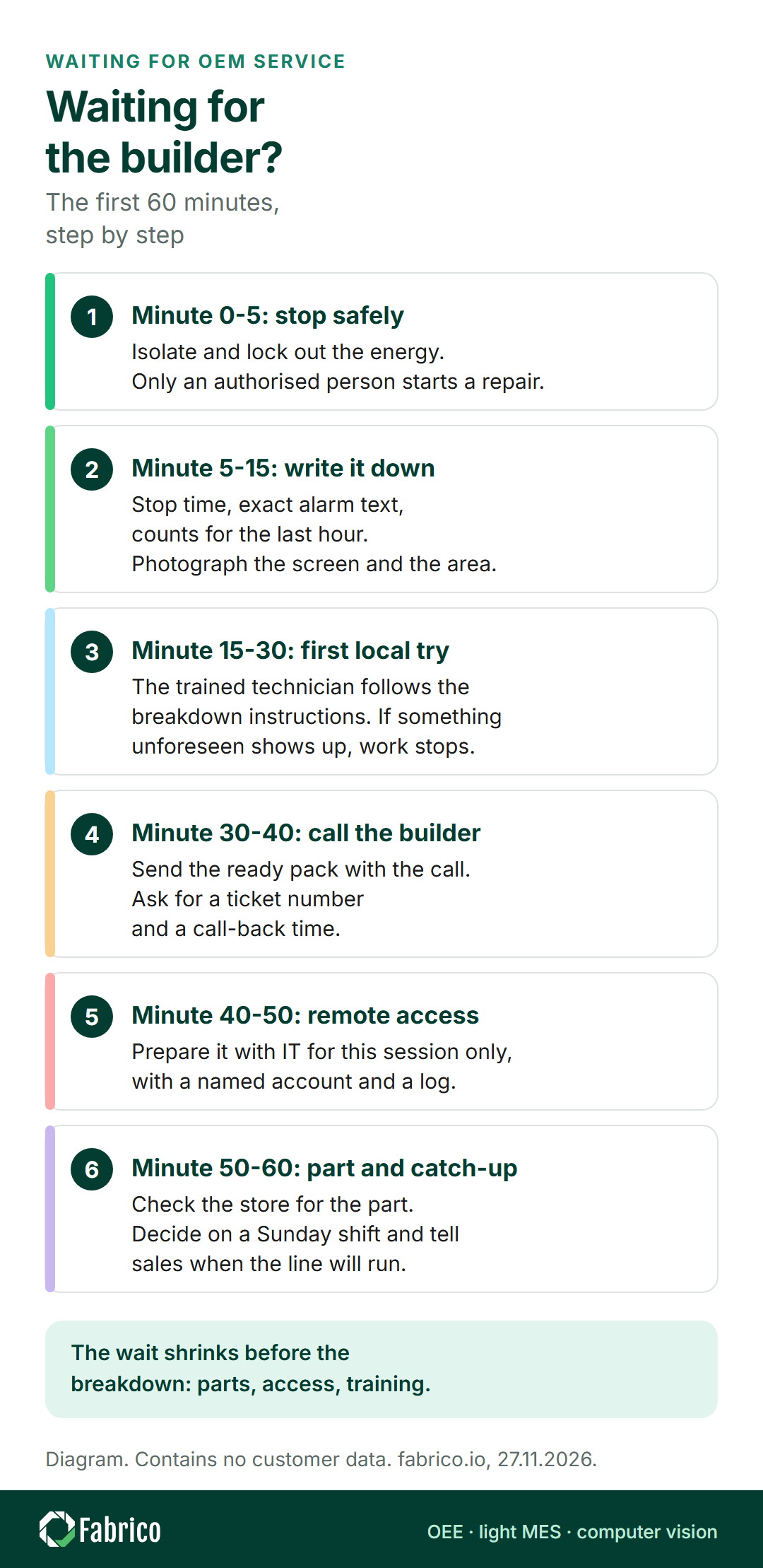
The first 60 minutes of a breakdown that needs the builder
Print the card and hang it next to the machine. It covers the first hour, when it is decided how long the line will stand.
Text version of the diagram
- Minute 0-5: stop safely, isolate and lock out energy; only an authorised person starts a repair.
- Minute 5-15: write down the stop time, the exact alarm text and the counts for the last hour; photograph the screen and the area.
- Minute 15-30: first try by the trained technician, following the breakdown instructions; if an unforeseen problem appears, work stops.
- Minute 30-40: call the builder with the ready pack; ask for a ticket number and a call-back time.
- Minute 40-50: prepare remote access with IT for this session only, with a named account and a log.
- Minute 50-60: check the store for the part, decide on a Sunday shift and tell sales when the line will run.
Frequently asked questions
How long does it take for an OEM service technician to arrive?
There is no general figure: it comes from the contract and from whether the part is in stock. In the example the technician travels for 21 hours and the part for 22. Without a written response time, it depends on how busy the builder's service team is.
What should a machine service contract include?
Response time by severity, remote diagnosis first, spare parts availability in years, and call-out and travel prices. It should also cover language, escalation, documentation, and which repairs a local technician may do without voiding the warranty.
Is remote support for a machine safe?
It can be, if access is off by default and switched on per session. Every engineer needs a named account with multi-factor authentication, and each session is logged. IEC 62443 describes how to place the machine in its own zone with one controlled conduit.
Does NIS2 cover food and beverage manufacturers?
As the Directive reads, food businesses engaged in industrial production and processing, drinks included, are in Annex II if they are medium-sized or larger. As a rule, that makes them important entities. In Bulgaria, the Cybersecurity Act's Annex II does not repeat that limit. Check your own case with a lawyer.
Which spare parts should be stocked for a machine built abroad?
The parts that stop the line and take more than a day to arrive. Ask the builder for the list with the lead time of each part, and check it against the breakdowns of the last few years.
Can a local technician repair a machine under warranty?
It depends on the contract. Ask in writing which repairs a trained local technician may do without voiding the warranty, and which training the builder recognises.
What should be recorded before the technician arrives?
The stop timeline with times, the reason, the exact alarm text, the counts before the stop, photos and the minute of the stop, if a camera covers the machine. The pack goes out with the ticket.
See your stops with reason, time and cost. The demo shows how a stop is logged with its reason and time and how the loss is priced in euros. It also shows how a work order is created from the logged stop in one tap.
Latest from our blog






Real Fabrico tiles, sample data.