





 Login
 Blog
Promotional pack production cost: pricing a short promo run

In short
- A promo pack is a short run: two changeovers, start-up scrap, a slower first hour, leftover film, extra checks and separate storage. Price them in EUR before you say yes.
- In this example 24,000 "+30% free" packs earn 1,200 EUR of margin and cost the line 1,605.80 EUR. That is a loss of 405.80 EUR per promo, and 9,739.20 EUR a year at 24 promos.
- The minimum run is the fixed cost of a promo divided by the margin per pack after storage. In this example: 33,223 packs.
- The strongest move that keeps the "+30% free" pack is one joint campaign. In this example it is worth 1,282.60 EUR a month, if both retail chains accept one format and one date.
- For food, Bulgarian law asks for a prior written agreement before a chain makes a supplier pay toward its promotion, within the Act's turnover bands. The source is Chapter 7b of the Protection of Competition Act, read as of 26.11.2026. Check with a lawyer or the competition authority.
What does it cost to produce the promotional pack a retail chain asks for? More than the promotion budget shows. A "+30% free" pack is a short production run with its own changeovers, start-up scrap and leftover material. The free 30% is only the visible part of the price.
Price the six line costs in EUR and set them against the margin of the run. If the margin does not cover them, negotiate a bigger run, a higher price or a different form of promotion. Or decline, with the numbers in hand.
The guide is written for food and FMCG producers who supply retail chains, with Bulgarian examples and law.
It gives a table of the six costs and a worked example on a biscuit line, priced in EUR per promo, per month and per year. It also has a minimum-run calculator and a reading of the unfair trading practices rules.
What do promotion decisions rest on today? A case study at a large consumer packaged goods company in Bulgaria looked at price promotions. It found the decisions were largely made out of inertia, on very limited information.
Volume sold stayed the only measure of effect, with no analysis of profit (Kostadinova, Economic Alternatives, 2022, accessed 26.11.2026).
The same study names another reason for promotions: to load the production facilities optimally and to clear stock. That is exactly why production, not only the commercial team, needs to see the cost of the run.
The six costs a promotion brings to the line
A standard SKU runs long, and its start-up costs spread over many packs. A promo pays the same start-up costs over few packs, and pays them twice: going into the promo format and coming back out of it.
| Cost | What creates it | How to measure it | In this example |
|---|---|---|---|
| 1. Changeover in and out | New format, promo film, another case, line clearance | Minutes against the standard, in and out separately | 70 min, 784.00 EUR |
| 2. Start-up scrap | Cuts off the print mark, weak seals, weight, case label | kg and packs by reason | 80 kg biscuits and 8 kg film, 244.00 EUR |
| 3. Slower first hour | Fine-tuning, the crew getting used to the format | First-hour output against the rate | 9 min, 100.80 EUR |
| 4. Packaging left over or written off | Minimum order, unused reels and cases, new printing plates | kg left over and EUR per promo | 277.00 EUR |
| 5. Checks and label approval | New artwork, first-pack sign-off, more weight checks | Hours of QA and technologist | 56.00 EUR |
| 6. Storage and handling | Separate pallets until the chain's delivery slot | Pallet-days | 144.00 EUR |
1. Changeover in and out
Here "+30% free" means a bigger pack: a longer cut length, a new film with promo print, another case and another case label. Before the run, the line is cleared of standard film and cases so the two cannot mix.
Cost the changeover in and the changeover out separately. The way out is easy to leave out of the costing, yet it is a changeover too: clear the promo materials, then start the standard SKU again.
2. Start-up scrap
The first packs after a changeover go to scrap: cuts off the print mark, weak seals, weight out of tolerance, the wrong case label. Log them in kg and packs by reason, for the way in and the way out separately.
To separate this loss from yield loss during the run, see the guide on start-up loss and reduced yield loss.
3. Slower first hour
After start-up, a line may not run at full speed straight away. Operators fine-tune seals and film feed, and QA checks more often. Measure first-hour output against the rate: the gap is lost time, even with not a single stop.
4. Packaging left over or written off
Printed promo film, promo cases and labels cannot be used for the standard SKU. The film printer has a minimum order and a tolerance on metres, over or under. New artwork brings new printing plates. Whatever is left after the campaign and cannot be reused is written off.
5. Checks and label approval
A new film is a new label. Under Article 8 of Regulation (EU) No 1169/2011, the food business operator under whose name the food is marketed is responsible for the food information. That operator also ensures the information is present and accurate.
Article 13 requires mandatory information not to be hidden, obscured or interrupted by any other text or image. The x-height must be at least 1.2 mm, or 0.9 mm where the largest surface of the pack is under 80 cm² (Regulation (EU) No 1169/2011, accessed 26.11.2026).
So every promo design goes through the technologist and QA, and the first pack off the line is signed off before the run. These hours are small, but they repeat with every promotion.
6. Storage and handling
Promo pallets are kept apart from standard ones. They are made early and wait for the chain's delivery slot, sometimes in a separate location with separate picking. Measure them in pallet-days.
Worked example: 150 g biscuits and "+30% free" twice a month
The numbers are an example, not a customer's data. Biscuits are a fair test case. In the EU, almost a third (32.0%) of the food and beverage processing workforce works in bakery and starch-based products, biscuits included (Eurostat, Key figures on the European food chain, 2025, 2023 data, accessed 26.11.2026).
The line and the promotion
- The oven delivers 630 kg/h. A flow wrapper and a case packer follow it.
- Standard 150 g pack: 4,200 packs an hour, which is 70 a minute.
- Promo pack "+30% free": 195 g (150 g + 45 g). At the same 630 kg/h that is about 3,230 packs an hour.
- Contribution margin of the standard pack: 0.16 EUR. One line minute earns 70 × 0.16 = 11.20 EUR, one hour earns 672 EUR.
- The chain pays the same for the promo pack as for the standard one: 0.55 EUR. Biscuits cost 2.40 EUR/kg, the promo packaging 0.032 EUR. Margin per promo pack: 0.55 - 0.195 × 2.40 - 0.032 = 0.05 EUR.
- Order: 24,000 promo packs, twice a month, one order from each of two chains. The run is 4,680 kg, about 7.4 h of oven time.
- In season the line is full: every lost minute is 70 standard packs not made.
The six costs priced
- Changeovers: 40 min in and 30 min out, 70 min in total × 11.20 EUR = 784.00 EUR.
- Start-up scrap: 50 kg of biscuits going in and 30 kg coming out, 80 kg × 2.40 EUR = 192.00 EUR. Plus 8 kg of promo film × 6.50 EUR = 52.00 EUR. Total 244.00 EUR.
- Slower first hour: 85% of the rate, so 15% × 60 min = 9 lost minutes × 11.20 EUR = 100.80 EUR.
- Packaging: 20 kg of promo film left over × 6.50 EUR = 130.00 EUR and 60 promo cases × 0.45 EUR = 27.00 EUR. Plates cost 720 EUR per design, split over 6 promos: 120.00 EUR. Total 277.00 EUR.
- Checks and approval: artwork approval takes 6 h × 20 EUR = 120 EUR, split over 6 promos: 20.00 EUR. Line clearance, first-pack sign-off and weight checks: 2 h × 18 EUR = 36.00 EUR. Total 56.00 EUR.
- Storage and handling: 2,000 cases of 12 packs on 32 pallets. Storage is 32 pallets × 7 days × 0.40 EUR = 89.60 EUR, handling 32 × 1.70 EUR = 54.40 EUR. Total 144.00 EUR, or 0.006 EUR per pack.
| In this example | Per promo | Per month (2) | Per year (24) |
|---|---|---|---|
| Line costs | 1,605.80 EUR | 3,211.60 EUR | 38,539.20 EUR |
| Margin of the promo run | 1,200.00 EUR | 2,400.00 EUR | 28,800.00 EUR |
| Result | loss 405.80 EUR | loss 811.60 EUR | loss 9,739.20 EUR |
In this example every promotion loses 405.80 EUR, and over a year the line pays 38,539.20 EUR for promotions. A standard 8-hour shift earns 8 × 672 = 5,376 EUR of margin. One promotion eats about 30% of it.
If the oven keeps running during the changeover, those minutes show up as rework or scrap instead of downtime. The costing is similar: you lose either time or biscuits.
The free 30% is a separate bill. On a full line, the biscuits in the promo run also take oven time. The same 4,680 kg in standard packs would be 31,200 packs × 0.16 EUR = 4,992 EUR of margin, while the promo run earns 1,200 EUR.
The 3,792 EUR gap is the price of the free product. Against standard production, one promotion on a full line costs both bills: 1,605.80 + 3,792 = 5,397.80 EUR. The 405.80 EUR loss above sets the run only against its own line costs.
Calculator: the minimum promo run that pays for itself
A promotion's costs come in two kinds. Fixed costs do not depend on the run size: changeovers, start-up scrap, the first hour, leftover packaging and checks. Variable costs grow with every pack: storage and handling.
Minimum run = F / (m - s)
- F: the fixed costs of one promotion, in EUR;
- m: the margin of one promo pack, in EUR;
- s: storage and handling per pack, in EUR.
In this example F = 784 + 244 + 100.80 + 277 + 56 = 1,461.80 EUR, m = 0.05 EUR and s = 0.006 EUR. The minimum run is 1,461.80 / 0.044 = 33,223 packs, about 2,770 cases and 10.3 h of oven time. It covers the run's own line costs, not the free-product bill above.
| Run, packs | Margin | Line costs | Result | Cost per pack |
|---|---|---|---|---|
| 24,000 | 1,200.00 EUR | 1,605.80 EUR | loss 405.80 EUR | 0.067 EUR |
| 36,000 | 1,800.00 EUR | 1,677.80 EUR | profit 122.20 EUR | 0.047 EUR |
| 48,000 | 2,400.00 EUR | 1,749.80 EUR | profit 650.20 EUR | 0.036 EUR |
If the chain insists on 24,000 packs, work out how much the promo pack price must rise: 405.80 / 24,000 = 0.017 EUR. Below that uplift the run loses money, in this example.
Fill the formula with your own minutes, kilograms and margins. The least certain number is F, unless changeovers and start-up scrap are measured separately for promotions. So measure the first promotion instead of estimating it.
How to cut the cost of a promotion
Four moves bring the line costs down. They do not simply add up: a joint campaign, for instance, already removes one pair of changeovers. Cost each move with your own numbers.
Bundle promotions into one campaign
Two promotions a month mean two pairs of changeovers. If both chains accept the same promo pack, run them as one 48,000-pack run. That saves one set of fixed costs: 1,461.80 EUR.
Storage grows, though: the second half waits 14 days longer on average, 32 pallets × 14 days × 0.40 EUR = 179.20 EUR. Net in this example: 1,461.80 - 179.20 = 1,282.60 EUR a month, or 15,391.20 EUR a year, if both chains accept the format and the date.
A calendar helps the orders too. Lee, Padmanabhan and Whang describe the "bullwhip effect": orders swing more than sales do, and the swings grow further up the supply chain. One of the four causes they analyse is price variation (Management Science, 1997, accessed 26.11.2026).
A promotion calendar agreed with the chain at the start of the season makes the peaks predictable. Campaigns can then be merged by plan, not at the last minute.
A sticker or a band instead of a new film
If the promotion can be a price promotion, the line keeps its format. That means a "promo price" sticker on the standard pack, or a "2+1" band around standard packs.
In this example that removes the format changeover, the slow first hour and the plates. The saving is up to 784 + 100.80 + 120 = 1,004.80 EUR per promotion, before the cost of stickers and labour.
The sticker is part of the label. Article 13 of Regulation (EU) No 1169/2011 does not allow mandatory information to be hidden by other text or images. So the sticker position is approved as artwork, not left to the shift.
Order packaging to the run
- Order film for the run plus start-up scrap, not "with a margin" out of habit.
- Agree with the film printer the tolerance on metres, over or under, and the return of full unused reels.
- Use one generic "+30% free" design for every chain in the season: one set of plates for more runs.
- For very short runs, ask for a quote with plates and without plates (digital print) and compare the cost per pack.
In this example, one design for 12 promotions instead of 6 cuts plates from 120 to 60 EUR per promotion. If leftover film drops from 20 to 8 kg, that saves another 12 kg × 6.50 EUR = 78 EUR. In total 138 EUR per promotion, if the saving holds.
Run the promo after the same format
The shortest changeover is one where only the print changes. Say the promo run follows another SKU in a 195 g pack, or one with the same film width and the same case. Then the changeover in drops from 40 to 15 min.
In this example that is 25 min × 11.20 EUR = 280 EUR per promotion, if the new time holds. For how to order SKUs, see the guide on SKU changeover sequence.
Promotions and the unfair trading practices rules
Two layers apply: Directive (EU) 2019/633 and, in Bulgaria, the Protection of Competition Act (Закон за защита на конкуренцията, ЗЗК). The Act brings the Directive into Bulgarian law in Chapter 7b. What follows is a reading of the texts as in force on 26.11.2026. It is not legal advice.
Who the rules cover
- Agricultural and food products only: products listed in Annex I to the TFEU and food processed from them (Directive, Article 2(1); ЗЗК, § 1, point 53 of the Supplementary Provisions). Biscuits are in. Detergents and cosmetics are out.
- Only for certain turnover pairs: the Directive has five bands. The first is a supplier with turnover up to EUR 2 million selling to a buyer above EUR 2 million. The last is a supplier between EUR 150 and 350 million selling to a buyer above EUR 350 million (Article 1(2)). The Bulgarian Act repeats the bands in leva, from 3,911,000 to 684,540,000 BGN (Article 37г).
- Not for agreements between suppliers and consumers (Directive, Article 1(2); ЗЗК, Article 37д(3)).
What they say about promotions
Under Article 3(2)(c) of the Directive, a buyer may not make a supplier carry all or part of the cost of promotional discounts. The exception is when this was agreed beforehand in clear and unambiguous terms (Directive (EU) 2019/633, accessed 26.11.2026).
If the buyer starts the promotion, the supplier may carry part of the discount only if the buyer first sets its period and the expected quantity to be ordered at the discounted price. On the supplier's request, the buyer gives a written estimate of the payments per unit or overall (Article 3(3)).
The Bulgarian Act holds the same conditional ban in Article 37в(1), point 3. After the amendment in State Gazette No. 58 of 2026, in force from 26.06.2026, paragraph 2 requires all conditions at once (ЗЗК on lex.bg, in Bulgarian, accessed 26.11.2026):
- agreed beforehand and in writing, in clear, unambiguous and economically justified terms;
- a defined subject, period, scope, price and manner of performance;
- the service is actually provided, and its value is justified and proportionate;
- the supplier holds a document proving performance, and the payment is shown transparently in the accounting and commercial documents.
When the buyer asks for such a payment, paragraph 3 requires a written estimate in advance with nine items, among them the basis, the service in return, period, scope, quantities, products and stores.
The same amendment adds new absolute bans in Article 37б(1). Four of them touch promotions directly:
- point 20: shifting onto the supplier the commercial risk of unsold quantities, promotional campaigns and cuts in shelf prices;
- point 21: requiring the supplier to fund a buyer-initiated promotion without a prior written agreement on period, scope, quantities, price and financial effect;
- point 23: requiring or imposing supplier participation in a promotional price cut where the buyer bears less than 50% of the total cut;
- point 24: requiring or imposing supplier participation above 10% of the delivery price where the cut is the buyer's initiative.
Point 3 of the same paragraph also lists a unilateral change of delivery volume or timing. The penalty for a breach of Chapter 7b is up to 10% of total turnover for the previous financial year (Article 100(1), point 6).
Supply contracts signed before the amendment had to be brought into line with Chapter 7b within two months of 26.06.2026 (§ 17 of the transitional and final provisions of the amending act, State Gazette No. 58 of 2026).
The Bulgarian Commission for Protection of Competition (КЗК) describes the absolute bans as practices that by their nature are always considered unfair. The identity of a supplier who files a request can be kept confidential under the Commission's rules (КЗК, prohibited trading practices, in Bulgarian, accessed 26.11.2026).
What the texts do not say
- They do not mention "+30% free" packs as such. They speak of price cuts, discounts and financial participation. Point 22 names free quantities, but as a condition for access to the chain's network. Whether a free quantity counts as such participation is a question for a lawyer or for the competition authority.
- They do not say who pays for the changeovers and scrap on your line. They require a written agreement and an estimate. Costing the line stays your job.
- They do not cover non-food FMCG such as detergents and cosmetics.
The practical point is a production one. The period and quantity the law wants in writing are exactly the data needed to plan the run and order the film. Without them, do not order the print.
A reading, not legal advice. The texts were read as of 26.11.2026, and the contract with the chain may hold its own terms. Check with a lawyer or the competition authority before signing a promotion agreement.
What to measure for every promotion
The costing above is only as good as the numbers in it. After every promotion, log four things by line and shift.
| Measure | How | What it shows |
|---|---|---|
| Changeover time against the standard | Minutes in and out, separately, under a "changeover: promo" reason | The largest part of F |
| Start-up scrap by reason | kg and packs by reason: print mark, seal, weight, label | Which start-up step to fix |
| First-hour output | Packs in the first hour against the rate | The hidden speed loss |
| Cost per promotion | The six lines in EUR against the margin | Whether to accept the next one |
The standard changeover time is set once and then checked. For how to set it and cut it, see the guide on changeover standards and SMED in FMCG. For biscuit lines there is also a separate guide on OEE for biscuit production lines.
The promo pack must be a separate SKU with its own rate. Otherwise its scrap and slow hour blur into the standard SKU, and the promotion looks free.
A paper log is enough for the first two or three promotions. With more lines and many SKUs, the data has to come from the line.
For what to look for when choosing, see the review of OEE software for consumer goods manufacturing and the page on OEE for FMCG manufacturing.
Decision: accept, offer another form, or decline
A promotion request has three possible answers. The last column uses the biscuit example.
| Option | When | What to ask for | In this example |
|---|---|---|---|
| Accept | The run is above the minimum, or the price covers the gap | Period and quantity in writing before the print is ordered | 48,000 packs: profit 650.20 EUR |
| Offer another form | The run is below the minimum, but the customer matters | A bigger run, +0.017 EUR per pack, a joint campaign, a sticker or a band | Joint campaign: +1,282.60 EUR a month |
| Decline | The line is full, the run is small and the format cannot change | Another date, or a price promotion on the standard pack | 24,000 packs: loss 405.80 EUR |
This is not a decision for the commercial team alone. The commercial director brings the request, the production manager supplies the minutes and kilograms, and the controller checks the margin. In this example the line cost runs from 0.036 to 0.067 EUR per pack, depending on the run.
6 questions for the buyer
- What is the period of the promotion, and what quantity will be ordered on promotional terms?
- Will the period, the quantity and the supplier's share be written into an agreement before the start?
- Who carries the cost of the free quantity, and is there a written estimate for it?
- Can the promotion use one generic design for all chains, or does it need its own print?
- Would a price promotion with a sticker or a band work instead of a bigger pack?
- What happens to unsold promo packs if the quantity changes after the print is ordered?
5 questions for the packaging supplier
- What is the minimum order for a new design, and what is the tolerance on metres delivered?
- Are full unused reels taken back, and on what terms?
- What do the plates cost, and can they serve more than one run?
- What is the cost per pack with digital print at 24,000 and at 48,000 packs?
- What is the lead time for promo film from artwork approval?
Where Fabrico fits
Fabrico, an OEE platform and light MES, measures the line part of F for every promotion: changeover minutes, start-up scrap and first-hour output, by line and shift. The run plan is made in the ERP or a spreadsheet, and Fabrico supplies the measured times.
- Changeovers against a standard time: every promo changeover shows in minutes, going in and coming out.
- Scrap by product and reason: start-up scrap is logged by SKU and reason, so the promo pack carries its own costing.
- Losses priced in money per SKU: the Financial impact module prices losses in EUR per SKU and ranks stops by financial impact.
- Live OEE by line and shift: on a linked line it is read at the core machine, and hourly analytics show first-hour output.
- Stop reasons: operators add the stop reason in a few taps.
Ficosota, a maker of home and hygiene products rather than food, runs OEE and the Financial impact module on 16 lines. Between June and September 2026, time with no recorded stop reason fell from 3.20% to 0.40%, and OEE rose from 53.11% to 59.62%. The customer approved these numbers.
Ficosota has also been an investor in Fabrico since January 2025 and an industrial partner in developing the OEE module (the Ficosota story). See how a light MES handles OEE and changeovers.
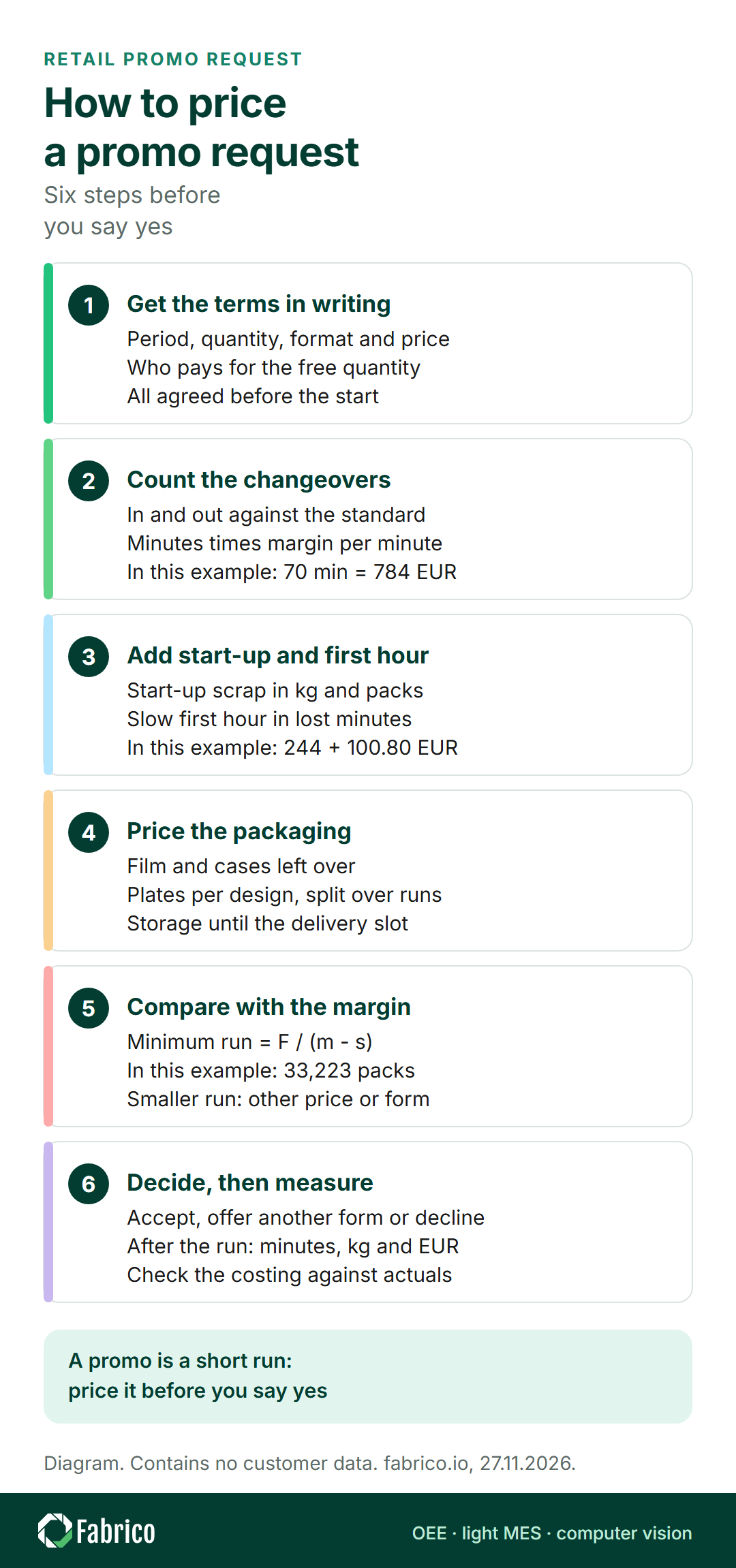
The diagram: pricing a promotion request in 6 steps
Print the diagram for the meeting with the commercial team. The steps are the same for biscuits, drinks and non-food goods. For food, add the reading of the Bulgarian Act from the section above.
Text version of the diagram
- Get the terms in writing: period, quantity, format and price; who pays for the free quantity; all agreed before the start.
- Count the changeovers: in and out against the standard, minutes times the margin per minute; in this example 70 min = 784 EUR.
- Add start-up and the first hour: start-up scrap in kg and packs, the slow first hour in lost minutes; in this example 244 + 100.80 EUR.
- Price the packaging: film and cases left over, plates per design split over runs, storage until the delivery slot.
- Compare with the margin: minimum run = F / (m - s); in this example 33,223 packs; for a smaller run, another price or form.
- Decide, then measure: accept, offer another form or decline; after the run log minutes, kg and EUR and check the costing.
Frequently asked questions
How much does a promotional pack cost on the line?
It depends on the run, because in this example 91% of the costs are fixed. In this example the line cost is 0.067 EUR per pack at 24,000 packs and 0.036 EUR at 48,000. Cost the six items with your own minutes and kilograms.
What is the minimum promo run that pays for itself?
The fixed costs of the promotion divided by the margin per pack minus storage per pack. In this example 1,461.80 / (0.05 - 0.006) = 33,223 packs.
Can a retail chain pass the cost of a promotion to the supplier?
For food in Bulgaria, and within the turnover bands of Article 37г, only under a prior written agreement with a set period, scope, price and quantities, plus the other conditions of Article 37в(2) of the Protection of Competition Act (as of 26.11.2026). Article 37б adds absolute bans, such as requiring the supplier to fund more than 10% of the delivery price in a buyer-initiated cut. Check with a lawyer or the competition authority.
Do the unfair trading practices rules apply to detergents and cosmetics?
No. Chapter 7b of the Bulgarian Act and Directive (EU) 2019/633 cover agricultural and food products only. For non-food goods, the contract with the chain is the basis.
Which is cheaper for a promotion: a sticker or a new film?
Where the format allows it, the sticker, because the line keeps its format and needs no new plates. In this example that removes up to 1,004.80 EUR per promotion before the cost of the stickers. The sticker must not hide mandatory food information (Regulation (EU) No 1169/2011, Article 13).
How can changeovers be cut when promotions are frequent?
Bundle promotions into a joint campaign with one design, and run the promo after an SKU in the same format. In this example the joint campaign saves 1,282.60 EUR a month and the right sequence 280 EUR per promotion.
What should happen to leftover promo film?
Agree the tolerance and the return of full reels with the film printer when ordering. Use one generic promo design across runs, so film is not written off after every promotion.
See what every promotion costs your line. The demo shows changeovers against a standard time, scrap by SKU and reason, and losses priced in EUR per SKU.
Latest from our blog




Real Fabrico tiles, sample data.