





 Login
 Blog
Seasonal workers in food production: staffing the peak season

In short
- How many people: positions per shift × number of shifts ÷ (1 - absence rate). In the example, 13 × 2 ÷ 0.87 = 30 seasonal workers for one line.
- Two legal routes for the plant floor in Bulgaria: a fixed-term employment contract, or a temporary work agency registered with the Employment Agency. The one-day contract under Art. 114a of the Labour Code covers crop farming only, not processing.
- The first 10 days are the expensive part: in the example, the new crew runs the line at 54% OEE instead of 65%. It also scraps more jars. That costs EUR 22,800 on one line.
- A trained core of 6: in the example, placed at the filler, it cuts that loss to EUR 10,000. A core plus direct contracts comes out EUR 10,370 a season cheaper than 30 new hires, if the core comes back.
- Measure from the first shift: OEE by line and shift, stops with reasons, scrap by product and reason. Put week 1 next to week 3.
In Bulgaria, seasonal workers in food production are hired through two legal routes: a fixed-term employment contract for seasonal work, or a temporary work agency. The one-day contract under Art. 114a covers picking in the field, not the line in the plant.
The bigger cost is not the wage, though. It sits in the first 10 days, when a new crew runs the line slower and scraps more.
Below you get a headcount calculator, the hiring routes compared and a 3-day training plan. There is also a worked example for a lutenitsa jar line with two shifts and 30 seasonal workers, carried through to EUR.
Peak season staffing: how many people and when
Start the count from the positions on the line, not from last year's headcount. Last year's number hides last year's mistakes: an empty position on a bad day, or a third person where there was work for two.
There is one formula:
People to hire = positions per shift × number of shifts ÷ (1 - absence rate)
You divide rather than multiply, because absence is a share of the people you hire, not of the positions. With 13% absence, 87% of the crew turns up.
26 positions × 1.13 gives 29.4 people, and the line is one person short. 26 ÷ 0.87 gives 29.9, so 30 people.
The absence rate is your own number from last season: sick days, no-shows, people who left halfway through. In the example it is 13%. If you have no data from last season, start measuring it by shift this season.
Here are the positions on one shift of a line filling lutenitsa, a roasted pepper and tomato relish, into 260 g jars. Headcount and days are an example.
| Position | Per shift | Days to work alone | What a mistake costs |
|---|---|---|---|
| Raw material intake and sorting | 2 | 1 | Rotten or green peppers in the batch |
| Hand-cleaning roasted peppers and aubergines | 5 | 2 | Skins in the product, slow flow to the kettle |
| Jar feeding and fill level check | 2 | 3 | Broken jars, underfill, filler stops |
| Capping and visual check | 1 | 3 | Badly sealed lids, scrap after pasteurising |
| Labelling and case packing | 2 | 1 | Wrong label, crushed cases |
| Palletising and internal transport | 1 | 2 | Blocked line outfeed |
| Total | 13 |
The permanent crew is not in the count: the filler operator, the kettle technologist, the pasteuriser operator and maintenance. The seasonal crew is 13 per shift, 26 for both shifts and 30 with the absence buffer.
When: count back from the first batch
- May: the headcount and the list of people returning from last season.
- June: the agency contract, or job ads for direct contracts.
- July: paperwork, position instructions, buddies.
- Last week of July: the three training days.
- August to October: the peak, measured every week.
Do not leave hiring late. Preliminary data from Bulgaria's National Statistical Institute (NSI) show 23,400 fewer employees in manufacturing at the end of September 2026 than a year earlier. That is a 5.4% drop (accessed 27.11.2026). The pool of people already working in manufacturing is shrinking.
Temporary contracts are also rare. In 2025, only 2.3% of people in employment aged 15-64 in Bulgaria had a temporary contract, against 10.9% across the EU (Eurostat, table tps00073, accessed 27.11.2026). People who have already worked a season for you are your most valuable reserve.
Three ways to hire in Bulgaria: fixed-term contract, agency or one-day contract
The table compares the three routes on what matters for a season: cost, risk and speed. The legal texts below were read on lex.bg as they stand on 27.11.2026.
This is a reading of the texts, not legal advice. For your own case, check with a lawyer or with Bulgaria's General Labour Inspectorate (ИА ГИТ).
| Route | Cost to the plant | Main risk | Speed |
|---|---|---|---|
| Fixed-term contract (Labour Code Art. 68) | Wage and social contributions, plus your own recruiting | No-shows and quits during the season | Weeks: recruiting, paperwork, registration |
| Temporary work agency (Labour Code Art. 107r) | Wage and social contributions, plus the agency fee | Unregistered agency, 30% cap | Days, if the agency has people |
| One-day contract (Labour Code Art. 114a) | Does not apply to a processing line | A breach if used on the plant floor | Not an option for the plant |
Fixed-term contract for seasonal work
As Art. 68(1)(1) and (3) of the Bulgarian Labour Code read, a fixed-term contract is signed for temporary, seasonal or short-term work (accessed 27.11.2026). Paragraph 5 treats a contract that breaks these rules as open-ended.
A seasonal worker has the same rights as a colleague on an open-ended contract (paragraph 2). A fixed-term contract is not a way to pay less.
Mind the order of steps. The contract is in writing (Art. 62(1)) and must be entered in the employment register within three days (Art. 62(3)). Under Art. 63(2), the person may not start work before receiving the contract and a copy of that entry.
The induction safety instruction takes place on the day the person starts work (Art. 12(2) of the ordinance below). So the paperwork has to be ready before the first training day, not before the first day on the line.
Temporary work agency
The agency signs the employment contract and sends the person to you. Under Art. 107r(7) of the Labour Code, it operates after registering with the Employment Agency under the Employment Promotion Act.
Art. 74e of that Act requires the registration, and under Art. 74k(2) the certificate runs for 5 years (accessed 27.11.2026).
Checking takes two minutes. In the Employment Agency's single electronic register, choose the type "Предприятие, осигуряващо временна работа" (temporary work agency) and search for the name (accessed 27.11.2026). The public part shows the certificate number and date and the registration term (Art. 74l(2)).
Skipping the check gets expensive. Since 1 January 2025, Art. 74l(7) makes the user company jointly liable for the taxes, social contributions and VAT an unregistered agency failed to pay.
Four Labour Code rules change the maths:
- A 30% cap: as Art. 107r(2) reads, workers sent by an agency may not exceed 30% of all people working at the user company. Check with a lawyer how the base is counted in your case.
- The same pay: Art. 107t(2) requires equal treatment and the same basic working conditions as your own staff doing the same work. Under § 1, item 20 of the additional provisions, those conditions include pay. An agency does not mean a lower wage. You pay the wage plus a fee.
- Training stays with you: Art. 107t(1), items 3 and 12, require the user company to give the safety instruction and the initial training. The learning curve does not move to the agency.
- Shared liability: under Art. 107u(3), the agency and the user company are jointly liable for obligations to the worker arising from the work.
The agency hands the worker a written posting document no later than one working day before the first day with you. It states the initial training the person will receive (Art. 107s(2)). Ask for a copy, so you know who is coming and when.
One-day contract: for the field only
Art. 114a of the Labour Code looks like an answer to the season. The text is narrow. It covers "short-term seasonal agricultural work" between a worker and a registered farmer or tobacco grower, for one day (paragraph 1).
Paragraph 3 narrows it further: unskilled occupations in crop farming, only for tending crops and harvesting fruit, vegetables, rose blossom, lavender and tobacco. With one worker, such contracts may cover no more than 120 days in a calendar year (paragraph 2).
What the text does not say: anything about processing, canning or packing. Cleaning roasted peppers in the plant, filling and labelling jars are not harvesting.
If your company is also a registered farmer, the contract may cover picking your own peppers, but not the line. Check with a lawyer or the labour inspectorate before relying on it.
The learning curve: what happens to OEE in the first 10 days
A new person is not equally slow at every position. The line, though, runs at the pace of the weakest position in front of the filler. One unsure person at jar feeding is enough to stop the core machine every few minutes.
The loss lands in all three parts of OEE:
- Availability: stops at the infeed, jammed jars, waiting for cleaned peppers.
- Performance: the filler is slowed to the pace of the slowest position.
- Quality: broken jars, underfill and badly sealed lids that come out as scrap after pasteurising.
The chart shows an example curve for a new crew. The values are an example, not customer data.
Research explains why the curve comes back every year. Argote, Beckman and Epple found that knowledge gained in production is lost quickly. They also found that total output to date overstates how much of the learning stays (Management Science, 1990, DOI 10.1287/mnsc.36.2.140, accessed 27.11.2026).
For a season, that means last year's worker has forgotten part of the position over the winter. Returning staff need a refresher too.
Shafer, Nembhard and Uzumeri studied an assembly line building car radios. More prior experience went with higher productivity once workers were up to speed.
In their simulations, the learning rate, time spent on the same task and forgetting all had a statistically significant effect on the line's performance (Management Science, 2001, DOI 10.1287/mnsc.47.12.1639.10236, accessed 27.11.2026).
The two lessons for a season are simple. A returning worker starts higher. A person who stays at one position learns faster than one who is moved every day.
The curve has a safety cost as well. The OSHwiki of the European Agency for Safety and Health at Work (EU-OSHA) cites survey data from 2015.
In that survey, 17% of employees on non-permanent contracts say they are not very well informed about the risks of their job, against 9% of permanent staff (EU-OSHA, OSHwiki, accessed 27.11.2026).
31% of them receive on-the-job training, against 40% of permanent staff. The same page notes a higher rate of workplace injury, and more severe injuries, among temporary agency workers.
Training in 3 days before the first shift
Three days before the start look expensive: 30 people for 3 days. They cost less than the three days in which the same people learn at full speed on real jars. Here is a split that covers the legal requirements and prepares every position.
Day 1: plant rules and hygiene
- Induction safety instruction: as Art. 12(2) of Bulgarian Ordinance No. RD-07-2 of 2009 reads on 27.11.2026, it takes place on the day the person starts (accessed 27.11.2026). The employer sets the programme. Art. 11(1) requires it for everyone, whatever the length of the contract, agency workers included.
- Food hygiene: the rule is in Regulation (EC) No 852/2004, Annex II, Chapter XII, in the consolidated text (accessed 27.11.2026). Food handlers must be supervised and instructed and/or trained in food hygiene to fit their work. The regulation sets no number of hours: the content depends on the position.
- Health and clothing: Chapter VIII of the same annex requires suitable, clean clothing. Anyone with diarrhoea, infected wounds or skin infections must report it to the food business operator immediately. New people need to know this on day one.
Day 2: the position and its instruction
- On-the-job safety instruction: Art. 13(1) of the ordinance requires it before anyone works alone. For positions with machines, paragraphs 2 and 4 add training and an exam before the person works alone.
- Position instruction: one page with photos. A good jar and a bad jar, the right fill level and a properly sealed lid. What to do when the line stops, and who to tell.
- Trial run: a few hours on the line at low speed, with water or a test batch if the technologist allows it.
Day 3: working next to a buddy
- Buddy system: one trained person from the core crew for every 3-4 new people, at the next position. The buddy stays in place for the first 10 days.
- Sign-off to work alone: the supervisor confirms it with a signature in the instruction log (Art. 13(7)). Since 27.09.2024, the instruction log may also be kept electronically (Art. 11b).
- No rotation: everyone stays at one position for the first 10 days. Rotate once the curve has levelled off.
How to deliver the training itself is covered in detail in the article on Training Within Industry. The first-day list is in the operator onboarding checklist.
Track who can do what in an operator skill matrix. At the end of the season you will know whom to invite back next year, and to which position.
Worked example: a lutenitsa jar line with 2 shifts and 30 seasonal workers
The numbers are an example to illustrate the method, not customer data. Replace them with your own.
Inputs
- Core machine: the filler, 50 jars of 260 g per minute at ideal rate.
- Shifts: 2 shifts of 8 hours, with 450 minutes of planned production time per shift.
- Season: 12 weeks of 5 working days, so 60 days and 120 shifts.
- Margin per jar: price minus variable costs, EUR 0.40. The material in one scrapped jar (jar, lid, label, product) costs EUR 0.50.
- Cost per person: EUR 55 per working day, the employer's full cost. For comparison, the average gross monthly wage in Bulgarian manufacturing was EUR 1,275 in September 2026 (NSI).
- OEE: 65% for a trained crew. A new crew averages 54% over the first 10 days, as in the chart.
The condition behind the example: at the peak, the line is the bottleneck and the peppers do not wait. A jar not made during the season is not made later.
Option A: 30 new people
- Maximum per shift: 50 × 450 = 22,500 jars.
- OEE gap: 65% - 54% = 11 points. That is 22,500 × 0.11 = 2,475 good jars missing per shift.
- Lost margin: 2,475 × EUR 0.40 = EUR 990 per shift. Over 10 days, so 20 shifts: EUR 19,800.
- Extra scrap: 300 more jars per shift × EUR 0.50 = EUR 150 per shift. Over 20 shifts: EUR 3,000.
- Total: EUR 1,140 per shift and EUR 22,800 for the first 10 days.
The whole loss falls in the first month, August, and repeats every year with a new crew. EUR 22,800 is 23% of the seasonal crew's wages for the whole season (30 × 55 × 60 = EUR 99,000).
A scrapped jar costs twice: it is missing from sales, and the material in it has been paid for. That is why scrap is counted separately from lost margin.
Options B and C: a trained core of 6
The core is 6 people from last season, 3 per shift. They work the two positions next to the filler: jar feeding with the fill level check, and capping. The other 24 are new and work on intake, cleaning and packing, where a mistake does not stop the core machine.
In the example the curve is shallower: 60% OEE on average over the first 10 days, and 100 extra scrapped jars per shift.
- OEE gap: 65% - 60% = 5 points, so 22,500 × 0.05 = 1,125 jars per shift.
- Lost margin: 1,125 × EUR 0.40 = EUR 450 per shift, EUR 9,000 over 20 shifts.
- Scrap: 100 × EUR 0.50 = EUR 50 per shift, EUR 1,000 over 20 shifts.
- Total: EUR 500 per shift and EUR 10,000 for the first 10 days.
The core has a price: a EUR 500 return bonus per person, paid after week four, and 2 refresher days instead of 3 training days. Options B and C differ only in where the 24 new people come from: an agency (B) or direct fixed-term contracts (C).
The three options for the season, in EUR
| Season cost | A: 30 new | B: core + agency | C: core + direct |
|---|---|---|---|
| Training before the start | 4,950 | 4,620 | 4,620 |
| Return bonus for the core | 0 | 3,000 | 3,000 |
| Agency fee, 12% | 0 | 9,504 | 0 |
| Recruiting and paperwork, EUR 40 per hire | 1,200 | 0 | 960 |
| Learning curve loss, first 10 days | 22,800 | 10,000 | 10,000 |
| Total | 28,950 | 27,124 | 18,580 |
How the rows are calculated:
- Training: A = 30 × 3 days × 55 = 4,950. B and C = 24 × 3 × 55 + 6 × 2 × 55 = 3,960 + 660 = 4,620.
- Bonus: 6 × 500 = 3,000.
- Fee: 24 people × EUR 55 × 60 days × 12% = 9,504.
- Recruiting: A = 30 × 40 = 1,200. C = 24 × 40 = 960. In B, the agency does the recruiting.
Wages for the season (EUR 99,000) are the same in all three options, because the agency has to pay what you pay. That is why they are not in the table.
What does the maths show? In this example, the core saves EUR 12,800 on the curve. The agency fee eats almost all of that gain: B is only EUR 1,826 cheaper than A.
In this example, option C is EUR 10,370 a year cheaper than A and EUR 8,544 cheaper than B. That holds if the core comes back and the new crew's curve stays as shown here.
An agency buys speed and fast replacements, not higher OEE. It pays off if you cannot find 24 people in time without it, or if no-shows cost you more than the difference.
Agency, direct contracts, overtime or automation: how to choose
The four options do not exclude each other. A plant can combine a core crew, direct contracts and a little overtime. The table shows when each one fits.
| Option | Fits when | What drives the cost | Main risk |
|---|---|---|---|
| Direct fixed-term contracts | There are 8-10 weeks to the season and people from last year | Recruiting, paperwork, training | No-shows, quits during the season |
| Temporary work agency | People are needed within days, or nobody can run the recruiting | Fee on top of the wage | Unregistered agency, 30% cap |
| Overtime of the permanent crew | Absences need covering, not a whole shift | At least +50% on a working day | Cap of 6 h a week and 150 h a year |
| Automating one position | One position is the bottleneck every season | The machine and its installation | Delivery and start-up before the season |
Overtime does not replace a shift
Art. 144(7) of the Labour Code allows overtime for "intensive seasonal work". Art. 146 then caps it: no more than 150 hours a year per person, or up to 300 under a collective agreement under Art. 51b.
On top of that: no more than 30 hours of daytime overtime a month, 6 hours a week, and 3 hours over two consecutive working days. Art. 262 requires a premium of at least 50% on a working day.
The season does not lift the cap. Art. 146(4) exempts only the cases in Art. 144, items 1-4, from the limits, and intensive seasonal work is item 7.
The maths is quick. One position on one shift for 5 days is 40 hours a week. With a cap of 6 hours per person, it takes 7 people from the permanent crew to cover one empty position. Overtime fills gaps left by absence, not a second shift.
Automation: work out the threshold, not the price
Say an automatic jar infeed removes 2 positions per shift, so 4 positions over both shifts. With the absence buffer, that is 4 ÷ 0.87 = 4.6, so 5 fewer people.
In the example: 5 × EUR 55 × 60 days = EUR 16,500 of wages per season, or EUR 49,500 over 3 seasons.
A machine that has to pay back in 3 seasons makes sense below roughly EUR 50,000 installed, before maintenance. That is a threshold from the example, not a market price.
There is a bonus too: the position where new people break the most jars disappears.
What drives the cost of a season
- Depth of the curve: how many OEE points you lose and for how many days. In the example it is the biggest row.
- Share of returning staff: every trained person at a position next to the filler makes the curve shallower.
- Absence rate: 13% or 20% changes the number of hires by several people.
- Agency fee: in the example, each percentage point is EUR 792 a season.
- Season length: every week adds wages, but no extra curve.
Who should pick what
- A one-line plant with people from last season: a core plus direct contracts, option C.
- A plant with several lines and no reserve of people: a core plus an agency, option B, with replacement times in writing.
- A plant where one position is the bottleneck every season: work out the automation threshold before hiring more people for it.
- Every plant: overtime only to fill gaps left by absence.
7 questions to ask a temporary work agency
- What is the registration certificate number, and until when is it valid? Check it in the Employment Agency's register.
- How many of the people being sent have worked on a food line, and can the same people come back next year?
- How many hours does it take to replace someone who does not turn up for a shift, and is a shift without a replacement charged?
- What exactly does the fee cover: wage, social contributions, leave, overtime and night work?
- How, and by when, are hours worked reported, so that wages are paid on time?
- What documents does the plant receive each month as proof that wages and contributions have been paid?
- How many people in total can the agency send under the 30% cap, and who keeps track of it?
What to measure through the season
Measure from the first shift. Without week 1 numbers there is nothing to compare week 3 against. Without that comparison you do not know whether the training works.
- OEE by line and shift: on a linked line it is read at the core machine, the filler. How to calculate it for a canning line is covered in OEE for food canning lines.
- Stops with reasons: a short list new people understand: jammed jar, missing lid, waiting for product, fill level. Measure the minutes with no reason too.
- Scrap by product and reason: broken jar, underfill, bad seal, wrong label. Separately for each product, because a 260 g jar and a 500 g jar behave differently.
- Losses from missing people: the minutes the line stands because a position is empty. How to separate them is described in the article on staffing losses in OEE.
Week 1 and week 3 side by side
| Measure | Week 1 | Week 3 | If it does not improve |
|---|---|---|---|
| Line OEE | 48% | 65% | Look at the position with the most stops |
| Scrap at the filler | 4.5% | 1.6% | Put a buddy back on jar feeding |
| Stop minutes with no reason | 18% | 4% | 10 minutes on stop reasons before the shift |
| OEE gap between shifts | 9 points | 3 points | Check which buddy works on which shift |
The values in the table are an example. Week 1 is the average of the first 5 days in the chart: (40 + 45 + 49 + 52 + 55) ÷ 5 = 48.2%.
If counts and stops are still written on paper at the end of the shift, the comparison is slow and open to dispute. Then it is worth reading about MES for food manufacturing: counts come from the line, and the shift only adds the reasons.
Where Fabrico fits
Hiring, shift plans and training stay with HR and the line managers. Fabrico shows what the learning curve costs and whether it is straightening out:
- Live OEE by line and shift; on a linked line it is read at the core machine.
- Operators add the stop reason in a few taps, with planned and unplanned stops kept apart.
- Scrap by product and reason, and analytics by hour, shift, day and week, so week 1 sits next to week 3.
- The Financial impact module prices losses in money per SKU and ranks stops by financial impact.
More on the OEE software page.
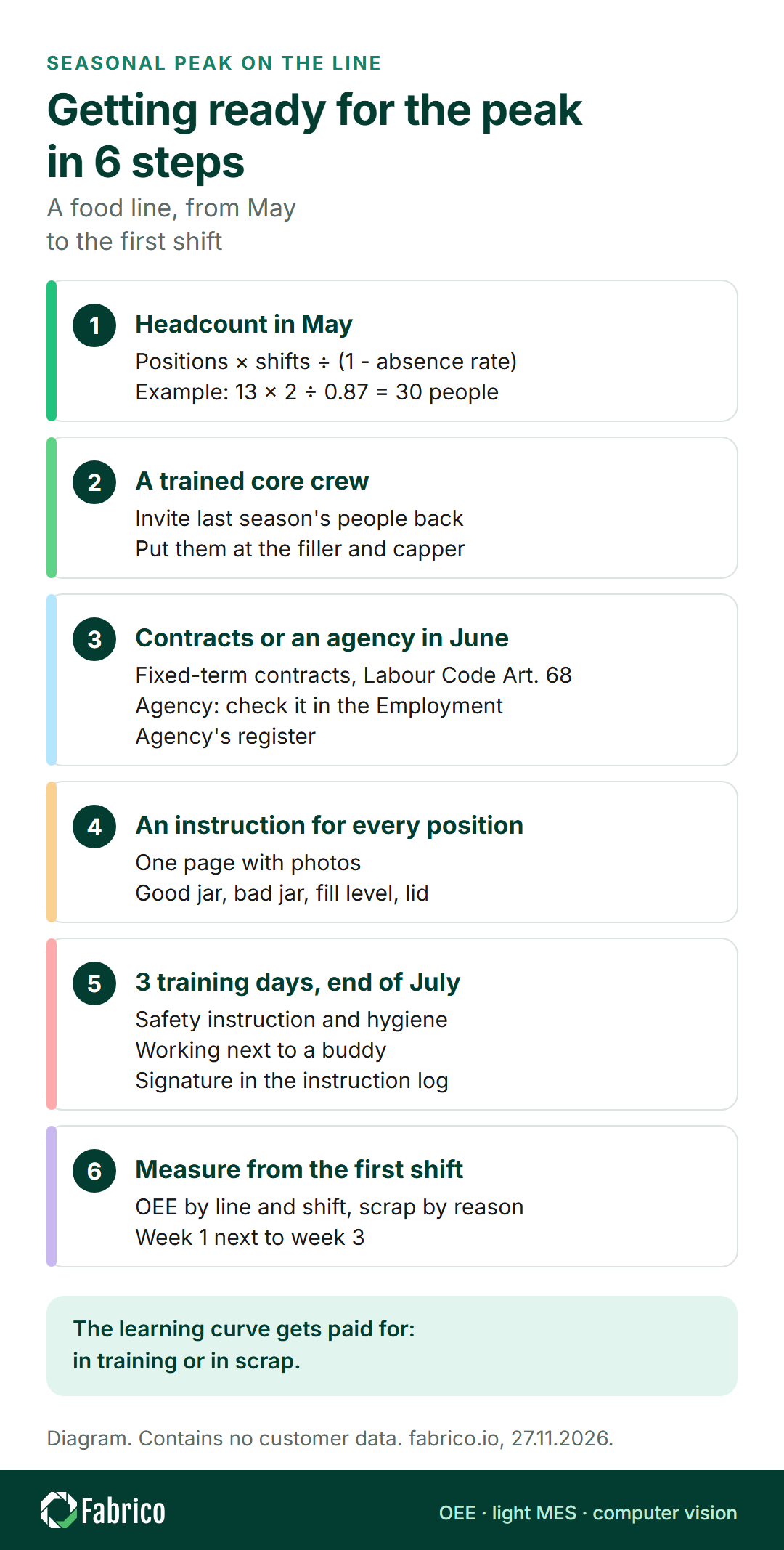
Getting ready for the peak in 6 steps
The whole preparation on one card, from the headcount in May to measuring from the first shift.
Text version of the diagram
- Headcount in May: positions × shifts ÷ (1 - absence rate). In the example, 13 × 2 ÷ 0.87 = 30 people.
- A trained core: invite last season's people back and put them at the filler and the capper.
- Contracts or an agency in June: fixed-term contracts under Art. 68 of the Bulgarian Labour Code; check the agency in the Employment Agency's register.
- An instruction for every position in July: one page with photos, a good jar and a bad jar.
- 3 training days at the end of July: safety instruction, hygiene, working next to a buddy and a signature in the instruction log.
- Measuring from the first shift: OEE by line and shift, scrap by reason, week 1 next to week 3.
Frequently asked questions
Can a one-day employment contract be used for work in a cannery in Bulgaria?
Not for work in the plant, as Art. 114a of the Bulgarian Labour Code reads on 27.11.2026. The contract is for short-term seasonal agricultural work for a registered farmer or tobacco grower, and only for tending crops and harvesting. Processing and filling jars are not included.
What employment contract is used for a seasonal worker?
A fixed-term contract under Art. 68(1)(1) and (3) of the Labour Code, for seasonal work. The seasonal worker has the same rights as colleagues on open-ended contracts.
How many seasonal workers does one production line need?
Positions per shift × number of shifts ÷ (1 - absence rate). For 13 positions, 2 shifts and 13% absence: 13 × 2 ÷ 0.87 = 30 people.
How much overtime is allowed for seasonal work in Bulgaria?
Art. 144(7) of the Labour Code allows overtime for intensive seasonal work. Art. 146 caps it at 150 hours a year per person, or 300 under a collective agreement. Further caps: 30 hours of daytime overtime a month and 6 hours a week. The premium is at least 50% on a working day.
How to check if a temporary work agency is registered in Bulgaria?
In the Employment Agency's single register, with the type "Предприятие, осигуряващо временна работа". Since 1 January 2025, a company using an unregistered agency is jointly liable for the taxes, contributions and VAT the agency failed to pay (Art. 74l(7) of the Employment Promotion Act).
How long does it take to train a seasonal worker?
Three days before the start are enough for the safety instruction, hygiene and working next to a buddy. After that, in the example, OEE climbs from 40% to 62% over 10 days. A returning worker starts higher.
How many workers can a temporary work agency send to one company?
As Art. 107r(2) of the Bulgarian Labour Code reads, workers sent by an agency may not exceed 30% of all people working at the user company. Check with a lawyer or the labour inspectorate how the base is counted in your case.
See what the learning curve costs on your own line. The demo shows live OEE by line and shift, stops with reasons and scrap by product and reason, with losses priced in EUR.
Latest from our blog





Real Fabrico tiles, sample data.