





 Login
 Blog
Shelf-Ready Packaging and Line OEE: The Cost per Case of SRP

In short
- Three line losses: shelf-ready packaging adds changeovers, slows the tray packer in cans a minute, and turns promo runs into packing at the pace of a hand crew.
- Pick a reference speed: against each format's own rated speed, the example line's OEE fell from 81.8% to 76.9%. Against the plain-tray speed it fell to 61.0%.
- Two prices for a minute: with spare hours, a line minute costs the crew, EUR 1.28 in the Croatian example. With the line full, it costs lost margin, EUR 43.20.
- Cost per case: in the example, an SRP tray costs EUR 0.082 more than packing the same 12 cans plain and a hand-stickered promo tray EUR 0.219, while the line has spare hours.
- Decide per SKU: a low-volume SRP SKU is cheap on a line with spare hours and expensive on a full one.
Shelf-ready packaging (SRP) lowers end-of-line OEE in three measurable ways: more formats and changeovers each week, a tray packer that packs fewer cans a minute on small perforated trays, and promo variants packed at the pace of a hand crew. Tear-off rejects and artwork changes add rework on top.
Measure it by format against one reference speed, then price each SRP SKU per case before agreeing to the retailer's ask. Below: a failure-mode table, one canned tomato line in Croatia carried to EUR per shift, month and year, a cost-per-case calculator and a decision on which SKUs earn SRP.
What shelf-ready packaging changes at the end of the line
Shelf-ready packaging, also called retail-ready packaging (RRP), is a secondary pack that goes onto the shelf as it is. Store staff tear off the front, place the tray in one move and flatten the waste.
FEFCO, the European corrugated board federation, lists the "five easies" retailers ask of it: easy to identify in the back of the store, easy to open, easy to get on shelf, easy for shoppers to access, and easy to flatten and recycle.
A paper in the Bulletin of the Japanese Society for the Science of Design (Theppituck et al., 2014) defines SRP as packaging designed to reduce the process of in-store operation. That is the trade: the work saved is in the store, the work added is in the packing hall.
Croatian food manufacturers know the second half. In a survey of 34 Croatian food manufacturers with more than 50 employees, Franjković, Ferenčić and Dujak (Ekonomska misao i praksa, 2017) found the most used type was a shelf-ready box with perforations for easy opening.
The same authors note that the cost of implementing RRP falls almost always and exclusively on manufacturers, while RRP significantly reduces in-store costs at retailers.
What changes on the line
- Formats: each retailer wants its own tray, print and tear-off line. Two plain formats can become six or more.
- Units per tray: the tray is sized for the shelf, not the pallet. In the example below, the SRP tray holds 12 cans where the plain tray held 24, so the packer runs twice the cycles per can.
- Blanks: printed, perforated board with a tear-off panel. Board quality now decides both packer stops and opening in the store.
- Promo variants: stickers, banded packs or display hoods, added by hand on the example line.
- Artwork: a retailer's new design turns printed blanks in stock into scrap.
SRP failure modes on the tray packer
On the example line, SRP problems show on the tray packer, because that is where the blank is formed, filled and glued. Few start there. The table names each failure mode, how it shows, which OEE factor it hits, and the first check.
| Failure mode | Shows as | OEE loss | First check |
|---|---|---|---|
| Blanks warped or damp | Misfeeds at the magazine, erecting jams | Availability | Blank storage, magazine pick |
| Perforation too weak | Fronts torn on the packer or pallet | Quality | Tear test per blank delivery |
| Perforation too strong | Store staff cannot open the front | Quality, complaint | Same test, limit agreed with the board supplier |
| Glue on the tear-off panel | Front tears unevenly, open corners | Quality | Glue pattern stored per format |
| Wrong retailer's blank loaded | A run in the wrong print | Quality, rework | Blank code check at changeover |
| More formats a week | More and longer changeovers | Availability | Standard time per format change |
| Small trays at top cycle rate | Fewer cans a minute | Performance | Rated speed per format |
| Promo added by hand | Line runs at crew pace | Performance | Promo on or off the line |
The first five rows are board and set-up problems: the board supplier and the line lead own them. The last three are planning choices agreed with the retailer, so they need a price, not a repair.
Erecting jams have their own causes and checks, covered in case erector jams. The general loss map of the packer is in case packer OEE. This page stays on what SRP adds.
One tear test, two failures
A perforation that tears on the packer and one that will not tear in the store are the same defect seen from two ends.
Agree one test with the board supplier: tear the front off a few trays from each delivery and record pass or fail against a reference tray the retailer approved.
Count tear-off rejects at the tray check by reason: torn, will not tear, glue. The reason split tells the board supplier and the line lead which of them has the fix.
Which speed to measure SRP against
OEE performance compares actual output with a rated speed. On a line that packs several formats, the choice of rated speed decides whether SRP shows up in the number at all.
- Each format's own rated speed: fair to the crew. A slow SRP run at its own standard looks fine, so the cost of SRP disappears from OEE.
- One reference speed for the line: the best format's rate, here the plain tray. The SRP slowdown shows as performance loss, so the format cost is visible.
Use both. Report OEE against each format's standard to the floor. Report line OEE against the reference speed to whoever agrees SRP terms with retailers. Write both speeds down once per format and never adjust them to make a week look better.
Changeovers show in availability either way. Time each one against a standard for that format change; the method is in changeover time. A retail-ready packaging changeover can swap the blank magazine, glue pattern and guides together, so it runs longer than a label change.
Worked example: canned tomatoes in SRP trays in Croatia
The numbers below are an example, not a customer's. Every line can be redone with a calculator.
- Product: 400 g cans of chopped tomatoes, filled in season, stored, then labelled and packed to order all year.
- Line: labeller, one tray packer, palletiser. The tray packer is the core machine: it sets the pace.
- Shifts: 2 shifts of 8 hours with 30 minutes of break: 450 minutes available per shift, 4,500 a week. 20 working days a month gives 40 shifts a month and 480 a year.
- Crew: 4 people. Eurostat labour cost levels (lc_lci_lev) put Croatian manufacturing at EUR 19.20 an hour in 2025: EUR 76.80 an hour for the crew, EUR 1.28 a minute.
- Case value (sample figure): EUR 9.60 for a 12-can tray, EUR 0.80 a can.
- Board (sample figures): an SRP blank costs EUR 0.30, which is EUR 0.06 more than the plain pad and film it replaces for 12 cans.
Formats and rated speeds
| Format | Cans a tray | Rated speed | Cans a minute | Trays a week |
|---|---|---|---|---|
| Plain shrink tray | 24 | 18 trays a minute | 432 | 18,000 |
| SRP perforated tray, 3 retailers | 12 | 30 trays a minute | 360 | 54,000 |
| Promo SRP, sticker by hand | 12 | 12 trays a minute, crew of 3 | 144 | 7,200 |
The week holds 1,166,400 cans. Before SRP the same volume ran as plain trays only. The SRP tray needs twice the packer cycles per can; even at 30 cycles a minute against 18, its rated speed in cans a minute is 17% lower. The promo runs at the pace of 3 people applying a sticker to each tray.
The week before and after SRP
| Line minutes a week | Before SRP | After SRP |
|---|---|---|
| Ideal run time at rated speeds | 2,700 | 3,400 |
| Changeovers | 60 (3 x 20) | 360 (9 x 40) |
| Other stops and slow running | 540 | 540 |
| Tray erecting and perforation stops | 0 | 100 |
| Time used | 3,300 | 4,400 |
| Spare of 4,500 | 1,200 | 100 |
Ideal run time is cans divided by rated speed. Before: 1,166,400 / 432 = 2,700 minutes. After: 432,000 / 432 = 1,000, plus 648,000 / 360 = 1,800, plus 86,400 / 144 = 600, which is 3,400 minutes.
SRP added 1,100 line minutes a week:
- Extra changeovers, 300: 360 minutes after, 60 before.
- Slower packer speed, 300: the SRP cans take 1,800 minutes, against 1,500 at the plain rate.
- Promo at crew pace, 400: the promo cans take 600 minutes, against 200 at the plain rate.
- Tray erecting and perforation stops, 100.
OEE by format
Of the 54,000 SRP trays, 540 fail the tear-off check and are repacked by hand: a 1.0% quality loss. The plain and promo trays have no tear-off check loss in this example.
Changeovers and stops are split by format: 2 changeovers into plain, 6 into SRP and 1 into promo. OEE is taken over the minutes the line ran to orders; the spare minutes have no orders and are not planned time. The week then reads:
| Format | Minutes used | OEE vs own speed | OEE vs 432 cans a minute |
|---|---|---|---|
| Plain shrink tray | 1,230 | 81.3% | 81.3% |
| SRP perforated tray | 2,420 | 73.6% | 61.4% |
| Promo SRP by hand | 750 | 80.0% | 26.7% |
| Line, after SRP | 4,400 | 76.9% | 61.0% |
| Line, before SRP | 3,300 | 81.8% | 81.8% |
The SRP row as an example: 53,460 good trays are 641,520 good cans. At 360 cans a minute they need 1,782 ideal minutes, and 1,782 / 2,420 = 73.6%. At the reference speed: 641,520 / 432 = 1,485 minutes, and 1,485 / 2,420 = 61.4%.
Against each format's own speed, SRP cost the line under 5 points of OEE. Against the plain-tray speed it cost almost 21. The promo is the extreme case: well run at its crew pace (80.0%), it uses the packer at about a quarter of what the line can pack.
The bill for SRP: per shift, month and year
After SRP the line still fits in two shifts. The plant schedules the crew to the hours the orders need, so each extra minute is a paid crew minute at EUR 1.28. Hand work is priced per person at EUR 19.20 an hour. A week is 10 shifts.
| Cost line | Per shift | Per month (40) | Per year (480) |
|---|---|---|---|
| Extra changeovers: 300 min a week x EUR 1.28 | EUR 38.40 | EUR 1,536 | EUR 18,432 |
| Slower SRP packer speed: 300 min x EUR 1.28 | EUR 38.40 | EUR 1,536 | EUR 18,432 |
| Promo at crew pace: 400 line min x EUR 1.28, plus 30 hand-packer hours x EUR 19.20 | EUR 108.80 | EUR 4,352 | EUR 52,224 |
| Tray erecting and perforation stops: 100 min x EUR 1.28 | EUR 12.80 | EUR 512 | EUR 6,144 |
| Tear-off rejects: 540 trays, 9 hours to repack plus 540 blanks x EUR 0.30 | EUR 33.48 | EUR 1,339.20 | EUR 16,070.40 |
| Board premium: 61,200 SRP trays x EUR 0.06 | EUR 367.20 | EUR 14,688 | EUR 176,256 |
| Total | EUR 599.08 | EUR 23,963.20 | EUR 287,558.40 |
The 30 hand-packer hours are 3 people for the 600 promo minutes. The 9 repack hours are 540 trays at 1 minute each.
The board premium is 61% of the total here. At EUR 19.20 an hour a line minute is cheap; the board is not. On a line with higher labour cost, the minutes weigh more and the split moves.
The SRP cost-per-case calculator
Divide each weekly cost by the trays that cause it. Changeovers and erecting stops are shared by all 61,200 SRP trays. Speed loss and tear-off rejects belong to the 54,000 standard SRP trays. The promo crew belongs to the 7,200 promo trays.
| EUR per tray | Standard SRP tray | Promo SRP tray |
|---|---|---|
| Board premium | 0.0600 | 0.0600 |
| Slower packer speed | 0.0071 | in crew pace |
| Crew pace and hand packers | none | 0.1511 |
| Changeovers | 0.0063 | 0.0063 |
| Erecting and perforation stops | 0.0021 | 0.0021 |
| Tear-off rejects | 0.0062 | checked by the crew |
| Cost per tray | EUR 0.082 | EUR 0.219 |
| Share of the EUR 9.60 case value | 0.85% | 2.29% |
Check: 54,000 x EUR 0.08168 plus 7,200 x EUR 0.21948 is about EUR 5,991, the weekly total above.
To use it on another line, replace the inputs with measured ones. The formulas:
- Speed, per tray: (cans a tray / SRP speed minus cans a tray / reference speed) x cost of a line minute. Here (12 / 360 minus 12 / 432) x 1.28 = EUR 0.0071.
- Changeovers, per tray: extra changeover minutes a week x cost of a minute / SRP trays a week.
- Promo, per tray: (extra line minutes x cost of a minute, plus hand hours x labour rate) / promo trays.
- Rejects, per tray: rejected trays x (repack minutes x labour rate / 60, plus blank price) / SRP trays.
- Board, per tray: the SRP blank price minus the plain material it replaces. Ask the board supplier for both prices.
Re-price when the line is full
After SRP this line has 100 spare minutes a week, so the next retailer request will not fit in two shifts.
Once the line is full, a lost minute costs the cans it could have packed: 432 cans x a sample margin of EUR 0.10 a can, EUR 43.20 a minute, about 34 times the crew cost.
At that price, the 1,100 SRP minutes of this example would cost EUR 47,520 a week. The speed loss alone becomes EUR 0.24 per SRP tray: 2.4 cans not packed x EUR 0.10. That is about three times the whole cost per tray with spare hours.
SRP may not look expensive in the week it starts. It gets expensive once it has used up the spare hours and the next retailer asks for its own tray.
Which SKUs earn SRP
ECR Europe's process for SRP, as published by GS1 Germany, ranks products by sales volume and possible benefit for the shopper. It says the added benefit must be weighed against the extra cost, decided for each product.
The same publication names the conflict on the factory side: packaging per sales channel against producing one SKU in one size.
Erceg and Trauzettel (2016) call case size a major transmission belt between the logistics of manufacturer and retailer, driving transport, warehousing and safety stock cost on both sides.
On the line, cost per tray depends on run length. Changeover cost per tray in the example, at 40 minutes a run, priced with spare hours and with the line full (the promo row adds its crew pace):
| SKU | Trays a week (runs) | EUR a tray, spare hours | EUR a tray, line full | Call |
|---|---|---|---|---|
| Retailer A SRP | 30,000 (2) | 0.003 | 0.115 | SRP at any load |
| Retailer B SRP | 18,000 (2) | 0.006 | 0.192 | SRP, one run a week when full |
| Retailer C SRP | 6,000 (2) | 0.017 | 0.576 | Share A's tray size or run fortnightly |
| Promo by hand | 7,200 (1) | 0.158 | 2.720 | Hand-pack table off the line when full |
Retailer C shows the trap. With spare hours its SRP costs under 2 cents a tray in changeovers. On a full line the same two changeovers cost EUR 0.576 a tray, 6% of the case value. Running B once a week on a full line halves its cost to EUR 0.096.
The promo row is the loudest number. On a full line, 400 minutes at crew pace cost EUR 2.40 a tray in lost output. A hand-pack table beside the line keeps the packer at full speed and moves the crew pace off the constraint.
Sequencing the week so similar SRP trays follow each other cuts changeover minutes further; the method is in FMCG sequencing by changeover cost. The plan itself is made in the ERP, APS or planning spreadsheet.
Five questions for each SKU
- Does the SKU sell enough per run to spread a 40-minute changeover over thousands of trays?
- Can it share a tray size with another retailer, so the change is a blank swap without new guides or glue pattern?
- Is the line full? If yes, price minutes at lost margin, not crew cost.
- Can the promo be packed off the line at a hand-pack table?
- Does the retailer's price or volume cover the cost per tray? Read the retailer's supplier manual for its SRP specification and what it says about non-compliant deliveries.
When a retailer changes the artwork
An SRP blank is printed for one retailer. When that retailer changes its design, blanks in stock and on order become scrap or rework, and the first run on the new print needs a first-off check.
- Agree a run-out quantity and date with the retailer before the new print is ordered.
- Hold blank stock per retailer to a set number of weeks of use.
- Check the blank code against the work order at every changeover.
- Record scrapped blanks and repacked trays by product and reason, so the cost reaches the SKU.
Lead time is part of the price. In the Croatian survey, manufacturers usually implemented RRP within up to 6 months, and 44.44% of those that made no investment in a packaging line still took more than three months for their first one.
The empty space rule from 2030
The EU Packaging and Packaging Waste Regulation, Regulation (EU) 2025/40, defines grouped packaging to include packaging that serves as a means to facilitate the restocking of shelves at the point of sale. An SRP tray fits that definition.
Article 24 says that by 1 January 2030, or 3 years after the implementing acts on the method, whichever is later, economic operators who fill grouped, transport or e-commerce packaging must keep the empty space ratio at a maximum of 50%.
Deep display hoods and oversize promo trays are the first formats to check.
A two-week SRP measurement plan
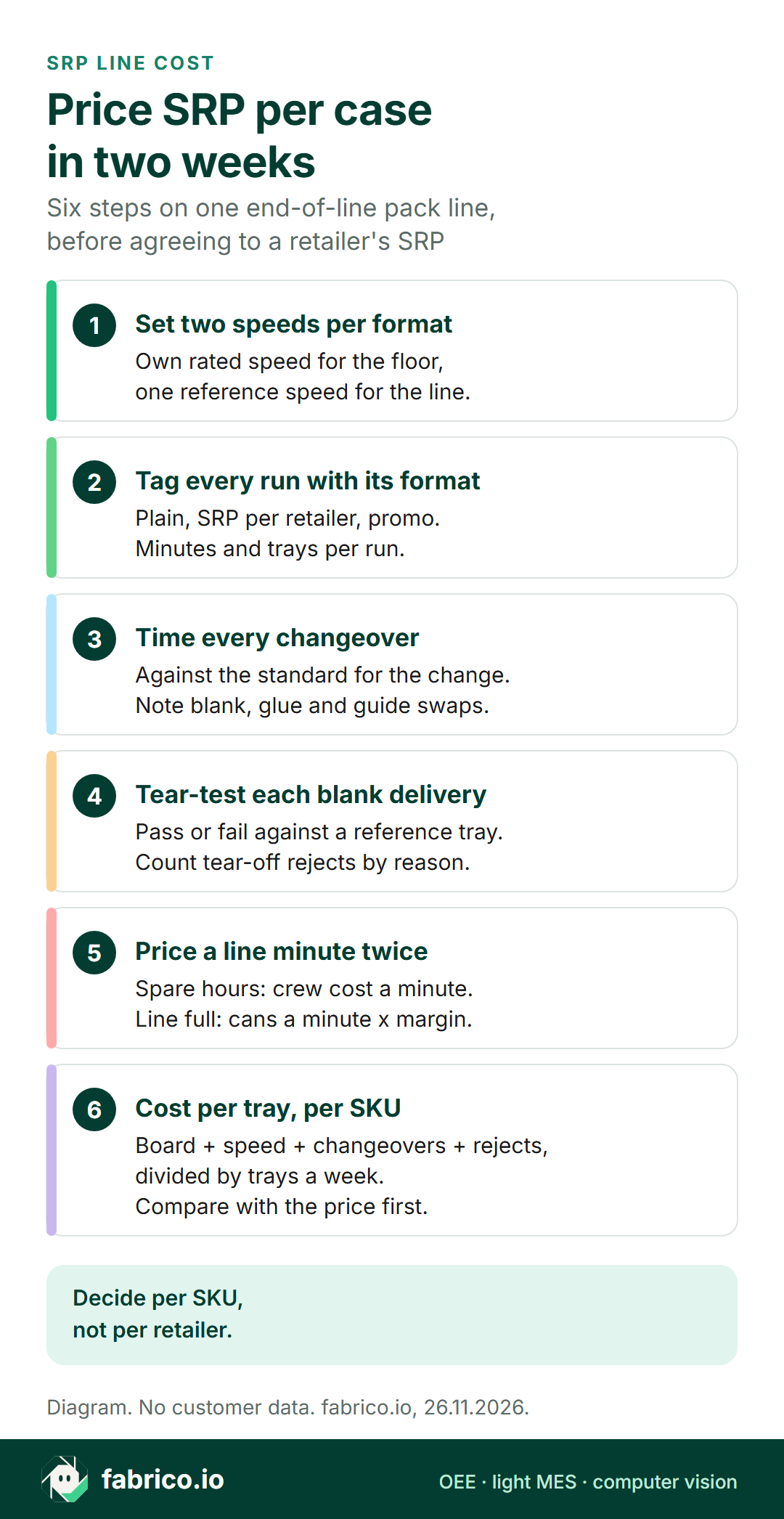
Two weeks of data on one line is enough to price SRP per SKU. The plan fits on one floor card:
Text version of the diagram
- Set two speeds per format: its own rated speed for the floor and one reference speed for the line.
- Tag every run with its format: plain, SRP per retailer or promo, with minutes and trays per run.
- Time every changeover against the standard for that change, noting blank, glue and guide swaps.
- Tear-test each blank delivery against a reference tray and count tear-off rejects by reason.
- Price a line minute twice: crew cost with spare hours, cans a minute x margin with the line full.
- Work out the cost per tray for each SKU and compare it with the price before agreeing to SRP.
Two habits keep the data clean. The rated speed per format is written down once and never changed to flatter a week. And every hand-repacked tray is counted, even when the product reaches the retailer.
Decision: measuring SRP formats on the line
The calculator needs minutes by format, changeovers by format and rejects by reason. Three ways to get them:
| Option | Gives | Cost basis | Fits |
|---|---|---|---|
| Run sheet by format and tally | Changeovers, stops over 2 min, rejects by hand | 10 min a shift: EUR 3.20 a shift, EUR 1,536 a year at Croatian 2025 labour cost | A 2-week baseline on one line |
| Tray packer signals into line software | Run, stop, micro-stops, counts per shift; the operator picks the stop reason | Ask the vendor for a price per line per month | Lines where the packer PLC signals can be reached |
| Camera counting trays where no signal exists | Trays out at a hand-pack table or an old packer | Ask the vendor for a price per line per month | Off-line promo tables, closed machines |
Line software that reads machine signals, such as OEE software, turns the tray packer's run and stop signals into stops, micro-stops and counts per shift, with the stop reason chosen by the operator at the machine.
What you see: a shift timeline, unclassified time waiting for a reason, and the operator's line-down screen, on sample lines. Book a demo.
Plays from YouTube. Google may set cookies when you press play. Privacy policy.
The run sheet is cheap, but stops under 2 minutes go missing, and short misfeeds at the blank magazine go missing with them. It is enough to price the first SRP request; it is thin for a weekly review of six formats.
Who should pick which
- First SRP request, one line: the run sheet for 2 weeks, then the calculator. Price before signing.
- Several retailers on SRP, packer signals reachable: line software on the packer, a rated speed per format, changeovers against a standard.
- Promo packed at a hand table: a camera on the table outfeed, or a tally per hour.
- Many lines across sites: compare OEE software for high speed packaging lines and OEE software for consumer goods before a pilot.
Questions to ask a vendor or supplier
- Vendor: can each format keep its own rated speed while one reference speed is kept for the line?
- Vendor: are changeovers timed against a standard for each format change?
- Vendor: are stops under 2 minutes kept as micro-stops, and can "blank misfeed" and "perforation tear" be set up as stop reasons?
- Vendor: where a hand-pack station gives no signal, what counts the trays, and how is that checked against a hand count?
- Board supplier: what tear test runs on each delivery, and against which limit?
- Board supplier: what is the price per blank for each SRP format and for the plain material it replaces?
- Retailer: what does the supplier manual specify for the SRP, and how much notice comes with an artwork change?
Where Fabrico fits
Fabrico is made by the publisher of this article. It measures OEE on the end-of-line pack line, read at the core machine: here the tray packer.
- OEE by line and shift from the core machine, through the line PLC or a Fabrico IoT device.
- Micro-stops from the machine signal. The operator logs blank misfeed or perforation tear as the stop reason in a few taps, set up in the reason list.
- Changeovers tracked against a standard time; scrap recorded by product and reason, so tear-off rejects and scrapped blanks each get their own reason.
- Where a station has no usable signal, such as a hand-pack promo table, the camera add-on counts output.
- With the selling price and margin of each product entered, losses are priced in money and stops are ranked by financial impact.
More on OEE with computer vision. Pricing is one quote per plant by machines and modules: see pricing.
Sources, accessed 26.11.2026: Eurostat, Labour cost levels by NACE Rev. 2 activity (lc_lci_lev); FEFCO, Shelf Ready Packaging (SRP); GS1 Germany, Shelf Ready Packaging: Praxisgerechte Verpackung für die gesamte Supply Chain (2009), based on the ECR Europe Blue Book; Franjković, Ferenčić and Dujak, Marketing opportunities of retail ready packaging: the case of Croatian food manufacturers, Ekonomska misao i praksa 26(1), 2017; Theppituck, Paskevicius, Ono and Watanabe, An exploratory study on shelf ready packaging design solutions, Bulletin of JSSD 60(5), 2014; Erceg and Trauzettel, Packaging in retail supply chains, Business Logistics in Modern Management, 2016; EUR-Lex, Regulation (EU) 2025/40 on packaging and packaging waste, Article 3 and Article 24.
Frequently asked questions
How does shelf-ready packaging affect OEE?
It adds changeovers for each retailer's tray, lowers the tray packer's speed in units a minute on smaller trays, and slows promo runs to the pace of a hand crew. Tear-off rejects add a quality loss. How much shows depends on the rated speed OEE is measured against.
Should SRP formats have their own rated speed?
Yes for the floor, so the crew is measured against what the format can do. Keep one reference speed for the line as well, so the cost of slower SRP formats stays visible to whoever agrees terms with retailers.
How do you calculate the cost per case of shelf-ready packaging?
Add the board premium per tray to the line cost per tray: extra changeover minutes, slower speed, erecting stops, rejects and hand packing, each divided by the trays that cause it. Price a line minute at crew cost with spare hours, and at lost margin when the line is full.
Are tear-off rejects a quality loss?
Yes. A tray that fails the tear-off check was not packed right the first time, even if it is repacked by hand and shipped. Count rejects by reason: torn, will not tear, glue.
Which products should go into shelf-ready packaging?
Start with high-volume SKUs where the shopper benefits most, the order ECR Europe's process uses. Long runs spread the changeovers thin. In the worked example, a low-volume SKU on a full line costs 6% of the case value per tray in changeovers alone.
Who pays for shelf-ready packaging?
The manufacturer, in the one study found. A 2017 paper on Croatian food manufacturers notes that the cost of implementing RRP falls almost always on them. That is why the cost per case belongs in the price talk with the retailer.
Price every SRP format before the next retailer asks. A demo shows OEE by line and shift from the core machine, changeovers against a standard time and stop reasons chosen at the machine, with losses priced in money.
Latest from our blog




Real Fabrico tiles, sample data.