


 Login
 Blog
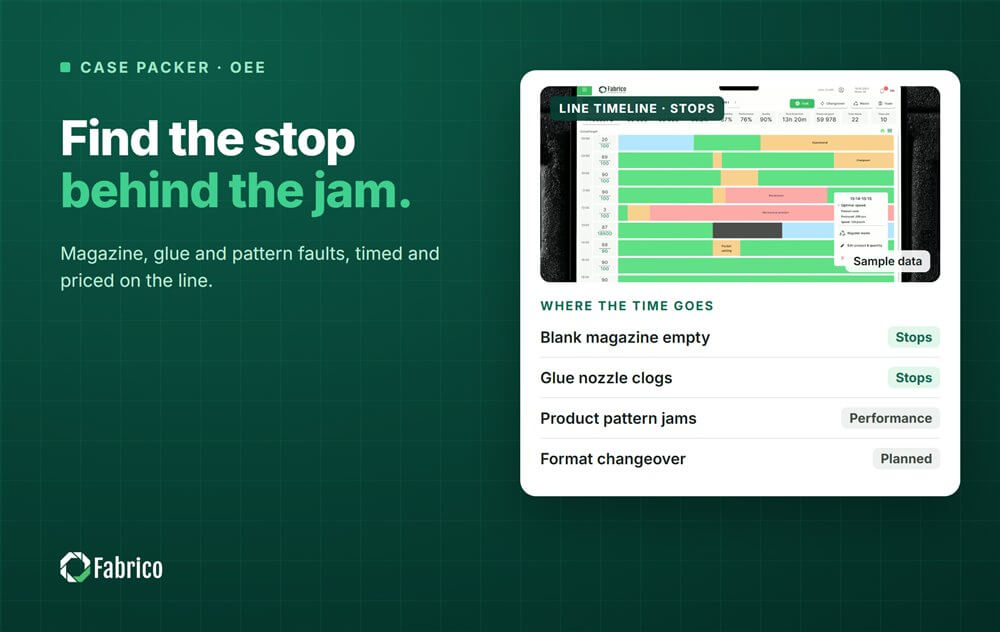
Case Packer OEE: Separating the Packer's Own Stops From Line Effects

Key takeaways
- Most case packer losses are short stops: blank magazine empty, blank misfeeds, glue nozzle clogs and product pattern jams.
- Count in cases and in product units, and set the rated speed per pack format.
- Split the packer's own stops from starved and blocked time before anyone acts on its OEE.
- Format changeovers are where the packer loses its long minutes; measure them to the first good case at rated speed.
- Packer stops cost line output only when they outlast the buffer and block the filler.
Third shift, line 1. The case packer stops with the blank magazine empty, then twice on fallen bottles in the collation lanes, then waits five minutes because the labeller upstream is down. On the shift report it all reads the same: case packer, stopped, about 20 minutes. The packer's OEE drops, and nobody can say which part of the drop the packer caused.
This guide is for line managers and OEE leads who run wraparound, drop or pick and place case packers at the end of food, beverage and household lines. It covers where the packer's time goes, how to measure each OEE factor, format changeovers, and how to separate the packer's own stops from what the line does to it.
Where the case packer's time goes
A case packer has a few stations, and each has its own stops: the blank or case magazine and feed, product infeed and collation, the packing motion, glue or tape closing, and the outfeed to the palletiser.
| Station | Typical stops | Usually whose loss |
|---|---|---|
| Blank or case magazine | Magazine empty, warped or damp blanks, double pick, misfeed | Packer, or the blank supplier |
| Infeed and collation | Fallen or tipped product, lane jam, wrong count in the pattern | Packer, sometimes upstream handling |
| Packing motion | Pusher or robot fault, product out of position, crushed case | Packer |
| Glue or tape closing | Glue nozzle clog, hot melt tank low, glue temperature, tape out | Packer |
| Outfeed backed up | Cases waiting for the palletiser | Palletiser (blocked) |
| Infeed empty | No product from the labeller or shrink wrapper | Upstream (starved) |
Blank quality deserves its own code. Warped, damp or badly scored blanks cause misfeeds and open flaps that look like a packer fault but trace back to storage or the supplier. Without a separate code, the packer crew gets blamed for a material problem. Our guide to operator friendly reason codes shows how to keep the list short enough to use.

How to measure Availability, Performance and Quality on a case packer
- Availability = run time / planned production time. Own faults, changeover overruns and, in the full machine view, starved and blocked time reduce it.
- Performance = cases packed / (run time x rated cases a minute). Set the rated speed per format: a 24-pack and a 6-pack do not cycle at the same speed.
- Quality = good cases / cases packed. Open or badly glued cases, crushed cases, wrong counts and cases rejected at a checkweigher after the packer count against it.
Keep two units side by side. The packer counts cases, the filler counts bottles. Convert with the pack count of the running format, so a packer stop can be priced in the same product units as the rest of the line.
Like most machines around the filler, the packer is usually built with spare speed. Against its own rated speed it will not reach full Performance on a line fed at the filler's pace, and that is not a loss to chase.
Separating the packer's own stops from line effects
This is the step most plants skip. At any moment a case packer is running, down on its own fault, starved by upstream, or blocked by the palletiser. Only the second is the packer's to fix.
- Read the state at the moment the packer stopped. No product at the infeed sensor means starved; cases backed up at the outfeed sensor means blocked.
- Charge starved and blocked minutes to the machine that stopped first.
- Report two Availability figures for the packer: all causes, and own causes only.
- Pareto the own causes by minutes and by count. A glue clog may be rare and long, a pattern jam frequent and short.
Then check which own stops reached the filler. A packer stop that ends before the upstream tables fill costs the line nothing; one that outlasts them blocks the filler and costs line output. Our guide to finding the real constraint on linked packaging lines covers the logic.
Format changeover on a case packer
A format change can mean new magazine guides, collation or lane divider settings, pusher or gripper heads, glue gun positions and case size settings. On a robotic packer it can also mean a different gripper and program.
Measure from the last good case of the old format to the first good case of the new one at rated speed. Then split the steps into internal (the packer must be stopped) and external (prepared while it runs), the core idea of SMED. Change parts on a trolley, settings recorded per format and glue gun positions marked are the usual first wins. Set a standard time per format pair and code each minute over it.
Micro stops: where the packer's minutes hide
Pattern jams, blank misfeeds and glue skips are often cleared in under a minute. Paper logs miss them, and many OEE tools filter them out. Counted, they can be the packer's biggest loss by total minutes.
The PLC usually records a stop and a fault number, but many packers report several different jams under one generic code. Where a camera watches the collation or the magazine, the clip shows whether it was a tipped bottle, a double blank or a glue string, and the operator confirms it in one tap. Our guide to micro stops covers thresholds and causes.
A worked shift on a case packer
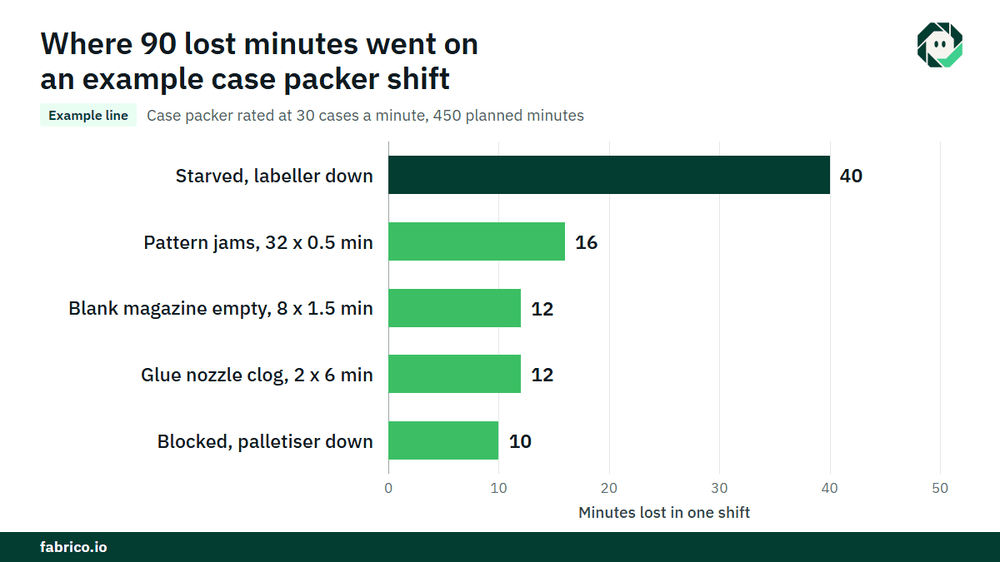
Sample line (illustrative numbers, not a customer): a case packer packing 12-bottle cases, rated at 30 cases a minute, behind a filler at 300 bottles a minute (25 cases a minute), on a shift with 450 minutes of planned production time.
| State | Minutes | Charged to |
|---|---|---|
| Running | 360 | None |
| Starved, labeller down | 40 | Labeller |
| Blocked, palletiser down | 10 | Palletiser |
| Blank magazine empty, 8 x 1.5 minutes | 12 | Packer |
| Glue nozzle clog, 2 x 6 minutes | 12 | Packer |
| Pattern jams, 32 x 0.5 minutes | 16 | Packer |
| Total | 450 |
- Availability, all causes = 360 / 450 = 80.0%.
- Availability, own causes only = (450 minus 40) / 450 = 410 / 450 = 91.1%. So 50 of the 90 lost minutes belong to the labeller and the palletiser.
- The tables upstream of the packer protect the filler for 2 minutes. Magazine empties and pattern jams end inside that window, so the filler keeps running as long as the tables drain between stops.
- Each 6 minute glue clog blocks the filler for 6 minus 2 = 4 minutes. Two clogs: 8 minutes.
- 8 minutes x 300 bottles = 2,400 bottles, or 200 cases.
- At a contribution of $1.50 a case: $300 a shift, or €300 in a euro plant at €1.50 a case. Over 750 shifts a year: $225,000, or €225,000.
The pattern jams carry more own minutes, 16 against 12, but the glue clogs are what cost the line. Ranked by money, the glue gun goes first. Ranked by minutes, the crew would have started on the wrong problem.
Mistakes plants make with case packer OEE
- Treating each packer stop as a packer problem without checking starved and blocked.
- One rated speed for every pack format.
- No code for blank quality, so supplier problems land on the crew.
- Filtering out short stops, so pattern jams never reach the Pareto.
- Ranking losses by minutes instead of by what they cost the line.
Where Fabrico fits
Fabrico is a computer vision enabled Manufacturing Performance Platform. OEE and light MES come first: automatic downtime logging that keeps own stops, starved and blocked time apart, and OEE live by line and shift.
- The operator confirms the reason in one tap, so a blank misfeed and a glue skip get different codes.
- A camera clip as evidence for a stop, where a camera watches the magazine or the collation.
- Losses priced in money and ranked, so the stop that blocks the filler rises to the top.
- One view across plants for packers on different sites.
- A work order with its cost to the right technician when a stop is a breakdown.
You start on one line, with a baseline and a decision date agreed in advance. Each plant gets a quote after a review of its lines. See how stops are logged and coded on our downtime tracking page.
Frequently asked questions
How do you calculate case packer OEE?
Availability is run time over planned production time, Performance is cases packed over what the packer could pack at its rated speed for that format, and Quality is good cases over cases packed. Multiply the three.
What causes case packer jams?
Common causes are warped or damp blanks, double picks from the magazine, tipped product in the collation lanes, a wrong count in the pattern and glue that strings or skips. Code them separately so the Pareto shows which one costs most.
Should starved time count against the case packer?
Show it in the packer's full OEE, but charge it to the machine upstream that stopped first. Judge the packer on its own causes and on the minutes it blocked the filler.
What is a good changeover time for a case packer?
There is no general figure; it depends on the machine and the formats. Measure your own changeovers to the first good case at rated speed, set a standard per format pair and track the minutes over it.
Is the case packer the bottleneck of the line?
Usually not. On most lines the filler sets the pace and the packer has spare speed. It becomes the line's problem when its stops outlast the buffer and block the filler.
See your packer's losses in a demo
Bring one line and its current downtime log. We will show the packer's own stops, its starved and blocked minutes and what each one cost.








Real Fabrico tiles, sample data.