


 Login
 Blog
OEE for Coffee Capsule Lines: Lanes, Lidding, Nitrogen and Weights

Key takeaways
- The ideal rate of a capsule filler is cycles per minute times all lanes, set per product. A closed lane is a Performance loss with its own code.
- At high speed the biggest losses are often short stops: double capsules, lid pick misses, a capsule not seated. Count them or they disappear into slow running.
- Nitrogen supply is a quality gate. A drop in pressure can put a run on hold while the line keeps running.
- Weight depends on grind. A grind or blend change is a changeover in its own right, with its own purge and checks.
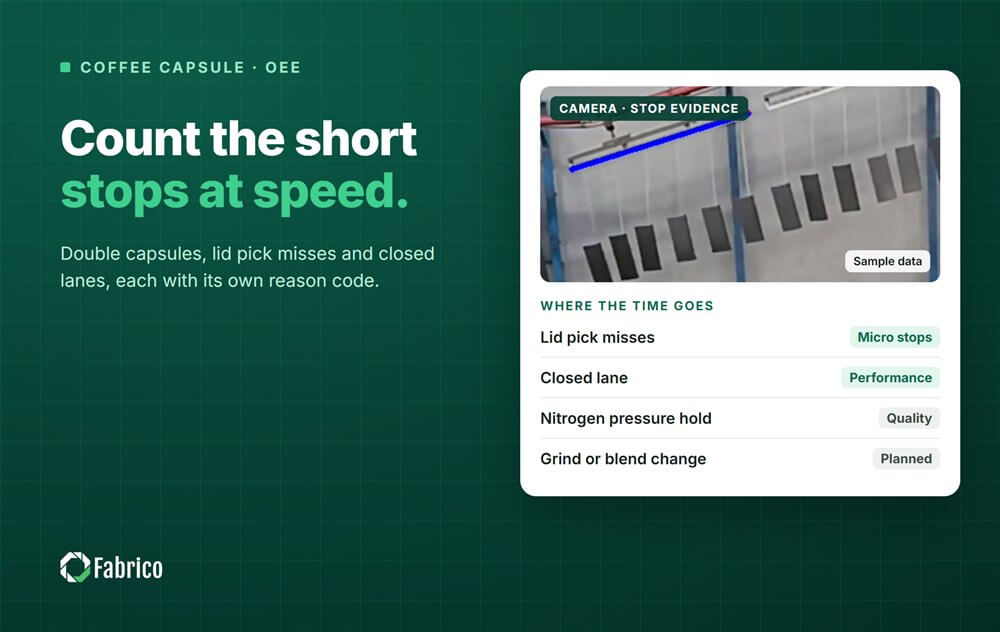
- The PLC says stopped. A camera over the lidding station keeps a clip of the lid that did not land.
At 06:40 the nitrogen pressure on the capsule line dipped. The line ran on, the quality sample at 07:00 came back out of spec for residual oxygen, and twenty minutes of capsules went on hold. The OEE screen showed the line running the whole time, because by every machine signal it was.
Coffee capsule and pod lines are fast, multi-lane and unforgiving. A machine can fill and seal hundreds of capsules a minute across its lanes, and a fault that lasts a few seconds costs more capsules than a long stop on a slower line. Quality depends on coffee weight, a clean sealing rim and a nitrogen flush, and none of them shows on a run signal.
This guide covers the line, the ideal rate, short stops, nitrogen, weights and dosing, grind changeovers, data sources and a worked shift.
Where the time goes on a capsule line
Empty capsules are denested and placed into a carrier or format plate with several lanes. Each lane has a dosing unit that fills ground coffee by weight or volume, and on many machines the dose is compacted. The sealing rim is cleaned of coffee grounds, the station runs under a nitrogen flush to lower the oxygen in the capsule, and a lid is placed, from a magazine of cut lids or cut from a reel, and heat sealed. Capsules are weighed, rejects are ejected, and the rest go to a cartoner or a flow wrapper. Soft pods follow a similar path with filter paper webs instead of rigid capsules.
The time goes to capsule feed faults, dosing faults, lid feed and sealing faults, nitrogen supply, weight rejects, and changeovers between blends and grinds.

The ideal rate: cycles times lanes
The ideal rate is the rated cycles per minute times the number of lanes. A 10-lane machine at 30 cycles a minute has an ideal of 300 capsules a minute. Set the cycle rate per product from the OEM rating or the best speed the machine holds for a full hour on that product, because dose weight, compaction and the lid material all change how fast it can run.
Keep the ideal on all lanes when one is closed. A closed lane on a running machine is then a Performance loss, and it should carry its own code with the lane number, a start and an end. If the ideal follows the running lanes, the lost capsules vanish. Our guide to rate loss on high-speed lines shows how to break the Performance gap into its parts.
Short stops at high speed
On a capsule machine, the typical short stop lasts seconds: a double capsule in the denester, a capsule not seated in the carrier, a lid that the pick-up missed, a capsule that tipped at the transfer. The operator clears it and restarts. At hundreds of capsules a minute, a handful of these an hour can cost more output than the shift's one long breakdown.
Set a stop cutoff and write it down. Stops above it are downtime with a reason in Availability; shorter stops are booked in Performance. Then count the short ones by type, because a lid pick problem and a denester problem have different fixes. Our article on micro stops on packing lines explains why they never reach a paper log.
Typical stops and their causes
| Station | Typical stop or loss | Usual cause | OEE factor |
|---|---|---|---|
| Capsule feed | Double capsule, capsule not seated | Denester set-up, capsule quality, static | Performance |
| Dosing | Lane fault, weight drift | Coffee build-up, grind change, low hopper | Closed lane, Quality |
| Rim cleaning | Grounds left on the rim | Vacuum or brush worn, dose overflow | Quality, through bad seals |
| Nitrogen flush | Stop or product on hold | Supply pressure, hood leaks, flow setting | Availability, Quality |
| Lid feed and sealing | Lid missing, magazine empty, seal fault | Pick-up wear, lid stock, seal temperature | Performance, Availability, Quality |
| Weighing and outfeed | Rejects, outfeed full | Light or heavy capsules, cartoner stop | Quality, Availability when blocked |
Nitrogen flush and held product
The nitrogen flush lowers the oxygen left in the capsule, which protects the coffee's shelf life. Residual oxygen is usually checked on samples taken during the run, not on each capsule. That makes nitrogen a delayed quality gate: if pressure drops, the line can run on, and the problem shows only when the next sample comes back.
Two things help. Treat a nitrogen supply fault as a stop with its own code, so its minutes are visible. And agree in advance how held product counts in OEE: as not good until it is released, or as good with a correction if it is later scrapped. Either rule works if it is written down and kept.
Weights, dosing and the sealing rim
Dose weight depends on the grind. A finer grind packs differently from a coarser one, and a new batch of the same blend can behave differently from the last. Each capsule is checked, light capsules are rejected and count against Quality, and heavy capsules pass as good while giving coffee away. Our article on giveaway and overfill covers how to price that.
Coffee grounds on the sealing rim cause seal faults, and a bad seal lets oxygen in. When seal rejects rise on one lane, look at that lane's dose and rim cleaning first.
Grind and blend changeovers
A blend or grind change empties and purges the hopper and the dosing units, swaps the lid reel or magazine if the print changes, loads the recipe and checks the first capsules for weight and seal. A move from a regular blend to a decaf usually needs a more thorough purge, to the plant's own standard. Count the change from the last good capsule of the old product to the first good capsule of the new one at rated speed.
The minutes to win are in preparation: the next blend at the hopper, the next lids at the machine, the check sheet ready. The order of products matters too, because a plan that groups similar blends needs fewer full purges. Our guide to SKU changeover sequence covers how plants weigh that.
What each data source sees
- The PLC gives the machine state, alarms, the cycle count and often the nitrogen pressure.
- The weighing system gives each capsule's weight and the rejects, often by lane.
- A camera over the denester or the lidding station shows what an alarm cannot: the double capsule, the lid that did not land, grounds on a rim. The clip is the evidence for the stop.
- The quality samples give residual oxygen and seal checks.
- The operator confirms the reason.
A worked shift
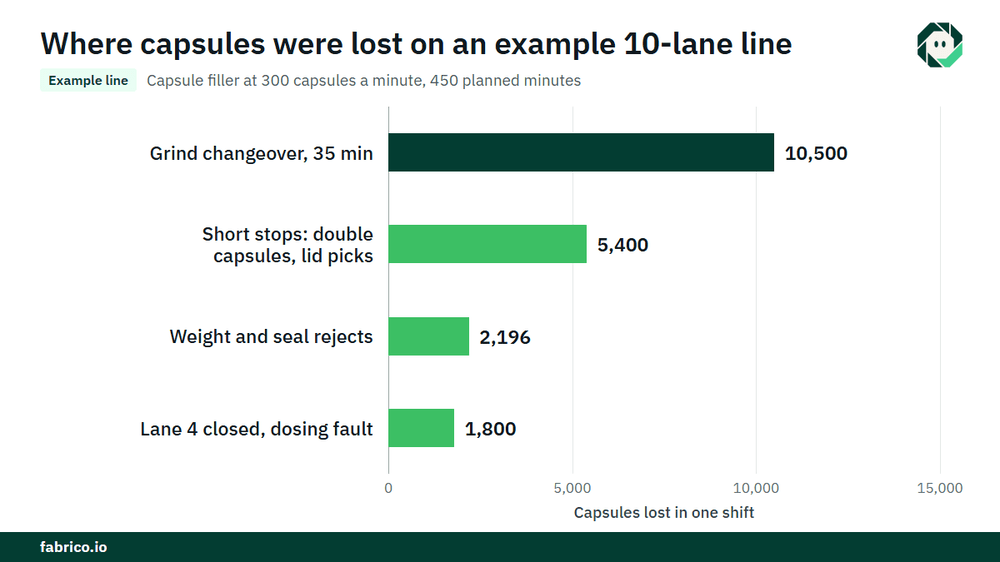
Sample line (illustrative numbers, not a customer): a 10-lane capsule filler rated at 30 cycles a minute, so the ideal rate is 300 capsules a minute. The shift has 450 minutes of planned production time, so 135,000 capsules are possible. Stops above the 2-minute cutoff: a grind changeover of 35 minutes, three lid magazine stops of 5 minutes (15) and a nitrogen pressure stop of 10 minutes, 60 minutes in all. Run time is 390 minutes, so Availability = 390 / 450 = 86.7%.
At 300 a minute, 390 minutes should give 117,000 capsules. The counter shows 109,800, so Performance = 109,800 / 117,000 = 93.8%. Of the 7,200 missing, 1,800 come from lane 4, closed for 60 minutes with a dosing fault (60 x 30). The other 5,400 are 18 minutes at full rate of short stops: double capsules and lid pick misses.
Weight and seal rejects are 2,196, so the good count is 107,604 and Quality = 107,604 / 109,800 = 98.0%. OEE = 0.867 x 0.938 x 0.980 = 79.7%. Check: 107,604 good capsules out of 135,000 possible is 79.7%.
Price it at a contribution of $0.05 a capsule, €0.05 in a euro plant. The grind changeover is 35 x 300 = 10,500 capsules, $525 (€525). The short stops are 5,400 capsules, $270 (€270). The closed lane is 1,800 capsules, $90 (€90). The rejects are 2,196 capsules, $109.80 (€109.80) before the coffee and materials inside them.
Where Fabrico fits
Fabrico is a computer vision enabled Manufacturing Performance Platform. On a capsule line it starts with OEE and light MES: automatic downtime logging from the machine signal and OEE live by line and shift, so the short stops are recorded with the changeovers.
The operator confirms the reason in one tap, so a closed lane, a lid pick miss or a nitrogen fault each get their own code. Where a camera watches the denester or the lidding station, a camera clip is kept as evidence for a stop. The camera suggests the reason, the operator decides.
Losses are priced in money and ranked by money, so a changeover and a lid problem can be compared in one currency. A breakdown becomes a work order to the right technician with its cost. One view across plants compares capsule lines across sites, and you start on one line with a decision date agreed in advance. More in our guide to OEE for CPG manufacturing.
Each plant gets a quote after a review of its lines.
Frequently asked questions
How do you calculate OEE on a coffee capsule machine?
Set the ideal rate as rated cycles per minute times all lanes, per product. Availability is run time over planned production time, Performance is the capsule count over run time times the ideal rate, and Quality is good capsules over all capsules.
Is a closed lane on a capsule filler downtime?
Not for the machine, which is running. It is a Performance loss with its own reason code. Measured lane by lane, the same time is an Availability loss for that lane, and the machine OEE comes out the same.
How does nitrogen flushing affect OEE?
A nitrogen fault can stop the line, which is an Availability loss, or let it run while residual oxygen goes out of spec, which puts product on hold. Code supply faults as stops, and agree how held product counts.
Why do coffee capsule weights vary?
Because grind size and bulk density change with the blend and the batch, and dosing units build up. Weight checks and dose corrections catch most of it; light capsules are rejected, heavy ones give coffee away.
See your capsule line's losses in a demo
Bring one shift of machine and weight data. We will show where the short stops, closed lanes and rejects sit, and what each costs.








Real Fabrico tiles, sample data.