


 Login
 Blog
OEE for Confectionery and Chocolate Lines: Where the Minutes Go

Key takeaways
- Measure OEE in one unit, at the rated speed of the machine that paces the line for that product, often the wrapper.
- When the wrapper stops, the moulding side keeps running and bars go to an off-load table, so count what was moulded and what was wrapped.
- Changeovers and validated allergen cleans get their own codes: measured, kept apart from breakdowns, never shortened.
- Broken bars, bloom and remelted rework are quality losses.
- The wrapper PLC knows it stopped; a camera clip shows what happened, and the operator confirms the reason.
The temper meter on the moulding line reads out of range at 06:40, the depositor is held, and the cooling tunnel slowly empties onto a wrapper with nothing to wrap. Twenty minutes later the line runs again. The shift report says 'temper', the OEE figure drops, and nobody knows how many bars from the next hour went to rework.
Chocolate lines lose time in ways a bottling line does not, because the product cannot simply wait. The general rules are in our guide to OEE for food and beverage. This article covers confectionery: the stations, the stops, how to measure each OEE factor, changeovers and cleaning, and a worked shift with the losses priced.
The stations and where the time goes
A moulding line runs in a loop. Moulds are heated, filled by the depositor with tempered chocolate, shaken to release air, cooled in the tunnel and turned over so the bars drop out at demoulding. The bars go to one or more flow wrappers, then to a cartoner or case packer. An enrobing line is straight: centres pass under a chocolate curtain, a blower takes off the excess, and the product goes through the cooling tunnel to the wrappers.
Gums made in a starch mogul add a drying room, a batch step inside a continuous line. Measure it on its own and keep it out of the packing line's OEE.
The time goes in four places: temper and viscosity at the front, moulds and depositor in the middle, wrapper stops at the end, and changeovers. The cooling tunnel rarely breaks, but it sets the recovery time after any stop, because it has to fill again before the wrapper sees product.

Which machine sets the ideal rate
On a moulding line the depositor and mould chain run at a set number of moulds a minute, so the design rate in bars is moulds a minute times cavities per mould. The wrapper is usually sized to keep up, but on small bars, multipacks or fold wraps it often cannot, and then the wrapper is the constraint.
Set the ideal rate per product from the machine that paces the line, at its rated speed, and note where the number came from. If your wrapper is rated at 600 bars a minute on one format and 450 on another, those are two ideal rates. Never use last month's best shift: that hides slow running inside the ideal. Count in one unit across the line, bars for example, so OEE moves with the line and not with the pack size.
Availability: the stops that take the line down
| Station | Typical stops | Where the loss lands |
|---|---|---|
| Tempering | Temper out of range, viscosity drift, cold pipes | Availability; bars made before the alarm are quality |
| Depositor | Nozzle tailing, piston leaks, moulds not filled | Availability; weight drift is quality |
| Demoulding | Bars not releasing, mould jams | Availability; broken bars are quality |
| Cooling tunnel | Temperature or humidity out of range | Availability; bloom is quality |
| Flow wrapper | Film splice, print mark not read, seal jaw temperature, bars out of pitch | Availability for long stops, Performance for micro stops |
| Cartoner, case packer | Carton magazine empty, glue gun clog | Availability, or blocking the wrapper |
Pick a threshold, many plants use two to five minutes: stops above it are Availability losses with a reason, shorter ones go to Performance. No standard sets it, so keep the same threshold on all lines.
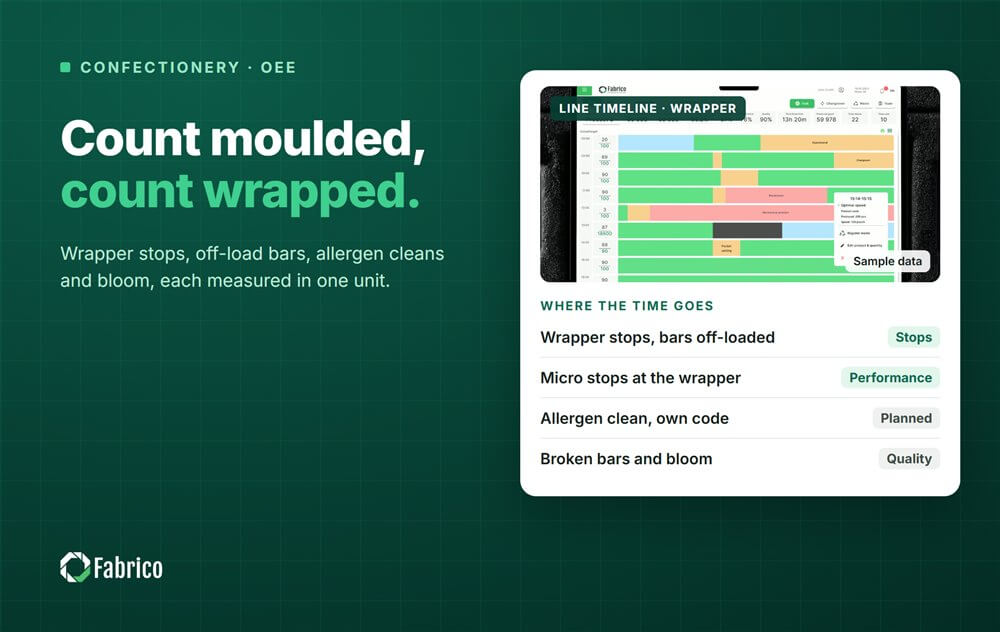
One trap is specific to chocolate. When the wrapper stops, the moulding side usually keeps going, because stopping a full mould chain or an enrober curtain costs more than diverting product. Bars go to an off-load table by hand. The depositor never stopped, the line's output fell, and OEE measured at the depositor shows nothing.
Product changeovers and cleaning
A new chocolate type can mean purging the tempering machine, pipes and depositor until the new mass runs clean, changing moulds, changing film and jaw settings on the wrapper, and a first-off check of weight, shape and print. Moving from a product with nuts to one without adds a validated allergen clean.
Log each part on its own: purge, mould change, wrapper format change, restart. The validated allergen clean gets its own code. Do not shorten it to win OEE points: it is a food safety control, as our guide to allergen changeover validation explains. Measure it and keep it apart from breakdowns so it does not hide them.
The rest is open to SMED: preheat the next moulds while the line runs, stage film reels and change parts, write down wrapper settings. Record a standard time for each changeover and log each minute over it with a reason.
Performance: micro stops and slow running at the wrapper
Wrappers stop often and briefly. A crooked bar is rejected at the infeed, a print mark is missed, two bars land in one pitch. These micro stops are cleared by the operator and rarely written down. Our guide to micro stops on packing lines shows how to find them.
Slow running is the other half. Operators turn the wrapper down when seals fail or soft bars smear the jaws, and the lower speed becomes normal. Compare running speed with rated speed per product each shift.
Watch the gap after a front-end stop too. A ten minute depositor stop sends a gap through the tunnel, and the wrapper sees it as starvation later. Charge that time to the machine that caused it, as described in starvation and blocking on linked lines.
Quality: broken bars, bloom and rework
Quality is good units out divided by units made. The usual losses are broken bars at demoulding and transfers, misshapes and air bubbles, fat bloom from poor temper, sugar bloom from condensation, bad seals, checkweigher rejects and start-up product made before temper is stable.
Broken chocolate often goes back into the mass as rework. It is still a quality loss: the line spent time making it. Giveaway, product above the declared weight, does not reduce the good count, but it is money: track it at the checkweigher next to OEE.
Data sources: what each one sees
The wrapper PLC gives run state, stop codes and counts. The depositor counter gives bars made, so the gap to bars wrapped shows breakage and off-load. The checkweigher gives rejects and giveaway, the temper meter and tunnel sensors give the process readings. The operator gives the reason, in one tap.
The PLC is the clock and the camera is the witness. Where the wrapper PLC says only 'stopped', a camera at the infeed shows whether bars jammed, the film ran out or nothing arrived. The software suggests a reason, the operator confirms it, and the clip stays with the stop as evidence.
A worked shift on a moulding line
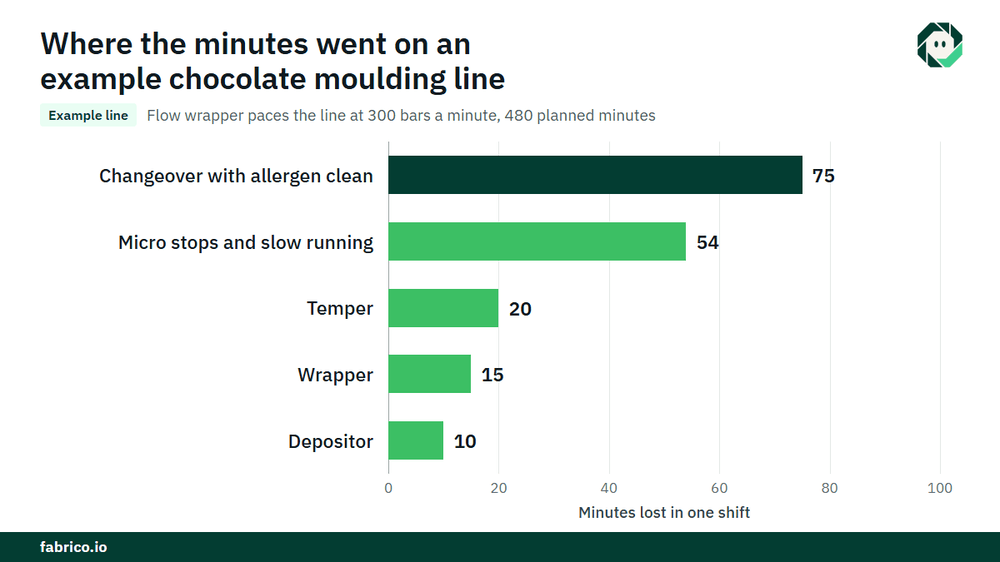
Sample line (illustrative numbers, not a customer): a moulding line with one flow wrapper, rated at 300 bars a minute for this product, runs a 480 minute shift with crews covering breaks, so planned production time is 480 minutes.
- Changeover with a validated allergen clean: 75 minutes, against a standard of 60.
- Stops over three minutes: temper 20 minutes, depositor 10, wrapper 15. Total 45 minutes.
- Run time: 480 minus 75 minus 45 = 360 minutes. Availability = 360 / 480 = 75.0%.
- Ideal output: 360 x 300 = 108,000 bars. Bars made: 91,800. Performance = 91,800 / 108,000 = 85.0%.
- Broken bars and rejects: 1,836. Good bars: 89,964. Quality = 89,964 / 91,800 = 98.0%.
- OEE = 0.750 x 0.850 x 0.980 = 62.5%. Check: 89,964 / 300 = 299.9 minutes at ideal rate, and 299.9 / 480 = 62.5%.
The Performance loss is 108,000 minus 91,800 = 16,200 bars, or 54 minutes at rated speed. The changeover overrun is 15 minutes, or 4,500 bars. If the line is sold out and a bar carries $0.12 of contribution (€0.12 in a euro plant), the micro stops and slow running cost $1,944 a shift and the overrun $540. Over 500 shifts a year that is $972,000 and $270,000 (€972,000 and €270,000). The 60 minute allergen clean is not a loss to cut: it is the cost of running both products on one line.
Mistakes plants make on confectionery lines
- Measuring OEE at the depositor, so wrapper stops and off-loaded bars never show.
- Charging starved time to the wrapper when the gap came from upstream.
- Hiding the whole changeover, overrun included, in planned time.
- Treating the validated allergen clean as a target to cut.
- Counting remelted rework as good output.
Where Fabrico fits
Fabrico is a computer vision enabled Manufacturing Performance Platform. On a confectionery line it starts with OEE and light MES:
- Automatic downtime logging from the wrapper, the depositor and the other machines.
- The operator confirms the reason in one tap, so temper, mould and wrapper stops each carry a cause.
- A camera clip as evidence for a stop where a camera watches the station, such as the wrapper infeed.
- Losses priced in money and ranked by money, so the overrun and the micro stops compare in dollars or euros.
- OEE live by line and shift, and one view across plants.
- When a stop needs a technician, a work order goes to the right technician with its cost.
The allergen clean and its records stay with the plant's own procedures. You start on one line, with a measured baseline and a decision date agreed in advance. Each plant gets a quote after a review of its lines. See how stops get their cause on our downtime tracking page.
Frequently asked questions
How do you calculate OEE on a chocolate line?
Multiply Availability, Performance and Quality. Availability is run time over planned production time, Performance is bars made over what the ideal rate allows in that run time, Quality is good bars over bars made. Use one unit and one ideal rate per product.
What is a good OEE for a confectionery line?
The often quoted 85% world class figure is usually traced to Seiichi Nakajima's Introduction to TPM (1988). A line with several changeovers a day scores lower than a dedicated line, so compare each line with its own baseline.
Should cleaning time count in OEE?
Plants differ: some keep the validated clean inside planned production time as its own loss, others treat it as planned downtime. Either way, log it under its own code, measure it, and never mix it with breakdowns or shorten it.
Is rework chocolate a quality loss?
Yes. Broken, misshapen or bloomed bars were not good the first time, even if the chocolate is remelted. Count them as rejects and track how much goes back into the mass.
Can a camera tell why a flow wrapper stopped?
It shows what happened at the station it watches, such as a jam at the infeed or an empty belt. The software suggests a likely reason and the operator confirms it. It cannot see inside a closed machine.
See your line's losses in a demo
Bring one confectionery line's stops and rates, and we will show them priced in money, by station and by shift.








Real Fabrico tiles, sample data.