


 Login
 Blog
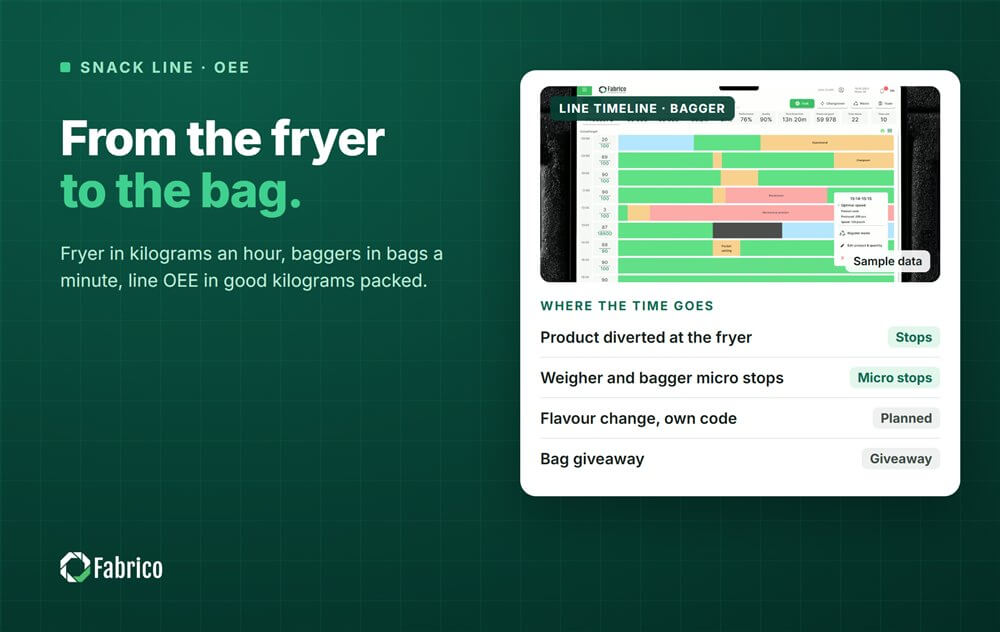
OEE for Snack Food Lines: From the Fryer to the Bagger

Key takeaways
- Measure the fryer in kg an hour and each weigher and bagger in bags a minute; report line OEE in good kg packed.
- The fryer rarely stops for the packers: when a bagger stops, product is diverted or the fryer is turned down, and both are losses.
- Flavour changes and allergen cleans get their own codes: measured, kept apart from breakdowns, never shortened.
- Bag giveaway does not lower OEE, but it is product nobody pays for: track it next to OEE.
- Where a bagger PLC says only 'stopped', a camera clip shows what happened and the operator confirms the reason.
At 10:15 the seal jaws on bagger two jam on a crumb of seasoning. The fryer keeps running, the distribution conveyor sends more chips to the other two weighers, and when they fill up the overflow goes to a scrap bin. On the OEE report the hour looks fine at the fryer and poor at the packers, and nobody can say which number is the line.
Snack lines join a continuous process, slicing, frying or baking and seasoning, to discrete packing: multihead weighers and vertical baggers. That joint is where most OEE confusion starts. This guide covers where to measure, how to set the ideal rates, the usual stops, seasoning changes, giveaway, and a worked shift with the losses priced.
Where to measure OEE on a snack line
A potato chip line runs from peeler and slicer through washing, the fryer, de-oiling and an optical sorter to the seasoning drum, then along a distribution conveyor to several weigher and bagger stations, a case packer and a palletiser. Extruded and baked snacks swap the slicer and fryer for an extruder, oven or dryer, but the shape is the same: one continuous process feeding several packing machines.
Measure at two levels. On many lines packing is sized above the fryer so the baggers can catch up, which makes the fryer the constraint. Its OEE is in kg an hour of finished product. Each weigher and bagger station gets its own OEE in bags a minute, so you see which one stops. The line figure is good kg packed against the fryer's rated output over planned time. Our guide to OEE across multiple machines covers the arithmetic.

Setting the ideal rates
For the fryer, the ideal rate is the rated output in kg an hour for that product, from the design or a tested maximum, not a good week's average. Thin chips, kettle chips and extruded shapes run at different rates, so give each its own. If the fryer is turned down because the potatoes are poor, that is a speed loss with a reason, not a new ideal.
For a weigher and bagger station, the ideal is bags a minute for that bag size and film. A bagger that is fast on a small bag is slower on a family bag. Use the slower of the weigher and the bagger for each bag size as the station's ideal.
Stops by station
| Station | Typical stops | OEE factor |
|---|---|---|
| Slicer and washer | Blade changes, gaps in the potato feed, stones | Availability; blade changes can be planned |
| Fryer | Oil temperature out of range, feed interruptions, belt faults | Availability, or speed loss when turned down |
| Seasoning drum | Applicator blocked, seasoning hopper empty, flavour change | Availability; uneven coverage is quality |
| Multihead weigher | Product sticking in buckets, feeder pans out of tune, no valid combination | Performance; under weight rejects are quality |
| Vertical bagger | Film splice, print registration, product in the seal, jaw jam, gas flush faults | Availability for long stops, Performance for micro stops |
| Case packer | Case magazine empty, glue gun clog, bag jam at the infeed | Availability, or blocking the bagger |
When a bagger stops, the fryer usually keeps running. The product goes to the other stations, to a surge bin or to scrap. That is why a fryer can show a perfect hour while the line loses output. Charge the diverted product to the station that stopped, not to the fryer, as explained in finding the real constraint on linked lines.
Seasoning and flavour changes
With seasoning in a drum after the fryer, a flavour change means emptying and cleaning the drum and applicator, loading the new seasoning, and sending the mixed product in between to rework or scrap. A change from a flavour with milk to one without needs a validated allergen clean. Do not shorten it to win OEE points: measure it, give it its own code and keep it apart from breakdowns. More in our guide to allergen changeover validation.
Lines with seasoning at each packing station change one station at a time while the fryer keeps going. That moves the changeover out of the process and into one station's Availability. Either way, record a standard time per change and log each minute over it with a reason.
Micro stops at the weighers and baggers
Most snack line stops are short. Oil and seasoning make product stick in weigher buckets, fines get into the bag seal, the film splice passes the jaws, a bag jams at the case packer infeed. The operator clears each one in under a minute, and each one sends product to the overflow. Logged by hand, they vanish. Our guide to micro stops on packing lines shows how to bring them into the open.
Slow running hides here too. A bagger turned down to stop leaking seals on one film keeps that speed after the film is gone. Compare bags a minute with the rated speed for that bag size, shift by shift.
Quality losses and bag giveaway
Quality on a snack line is good kg packed over kg made. The losses: chips rejected by the optical sorter for colour or defects, broken product and fines, product scrapped at the overflow while a bagger was down, mixed flavour at changeovers, and bags rejected for leaking seals, bad codes or weight.
Giveaway is separate. A multihead weigher set above the declared weight, to stay clear of under weight rejects, packs product that is never paid for. Overfilled bags still count as good, so OEE does not show it. Track the average pack weight against the declared weight per station and price the difference, as in our guide to giveaway and overfill.
Data sources and what the camera adds
The fryer PLC gives state, oil temperature and feed rate; a weigh belt after the fryer gives kg made. Each weigher reports weighments and average weight, each bagger its state, stops and bag count. The checkweigher gives rejects. The operator gives the reason, in one tap.
What is missing is why. Where a bagger PLC says only 'stopped', a camera watching the weigher discharge or the jaws keeps a clip of what happened: product bridging in a hopper, a film break, a bag caught in the jaws. The software suggests a reason, the operator confirms it, and the clip stays with the stop as evidence.
A worked shift on a chip line
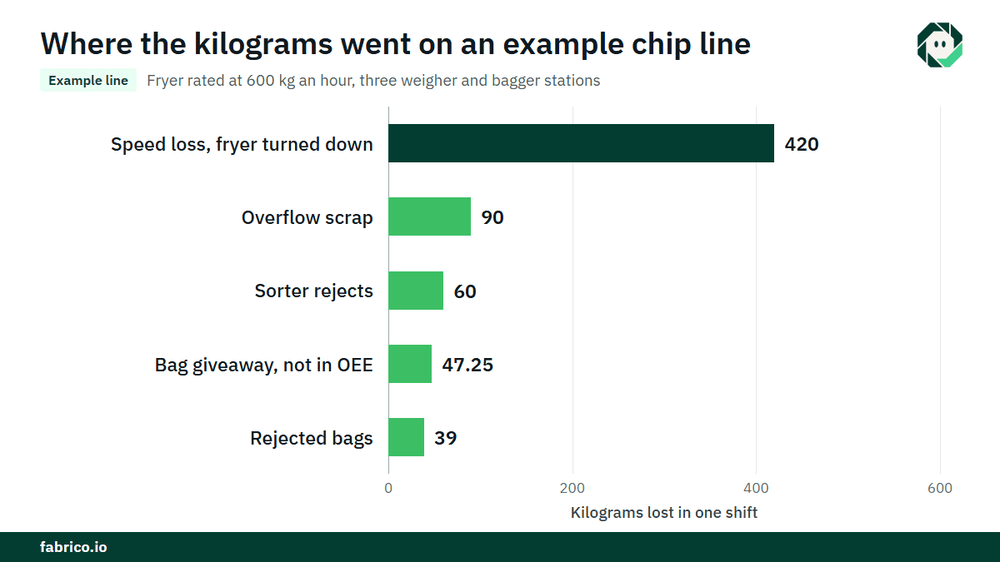
Sample line (illustrative numbers, not a customer): a fryer rated at 600 kg of finished chips an hour feeds three weigher and bagger stations packing 150 g bags. Planned production time is 480 minutes.
- Flavour change with allergen clean: 45 minutes. Fryer and slicer stops: 15 minutes. Run time = 480 minus 60 = 420 minutes. Availability = 420 / 480 = 87.5%.
- Ideal output in 420 minutes: 7 hours x 600 = 4,200 kg. The weigh belt measured 3,780 kg, because the fryer was turned down while baggers were stopped. Performance = 3,780 / 4,200 = 90.0%.
- Losses: sorter rejects 60 kg, overflow scrap 90 kg, rejected bags 39 kg, total 189 kg. Good packed = 3,591 kg. Quality = 3,591 / 3,780 = 95.0%.
- OEE = 0.875 x 0.900 x 0.950 = 74.8%. Check: 3,591 kg / 600 kg an hour = 5.985 hours, or 359.1 minutes, and 359.1 / 480 = 74.8%.
Now price it. If the line is sold out and a kg of chips carries $3.00 of contribution (€3.00 in a euro plant), the 420 kg of speed loss cost $1,260 a shift. Giveaway comes on top: the weighers averaged 152 g on a 150 g bag, so the 3,591 kg filled 23,625 bags with 2 g extra each, 47.25 kg of product. At a variable cost of $2.00 a kg (€2.00) that is $94.50 a shift. Over 600 shifts a year: $756,000 of speed loss and $56,700 of giveaway, or €756,000 and €56,700.
Mistakes plants make on snack lines
- Taking the fryer's OEE as the line's OEE, so bagger stops and overflow scrap never show.
- Using a different unit at each machine instead of kg.
- Booking overflow scrap to the fryer instead of the bagger that stopped.
- Shortening a validated allergen clean at a flavour change to save minutes.
- Leaving giveaway out of the loss review because OEE does not show it.
Where Fabrico fits
Fabrico is a computer vision enabled Manufacturing Performance Platform. On a snack line it starts with OEE and light MES: automatic downtime logging at the fryer and at each weigher and bagger, and OEE live by line and shift.
- The operator confirms the reason for a stop in one tap, at the station where it happened.
- A camera clip as evidence for a stop where a camera watches a weigher or bagger.
- Losses priced in money and ranked by money, so speed loss, overflow scrap and changeover overruns compare in dollars or euros.
- One view across plants for groups running several snack lines.
- For a breakdown, a work order to the right technician with its cost.
You start on one line, with a measured baseline and a decision date agreed in advance. Each plant gets a quote after a review of its lines.
Frequently asked questions
Where should OEE be measured on a snack line?
At two levels: the fryer or oven in kg an hour, and each weigher and bagger station in bags a minute. Report line OEE as good kg packed against the fryer's rated output over planned time, so losses at both ends show.
Is giveaway part of OEE?
No. Overfilled bags still count as good, so giveaway does not lower OEE. Track it beside OEE, per weigher, and price it.
How do you handle a flavour change in OEE?
Log it as a changeover with its own code and a standard time. If it includes a validated allergen clean, measure that part separately and never shorten it. Minutes over the standard get a reason.
What is the ideal rate for a multihead weigher and bagger?
The rated bags a minute for that bag size and film, taken from the slower of the two machines. Use the design or a tested maximum, not the average of a good week.
Can a camera find the cause of bagger micro stops?
It keeps a clip of what happened at the station it watches, such as product bridging in a hopper or a bag caught in the jaws. The software suggests a reason and the operator confirms it. It does not see inside closed machines.
See your snack line's losses in a demo
Bring the stops and rates from one fryer and its baggers, and we will show the losses priced in money, station by station.








Real Fabrico tiles, sample data.