


 Login
 Blog
OEE for Tissue Converting: Web Breaks, Reel Changes and Packing

Key takeaways
- Measure OEE in good rolls against the rated speed of the machine that sets the pace for that SKU, often the bundler on large packs.
- Web breaks and parent reel changes are Availability losses, each with its own reason code and a standard time.
- Short stops at the core feed, the log saw and the packer infeed hide in Performance.
- Track Quality in rolls and in kilograms of paper: trim and broke rarely become rolls.
- The PLC says the rewinder stopped. A camera clip shows what happened, and the operator confirms the reason.
Halfway through the night shift, the bundler at the end of line 2 stops for the fourth time in an hour. The log accumulator fills, the rewinder slows down, and by the time the operator has stood the toppled rolls back up, the line has lost more minutes that nobody writes down. On a tissue converting line, that is where OEE goes: not in one big breakdown, but in many short stops spread across the unwind, the rewinder, the log saw and the packer.
This guide is for plant managers, production engineers and CI leads on toilet tissue and kitchen towel lines. It covers where the time goes by station, how to set the ideal rate when the packer sets the pace, how to book web breaks and reel changes, and how to measure Quality in rolls and in paper.
The converting line, station by station
- Unwind stands. Each ply comes from a parent reel. When a reel runs out, the crew or an automatic splicer joins the next one.
- Embossing and lamination. Engraved steel rolls press the pattern, and glue bonds the plies on two-ply and three-ply products.
- Perforation. A blade and an anvil cut the perforation at the sheet length.
- Rewinder. Winds the web onto cores into logs and glues the tail. A core winder upstream supplies the cores.
- Log accumulator. Stores logs, so a short stop downstream does not stop the rewinder at once.
- Log saw. Cuts logs into rolls and trims both ends. Grinding wheels sharpen the blade as it runs, and it is replaced when worn.
- Wrapper and bundler. Groups rolls into packs, wraps them in film and bundles them for the pallet.
The stations are linked, so one OEE figure suits the plant manager, but the CI lead needs the losses by station to know what to fix.

Where the time goes on a converting line
| Station | Typical stops | OEE factor | What the signal shows |
|---|---|---|---|
| Unwind | Parent reel change, failed splice, reel with holes or weak spots | Availability | Unwind stopped, reel diameter |
| Embosser and laminator | Web break, glue build-up, web wrapped round a roll | Availability | Line stopped, sometimes a fault code |
| Rewinder | Web break, core jam, tail not glued, log ejection fault | Availability or Performance, by length | Rewinder stopped, log count |
| Log saw | Blade change, log stuck at the infeed | Availability and Performance | Saw stopped, cut count |
| Wrapper and bundler | Toppled rolls at the infeed, film splice, film tracking | Performance | Packer stopped, pack count |
| Whole line | Grade or format changeover, waiting for parent reels | Availability | Line stopped |
Web breaks and reel changes stop the whole line and are long enough to write down. The short stops at the rewinder, the saw and the packer are each too short to log by hand, and over a shift they can cost more output than the breaks.
Setting the ideal rate: which machine sets the pace
Performance compares what the line made with what it could have made in the time it ran. That needs one ideal rate per SKU, in one unit, at one counting point.
The pace setter changes with the product. On a small pack, the rewinder is often the slowest machine. On a large pack format, the bundler may not keep up, and the log accumulator fills. Find the slowest machine for each SKU from its rated speed, convert it to rolls a minute, and use that as the ideal rate.
- Use the rated or best proven speed, never the speed the line usually runs. A good day's average hides the slow running you want to see.
- Count good rolls after the saw, or packs at the bundler times rolls per pack. Never mix logs, rolls and packs in one report.
- If Performance comes out above full speed, the ideal rate is set too low.
Our guides to setting the ideal cycle time and finding the real constraint on a linked line go deeper.
Availability: web breaks, reel changes and changeovers
Web breaks. The web tears at the embosser, the perforator or the rewinder, and the crew clears the broke and threads the web again. Causes include holes and weak spots in the parent reel, tension spikes at a splice, glue build-up and worn perforation blades. Put the location of the break in the reason code, because each location has a different fix.
Parent reel changes. Without automatic splicing, the line stops or slows for each change. Agree a standard time, count the change as an Availability loss and code the minutes over standard separately. A reel change moved into planned time disappears from the loss list, and nobody works on shortening it.
Changeovers. A grade or format change can mean new emboss rolls, a new perforation length, another core size, new saw settings and a new pack format. Time it from the last good pack to the first good pack at rated speed. Our guide to SMED for faster changeovers shows how to move steps outside the stop.
Waiting for parent reels is also an Availability loss. Code it as waiting for material, so the cause points upstream.
Performance: short stops and the log accumulator
The core feed jams for twenty seconds. A log sticks at the saw infeed. Rolls topple at the bundler and the operator stands them up. Each is cleared in under a minute, and none reaches a paper log.
The accumulator hides them further. When the packer stops briefly, it takes the logs and the rewinder keeps running. When the packer stops often, the accumulator fills, the rewinder slows, and the loss shows up upstream with no reason. Charge that time to the station that started it. Our article on starvation and blocking explains how.
Crews also run a weak parent reel below rated speed to avoid breaks. That may be right, but it is a speed loss, and a reason such as weak paper takes the cost to the paper machine or the supplier.
Quality: trim, broke and rejected rolls
In rolls: wrong diameter, loose winding, poor perforation, unglued tails, crushed cores, rough cuts, and packs rejected for bad seals or a wrong count.
In paper: saw trim, broke from web breaks, paper wound off after a reel change and logs scrapped at start-up. Weigh the broke and trim bins by shift against the parent reel weight used. A line can show high Quality in rolls while losing a lot of paper. More in our guide to the OEE Quality factor.
Data sources: what each one sees
| Source | What it gives you | What it misses |
|---|---|---|
| Rewinder and saw PLC | Run state, speed, log and cut counts, fault codes | Why the line stopped when the code only says stopped |
| Packer counter | Packs out, film splices | What happened at the infeed |
| Waste scales | Kilograms of broke and trim | Which stop made the waste |
| Operator input | The reason, the parent reel number | Short stops nobody records |
| Camera at a station | A clip of the moment of the stop | What happens inside a closed machine |
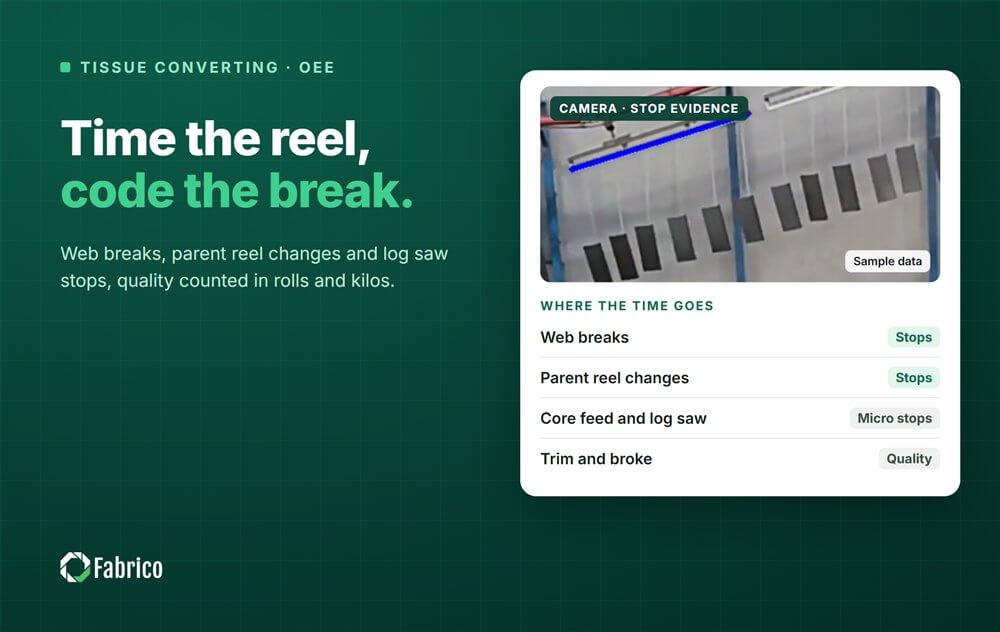
The PLC is the clock: it sets when a stop started and how long it lasted. Where a camera watches the bundler infeed or the rewinder, the clip shows toppled rolls, a wrapped web or a stuck log. A model can suggest the reason; the operator confirms it in one tap.
A worked shift on a toilet tissue line
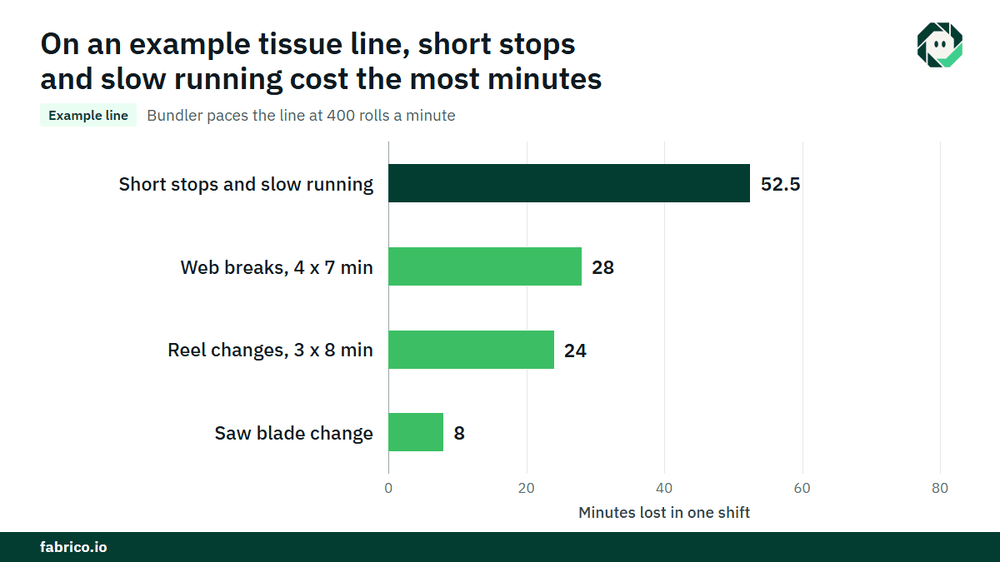
Sample line (illustrative numbers, not a customer): a two-ply toilet tissue line runs a 9-roll pack. The bundler sets the pace at 400 rolls a minute. Planned production time is 480 minutes.
- Stops: four web breaks of 7 minutes (28), three reel changes of 8 minutes (24) and one saw blade change of 8 minutes. Total 60 minutes, so run time is 420 minutes.
- Availability = 420 / 480 = 87.5%.
- Ideal output = 420 x 400 = 168,000 rolls. The saw counted 147,000. Performance = 147,000 / 168,000 = 87.5%. The missing 21,000 rolls are 52.5 minutes at the ideal rate, lost to short stops and slow running.
- Rejected rolls: 2,940. Good rolls = 144,060. Quality = 144,060 / 147,000 = 98.0%.
- OEE = 0.875 x 0.875 x 0.98 = 75.0%. Check: 144,060 / 400 = 360.15 minutes, and 360.15 / 480 = 75.0%.
Price one loss. The 28 minutes of web breaks are 28 x 400 = 11,200 rolls not made. At a contribution of $0.04 a roll (€0.04 in a euro plant), that is $448 a shift. On 900 shifts a year, three shifts on 300 days, it is $403,200, or €403,200, if the line is sold out. If it is not, the loss is the overtime needed to catch up, so agree the rule with your controller first.
Where Fabrico fits
Fabrico is a computer vision enabled Manufacturing Performance Platform. On a converting line it starts with OEE and light MES: automatic downtime logging from the machine signals and OEE live by line and shift.
- Losses priced in money and ranked by money, so the most expensive web break location or short stop gets fixed first.
- The operator confirms the reason in one tap instead of writing it on a sheet after the shift.
- A camera clip as evidence for a stop where a camera watches the bundler infeed or the rewinder.
- A work order to the right technician, with its cost, when a stop turns out to be a breakdown.
- One view across plants, with every line measured the same way.
You can start on one line, with a baseline and a decision date agreed in advance. Each plant gets a quote after a review of its lines.
Frequently asked questions
How do you calculate OEE on a tissue converting line?
Multiply Availability (run time over planned time), Performance (rolls made over the rolls the pace-setting machine could have made) and Quality (good rolls over all rolls). Check it: good rolls divided by the ideal rate, divided by planned time.
Should parent reel changes count as planned downtime?
No. Count them as an Availability loss with a standard time, and code minutes over standard separately, so they stay on the loss list.
Is the rewinder or the packer the bottleneck?
It depends on the SKU. If the log accumulator keeps filling and the rewinder keeps slowing, the packer is the constraint for that product.
What is a good OEE for a tissue converting line?
There is no standard benchmark for tissue, and other plants rarely use the same ideal rate. Compare the line with its own baseline and track the trend by station and SKU.
Can a camera detect web breaks?
A camera on the web path can show the moment of a break as evidence for the stop. The PLC still times the stop, the operator confirms the reason, and closed sections stay out of view.
See your converting line's losses in a demo
Bring one line and its downtime log. We will show where the minutes go and what each loss costs.








Real Fabrico tiles, sample data.