


 Login
 Blog
OEE Software Integration with Process Historians: OSIsoft PI, AspenTech IP.21, and OEE Calculation

OEE Software and OSIsoft PI / AVEVA PI Historian Integration

OSIsoft PI (now AVEVA PI System) is the dominant industrial data historian in process manufacturing, oil and gas, chemicals, food and beverage, utilities, and pharmaceutical manufacturers. Plants with PI historians have vast amounts of process data already collected but often lack the OEE analysis layer that contextualizes this data for production performance improvement.
See our roundup of the analytics layer that consumes historian data.
The PI Historian + OEE Software Architecture
- PI as data source for OEE: Machine run/stop signals and counter data already in PI can feed the OEE calculation engine, eliminating duplicate sensor installation on machines already connected to PI
- PI as parallel data source: Some OEE software reads machine state from PI tags rather than directly from PLCs, leveraging existing PI connectivity infrastructure
- OEE results back to PI: Some deployments write calculated OEE values back to PI for inclusion in PI-based process dashboards and long-term data archiving
Connecting OEE Software to PI: Technical Approaches
Three technical approaches exist for OEE-PI integration, each with different performance and maintenance profiles:
- PI Web API: AVEVA's REST API for PI, the recommended modern approach. OEE software that supports it reads PI tags via HTTP requests with OAuth authentication. Clean, maintainable, and supported by AVEVA.
- PI OLEDB Enterprise: SQL-style queries against PI data, useful for batch OEE calculations pulling historical PI data for analysis periods
- PI AF (Asset Framework): AVEVA's asset modeling layer can structure PI data into asset hierarchies that align with OEE asset structures, reduces the mapping work between PI tags and OEE asset records
The Data Quality Advantage of PI-Connected OEE
Plants with PI historians typically have higher quality machine data than plants relying on OEE-specific sensors, PI systems have been calibrated and validated over years of operation, with established data quality monitoring. OEE software reading from PI inherits this data quality infrastructure.
Selecting OEE Software for PI Historian Environments
Manufacturers with AVEVA PI deployments should verify these OEE integration capabilities:
- PI Web API connectivity: Native PI Web API connector, not a generic REST connector adapted for PI
- PI tag discovery: Ability to browse PI asset hierarchies and tag directories to identify relevant machine signals without requiring PI administrator involvement for each new machine
- PI AF support: Compatibility with PI Asset Framework for asset model alignment between PI and OEE systems
- Bi-directional capability: Can the OEE platform write calculated values back to PI for historian archiving?
- PI reference customers: Verified PI historian deployments in your industry where OEE software is actively reading PI data, not just "PI compatible" claims
For AVEVA PI, Fabrico has no ready connector today. It connects to PLCs and IoT sensors, and offers a REST API, webhooks and Excel export. If PI is in your stack, check the route with us in a demo before you commit.
See how Fabrico unifies OEE and maintenance in one platform.
Request a demoRelated articles




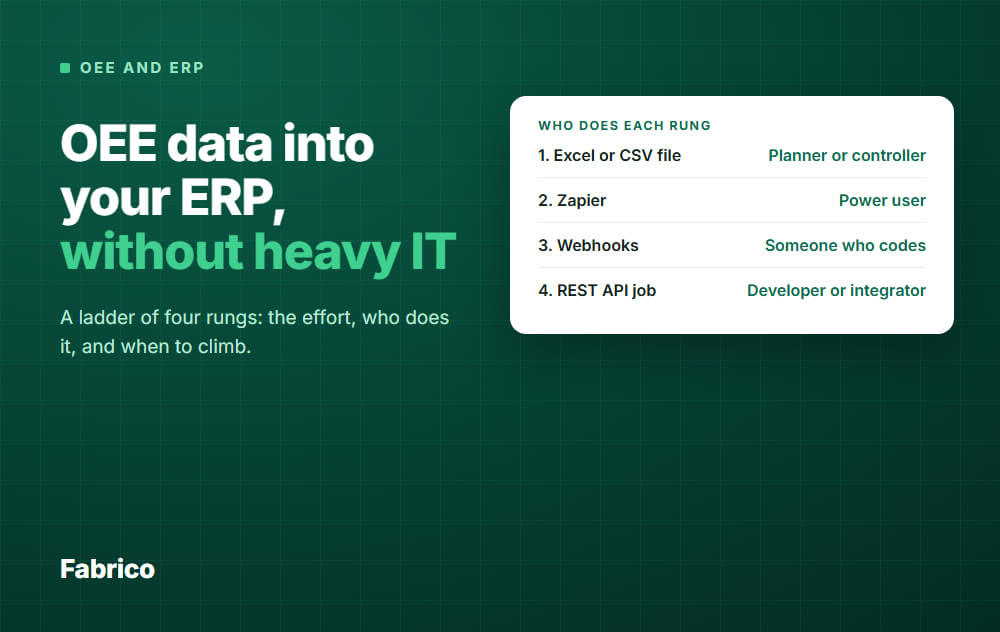
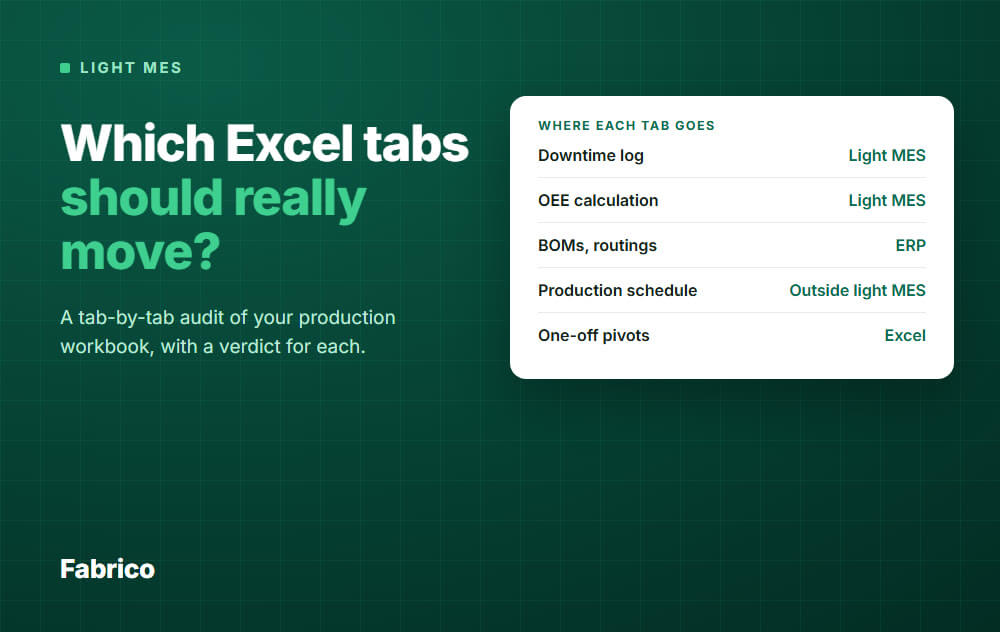


Real Fabrico tiles, sample data.