


 Login
 Blog

MES for Plastics Injection Moulding: Presses, Moulds and Cycle Drift

Key takeaways
- A moulding shop needs an MES to see many presses at once: which mould runs where, at what cycle, with how much scrap.
- Full MES functions in moulding include job and mould tracking, process data, quality records, material and lot tracking, scheduling and machine data with OEE.
- Start with production data and OEE per press: the cycle signal is simple to read, and cycle drift and long mould changes show up at once.
- Set the ideal cycle per mould from the validated process sheet, and count parts as shots times active cavities.
- Light MES puts press OEE and downtime first; a full MES adds lot tracking and process records where customers require them.
Press 12 has run more than a second slower than its process sheet all week. Nobody decided to slow it down: someone added cooling time to fix a sink mark on Monday and never took it back. On press 7 the mould change took the whole morning, and on press 15 one cavity has been blocked since the night shift. The shift report says the presses ran. An MES for plastics and injection moulding exists to catch exactly these losses.
This guide covers what a moulding shop needs from an MES, the functions, which to start with, how to measure OEE per press, light MES against a full suite, how to choose and the mistakes that cost the most.
What a moulding shop needs from an MES
A moulding shop is a press farm. Each press runs a mould with a set number of cavities, a material and often a colour, with dryers, temperature control units, hopper loaders and a robot or sprue picker around it. Orders change moulds; colours and materials change between runs.
That gives the MES four jobs. Show every press's state and cycle, live, because no supervisor can watch a whole press farm at once. Track which job and mould are on which press and how many parts are left. Keep the process within its validated window. And, for automotive, medical and packaging customers, link resin and masterbatch lots to the parts shipped.

The MES functions a moulding shop can use
ISA-95 places the MES at Level 3, between the press controllers and the ERP. In moulding its functions look like this:
| Function | What it does in a moulding shop | Where it usually starts |
|---|---|---|
| Machine data collection | Shot count, cycle time, alarms and state per press | A group of presses, first |
| Performance analysis (OEE) | OEE per press, per mould and per shift, losses ranked | The same presses, first |
| Job and mould tracking | Which order and mould run where, quantity left, shots per mould | When planners chase the floor for status |
| Process data and SPC | Temperatures, pressures, cushion and cycle against the validated window | Critical moulds and demanding customers |
| Quality records | First-off approval, inspection results, scrap reasons | Where paper first-off sheets get lost |
| Material and lot tracking | Resin and masterbatch lots linked to part lots | Where customers require it |
| Scheduling | Which mould on which press, colour order from light to dark | When mould changes collide |
Where the time goes in a press farm
- Mould changes: mould not preheated, hoses and clamps not staged, crane or forklift busy, first-off approval waiting for quality.
- Colour and material changes: purging, dryer not ready, the new material still wet.
- Alarms and faults: robot take-out faults, part stuck in the mould, hot runner zone faults, temperature control unit alarms, hopper empty.
- Cycle drift: cooling or hold time lengthened to fix a defect and never set back, slower robot moves, a mould running warm.
- Blocked cavities: a cavity shut off after damage, so each shot makes fewer parts.
- Scrap: start-up scrap after a change, short shots, flash, sink marks, splay from wet material, burns, warpage.
Cycle drift is the quiet one. The press never stops, the alarm never sounds, and each cycle is only a little slow. Our guide to OEE for injection moulding covers it in depth, and how to reduce changeover time covers the mould change side: preheat the mould, stage hoses and clamps, and get first-off approval ready before the press stops.
Start with production data and OEE per press
Machine data comes first in moulding because the signal is simple: a cycle signal or shot counter from the press controller tells you when it runs and how fast. Many newer presses also offer an OPC UA interface (EUROMAP 77). Older presses can be read from a cycle contact.
OEE = Availability x Performance x Quality. Per press:
- Availability: run time over planned production time. Mould changes, colour changes, waiting for material and alarms are stops with their own codes. Measure a mould change from the last good part to the first good part.
- Performance: the ideal is the validated cycle from the process sheet for that mould on that press. Count parts as shots times nominal cavities, so a blocked cavity shows as lost output. Decide that rule once and write it down. See ideal cycle time.
- Quality: good parts over total parts. Start-up scrap counts. Regrind is not good count.
The press gives the clock, the cycle and the shots. The operator confirms the stop reason in one tap. A camera adds evidence where the press signal only says "stopped", for example at the robot take-out or the conveyor where parts pile up.
What cycle drift and a long mould change cost
Sample line (illustrative numbers, not a customer): one press with a 4-cavity mould and a validated cycle of 20.0 seconds, so 5 seconds of ideal time per part. Planned production time is 480 minutes. Stops add up to 120 minutes (mould change 75, waiting for dried material 24, robot faults 21), so run time is 360 minutes, or 21,600 seconds.
- Availability = 360 / 480 = 75.0%.
- At 20.0 seconds the press could make 1,080 shots, or 4,320 parts. The real cycle drifted to 21.6 seconds, so it made 1,000 shots. One cavity was blocked for 250 of them, so it made 4,000 minus 250 = 3,750 parts. Performance = 3,750 / 4,320 = 86.8%.
- Scrap was 150 parts (start-up and short shots), so good count is 3,600. Quality = 3,600 / 3,750 = 96.0%.
- OEE = 0.750 x 0.868 x 0.960 = 62.5%. Check: 3,600 parts x 5 seconds = 300 minutes, and 300 / 480 = 62.5%.
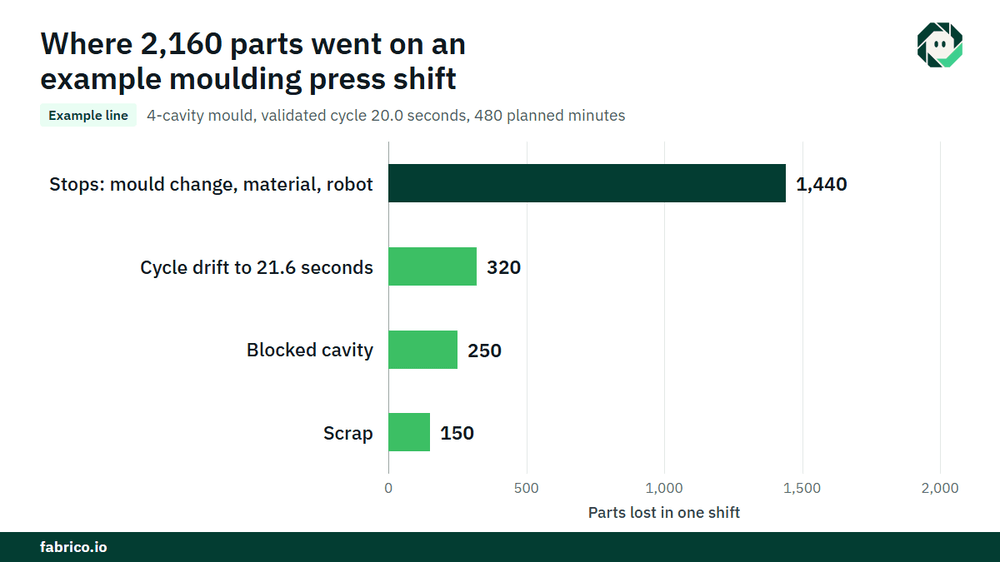
In 480 minutes the press could make 5,760 parts. It made 3,600 good ones, so 2,160 were lost. At a contribution of $0.12 a part (€0.12 in a euro plant), that is $259.20 a shift.
| Loss on the press | Parts lost | Value a shift |
|---|---|---|
| Stops (120 minutes, 360 shots x 4) | 1,440 | $172.80 |
| Cycle drift (80 shots x 4) | 320 | $38.40 |
| Blocked cavity | 250 | $30.00 |
| Scrap | 150 | $18.00 |
| Total | 2,160 | $259.20 |
Over 1,000 shifts a year that is $259,200 on one press, or €259,200 in a euro plant. Cycle drift alone is $38,400 a year. If 8 presses in a 24-press farm drift the same way, that is $307,200 a year that never shows as a stop.
Light MES vs full MES for a moulding shop
A full moulding MES tracks jobs and moulds, monitors process parameters against the validated window, runs SPC, records first-off approval and links material lots to part lots. Automotive and medical customers often require much of that, and in those plants it is worth the larger project.
A light MES is the same Level 3 layer in a different order: press data, downtime reasons and OEE first, on a group of presses, then more presses and functions where they are needed. It makes cycle drift, mould change time and scrap by mould visible, and prices them, before anyone writes a specification for process records.
Many shops end up with both: OEE on every press, process and lot records on the moulds and customers that demand them.
How to choose an MES for injection moulding
- Check the ideal cycle per mould and press, taken from the process sheet, with cavities handled correctly.
- Ask to see cycle drift against the validated cycle, per press, live.
- Ask how mould change time is measured: last good part to first good part, split into its steps.
- Ask how it reads old presses: controller interface where it exists, a cycle contact or a camera where it does not.
- Keep the ERP interface small: orders in, actuals out.
- Agree the start: one group of presses, a baseline and a decision date agreed in advance.
Mistakes moulding shops make with MES
- Using the fastest cycle ever seen as the ideal, or the slowest one as normal. Use the validated cycle and update it only by decision.
- Ignoring blocked cavities, so a 4-cavity mould running on 3 looks fine.
- Counting regrind as good.
- Timing mould changes to "press closed" instead of to the first good part.
- Averaging OEE across presses with different moulds and cycles. Compare each press with its own ideal.
- Comparing operators instead of processes. Measure the process, never the person.
Where Fabrico fits
Fabrico is a computer vision enabled Manufacturing Performance Platform. In a moulding shop it is a light MES with OEE and downtime first, starting on one group of presses.
- Automatic downtime logging from the press signal.
- The operator confirms the reason in one tap: mould change, material, robot fault, quality hold.
- A camera clip as evidence for a stop, where a camera watches the take-out or the conveyor.
- Losses priced in money and ranked by money.
- OEE live by line and shift, and one view across plants.
- As the last step, a stop coded as a breakdown becomes a work order to the right technician, with its cost.
In MESA terms that is data collection, performance analysis and, as the last hop, maintenance management. Machines connect through a PLC, a Fabrico IoT device or an AI camera. Fabrico is not an ERP and not a full MES suite: it does not do scheduling, process parameter records, batch records, genealogy or traceability.
Each plant gets a quote after a review of its lines. For a wider comparison, see our review of OEE software for injection moulding.
Frequently asked questions
What is an MES in injection moulding?
Software between the presses and the ERP that tracks jobs and moulds, records press states, cycles and scrap, and shows why output fell short. Fuller systems add process data, SPC and material lot tracking.
How do you calculate OEE for an injection moulding machine?
Availability is run time over planned time. Performance is parts made over the parts possible at the validated cycle with nominal cavities. Quality is good parts over total parts. Multiply the three.
Is a blocked cavity a Performance or a Quality loss?
If you count parts as shots times nominal cavities, a blocked cavity shows as Performance loss. Some plants book it differently; what matters is one written rule used on every press.
Do moulders need a full MES?
Where customers require process records and material lot tracking, yes, on those moulds. Where lost output is the main cost, start with OEE and downtime per press.
See your presses' losses in a demo
Bring one group of presses and their current downtime notes. We will show where the time goes, how much the cycles drift and what each loss costs.






