


 Login
 Blog
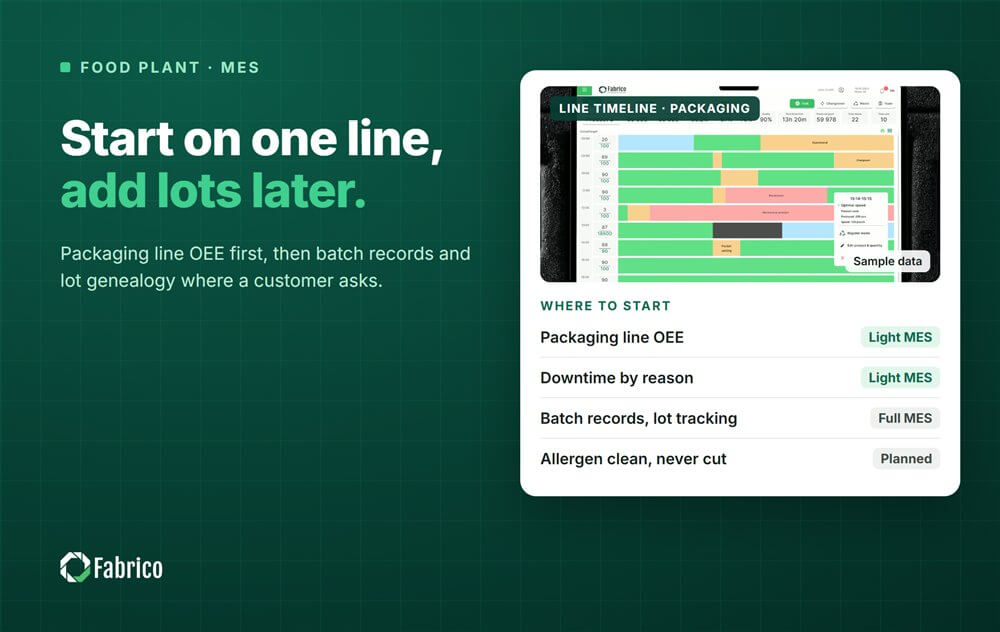
MES for Food Manufacturing: Functions, OEE and Where to Start

Key takeaways
- A food plant needs an MES for two jobs: running production well and proving what was made, from which lots, on which line.
- A full food MES covers recipes and weighing, batch records, lot tracking, quality checks, scheduling and production data with OEE.
- Start with production data and OEE on the packaging line: the data is easy to get and a measured result shows first.
- Light MES puts OEE and downtime first on one line; a full MES adds batch records and lot genealogy where a customer or regulator demands them.
- Never improve OEE by shortening a validated allergen clean or a CIP cycle.
It is 6:40 on a Monday at a snack plant. The flow wrapper on line 2 has stopped four times since start-up: a film splice, two infeed jams and a metal detector reject that needed a check. The paper log says "film". By the afternoon the ERP will show the line short of plan, and nobody will know where the missing cases went. That gap is the first question an MES for food manufacturing has to answer.
A manufacturing execution system sits between the machines and the ERP and runs the shift: what to make, on which line, how it went and why. In food it also helps prove what was made, with which ingredients and under which checks. This guide covers what a food plant needs from an MES, the functions, which to start with, light MES against a full suite, how to choose and the common mistakes.
What a food plant needs from an MES
A food plant has two halves. The process side makes the product: mixing, cooking, baking, frying, chilling. The packaging side turns it into sellable units at speed: depositor or filler, flow wrapper or bagger, tray sealer, checkweigher, metal detector, labeller and coder, case packer, palletiser.
The process side cares about recipes, weights, temperatures and the batch. The packaging side cares about speed, stops, changeovers and rejects, because that is where output leaves the plant one pack at a time.
Food safety sits on top of both. The seven HACCP principles include monitoring at critical control points and record keeping. EU Regulation 178/2002, Article 18, asks for traceability one step back and one step forward. In the US, the FSMA 204 Food Traceability Rule has a compliance date of July 20, 2028.
So a food MES has three jobs: make it right (recipes, weighing), prove it (checks, lots, labels) and make it efficiently (production data, downtime, OEE). Few plants need all three on every line from the start.

The MES functions a food plant can use
The MESA model, now with ISA, lists eleven MES functions, and ISA-95 places the MES at Level 3, between the machine controls and the ERP. In a food plant they become these jobs:
| Function | What it does in a food plant | Where it usually starts |
|---|---|---|
| Production data collection | Counts, machine states and stop times from wrappers, fillers and checkweighers | Packaging line, first |
| Performance analysis (OEE) | Availability, Performance and Quality by line, shift and SKU | Packaging line, first |
| Recipe and weighing | Sends the recipe to the mixer, checks ingredient weights against tolerance | Process side, where weighing errors are a risk |
| Batch records | What was made, with which ingredients, settings and checks | Where customers or auditors ask for it electronically |
| Lot tracking and genealogy | Links raw material lots to finished lots | Across the plant, when recall tests demand it |
| Quality and CCP records | Metal detector tests, temperatures, label checks against limits | Where paper checks get missed |
| Scheduling | Plans orders by line, often by allergen group | When the plan is rebuilt by hand daily |
Production data and performance analysis touch every line on every shift. The others are real needs, each one where a specific requirement sits.
Where the time goes on a food packaging line
On many food lines the lost time is not one big breakdown. It is many short stops at a few stations, plus changeovers and cleaning:
- Flow wrapper and bagger: film splice, film tracking off, seal jaw temperature alarms, product in the seal, infeed jams.
- Checkweigher and metal detector: reject bin full, test pack cycles, false rejects checked before restart.
- Labeller and coder: label roll end, ribbon out, unreadable print.
- Case packer: case blank feed, glue gun clog, cases jammed at the sealer.
- Between stations: starved by the oven or mixer, blocked by a full palletiser.
Changeovers add SKU, film and label changes and, between allergen groups, a validated clean that cannot be cut short. Quality losses are seal leaks, underweight rejects, start-up waste and giveaway: packs above declared weight that pass the checks and still cost product. See our guides to micro stops on packing lines and giveaway as a quality loss.
Start with production data and OEE
Production data and OEE come first because the data is easy to get from existing machines, the losses can be priced at once, and clean stop and count records make the later functions stronger.
OEE = Availability x Performance x Quality. On a food packaging line:
- Availability is run time over planned production time. Take out breaks and planned sanitation; keep changeovers visible with their own reason codes either way.
- Performance compares the count with the ideal rate of the pace-setting machine, usually the wrapper or filler. Set it per SKU from the validated speed, not the nameplate.
- Quality is good packs over total packs. Rework is not good count. Giveaway does not show here, because the packs pass, so price it separately.
- Micro stops: no standard sets the threshold, so write your cutoff down once.
The PLC run signal and counters give the clock and the count, the checkweigher gives rejects, a camera over the infeed shows what happened where the PLC only says "stopped", and the operator confirms the reason. More in our guide to OEE for food and beverage.
What the losses cost on one line
Sample line (illustrative numbers, not a customer): a biscuit line whose flow wrapper is rated, for this SKU, at 120 packs a minute. The shift is 480 minutes with a 30 minute break, so planned production time is 450 minutes. Unplanned stops add up to 54 minutes, so run time is 396 minutes.
- Availability = 396 / 450 = 88.0%.
- Ideal count in 396 minutes = 396 x 120 = 47,520 packs. The line made 41,580. Performance = 41,580 / 47,520 = 87.5%.
- Rejects were 832, so good count is 40,748. Quality = 40,748 / 41,580 = 98.0%.
- OEE = 0.880 x 0.875 x 0.980 = 75.5%. Check: 40,748 / 120 = 339.6 minutes of ideal time, and 339.6 / 450 = 75.5%.
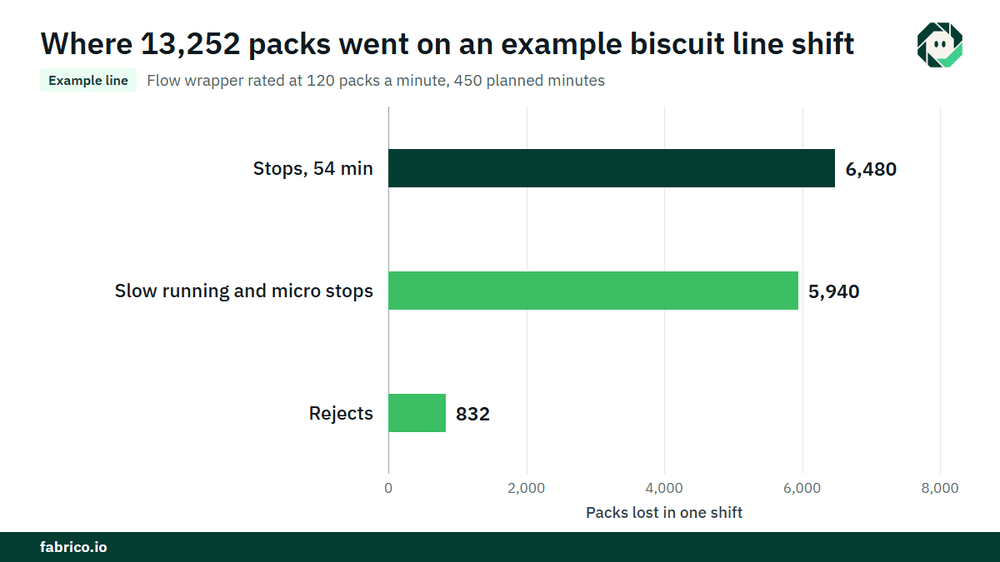
In 450 minutes the wrapper could make 54,000 packs. It made 40,748 good ones, so 13,252 were lost. At a contribution of $0.25 a pack (€0.25 in a euro plant), that is $3,313 a shift.
| Loss | Packs lost | Value a shift |
|---|---|---|
| Stops (54 minutes x 120) | 6,480 | $1,620 |
| Slow running and micro stops | 5,940 | $1,485 |
| Rejects | 832 | $208 |
| Total | 13,252 | $3,313 |
Over 480 shifts a year that is $1,590,240, or €1,590,240 in a euro plant. Not all of it can be recovered, but the split shows where to look first.
Light MES vs full MES for a food plant
A light MES is not a smaller MES. It is the same Level 3 layer in a different order: OEE and downtime first, on one line, then more lines and functions where a product or customer needs them. A full MES suite covers recipes, weighing, batch records, lot genealogy, quality and scheduling across the plant, with more ERP integration and a longer project before the first result.
Light MES fits a plant whose biggest cost is lost output: high-mix packaging, frequent changeovers, a paper downtime log. IoT Analytics reports that 54.4% of small and medium manufacturers still run production on paper or spreadsheets.
A full MES is the right tool where auditors expect electronic batch records and lot genealogy, or where weighing errors are the main risk. Many food plants run both. What a light MES does not do is replace your lot record: a stop log can support it, not stand in for it.
How to choose an MES for food manufacturing
- Price the problem first: lost output, a traceability gap or weighing errors. The answer picks the first functions.
- Watch the operator's part. A gloved operator at a wet station will tap a reason, not type one.
- Ask how it reads old machines: PLC signals, simple sensors, cameras, with no changes to validated control settings.
- Check SKU-level rates and a separate loss category for allergen changeovers.
- Keep the ERP interface small: orders in, actuals out.
- Agree the start: one representative line, a baseline from today's log and a decision date agreed in advance.
Mistakes food plants make with MES
- Buying everything for every line and waiting for value until the last module is live.
- Measuring OEE on the filler only. Starved and blocked time lives between machines.
- Hiding changeovers in planned time with no standard, so an overrun never shows.
- Shortening a validated allergen clean or CIP to win OEE points. That is a food safety breach. See allergen changeover validation.
- One ideal rate for all SKUs, which makes hard products look broken.
- Asking for reasons at the end of the shift, when nobody remembers the 6:40 jam.
Where Fabrico fits
Fabrico is a computer vision enabled Manufacturing Performance Platform. In a food plant it is a light MES with OEE and downtime first, starting on one line.
- Automatic downtime logging from the wrapper, filler and other machine signals.
- The operator confirms the reason in one tap.
- A camera clip as evidence for a stop, where a camera watches the station.
- Losses priced in money and ranked by money.
- OEE live by line and shift, and one view across plants.
- As the last step, a stop coded as a breakdown becomes a work order to the right technician, with its cost.
In MESA terms that is data collection, performance analysis and, as the last hop, maintenance management. Machines connect through a PLC, a Fabrico IoT device or an AI camera. Fabrico is not an ERP and not a full MES suite: it does not do recipe management, scheduling, batch records, genealogy or traceability, and it makes no HACCP or FSMA claim.
Each plant gets a quote after a review of its lines. Read more about light MES.
Frequently asked questions
What is an MES in food manufacturing?
The software layer between the machines and the ERP that runs and records production: what to make, on which line, how it went and why. In food it can also handle recipes, weighing, quality checks and lot records.
What is the difference between MES and ERP in a food plant?
The ERP plans in weeks and days: orders, stock, costs. The MES works in shifts, minutes and seconds: counts, stops, checks and lots. ISA-95 puts the ERP at Level 4 and the MES at Level 3.
Do food manufacturers need an MES for traceability?
They need traceability records. An MES with lot tracking is one way to keep them, next to ERP lot functions and paper. If traceability is the main gap, choose a system built for it; if lost output is the main cost, start with OEE and downtime.
How do you calculate OEE on a food packaging line?
Multiply Availability (run time over planned production time), Performance (actual count over the count at the ideal rate) and Quality (good packs over total packs), with the validated rate set per SKU.
See your food line's losses in a demo
Bring one packaging line and its current downtime log. We will show where its time goes and what each loss costs.






