


 Login
 Blog
MES for Cosmetics Manufacturing: Many SKUs and Small Batches

Key takeaways
- A cosmetics plant needs an MES for many SKUs and small batches: what to fill next, how the changeover went and what was filled from which bulk.
- Full MES functions in cosmetics include weighing and dispensing, electronic batch records, line clearance records, bulk-to-lot genealogy, scheduling and filling line performance.
- Start with production data and OEE on the filling line, with changeovers split into their steps.
- On high-mix filling lines changeovers are often the largest loss, so never hide them in planned time.
- Light MES puts OEE and changeovers first; a full MES adds batch records and genealogy where GMP documentation or a brand owner demands them.
The tube filler on line 3 is on its fourth changeover of the day: a hand cream in 50 ml tubes, then the same cream in 75 ml, then a new shade of the same base. Each change means a cleaned hopper and nozzles, new tube holders, line clearance, first-off weight checks and a QA signature. Between changes the line ran well, and the weekly report, built on running time, says so. An MES for cosmetics manufacturing has to show what that report leaves out.
This guide covers what a cosmetics and personal care plant needs from an MES, the functions, which to start with, how to measure OEE on a filling line, light MES against a full suite, how to choose and the common mistakes.
What a cosmetics plant needs from an MES
A cosmetics plant has two halves. Compounding weighs raw materials and makes the bulk in mixing vessels and homogenisers, with heating, cooling and a QC release before filling. Filling and packaging turns the bulk into units: tube filler and sealer, bottle filler with pump or cap application and torque check, jar filler, labeller, coder, cartoner with leaflet insert, case packer.
The shape of the business is many SKUs and small batches. One base becomes many shades, sizes and pack formats, so filling lines change product several times a shift. Cosmetics GMP, set out in ISO 22716, expects documented production and the ability to trace what was made.
So the MES has three jobs: make the bulk right (formula, weighing), prove it (batch documentation, line clearance, which bulk went into which lot) and fill it efficiently (changeovers, stops, speed, rejects).

The MES functions a cosmetics plant can use
ISA-95 places the MES at Level 3, between the machine controls and the ERP. In cosmetics its functions look like this:
| Function | What it does in a cosmetics plant | Where it usually starts |
|---|---|---|
| Production data collection | Counts, machine states, stop and changeover times on fillers and cartoners | One filling line, first |
| Performance analysis (OEE) | OEE by line, shift and SKU, changeovers split by step | The same line, first |
| Weighing and dispensing | Guides raw material weighing against the formula | Compounding, where weighing errors are a risk |
| Electronic batch records | The documented record of each bulk batch and fill | Where GMP paperwork is the bottleneck |
| Line clearance records | Checklist and sign-off between products | Where paper checklists are hard to audit |
| Bulk-to-lot genealogy | Links raw material lots to bulk and bulk to filled lots | Where brand owners or recalls require it |
| Scheduling | Fill order by shade, light to dark, and by format | When the plan is rebuilt by hand daily |
Batch records and genealogy are about proof. Production data and OEE are about output. Most cosmetics plants need both, but not on the same day or on the same line first.
Where the time goes on a cosmetics filling line
Changeovers are usually the largest block. A typical one has five steps, each with its own owner:
- Cleaning: hopper, pistons, nozzles and product lines, more for a shade or fragrance change.
- Format parts: tube holders or pucks, guide rails, star wheels, capping heads.
- Materials: new tubes, bottles, caps, labels, cartons and leaflets staged at the line.
- Line clearance: removing the previous product's materials and documents, then a sign-off. See our guide to line clearance.
- First-off checks and release: fill weight, seal, code and label checks, then QA approval to run.
Between changeovers the usual stops are tube feeder faults and tube orientation, hot air sealing faults, pump and cap feeder jams, cap torque rejects, labels misapplied on round or soft bottles, leaflet and carton feed faults at the cartoner, and waiting for released bulk. Quality losses are fill weight rejects, leaking pumps, label position and code rejects, and giveaway above declared content: see giveaway as a quality loss.
Start with production data and OEE on the filling line
OEE = Availability x Performance x Quality, measured at the filler, which sets the line's pace.
- Availability: run time over planned production time. Code changeovers as stops, split into cleaning, format parts, materials, line clearance and release, so each step can be improved by its owner.
- Performance: the count against the rated speed for that format. A 50 ml tube and a 200 ml tube run at different rates; set the ideal per format and SKU.
- Quality: good units over total units. Decide once how QC samples are counted, and count first-off rejects.
The filler and cartoner PLCs give states and counts, checkweighers and torque testers give rejects, the operator confirms the stop reason in one tap, and a camera over the tube feeder or the capper shows what happened where the PLC only says "stopped".
What changeovers cost on one line
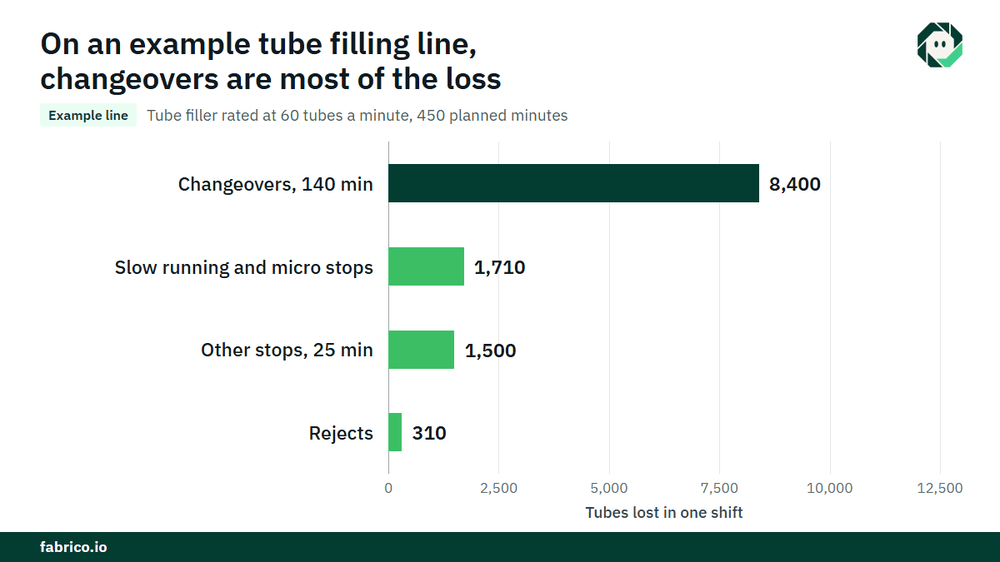
Sample line (illustrative numbers, not a customer): a tube filling line rated, for this format, at 60 tubes a minute. The shift is 480 minutes with a 30 minute break, so planned production time is 450 minutes. Three changeovers took 140 minutes (two shade changes of 35 minutes, one format change of 70), and other stops took 25 minutes. Run time is 450 minus 165 = 285 minutes.
- Availability = 285 / 450 = 63.3%.
- Ideal count = 285 x 60 = 17,100 tubes. The line made 15,390. Performance = 15,390 / 17,100 = 90.0%.
- Rejects were 310, so good count is 15,080. Quality = 15,080 / 15,390 = 98.0%.
- OEE = 0.633 x 0.900 x 0.980 = 55.9%. Check: 15,080 / 60 = 251.3 minutes of ideal time, and 251.3 / 450 = 55.9%.
In 450 minutes the filler could make 27,000 tubes. It made 15,080 good ones, so 11,920 were lost. At a contribution of $0.40 a tube (€0.40 in a euro plant), that is $4,768 a shift.
| Loss | Tubes lost | Value a shift |
|---|---|---|
| Changeovers (140 minutes x 60) | 8,400 | $3,360 |
| Other stops (25 minutes x 60) | 1,500 | $600 |
| Slow running and micro stops | 1,710 | $684 |
| Rejects | 310 | $124 |
| Total | 11,920 | $4,768 |
Changeovers are about 70% of the loss. If staging a cleaned hopper and nozzle set and finishing the bulk release before the stop cut each shade change from 35 to 20 minutes, the line would gain 30 minutes a shift: 1,800 tubes, or $720. Over 480 shifts a year that is $345,600 (€345,600), without touching the cleaning itself.
Light MES vs full MES for a cosmetics plant
A full cosmetics MES covers weighing and dispensing, electronic batch records, line clearance records, bulk-to-lot genealogy and scheduling across compounding and filling. It fits plants where GMP paperwork is the bottleneck, or contract manufacturers whose brand owners require electronic records.
A light MES is the same Level 3 layer in a different order: production data, changeover steps and OEE first, on one filling line, then more lines and functions where they are needed. For a plant whose problem is output on high-mix lines, that order shows the money first. Our guide to SKU changeover sequence covers what to do with the data.
Many plants end up with both: batch and genealogy functions where documentation requires them, OEE and changeover data on every filling line.
How to choose an MES for cosmetics manufacturing
- Price the problem first: lost output on the filling lines, a documentation burden or weighing errors.
- Ask to see changeovers split into steps, with the time each step took on each line.
- Check rated speed per format and SKU, not one speed per line.
- Keep line clearance and release with QA. The MES should measure them, never hurry them.
- Keep the ERP interface small: orders in, actuals out.
- Agree the start: one filling line, a baseline and a decision date agreed in advance.
Mistakes cosmetics plants make with MES
- Hiding changeovers in planned time, so the biggest loss never shows.
- One rated speed for every format, which makes small tubes look slow and large ones look fast.
- Shortening a validated clean or line clearance to gain OEE points. That is a GMP breach, not an improvement.
- Buying electronic batch records first when the real problem is output on the filling line.
- Comparing operators instead of changeover steps. Measure the process, never the person.
Where Fabrico fits
Fabrico is a computer vision enabled Manufacturing Performance Platform. In a cosmetics or personal care plant it is a light MES with OEE and downtime first, starting on one filling line.
- Automatic downtime logging from the filler, capper and cartoner signals.
- The operator confirms the reason in one tap, including each changeover step.
- A camera clip as evidence for a stop, where a camera watches the station.
- Losses priced in money and ranked by money.
- OEE live by line and shift, and one view across plants.
- As the last step, a stop coded as a breakdown becomes a work order to the right technician, with its cost.
In MESA terms that is data collection, performance analysis and, as the last hop, maintenance management. Machines connect through a PLC, a Fabrico IoT device or an AI camera. Fabrico is not an ERP and not a full MES suite: it does not do weighing, scheduling, batch records, line clearance records, genealogy or traceability, and it makes no GMP claim.
Each plant gets a quote after a review of its lines. For more on high-mix consumer lines, see OEE for CPG manufacturing.
Frequently asked questions
What does an MES do in cosmetics manufacturing?
It runs and records production between the machines and the ERP: weighing and batch documentation in compounding, and counts, stops, changeovers and rejects on the filling lines, depending on which functions the plant uses.
Do cosmetics manufacturers need electronic batch records?
GMP asks for documented production; electronic batch records are one way to keep it, paper is another. Choose by your audit burden and your customers' requirements.
How do you measure OEE on a filling line with many changeovers?
Code each changeover as a stop split into its steps, set the rated speed per format and SKU, and count first-off rejects. Then report OEE by SKU as well as by shift.
Should changeovers count as planned downtime?
You can choose either rule, but keep changeovers visible with their own codes. On high-mix cosmetics lines they are often the largest loss, and hiding them hides the main improvement.
See your filling line's losses in a demo
Bring one filling line and its changeover notes. We will show where its time goes, step by step, and what each loss costs.






