


 Login
 Blog
Ice Cream Manufacturing Software: What to Buy First

In short: ice cream manufacturing software is not one product. A plant usually runs an ERP, mix plant control, lab and quality software, a cold store WMS and, across the freezing and packing hall, OEE plus a light MES. If nobody can say where line hours went last summer, buy the line layer first.
- The mix plant works in batches and tanks. The freezing hall works in cones, cups and sticks a minute. Each side has its own system.
- Overrun links the two. It is a legal and a cost number, and it lives in the freezer and the lab, not in OEE.
- Peak season sets the order: measure the lines before the summer build, then plan with real changeover times.
- Fabrico is the line layer, from freezer to case packer. It is not an ERP, mix control, quality system or planner.
Ice cream is made twice in one plant. First the mix plant pasteurises and ages the mix in tanks. Then the freezing hall freezes it, fills it and hardens it, at speed, for a few hot months that decide the year.
Below, mix plant, lab, cold store and freezing hall records are sorted by owner, with what to fund first. Fabrico makes the freezing hall layer and none of the others.
The ice cream manufacturing software map
Most of the records an ice cream plant needs already have an owner. The table shows a typical split.
| System | What it owns in ice cream | Run by | Fabrico? |
|---|---|---|---|
| ERP | Orders, SKUs, bills of materials, lots, the seasonal stock build | Finance, planning | No |
| Mix plant control | Dosing, pasteuriser and homogeniser settings, ageing tanks, CIP sequences | Process engineering | No |
| Quality and lab | HACCP, pasteurisation records, allergen checks, overrun and weight samples | Quality | No |
| Planning tool | Flavour order, allergen sequence, the peak build plan | Planner | No, that stays with the planner |
| Cold store WMS | Pallets, stock rotation, dispatch | Logistics | No |
| Line OEE and light MES | Stops and counts on freezers, fillers, stick lines and wrappers, with reason codes, OEE and the cost of each loss | Production, CI | Yes, Fabrico's lane |
The mix plant rows carry the food safety weight. US rules describe ice cream as a food produced by freezing, while stirring, a pasteurized mix (21 CFR 135.110), so the pasteuriser record belongs to mix plant control and the quality system, where the temperature is measured. No line tool should hold it.
The bottom row is the one left orphaned: why the cone line lost two hours on Saturday, and what those hours were worth. Closing that gap is where OEE and a light MES start. The food-wide version of this map is in our guide to food manufacturing software.
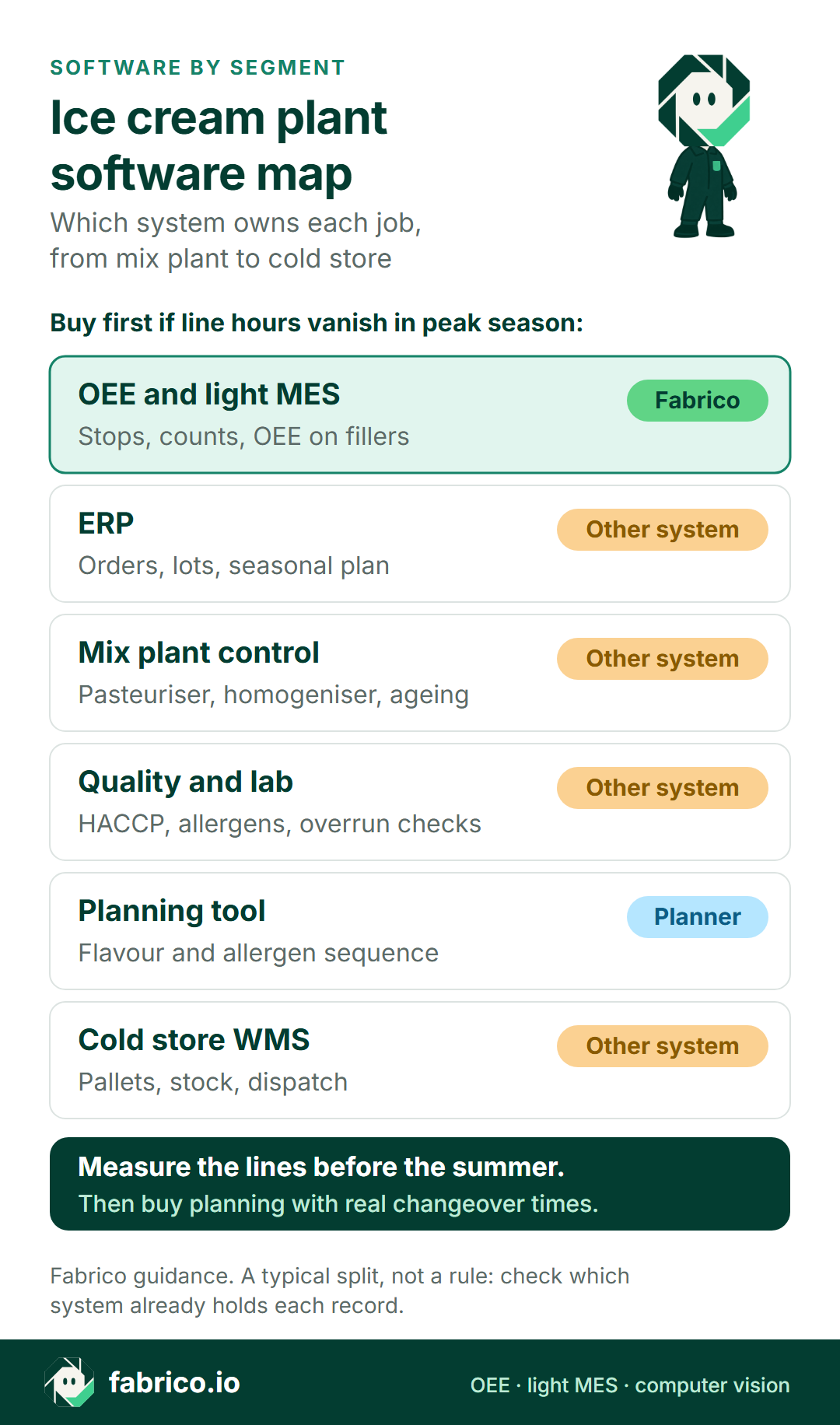
Text version of this infographic
- Ice cream plant software map card: OEE and light MES for stops, counts and OEE on fillers as Fabrico, next to the ERP, mix plant control, quality and lab, planning tool and cold store WMS as other systems, with the advice to measure lines before the summer.
Mix plant and freezing hall: one buffer between them
The mix plant runs in batches: dosing, pasteurising, homogenising, then ageing in tanks. The freezing hall runs in units a minute. Between them sit the ageing tanks, and they are the buffer that breaks first.
- Mix not ready: the filler waits because the next flavour has not aged. The reason sits in mix plant control, but the lost minutes show on the line.
- Line down, mix waiting: a long stop on the stick line leaves aged mix in the tank. Whether it can still be used is a quality decision, recorded in the quality system.
So ask any vendor how the two sides are joined. A light MES gives the line side, with the stop reason "mix not ready" as its own code. Tank times stay where they are measured. For a dairy plant with the same split, see MES for dairy processing.
Where an ice cream line loses its hours
In short: freezer start-ups after each flavour change or clean, allergen cleans and CIP, cone and lid feed jams at the filler, a full hardening tunnel when the wrapper stops, and the slow running that follows a start-up. After each clean or flavour change the filler runs slow until the freezer reaches overrun, and that start-up product is the loss most plants never price. The station-by-station detail, with the ideal rate rules, is on our page on OEE for ice cream production, and the line between start-up loss and yield loss is in start-up loss vs reduced yield.
Overrun, weight and the law: which system holds the number
Overrun is the air whipped into the mix at the freezer. It sets how many cones a tank of mix makes, so it is one of the plant's biggest cost levers. It also has a legal floor. Under the US standard, ice cream weighs not less than 4.5 pounds to the gallon and carries at least 1.6 pounds of total solids per gallon.
Too little air gives mix away. Too much risks the standard. Neither shows in OEE, because a cone is a cone whatever it weighs. Three systems hold the numbers: the freezer controls set the air, the lab or quality system checks weight per volume, and checkweigher software checks pack weight.
The line layer adds one thing: when an operator stops the filler for an overrun drift, that stop gets its own reason, and the cones rejected for it count against quality. How to price product given away is in giveaway as a quality loss.
Flavours, allergens and CIP belong to the plan
Ice cream carries more allergens than most dairy: milk always, and often eggs, tree nuts, peanuts, wheat in cones and cookie pieces, soy and sesame. In the US, the FDA lists the major food allergens as milk, eggs, fish, Crustacean shellfish, tree nuts, peanuts, wheat, soybeans, and sesame. A hazelnut or peanut flavour on a shared line means a validated clean before the next product.
The order of flavours is a planning decision. Allergen cleans are validated by the quality team. CIP sequences run in mix plant control. A light MES does none of these. It times each type separately, by line, and shows what each one cost, so the planner can build the sequence from measured minutes. See the allergen changeover matrix and how to book CIP time in OEE.
Peak season makes this matter. The EU produced 3.44 billion litres of ice cream in 2025, up 1.9% on 2024, Eurostat says. Much of a plant's year is built in a few months, so a lost hour in June is hard to win back in August.
Fund this first: match the season's worst problem
Spend on whatever cost the most last season. A long feature list can wait.
| What hurts most | Start with | Why |
|---|---|---|
| Peak orders run short and nobody can say where the line hours went | OEE and light MES for the line that limits output | Stops, start-up loss and slow running come straight from the filler and wrapper |
| The pasteuriser record is on paper and an auditor flagged it | Mix plant control or a quality system | The record belongs where the temperature is measured |
| A mock recall took days | ERP lot functions or a full MES | A trace needs ingredient lot consumption, which a light MES does not keep |
| The flavour plan is rebuilt by hand every week | A planning tool or the ERP | Sequencing is its own job. Feed it measured changeover times. |
| Overrun and pack weights drift | Freezer controls, checkweigher and lab data | Air and grams are measured there, not in OEE |
| Wrong pallets leave the cold store | A WMS | Pallet rotation and loading belong to the warehouse |
Many plants end with three layers: mix and quality records where the auditor looks for them, lots and the plan in the ERP, and OEE on every freezing line. Bring a peak-season stop log and a typical week's flavour sequence to a demo, and the map gets marked row by row: Fabrico's rows, and the rows that stay with other systems.
OEE and light MES from freezer to case packer
The line layer reads the freezer, filler, stick line, tunnel, wrapper and case packer, and the operator adds the reason at the filler. Where to set the ideal rate is in OEE for ice cream production.
One station has no signal at all: hand packing of multipacks and display boxes. At those tables Fabrico's camera add-on counts output, and its video is streamed on request, not stored in Fabrico. For camera add-on use in dairy, read our dairy camera page and the FMCG camera guide.
Worked example: tracing one hazelnut paste lot
Example records, from no real plant. A supplier recalls one lot of hazelnut paste, and the plant must find every cone it went into. The answer sits in five systems. The ERP holds the paste lot received. Mix plant control holds the mix batch it was dosed into and the ageing tank that batch went to. The quality system holds the allergen clean and the release. The line data shows when the cone filler ran the hazelnut flavour and how many good cones it made. The cold store WMS holds the pallets and where they went. The hand-off breaks at the ageing tank: if one tank feeds two runs, or is topped up from a second batch, the link from mix batch to filling run is lost unless the tank switch is logged against the run.
| Record | Held in | Where the hand-off breaks |
|---|---|---|
| Paste lot received | ERP | Lot booked by delivery, not by tub |
| Mix batch and ageing tank | Mix plant control | Tank topped up from a second batch |
| Allergen clean and release | Quality system | Release signed on paper only |
| Filling run times and good cones | Line data | Holds times and counts, not lots |
| Pallets and dispatch | Cold store WMS | Pallet not tied to a filling run |
Fabrico sits in the line data row only, with run times, stops and counts by line and shift; the lot records stay in the ERP, mix plant control and WMS. The OEE maths for a peak shift is in OEE for ice cream production.
Eight questions for an ice cream software shortlist
Put all eight to each supplier you are weighing, with last summer's stop log open on the table.
| Question | A strong answer |
|---|---|
| Which system is the source of good units for the ERP? | Filler count, case packer count or WMS receipt: one answer in writing. |
| How is freezer start-up product booked? | It should be a quality loss in units, with the mix lost in kilograms, logged against the change that caused it. |
| How are CIP, flavour changes and allergen cleans split? | Three separate types with their own minutes, and one written rule for whether CIP sits inside planned time, the same on every line. |
| How do measured changeover times reach the flavour plan? | Ask whether they leave the line software by export or API, or get retyped into the planning tool. |
| Where does overrun live? | Ask which system holds the overrun reading, and how an overrun drift becomes a stop reason and a reject count. |
| Can a seasonal operator log a reason in a cold hall? | Watch it done in gloves, on a tablet or phone, in the operator's language, in seconds. |
| Which data crosses to and from the ERP? | SKUs and ideal rates flow down; good cones and priced losses flow up. Find out who maintains the interface once it is live. |
| Which records does the vendor leave alone? | Get a written split of mix records, pasteuriser charts, lots, the flavour schedule and inspection: covered or not covered. |
Where Fabrico sits between mix plant and cold store
Fabrico is cloud software for OEE and light MES. In the freezing and packing hall it covers three jobs:
- Freezer start-ups in money: start-up cones, slow running and cleans by line, shift and flavour change, priced, so the planner sees what each change costs before the summer plan is fixed.
- The cold hall, on a phone: stops and counts from the filler, stick line, wrapper and case packer through the PLC, or an IoT device with external sensors on older machines, with seasonal crews tagging the cause from a tablet or phone.
- Hand-packed multipacks counted: at packing tables with no machine counter, Fabrico's camera add-on counts output.
Outside its lane: mix plant control, pasteuriser or CIP records, overrun control, recipes, lot genealogy, HACCP and inspection. It does not schedule flavours; its measured changeover times can inform the planner who does. For every feature, open the MES and OEE software overview; for the cameras, the computer vision add-on overview.
Ice cream software questions
What software does an ice cream plant need?
Usually five layers: an ERP for orders, lots and the seasonal plan; mix plant control for pasteurising, homogenising and ageing; lab and quality software for HACCP, allergens and overrun checks; a cold store WMS; and, across the freezing and packing hall, OEE plus a light MES. A separate planner's tool for flavour sequencing is common too.
Does an ice cream plant need a full MES?
Only if it wants one system to hold recipes, batch records, lot genealogy and the line data together, and has the time for a longer project. Many plants keep mix records in the mix plant control system and lots in the ERP, and add a light MES for the lines.
Can OEE software control overrun?
No. Overrun is set at the continuous freezer and checked by the lab or quality team. OEE software can give an overrun drift its own stop reason and count the cones or cups rejected for it, so the cost shows up next to the other losses.
Which ice cream line should go live first?
The line that limits peak-season output, which is often the one with the most flavour and allergen changes. Connect it before the season starts, so the planner has real changeover and start-up times when the summer plan is built.
Does Fabrico keep pasteurisation or HACCP records?
No. Pasteuriser charts, CIP records, allergen checks and HACCP records stay in the mix plant control system and the quality system. Fabrico records line stops, counts, stop reasons and OEE.
Who should own each system in an ice cream plant?
Process engineering owns mix plant control, quality owns pasteuriser, allergen and overrun records, planning owns the flavour sequence, logistics owns the cold store, and production owns line data. Fund the row that has no owner first.
Want to see what last July's freezer start-up sheet cost in money? Book a demo with that sheet and one shift's stop log.
Related articles

Latest from our blog



Real Fabrico tiles, sample data.