


 Login
 Blog
Packhouse Software: What a Fresh Produce Packer Buys First

In short: packhouse software is a set of products, each with its own record. A fresh produce packhouse runs a packhouse or grower management system for intake, grower lots, consignments and grower payments, an ERP for orders and costing, retailer label and EDI tools, QA and residue records, a warehouse and cold store system, and OEE and light MES on the packing lines. Optical graders come with their own software. Buy first the system behind the record that fails you in peak season.
- Grower lots, bin tickets and grower returns are the packhouse system's job, and they are money records.
- Retailer labels and order messages decide what each line packs today, so the label and EDI link sits close to the lines.
- OEE and light MES show why the punnet filler, flow wrapper or weigher stood still, and what the hand-pack tables turned out.
- Fabrico is that line layer. It does not grade fruit, hold lot codes, pay growers or print retailer labels.
A packhouse lives by the season. For a few months the bins arrive faster than the lines can take them, crews double, and retailer orders change by the hour. Then volumes drop, lines stand, and the people who knew the routine go home until next year.
Searches for packhouse software or packhouse management software return products for very different jobs: grower accounts, grading, labels, cold store, line performance. This page sorts them by the record each one keeps and gives a buying order for a fresh produce packer.
Fabrico's lane is the line layer, OEE and light MES. Everything else here is a category, with no vendor named.
The packhouse software map: which system keeps which record
Some packhouse systems prove where produce came from, what it was graded, how it was labelled and what the grower is owed. Others show where packing line hours went. Compare them on those terms.
| System | What it does in a packhouse | Owner | Fabrico? |
|---|---|---|---|
| Packhouse or grower management system | Intake, bin tickets, grower lots, pack-out per lot, consignments, grower payments or returns | Packhouse manager, finance | No |
| Optical grader software | Grade, size and colour results from the grading line | Grading line, QA | No, it comes with the grader |
| ERP | Orders, stock, costing, invoicing | Finance, commercial | No |
| Retailer label and EDI | Order messages, despatch notices, pack and pallet labels with class and origin | Commercial, line leaders | No |
| QA and residue records | Residue tests, grower certificates, audit files, intake checks | QA, technical | No |
| Warehouse and cold store (WMS) | Pallets, locations, cold room temperatures, stock rotation | Logistics | No |
| Labour and time systems | Clocking, crews, piece rates for pickers and packers | HR, finance | No |
| OEE and light MES | Line stops, pack counts and reasons on fillers, wrappers, weighers and tables | Operations, CI | Yes, Fabrico's layer |
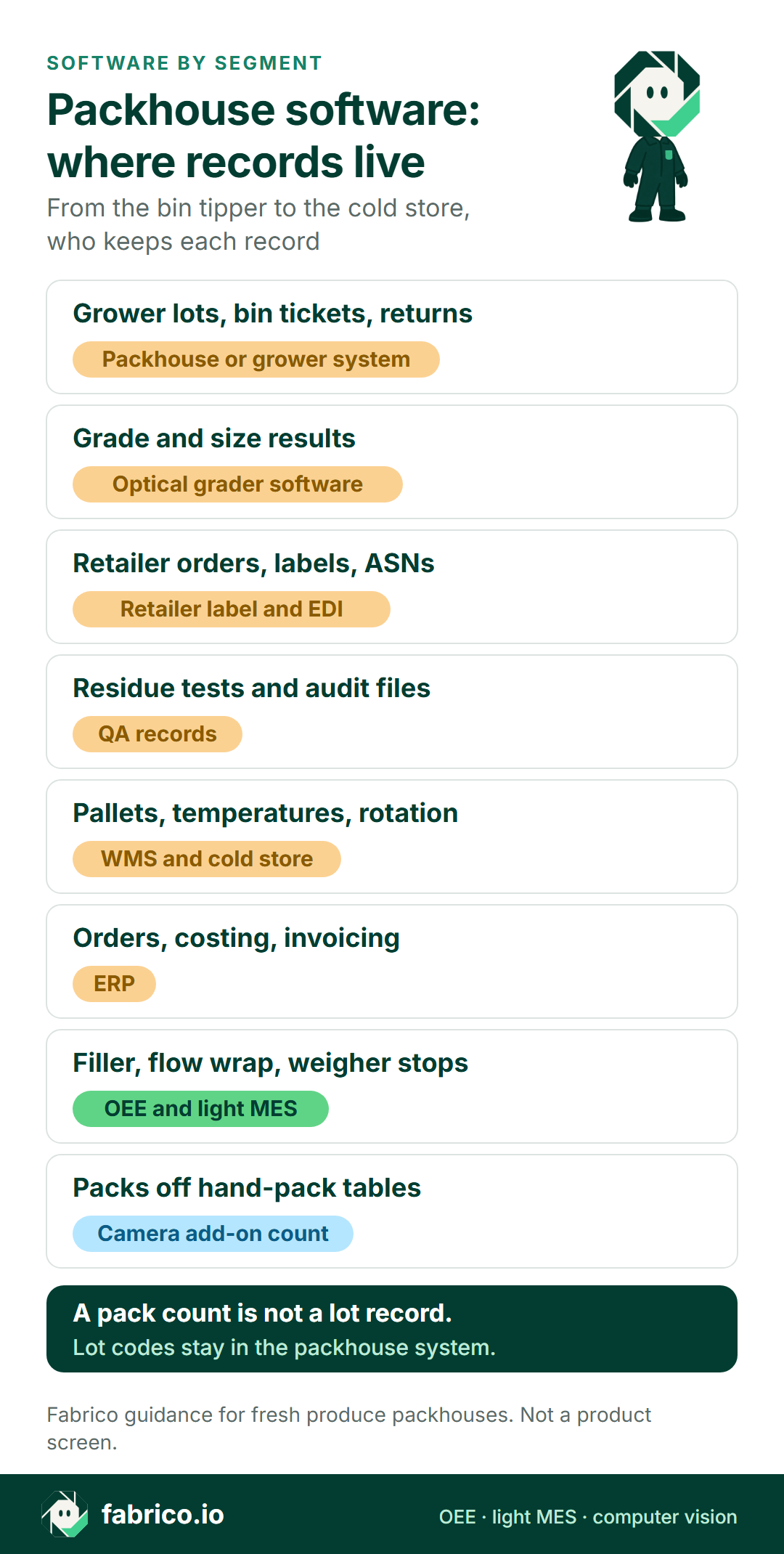
Text version of this infographic
- Grower lots, bin tickets and returns: packhouse or grower system.
- Grade and size results: optical grader software.
- Retailer orders, labels and ASNs: retailer label and EDI.
- Residue tests and audit files: QA records.
- Pallets, temperatures and rotation: WMS and cold store.
- Orders, costing and invoicing: ERP.
- Filler, flow wrap and weigher stops: OEE and light MES.
- Packs off hand-pack tables: camera add-on count.
- A pack count is not a lot record. Lot codes stay in the packhouse system.
How to judge each packhouse system
Every vendor demo looks fine on a quiet day. Test each one on a peak day instead.
Packhouse or grower management system
This is the spine. It books each bin to a grower, block and pick date, tracks the lot through the grader and the lines, and works out what the grower is paid or returned once the produce is sold. Test it with one grower lot split over two lines and three retailer pack formats, then ask to see the pack-out and the grower statement that come out of it.
Optical grader software
The grader sorts fruit by size, colour and defects into lanes. Its software belongs to the grader supplier and is a separate category from everything else here. Ask how its grade results reach the packhouse system per lot, and who keeps that link.
Retailer label and EDI
Orders arrive as messages, and each pack and pallet needs the right label. In Great Britain, the government's guidance on marketing standards says the label on packages of produce under the specific standards must include the quality class and the country of origin in full, with no abbreviations or flags. Test the label tool with a late order change: one retailer, a new pack date and a new origin, with the line already running.
QA and residue records
Residue tests, grower certificates and intake checks should sit against the grower lot, so a failed test can hold that lot before it is packed. Ask how a hold set in QA shows up at intake and in the cold store.
ERP, warehouse and cold store
The ERP holds orders, costs and invoices. The warehouse system holds pallets, cold room locations and temperatures, and which stock leaves first. Ask how a pallet built from two grower lots is labelled and booked.
Labour and time systems
Clocking and piece rates for pickers and packers live here, not in line software. Ask how crew hours reach the cost of each pack format.
OEE and light MES
The line layer takes run signals and counts from punnet fillers, top sealers, flow wrappers, weighers and baggers, and the line leader adds why the line stopped. Where packing is done by hand, the count must come from somewhere else. The limits of a light layer are set out in light MES vs full MES.
Where packing line hours go, briefly
On the packing side, the hours slip away after the grader. Lines wait for bins or for the right grade, retailer changes swap film, labels and punnets several times a shift, and weighers starve when the infeed is uneven. Hand-pack tables run as fast as the crew on the day, which is why new seasonal crews show up as slow running. How to set ideal rates per pack format, and how to treat grade-out, is in OEE for fresh produce packing. Camera stations are in computer vision for fresh produce packing.
Which packhouse management software to buy first
Pick the record that fails worst at peak. If grower statements or lot codes are wrong, nothing else matters yet. If the records are sound and the lines still miss orders, the line layer comes next.
The kind of packhouse changes the order.
| Packhouse | Usually first | Then |
|---|---|---|
| Grower-owned, own crop only | Packhouse system and labels | OEE on the busiest pack line |
| Marketing packhouse for many growers | Grower system with lots and returns | Grader link, then line OEE |
| Retail prepack with many formats | Label and EDI tied to the lines | OEE with a reason code per change |
| Year-round, several sites | A single ERP and one lot code format | The same stop reason list at every site |
Timing matters as much as choice. Set up before the season, not in the first week of harvest. And start the line layer on the line that misses the most orders, then add the hand-pack tables.
If peak weeks are where orders slip, a demo shows a retailer change, a weigher starve and a hand-pack table side by side on a single timeline.
What moves between packhouse systems
The lot code is the thread. It starts at intake, has to survive the grader, and must reach the pack label and the pallet. Every place it is typed again is a place a trace can fail.
US traceability rules and the packhouse record
US rules now spell out what an initial packer of listed produce must keep, which makes a clear test for any packhouse system. Plants outside the US work under their own rules, so check which apply to your buyers.
- Who assigns the lot code. Under 21 CFR 1.1320, a traceability lot code must be assigned when a business does the initial packing of a raw agricultural commodity on the Food Traceability List.
- What the initial packer records. 21 CFR 1.1330 lists the data to keep for each traceability lot, starting with the commodity and variety received, the date received, the quantity and unit of measure (its own example is "75 bins, 200 pounds"), and the farm where it was harvested.
- How fast. The FDA's page on the rule says that during an outbreak, recall or other threat, an electronic sortable spreadsheet of the relevant traceability information must be given to the FDA within 24 hours, unless a business is exempt. The same page says Congress directed the FDA not to enforce the rule before July 20, 2028.
Every one of those records belongs in the packhouse or grower system. Bin counts at the tipper and pack counts at the line are run data, not traceability records, and no line tool should be sold as one.
Worked example: one grower lot of cucumbers, traced to the pallet
Sample case, invented for this page. A retailer asks for every pack from one grower's Tuesday pick. The packhouse has to name the lot code, the grade run, the packs and labels, and the pallets now in the cold store, and no single system holds all four answers.
| Record | Held in | Where the hand-off breaks |
|---|---|---|
| Grower, block, pick date, bins received | Packhouse or grower system | Bins tipped before the intake ticket is booked |
| Traceability lot code | Packhouse system | Lot changed on the line without a new code |
| Grade results for the lot | Grader software | Grader run not tied to the lot |
| Pack label with lot, date and origin | Label and EDI tool | Label printed from the previous order |
| Pallets and cold room location | WMS and cold store | Mixed pallet booked to one lot |
| Line run and pack counts | OEE and light MES | Run times and counts, never a lot |
The weak point is the lot change on a busy line, when the next grower's bins are tipped before the code is changed. Fabrico holds no part of that record. It can only say when the flow wrapper ran and how many packs it counted. For the OEE maths of a punnet line shift, see OEE for fresh produce packing.
Eight questions for any packhouse software vendor
Bring last season's intake tickets and one peak week of line reports, and put these to every product you are still considering.
| Question | What a good answer shows |
|---|---|
| How does a grower lot follow the fruit through the grader? | Ask for one lot split over two lines, with the grade results on the lot. |
| What happens at a lot change mid-run? | Ask to see the code change on the line and the label change with it. |
| Can grower returns be built from the system alone? | Ask for one grower's statement for a week, with no spreadsheet step. |
| How do retailer order changes reach the line? | Ask for a late change to pack date and origin while the line runs. |
| Where does a residue hold show up? | At intake, in the cold store and on the line plan, from one entry. |
| Can the line layer count a hand-pack table? | Ask how the count is made where no machine signal exists. |
| What does the ERP send to the line layer, and what comes back? | Pack formats and quantities go down; good packs and lost minutes return. Ask who maintains it. |
| How fast can a new seasonal crew log a reason? | Ask a new packer to pick a reason on a phone, in their own language. |
Fabrico in a packhouse: the packing lines and the tables
In a fresh produce packhouse, Fabrico, a cloud OEE and light MES platform, covers three things:
- Machine lines: stops and counts come from the punnet filler, flow wrapper, weigher and bagger signals, and the line leader adds why it stopped, which keeps waiting for bins or grade apart from a film fault or a retailer change.
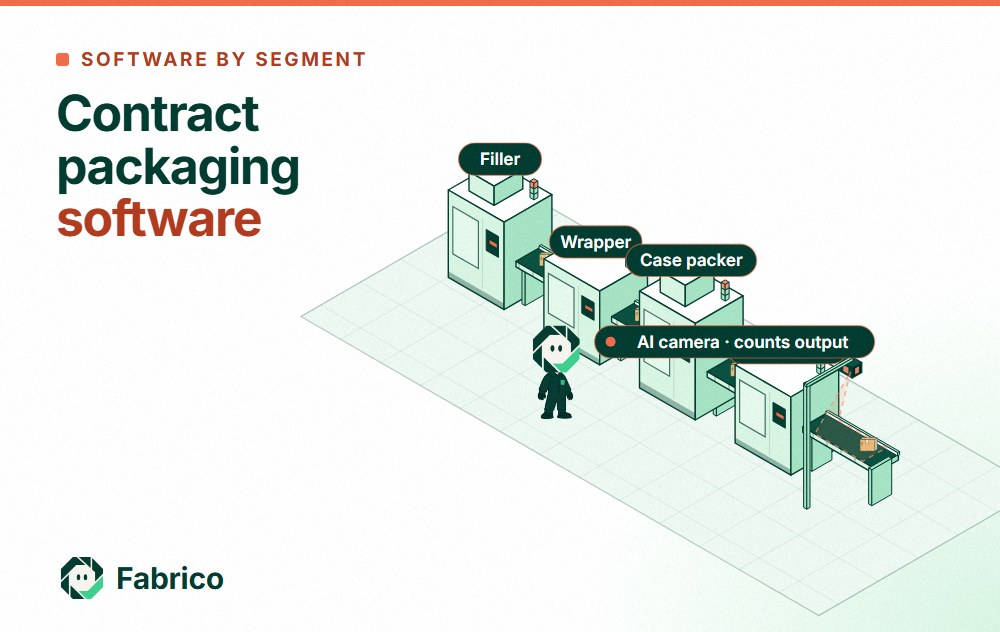
- Hand-pack tables: tables give no machine signal, so the camera add-on counts the packs at the table outfeed. Video for a chosen moment is streamed on request and is not kept in Fabrico.
- Peak season view: lost minutes and good packs by line and shift, shown in money, so the packhouse can see which retailer changes and which lines cost most during the weeks that matter.
The OEE software page covers the platform as a whole. Camera counting is explained on the computer vision add-on page and in the FMCG camera guide.
Outside Fabrico: grading or sorting fruit, grower lots, lot codes and traceability records, grower payments or returns, retailer labels and EDI, residue results, cold store control, piece-rate pay, and weight or label inspection. Planning the packing day remains the job of your planners and the packhouse system.
Food plants beyond fresh produce are covered in food manufacturing software.
What packhouse teams ask next
What is the difference between packhouse software and grader software?
Grader software runs the optical grader and records grade and size results. Packhouse software books those results to grower lots, along with intake, packing, stock and grower payments. They are usually separate products joined by a link.
Who assigns the lot code in a packhouse?
The packhouse or grower management system, at intake or at initial packing. Under US rules, the initial packer of listed produce assigns the traceability lot code. Line software only shows which lot was running.
Does OEE software replace the packhouse system?
No. The packhouse system holds lots, grower accounts and consignments. OEE software holds stop minutes, counts and reasons on the packing lines. A packhouse with busy pack lines needs both.
Can OEE software pay piece rates?
No. Piece rates and crew hours belong in the labour and time system and payroll. Fabrico counts packs at a hand-pack table, not people.
When does a small packhouse need line software?
When the pack lines run most days in season and orders are missed without a clear reason. A grower packing a few pallets a week usually gets more from a packhouse system and labels first.
Want a peak week of line sheets priced in lost minutes and money? Book a demo, with one retailer change log and the line sheets from those days in hand.
Related articles


Real Fabrico tiles, sample data.