


 Login
 Blog

MES (Manufacturing Execution System) in Manufacturing: What It Is and Examples

In short: MES in manufacturing means a manufacturing execution system: software that connects the plan in your ERP to the work on the line, and records what really happened.
- It answers floor questions the ERP cannot: what is this line making now, what stopped it, and how much was good.
- It sits at Level 3 of the ISA-95 model, between ERP and machine control.
- A full MES covers up to 11 functions. A light MES covers the part closest to the machine, led by OEE and downtime.
- Four plant examples with the math are below.
What does MES mean in manufacturing?
MES stands for manufacturing execution system. IBM's short definition is software "used to monitor and control production processes on the shop floor." (IBM, read 9 November 2026)
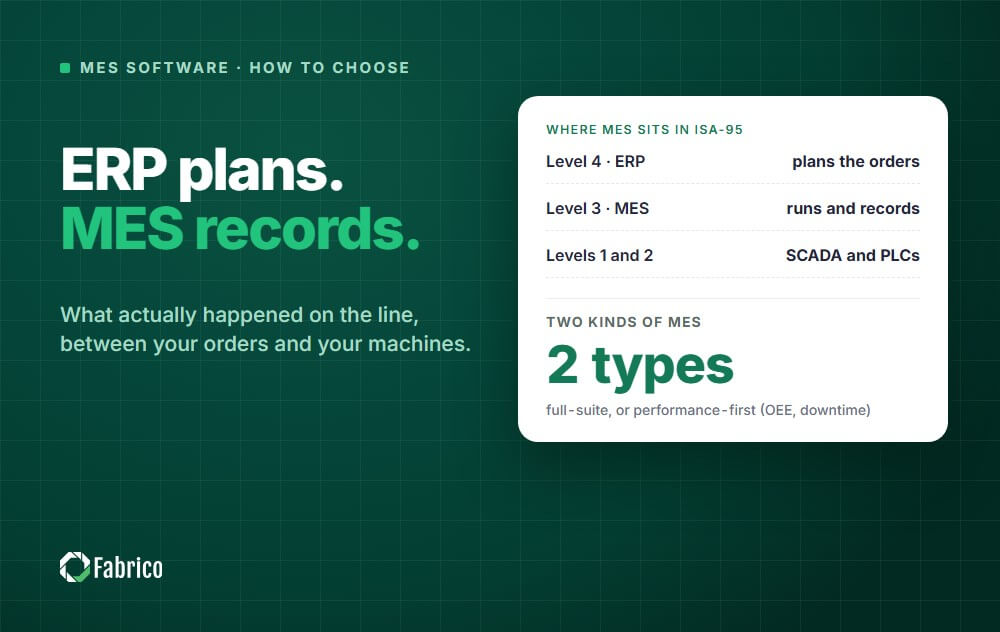
In plain terms: ERP decides what to make, the MES runs and records how it gets made, and PLCs control the machines that make it.
The ISA-95 standard gives the map. The International Society of Automation places MES at Level 3, manufacturing operations management, with ERP above it at Level 4. (ISA, read 9 November 2026)
How an MES works: one order through one shift
Take a packaging plant. This order is an invented example.
- The order arrives. The ERP sends order 4471: 36,000 packs of one product, due Friday.
- The work goes to a line. Line 2 gets the order, and the crew sees what to run.
- The machines report. Run and stop signals and counts come in from the PLC or from added sensors.
- People add what machines cannot know. The operator gives the reason for a stop, such as a film jam.
- The record builds up. Stops, counts and rejects are tied to the order, the line and the shift.
- The result goes back. The ERP and the planner see what was made, not what was planned.
That last step is the point. A signal that says "motor stopped" becomes "Line 2 stopped for 14 minutes during order 4471, film jam," which someone can act on.
What does an MES do? The 11 functions
The usual scope comes from MESA International, which defined 11 functions. Read it as a menu, because no plant starts with all of them.
| Function | The question it answers |
|---|---|
| Operations and detailed scheduling | What runs on which machine, in what order? |
| Resource allocation and status | Which machines, tools and materials are free right now? |
| Dispatching production units | Which order goes to which line next? |
| Document control | Is the current instruction or recipe at the station? |
| Data collection and acquisition | What did the machines and people report? |
| Labor management | Who is on this job, and are they qualified? |
| Quality management | Did this unit or batch pass its checks? |
| Process management | Is the work following the set route? |
| Maintenance management | Is the machine due for work, and what was done? |
| Product tracking and genealogy | Which lots went into which finished units? |
| Performance analysis | How did the line do against plan? OEE lives here. |
A plant that loses hours on its lines leans on data collection and performance analysis. A plant that must prove what went into each lot leans on genealogy, quality and document control.
MES examples in manufacturing
These four examples are generic. The plants and all the numbers are invented to show the method, so don't read them as results.
Example 1: a packaging line that loses time
Function: data collection and performance analysis. Line 2 is planned for 450 minutes, with an ideal rate of 100 packs a minute. The machine signal shows 45 minutes of stops, 36,450 packs and 729 rejects.
- Availability: 405 running minutes / 450 planned = 90%
- Performance: 36,450 packs / (100 x 405) = 90%
- Quality: 35,721 good / 36,450 total = 98%
- OEE: 0.90 x 0.90 x 0.98 = 79.4%
Now the stop reasons matter. Say film jams take 15 of the 45 minutes, and the team removes them. With the same speed and reject rate, the line runs 420 minutes and makes 37,044 good packs. That is 1,323 more per shift, and OEE moves to 82.3%.
The OEE calculation guide has each input in detail.
See this on a demonstration plant: Book a demo.
Example 2: a machine shop that misses its plan
Function: dispatching and performance analysis. A CNC cell has a 480 minute shift and a job of 400 brackets, with an ideal cycle of 2 minutes. The plan is 40 minutes of setup, then 220 parts by the end of the shift.
The record shows setup took 70 minutes, and short stops took another 40. That leaves 370 minutes of running, so 185 parts. The cell is 35 parts behind, which is the 70 lost minutes (30 of setup overrun plus 40 of short stops) at 2 minutes a part.
The planner sees this today, not on the day the job is due. The setup overrun also has a name now, so it can be fixed.
Example 3: a food plant that gets a lot question
Function: product tracking and genealogy. A supplier warns about flour lot 8812. The MES recorded that lot at the mixer, so one search shows it went into 3 batches and 42 pallets, and which orders shipped them.
Without that record, someone goes through paper and spreadsheets while the customer waits. This is a job for a full MES or your ERP, and a light MES won't do it.
Example 4: an assembly station with a new revision
Function: document control and process management. An electronics plant changes a work instruction to revision C. A full MES shows revision C at the station and can hold the unit until the test step passes.
The record then shows who built the serial number, against which revision. That matters when a customer returns a unit.
MES vs ERP, SCADA, PLC and OEE
These terms get mixed up because they share data. Each one answers a different question.
| System | The question it answers | Time scale |
|---|---|---|
| ERP | What should we make, for whom, at what cost? | Months to days |
| MES | How is this order being run and recorded? | Shifts to minutes |
| SCADA | What is the process doing, and what should change? | Seconds |
| PLC | What does the machine do next? | Milliseconds |
| OEE | How much of the planned time made good output? | Per shift, or live |
OEE is a measure, not a layer. An MES collects the inputs, and OEE software focuses on that one job. Sources also differ on SCADA: ISA lists it at Level 3, while many plants treat it as Level 2.
The full comparisons are here: ERP vs MES, MES vs SCADA, PLC vs SCADA vs MES and OEE vs MES.
What MES systems give a plant
- A live answer. You see what each line is making now, against plan.
- Real stop data. Short stops and slow running show up, and these rarely reach a paper log.
- One record. Production, quality and stops share one set of numbers, so meetings spend less time on whose figure is right.
- Traceability, if you buy a system that includes it.
Lost time has a real price. Siemens estimates that unplanned downtime costs the world's 500 biggest companies almost 1.4 trillion US dollars a year, 11% of their revenues. (Siemens, The True Cost of Downtime 2024) That is a vendor's estimate for giant companies, so use it for scale and work out your own number.
Which kind of MES does a plant need?
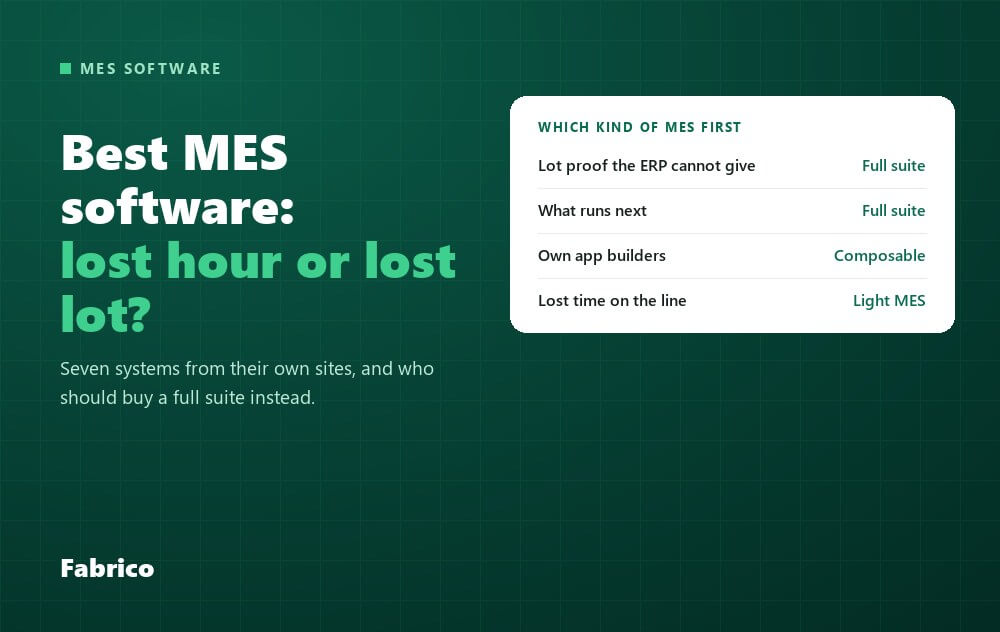
You likely need MES-class data when ERP, paper and spreadsheets can no longer answer floor questions in time. Start from your worst day last month.
| Your worst problem | Kind to look at |
|---|---|
| Lines lose hours, and nobody can say why | A light MES, led by OEE and downtime |
| You must prove which lot went where, for an auditor or a recall | A full MES suite |
| What runs next is the daily fight | A full MES suite, or a scheduling tool |
| Your team wants to build its own apps | A composable platform |
From here, see the shortlist of 7 MES systems, how to go about choosing MES software, and the steps and cost of MES implementation.
Where Fabrico fits: OEE and light MES
We sell Fabrico, a cloud-based OEE and light MES platform. It covers the first row of that table: where the time went, by line and shift.
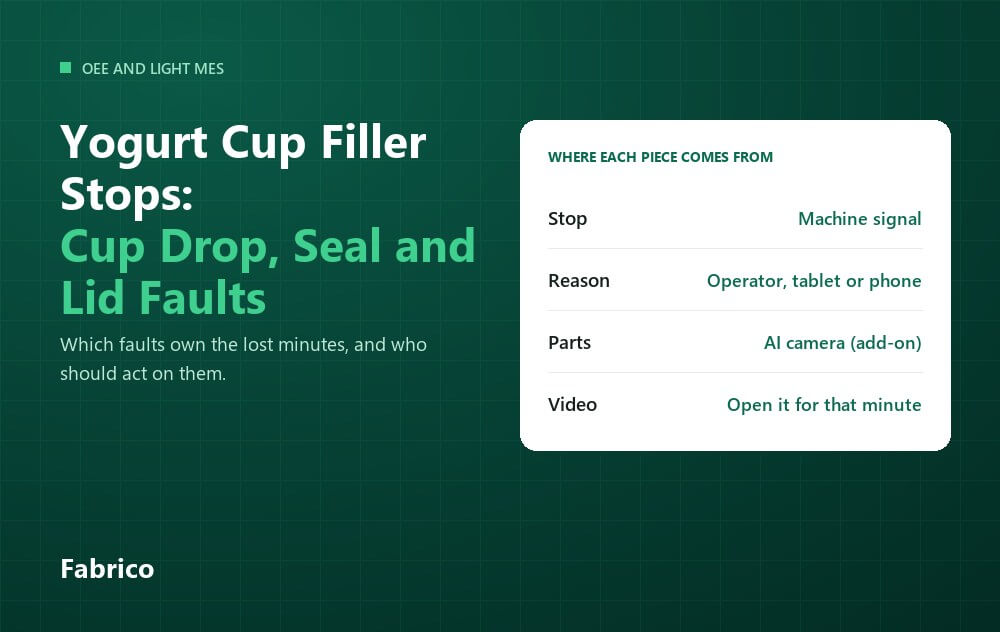
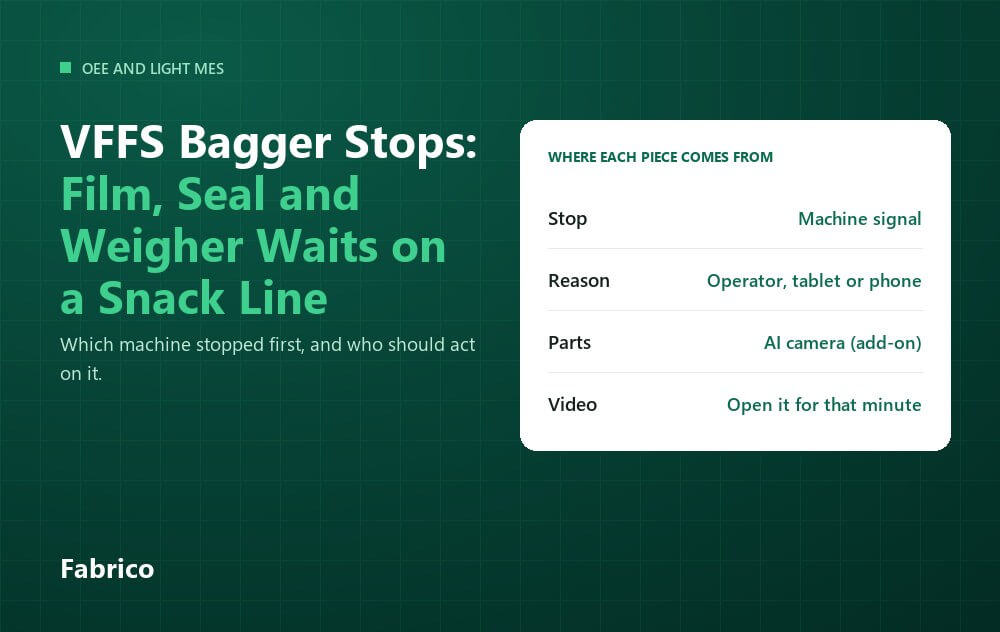
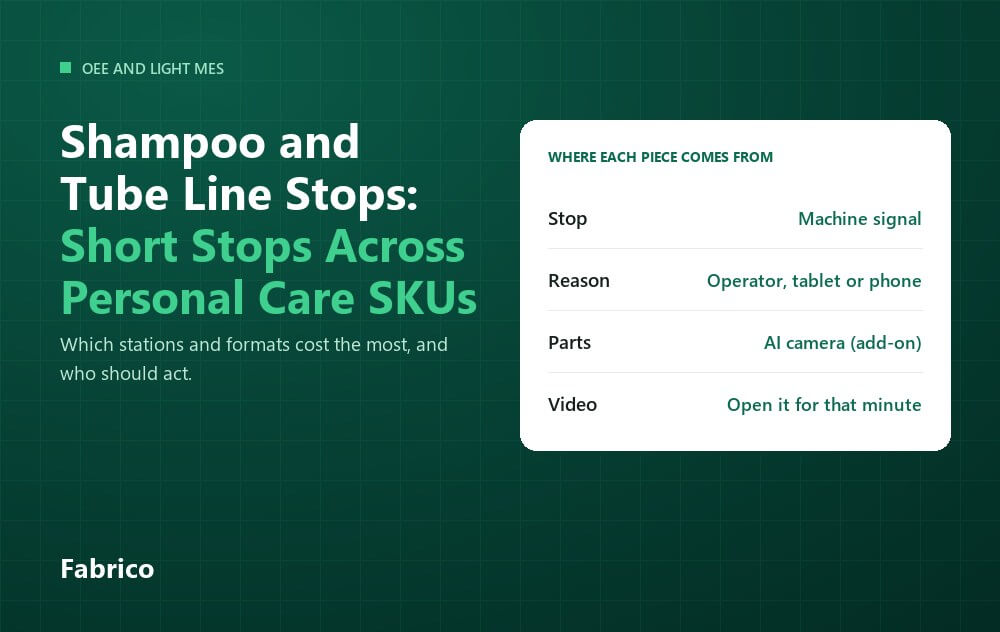
- Stops: they come from the machine signal, through a PLC or a Fabrico IoT device. The operator adds the reason on a tablet or phone.
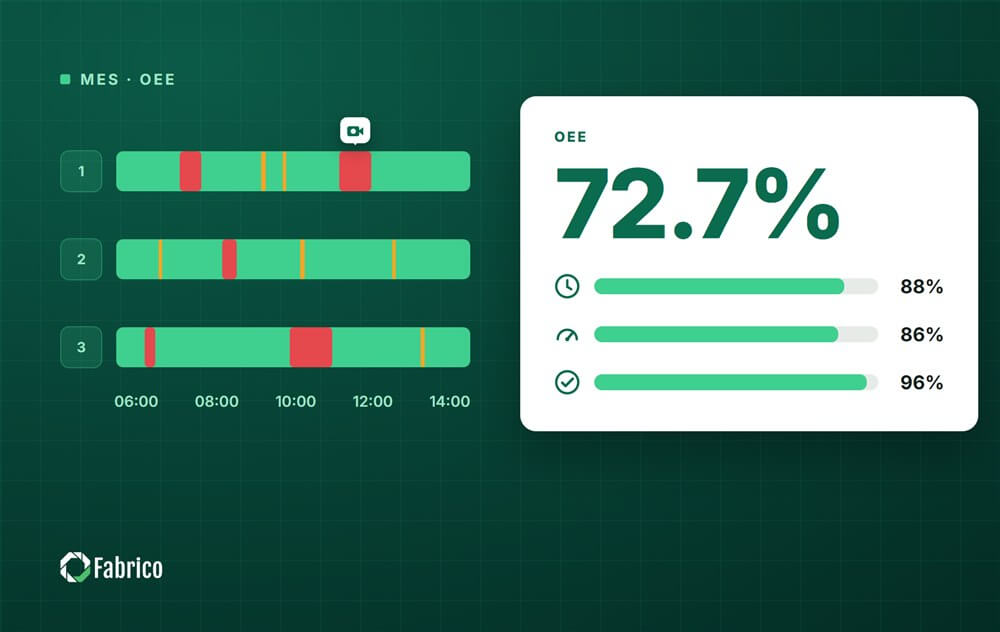
- OEE: availability x performance x quality, in real time per line and shift.
- Parts: AI cameras (an add-on) count parts. You can open the camera video for that minute. In the standard setup, it is streamed, not stored in Fabrico.
- Maintenance: a side benefit, as your team can open a work order from a stop, linked to the line.
What it does not do: production planning and scheduling are not part of Fabrico today. Job dispatching, routings, BOMs and genealogy stay in your ERP, and it keeps no electronic batch records. Suggested stop reasons are on our roadmap, not in the product today. If you need those things, buy a full suite.
Ficosota (also a Fabrico investor) raised OEE from 53.1% to 59.6% on 16 lines, June to September 2026, with monthly good output up 23.2%.
Installing the devices and connecting the machines takes about one month. Full rollout across the lines you choose takes 3 to 4 months.
If cameras fit your line, ask us to show them in the demo.
Frequently asked questions
What does MES stand for in manufacturing?
MES stands for manufacturing execution system. It is the software that connects the plan in your ERP to the work on the line, and records what really happened.
What is an example of an MES in manufacturing?
On a packaging line, an MES takes an order from the ERP, reads counts and stops from the machines, and holds the reason for each stop. At the end of the shift it can show that Line 2 made 35,721 good packs against the order and lost 45 minutes to stops. Those numbers are an invented example.
Is an MES the same as ERP?
No. ERP plans what to make, for whom and at what cost. An MES runs and records how the work is done on the floor, then reports back what was made, scrapped and lost. More in ERP vs MES.
What is the difference between MES and SCADA?
SCADA watches and controls the process through PLCs, so it works with signals and setpoints. An MES ties those signals to an order, a product and a shift, so a stopped motor becomes a production record a planner can use. More in MES vs SCADA.
Does an MES include OEE?
Usually, yes. An MES collects run time, stop time, total count and reject count, which are the inputs of availability, performance and quality. Performance analysis is one of the 11 functions. More in OEE vs MES.
What is a light MES?
A light MES covers the part of an MES closest to the machine: machine data, live monitoring, OEE and downtime. The name has no fixed definition, so ask each vendor what the system records without anyone typing it. More in our light MES guide.
When does a plant need an MES?
When ERP, paper and spreadsheets can no longer answer floor questions in time. Typical signs are not knowing what each line is making now, stop reasons rebuilt after the shift, and lot questions that take days to answer.
See OEE, stops and reasons per line on a demonstration plant.
Book a demoContact usRelated articles

Latest from our blog



Real Fabrico tiles, sample data.