


 Login
 Blog
Mingo Smart Factory Alternatives: ERP and Maintenance Links Compared

In short: the Mingo Smart Factory alternatives compared here, Vorne XL, Guidewheel, Worximity and Fabrico, differ most in how line data reaches the ERP and the maintenance system. Mingo, which Nulogy now sells as Nulogy Smart Factory, offers a managed integration for that step. Vorne XL has Data Link ERP and an SQL collector, Guidewheel lists SAP, MaintainX and Limble connectors, Worximity offers push and pull APIs, and Fabrico sends data out by REST API and webhooks, with maintenance built in.
- Mingo Smart Factory became a Nulogy company in a deal announced on 1 October 2024; nulogy.com now lists the product as Nulogy Smart Factory.
- Its pages describe ERP imports of parts and schedules, production and scrap counts sent back, and CMMS work order requests.
- The hard part is rarely the connector. It is the mapping: which count, which order, which scrap reason.
- All vendor facts here are from the vendors' own pages as of 11.11.2026 unless dated otherwise, linked where used. No prices and no rankings.
Take an invented pasta order: the ERP says 20,000 bags. The bagger counted 19,400, and the checkweigher pushed out 380. Which number should the ERP book, and which should OEE use? Get the mapping wrong and the books show stock that does not exist.
This page compares Mingo Smart Factory (mingosmartfactory.com) with four alternatives on that step: how line data reaches the ERP, the maintenance system and your own tools. Fabrico wrote it and is one of the four, so test its claims like any vendor's. How these tools collect data in the first place is covered in which source suits each machine and machine connectivity; a wider field is in the real-time production monitoring review.
Mingo Smart Factory today (as of 11.11.2026, from its site)
Mingo calls itself a manufacturing productivity and analytics platform for data from machines, devices and people. Its homepage reads "Mingo Smart Factory is Now a Nulogy Company", and the acquisition post of 1 October 2024 ties it to Nulogy's work with FMCG brands, co-packers and contract manufacturers. A Mingo post of 21 April 2025 traces the product from SensrTrx to Mingo Smart Factory and now to Nulogy Smart Factory, the name it carries on Nulogy's own site.
- Into the ERP and back. Its managed integration page describes importing parts, production data and schedules from the ERP, syncing each production run, and reporting production and scrap counts back. Its integration logos include SAP, Oracle NetSuite, Microsoft Dynamics, Epicor, IBM Maximo, Fiix and UpKeep, and its FAQ says the managed service connects with most ERP systems.
- Into maintenance. The same page describes sending cycles and run time to the CMMS to trigger preventive work, and work order requests raised from Mingo.
- Anywhere else. The page says Mingo can provide near real-time data from the cloud to ERP, MES and CMMS systems, and the homepage lists an open API.
- Jobs from the schedule. Its scheduling page imports work from an ERP or Excel into an operator work queue, so counts land against a job.
- Data in, hosting and apps. PLC hardware, retrofit sensors or wireless nodes, or operator entry on a PC or tablet. The FAQ adds a dedicated public cloud (AWS) environment, encrypted in transit and at rest, and its CPG page lists iPhone and Android apps.
- Food and CPG. Its food and beverage page gives examples such as reading checkweigher rejects for under or overweight product, and output per person on a line.
As of 12.11.2026, Nulogy's page describes Smart Factory as manufacturing operations software that sits between the ERP and the machines, puts production data next to connected maintenance, and lists ERP, BI and database integrations. Both sites show customer results; those are vendor-reported and not repeated here.
Ask in the demo: which ERP fields the managed integration maps, and who changes the mapping when the ERP is upgraded.
Plants Mingo fits, per its own pages
- Plants that want the vendor to run the ERP and CMMS link, as its managed integration page describes.
- Plants that schedule from the ERP or Excel and want counts booked against each job.
- Food, beverage and CPG plants that want checkweigher, labour and process data next to OEE.
- Co-packers and contract manufacturers, the partners Nulogy names in its acquisition post.
Where the data goes after the line
Every tool here shows stops, counts and OEE at the line. If you already run an ERP and a maintenance system, compare the next step: where those numbers go, and who keeps the link working.
Each cell is from the vendor's pages, read as of 11.11.2026, and linked in the sections below.
| Tool | How line data reaches other systems, per its site |
|---|---|
| Mingo (for reference) | Managed integration, with SAP, Epicor and Fiix among its logos: parts, production data and schedule in from the ERP; production and scrap counts back; CMMS work order requests; open API |
| Vorne XL | Data Link ERP connects the ERP and XL; Data Collector writes XL data to an SQL database |
| Guidewheel | SAP partner, connects to other ERPs; MaintainX, Limble and AVEVA among its integrations; open API |
| Worximity | Push and pull APIs exchange data or work instructions with ERP, MES and CMMS |
| Fabrico | REST API and webhooks; Excel and CSV export; a connection to SAP or another ERP scoped per customer |
A connector is half the answer; ask each vendor which count it posts to the ERP: the machine counter, the good count after rejects, or the packed count. The worked example shows why.
Want to see how one shift's good count and scrap leave Fabrico? Book a demo with a list of your stations.
Vorne XL: Data Link ERP, SQL and Excel export
XL, from Vorne, is a production monitoring device that sits on each process and serves its own reports (vorne.com). Its integration pages say, as of 11.11.2026:
- Data Link ERP moves job information from the ERP into XL and production data from XL back into the ERP (integration tools page).
- The Data Collector writes data from many XL devices into an SQL database on your own server, and integration partners can link XL to a production scheduling system. Reports also export to Excel (vorne.com).
- At the line, a barcode scan starts a part run, or the XL Sidekick app starts the next job, so counts land on the right job.
- Its co-packing page stresses counts tied to jobs and part runs for co-packers that handle stock they don't own, with emailed end-of-shift reports for clients.
Compared with Mingo: both list an API. Mingo's pages describe a managed integration service; Vorne's describe Data Link tools and third-party integration partners for XL devices on your network.
Ask in the demo: which job fields Data Link ERP brings into XL, and which production fields it sends back.
Guidewheel: SAP, CMMS work orders and an open API
Guidewheel's homepage calls it the practical operating platform for manufacturing, starting from sensors on a machine's power conductor, with temperature, pressure, flow or production inputs added where needed. Its integrations page, as of 11.11.2026, describes where that data goes:
- Guidewheel is an SAP partner and lists SAP Digital Manufacturing among its integrations, for live production, uptime and OEE signals.
- A downtime tag can become a MaintainX work order, and a flagged stop can open a Limble work order with the machine, the time and the reason attached.
- AVEVA CONNECT can receive power and minute-level energy data, and an open API gives runtime, downtime, cycle and energy data for connected machines.
- The page's FAQ says an admin in the partner system approves each integration.
Compared with Mingo: both name ERP and CMMS links. Guidewheel's page lists connectors for SAP, MaintainX, Limble and AVEVA; Mingo's shows logos for SAP, Epicor, Fiix, UpKeep and other systems, connected as a managed service.
Ask in the demo: which reason codes should open a work order, and what flows back when the job is closed.
Worximity: push and pull APIs, plus weight sampling
Worximity sells OEE and real-time production monitoring backed by a team of experts. Its pages, as of 11.11.2026:
- The Connect page says push and pull APIs exchange data or work instructions with ERP, MES and CMMS systems, while line sensors feed its IoT device.
- The Measure page adds data export and BI integration.
- The giveaway module samples weights and units with statistical process control, with KPIs for giveaway and process yield. Inputs and outputs along the line can capture rejects for quality KPIs, and a form builder keeps production records in one searchable place.
Compared with Mingo: Worximity's pages describe giveaway and yield KPIs from weight sampling; Mingo's food page describes reading checkweigher rejects for under or overweight product.
Ask in the demo: which work instructions the push API can send to the line, and how weights reach the giveaway module.
Fabrico: OEE and light MES, with data out by API and webhooks
This page is Fabrico's. Fabrico sells OEE and light MES as cloud software; per its solution overview and machine connectivity pages, today it offers:
- Data out. A REST API, webhooks and Zapier, Excel and CSV export, and a connection to SAP or another ERP scoped per customer.
- Maintenance built in, on the same machine record as the stops.
- Data in. PLCs over OPC UA, Modbus, PROFINET, EtherNet/IP and other protocols, a Fabrico IoT device with sensors on older machines, and, on request, an AI camera add-on for counts at stations without a usable signal. If the network link drops, the gateway can store machine data for up to 30 days.
- Rollout. Devices connected in about a month; full rollout in 3 to 4 months.
- Reasons and cost. Operators add stop reasons on a tablet or phone, and OEE shows with the money each loss costs, per line and per shift, on web, iOS and Android.
- Video at stations with the camera add-on, opened for any moment from the shift timeline. By default it is streamed when opened and not stored in Fabrico (camera add-on).
- Roadmap, not live today: with the camera add-on, stop-reason suggestions that the operator confirms, and jam and blockage zones on the camera view.
- Stays in your ERP: job dispatching, BOMs, routings and genealogy. Production planning is on our roadmap, with no release date. Today Fabrico does not build or schedule your plan: it shows what the lines can do.
- Not Fabrico: pack inspection, inspection plans and SPC.
One customer data point, disclosure first: Ficosota, a Bulgarian producer of hygiene, tissue and household goods, is also an investor in Fabrico (see the investment announcement). From June to September 2026, across 16 lines in Fabrico, OEE rose from 53.11% to 59.62%, and monthly good output grew from 10.49 million units to 12.92 million. The part of production time left without a recorded reason fell from 3.20% to 0.40%. This case study does not cover cameras. Read the Ficosota story.
Compared with Mingo: both list an API. Mingo's pages describe a managed integration service; Fabrico's describe webhooks and exports, with ERP connections scoped per customer.
Ask in the demo: how the camera add-on is tested against a hand count in a pilot.
Fit by where your data has to go
- Mingo Smart Factory fits plants that want a managed ERP and CMMS integration from the vendor, in a product Nulogy now sells as Nulogy Smart Factory.
- Vorne XL fits plants that want ERP job data on a device at each process, and XL data in their own SQL database.
- Guidewheel fits plants on SAP, MaintainX or Limble that want downtime tags to reach those systems.
- Worximity fits plants that want push and pull APIs to ERP, MES and CMMS next to weight-sampling KPIs.
- Fabrico fits plants that want OEE with the cost of each loss, maintenance on the same machine record, and data out by API and webhooks; the OEE software guide sets out what to compare.
Two of these can sit side by side on one site, but only one should post quantities to the ERP. See also our production monitoring systems comparison and OEE for CPG manufacturing.
Worked example: one penne order, three numbers
Invented figures for a dry pasta line that bags 500 g penne: one 450 minute shift, an ideal 50 bags a minute, and an ERP order for 20,000 bags.
The bagger's counter shows 19,400 bags. The checkweigher pushed 380 underweight bags off the line, so 19,020 good bags reached the pallet. Three systems now want a number, and each needs a different one.
The ERP should receive 19,020 good bags against the order and 380 as scrap, with the reason. If the integration posts the counter instead, stock shows 380 bags that do not exist, and the order looks 600 short when it is 980 short.
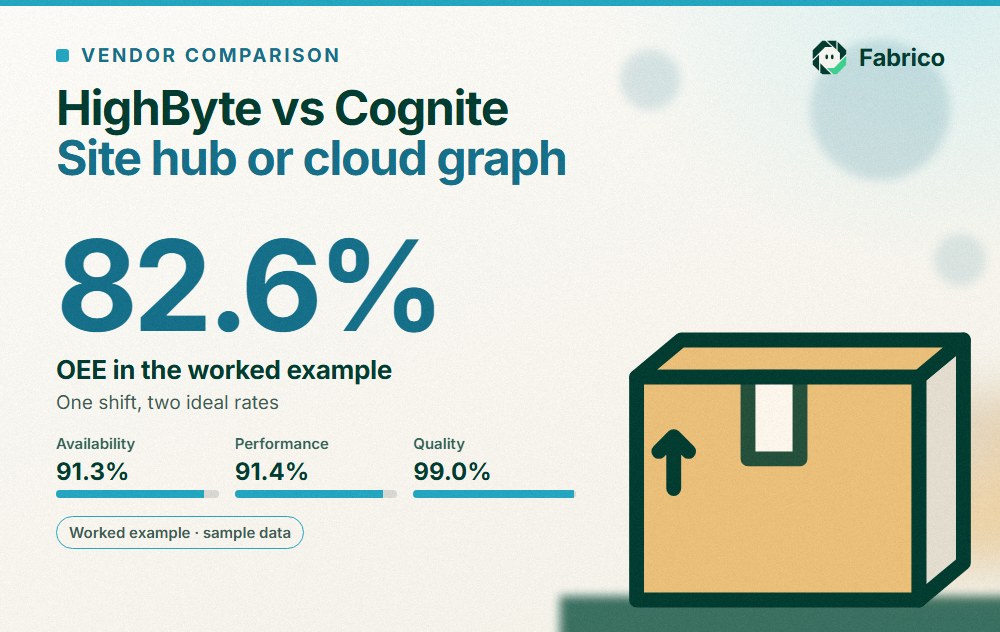
OEE uses the same good count against what the line could have made: 19,020 of 22,500 possible bags (450 minutes x 50 a minute), or 84.5%. The rejects land in the quality factor.
The maintenance system needs neither total. It needs the bagger's run hours, cycles and stop history, so a seal jaw fault can raise a work order before the next shift. If part of the order is hand-packed into multipacks at a table, that station needs its own count, from the operator or from a camera add-on, or the ERP and OEE both miss it. Our OEE calculation guide shows the arithmetic, and what OEE data to send to the ERP covers which fields belong there.
Integration questions to put to each vendor
Use one real production order and one real shift for every vendor, Fabrico included.
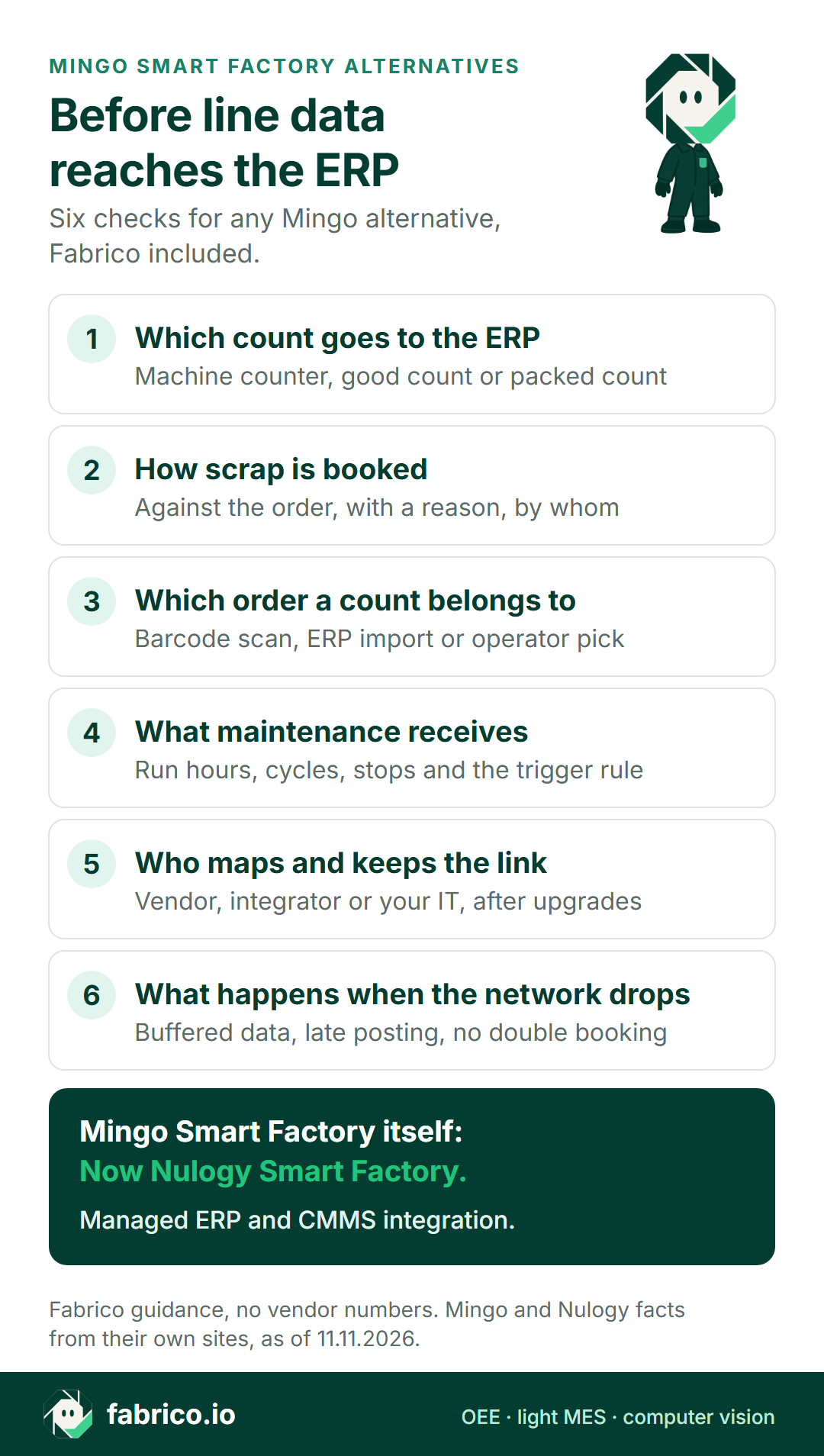
- Which count goes to the ERP? The machine counter, the good count after rejects, or the packed count.
- How is scrap booked? Against the order, with a reason code, and by whom.
- Which order does a count belong to? How a job starts at the line: a barcode scan, an ERP import or an operator pick.
- What does the maintenance system receive? Run hours, cycles or stop events, and who sets the rule that opens a work order.
- Who maps the integration, and who owns it after an ERP upgrade? The vendor, an integrator or your IT team.
- What happens when the network drops? Whether data is buffered and posted later, and how double bookings are avoided.
- Where do the raw numbers live? Export, API, SQL or a BI tool, and who can pull them.
- If a camera add-on counts a manual station, what it sees and who may open its video. Settle that with the works council before it is mounted (how to run line cameras without surveillance).
For cameras on FMCG lines, see the FMCG camera guide and, for contract packers, cameras for co-packers.
What people ask next
Who owns Mingo Smart Factory?
Nulogy announced its acquisition of Mingo Smart Factory on 1 October 2024, and Mingo's homepage says it is now a Nulogy company. Nulogy works with FMCG companies and their supplier networks.
Is Mingo Smart Factory now Nulogy Smart Factory?
Yes. A Mingo post of 21 April 2025 traces the product from SensrTrx to Mingo Smart Factory and now to Nulogy Smart Factory. Nulogy's site lists it as production monitoring and OEE software, connecting through PLCs, wireless nodes and sensors, with operator entry on the floor.
Does Mingo Smart Factory connect to an ERP?
Its FAQ says Mingo provides a managed integration service that connects with most ERP systems. Its integration page describes importing parts and schedules, and sending production and scrap counts back to the ERP.
How does Mingo Smart Factory compare with Vorne XL?
Both sell hardware and software. Vorne's integration tools page lists Data Link ERP for job data in and production data out, and a data collector that writes XL data to an SQL database. Mingo describes a managed integration service.
How is Fabrico different from Mingo Smart Factory?
Mingo describes itself as a manufacturing productivity and analytics platform. Fabrico is OEE and light MES: stops and counts from the PLC or a Fabrico IoT device, reasons from the operator, the cost of each loss, maintenance on the same machine record, and an AI camera add-on for counts at stations without a signal. Fabrico does not inspect packs.
Want to see a mixed line in one OEE? Book a demo, bring your station list, or contact us.
Related articles








Real Fabrico tiles, sample data.