


 Login
 Blog

Nameplate Capacity vs Real Capacity: Why Your Factory Makes Less Than the Spec Says

Every machine arrives with a number on its spec sheet: it can make X units per hour. Finance plans around it, sales quotes against it, and then reality delivers something noticeably smaller. Production monitoring software shows what the line actually made each shift, which gives planners a number they can use.
See how OEE captures this gap between spec and reality.
The gap between that headline figure, nameplate capacity, and what your factory actually produces is one of the most expensive blind spots in manufacturing, because decisions get made on a number that was never achievable in your plant.
The spec sheet sells the maximum; OEE reveals what your line truly delivers.
The three capacities to keep straight
-
Nameplate (theoretical) capacity, the maximum the manufacturer says the equipment can produce, under perfect, continuous, defect-free conditions.
-
Demonstrated capacity, the best sustained output you have actually achieved on your floor, with your products and people.
-
Real (effective) capacity, what you reliably produce day to day, after the normal losses of running a real operation.
Trouble starts when people plan with the first number while living with the third.
Why the gap exists
Nameplate capacity assumes conditions that never persist: no breakdowns, no changeovers, no minor stops, no slow running, no defects. Your real output is nameplate minus exactly the losses OEE measures, availability, performance and quality losses.
In fact, real capacity is essentially nameplate capacity multiplied by OEE. A line rated for 1,000 units a shift running at 65% OEE has a real capacity nearer 650. The "missing" 350 is not a mystery; it is your loss profile.
The cost of planning on the wrong number
-
Over-promising. Quoting lead times against nameplate capacity sets you up to miss them.
-
Unnecessary capex. Buying a new machine to add capacity you already have, trapped in losses.
-
Hidden upside. The gap is also opportunity, the hidden factory of capacity you can recover without spending a cent on equipment.
How to find your real capacity
You cannot plan honestly without measuring it. That means capturing actual output and losses over a representative period rather than trusting the spec sheet, basing rates on demonstrated ideal cycle time rather than nameplate, and understanding where time goes via the OEE time model. Capacity that is never measured stays as dark data, and you keep planning on fiction.
How to calculate production capacity
Three numbers cover most planning questions. Work them out per line, at the machine that sets the pace.
- Nameplate capacity = planned production time x the rated speed on the plate.
- Demonstrated capacity = planned production time x the ideal rate you have measured on your own format (the same ideal rate your OEE performance uses).
- Effective capacity = demonstrated capacity x OEE, where OEE = availability x performance x quality.
Sample figures for illustration only. A line plans 7,200 minutes a week. The plate says 120 units a minute, so nameplate capacity is 864,000 units. The measured ideal rate on the main format is 100 a minute, so demonstrated capacity is 720,000. At an OEE of 0.88 x 0.85 x 0.97 = 72.6%, effective capacity is about 522,400 good units a week. Plan on the last figure, and treat the gap to the first as losses to recover, not spare capacity.
How Fabrico reveals true capacity
Fabrico captures real output, speed and losses in real time, so you can see demonstrated and effective capacity rather than relying on the nameplate number, and quantify exactly how much capacity is locked in losses. That turns capacity planning from optimistic guesswork into evidence, and often shows you can meet demand by recovering hidden capacity instead of buying more machines.
Frequently asked questions
What is nameplate capacity?
The theoretical maximum output a manufacturer states for a machine, assuming perfect, continuous, defect-free operation, conditions that rarely hold in practice.
How is real capacity related to OEE?
Real (effective) capacity is approximately nameplate capacity multiplied by OEE, because OEE captures exactly the availability, performance and quality losses that reduce theoretical output to actual.
Why does the gap matter?
Planning on nameplate capacity leads to missed promises and unnecessary equipment purchases, while the gap itself is recoverable hidden capacity.
Plan on real capacity, not the spec sheet. See how Fabrico measures your true, demonstrated capacity and the losses hiding the rest. Book a demo today.
Want OEE captured straight from your machines, no manual logs?
Request a demoContact usRelated articles


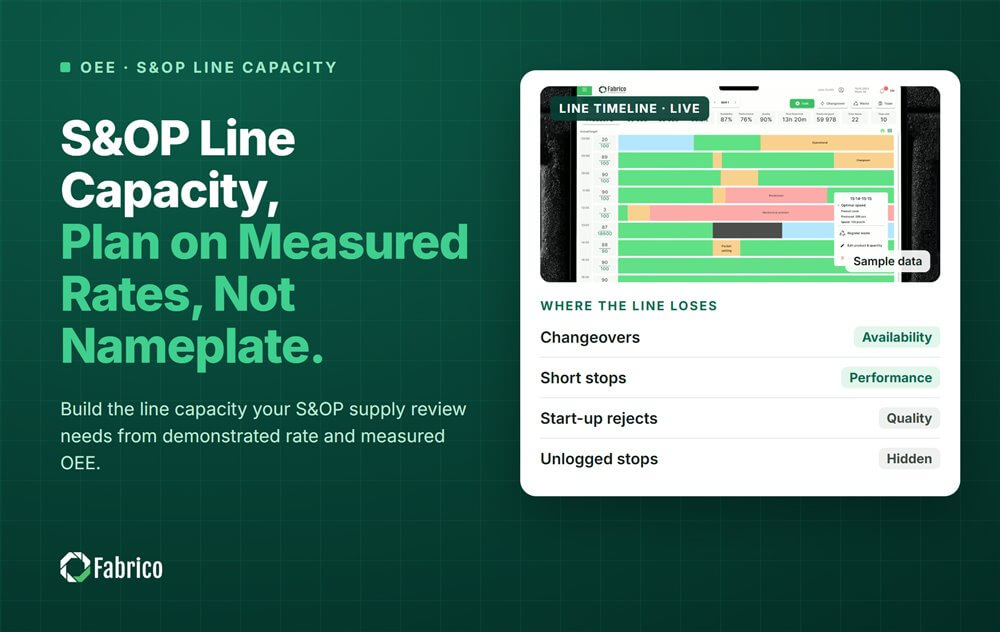










Real Fabrico tiles, sample data.