


 Login
 Blog

Mastering OEE in Food and Beverage Manufacturing: CIP, Allergen Changeovers and Giveaway

Key takeaways
- OEE in food manufacturing is availability x performance x quality on a food or beverage line, measured against planned production time.
- Four losses make food lines different: CIP and sanitation windows, allergen changeovers and their run order, short stops at high-speed fillers and packers, and giveaway from overfilled packs.
- The booking rule decides the number: on the sample plant-based drinks line the same shift reads 71.35%, 61.30% or 56.19% OEE, depending on where CIP and allergen changeovers are booked.
- OEE counted in packs does not show giveaway, because an overfilled pack is a good pack: measure fill against nominal on its own.
- Sample line: 54 allergen changeover minutes a shift put EUR 1,341.60 of margin at stake, and three fixes worth 43 minutes a shift return EUR 769,185 a year if the packs would sell.

OEE in food manufacturing is the share of planned production time in which a food or beverage line makes good product at its ideal rate: availability x performance x quality. The formula is the same as in any plant. What changes on a food line is where the points go: clean-in-place (CIP) and sanitation windows, allergen changeovers, short stops at high-speed fillers and packers, and giveaway, the product a filler puts into each pack above the declared quantity.
Those losses are also where food plants disagree on the arithmetic. Book CIP and allergen changeovers as planned stops outside planned production time and the line looks strong; count them inside it and the same shift can lose more than 15 points. This guide places each food-line loss in the OEE model, carries one sample line through all three factors to euros per shift, month and year, and ranks the fixes.
The sample line fills plant-based drinks into 1-litre aseptic cartons. The same logic holds for a juice filler, a yoghurt cup line or a snack bagger with a wet clean.
How OEE Works in Food Processing: Availability, Performance and Quality
OEE multiplies three factors. Availability is run time divided by planned production time. Performance is the count the line made divided by what it would have made at its ideal rate in that run time. Quality is good packs divided by all packs counted. Multiplied, they equal good packs x ideal cycle time divided by planned production time, which is the quickest check on any OEE figure; the OEE calculation guide covers the variants.
The model is general; the losses are not. A food line stops for cleaning its food safety plan requires, changes over between recipes with different allergens, runs fillers fast enough that stops of a minute or two add up, and puts product into packs above the label quantity. Each lands in a different place in OEE, or outside it, depending on how the plant books it; the planned production time vs operating time split is where the booking starts.
Measuring this needs a stop log that is complete and consistent. OEE software takes run time and counts from the machine's PLC or from an IoT device with sensors on the machines you connect, and operators give the reason for a stop at the machine, so CIP, changeover, short-stop and breakdown time add up by line and shift instead of by memory. In the video: a sample shift timeline, and an operator giving a stop its reason at the line.
What you see: a shift timeline, unclassified time waiting for a reason, and the operator's line-down screen, on sample lines. Book a demo.
Plays from YouTube. Google may set cookies when you press play. Privacy policy.
Where each food-line loss sits in OEE
The column that matters is the second: a loss booked outside planned production time does not lower OEE at all, so the rule has to be written down before anyone compares lines.
| Food-line loss | Where it sits in OEE | How to record it | Who owns it |
|---|---|---|---|
| CIP or sanitation at its validated length, in the plan | Planned stop outside planned production time, or availability loss if counted inside | One reason per circuit, start and end time, apart from any overrun | Production manager, with the sanitation lead |
| CIP overrun beyond the validated program | Availability loss under any rule | Its own reason: late start, CIP set busy, a repeated step | Production manager |
| Allergen changeover: wet clean, verification, restart | Availability loss (setup) | Changeover reason with the from and to recipe | Production manager and planner, with quality |
| Recipe or format changeover, no allergen change | Availability loss (setup) | Changeover reason, apart from allergen changeovers | Production manager |
| Restart after a clean: slow ramp, first packs rejected | Performance and quality loss | Rejects and count for the start of each run | CI engineer |
| Short stops at fillers, cappers, cartoners, case packers | Performance loss below the stop log's threshold; availability loss when logged | Count and duration at the machine, a reason above the threshold | CI engineer, with the operators |
| Reduced speed | Performance loss | Count against the ideal rate a run minute | CI engineer |
| Breakdowns and waits for packaging material | Availability loss | Stop reasons given at the machine | Maintenance for faults, planner or warehouse for material |
| Rejected packs: damaged, underfilled, failed seal | Quality loss | Rejects by cause at the checkweigher and inspection points | Quality manager |
| Giveaway: fill above nominal on a good pack | Not in OEE counted in packs; a yield loss in litres or kilograms | Average fill against nominal by filler head | Quality manager |
| No orders, no crew planned | Outside planned production time | The production calendar, not a stop reason | Planner |
Two rows carry most of the argument. CIP time can sit inside or outside planned production time, and both are defensible if the rule is the same on all lines; the overrun is a loss under any rule. Giveaway is invisible to OEE counted in packs, so it needs a measure of its own.
Allergen Changeovers and Run Order on a Food Line
On a line that runs several recipes, a change between products with different allergens is more than a format change. EU food information law lists the allergens a label must declare in Annex II of Regulation (EU) No 1169/2011, among them cereals containing gluten such as oats, soybeans, and nuts such as almonds. A plant-based drinks line that runs oat, soy and almond recipes changes allergen whenever it changes base, and each change needs a clean that the next recipe can be released after.
That clean sits in availability. A review of allergen risks in food processing from Agriculture and Agri-Food Canada names two practices that raise the risk of cross-contact: push-through uninterrupted production of different flavours (its example is ice cream) and shared equipment for foods with very different ingredient lists. The clean is what the changeover is for, so its length is not the first thing to cut.
The order of products is. The FDA's guidance on food allergens (Edition 5, January 2025) lists product carry-over due to use of common equipment and production sequencing among the ways allergens end up in a food that should not contain them. Read the other way, the sequence is a control: a run order that keeps recipes sharing an allergen together needs fewer full allergen cleans in a week than one that alternates them.
In OEE terms the planner owns this loss as much as the line does. On the sample line below, 2 allergen changeovers a shift at 27 minutes each cost 54 minutes; timing one of them to fall in the CIP window that has to run anyway wins back most of one. Sequence first, then shorten what is left.
Shortening the clean itself is a validation question, not an OEE one. How to prove a changeover clean works is covered in allergen changeover validation, and which product may follow which in the allergen changeover matrix. What OEE adds is the time: log each allergen changeover with its from and to recipe, so the minutes can be summed by pair and the expensive pairs show up.
The allergen matrix sets the hard limits; the rest of the sequence, such as plain before flavoured, is a cost decision, covered in SKU changeover sequence optimization.
CIP and Sanitation Time: Inside or Outside Planned Production Time
A food plant does not choose whether to clean. In the US, the FSMA preventive controls rule at 21 CFR 117.135 lists food allergen controls and sanitation controls among the preventive controls, and sanitation controls must include, where appropriate to the facility and the food, the cleanliness of food-contact surfaces and the prevention of allergen cross-contact. What the plant chooses is how the cleaning time is booked in OEE.
There are two defensible conventions. If the CIP window is in the production plan at its validated length, it can sit outside planned production time as a planned stop, like a break. If the plant wants OEE to show what cleaning costs the line, it counts CIP inside planned production time as an availability loss. Either works if it is written down and used on all lines. Mixing them does not: Bengtsson, Andersson and Ekström list the comparison of OEE results among the misconceptions in running an OEE program, and a line that leaves its CIP out reads higher than an identical line that counts it.
What is a loss under any rule is the overrun: CIP time beyond the validated program, from a late start, a CIP set busy with another circuit, or a step repeated after a failed check. Book the validated program and the overrun as two reasons, so the program can stay outside planned production time while the overrun lowers availability. The CIP time in OEE guide covers the circuit-level detail.
Shortening a validated clean to raise OEE trades a production measure against a food safety control, and that trade is not OEE's to make. How to book the stops a food safety control forces is covered in food safety stops in OEE. For plants that move sanitation onto a shift of its own, sanitation shifts, OEE and TEEP shows how the hours outside planned production time come back into view.
Short Stops at High-Speed Fillers and Packers
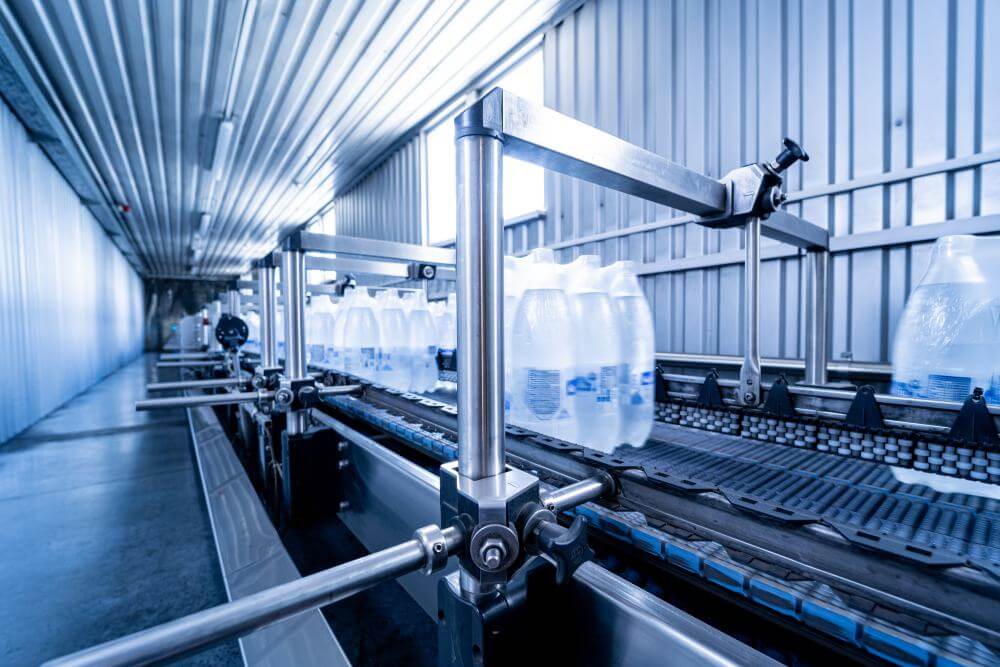
On a high-speed filler, the loss that hides is the short stop: a carton jam, a cap or straw feed fault, a sensor trip, cleared in a few minutes without anyone calling it downtime. A case study of a PET bottle filler in a Rio de Janeiro beverage plant (Brazilian Journal of Operations & Production Management, 2012), a 1,500 ml filler running at about 4,800 bottles an hour, found 473 minutes of filler downtime in 44 occurrences over the period studied; stops of 3 to 15 minutes added up to 287 minutes, 61% of it.
The same study names the recording problem. Many filler stops were logged by the labeler and packer operators under a generic code, and among the possible reasons the authors give is that the filler operator does not hold such short downtimes as significant and so does not record them. A stop that is not recorded does not disappear: it shows up in performance, as a count below the ideal rate with no reason attached.
That is the booking question again. A stop log with a duration threshold puts the stops under it into performance; a lower threshold moves them into availability. Neither changes the output. What changes it is a reason on the frequent ones, so short stops need counting at the machine, not estimating from the shift total. The filler and capper stops guide lists causes on bottle lines.
Fabrico shows real-time OEE (availability x performance x quality) per line and shift on a live OEE dashboard, with micro-stop detection and the six big losses made visible. Run time, stops and counts come from the machine's PLC or an IoT device with sensors on the machines you connect, and operators give the reason for a stop at the machine. Where a station gives no usable machine signal, for example a manual case packing station at the end of the line, the computer vision camera add-on counts output. Where the camera add-on covers the station, the video for the minute of a stop can be opened from the shift timeline, streamed on request and not stored in Fabrico.
If stops cluster after cleans and changeovers, count speed and rejects apart for the start of each run, so a restart problem is not mistaken for a machine problem.
Giveaway: why a full pack can still be a loss
Giveaway is the product a filler puts into each pack above the quantity on the label. It exists because of how declared quantities are checked. Under Council Directive 76/211/EEC on prepackaged products, the actual contents shall not be less, on average, than the nominal quantity, the share of packs short by more than the tolerable negative error must be small enough to pass the batch tests, and no pack short by more than twice it may carry the EEC sign, the e-mark. A filler with wide fill variation has to aim above nominal to pass, and the gap between its average fill and the label is product given away.
OEE does not see it. Quality in OEE is good packs over all packs, and an overfilled pack is a good pack: it passes the checkweigher and ships. Measure giveaway on its own, as average fill against nominal by filler head, in litres or kilograms a shift.
It is linked to OEE through speed. If fill variation grows when the filler runs faster, the fill target has to rise with it, so a performance gain can cost giveaway: set speed and fill target together. The giveaway and overfill guide shows how to book it as a quality loss in litres. Count it once: a rejected underfilled pack is a quality loss, and only the good packs carry giveaway.
Worked example: OEE in money on a plant-based drinks line
Sample figures for illustration only. Oat, soy and almond drinks go into 1-litre aseptic cartons on one filling line. The filler is its constraint, with an ideal rate of 120 packs a minute, over 3 shifts a day and 20 days a month. Last month's stop log gives the average 480-minute shift:
| What happened | Minutes a shift | Packs | Where it sits |
|---|---|---|---|
| CIP, validated program, once a shift | 40 | Outside or inside planned production time: the booking rule | |
| CIP overrun: late starts, CIP set busy | 8 | Availability loss | |
| Allergen changeovers, 2 a shift (for example soy to almond, almond to oat) | 54 | Availability loss | |
| Breakdowns and waits for packaging material | 30 | Availability loss | |
| Run time | 348 | 41,760 at the ideal rate | |
| Short stops under the log's threshold (41 stops) | 61, inside run time | Performance loss | |
| Slow running after restarts | 13 minutes' worth | Performance loss | |
| Not made in run time: (61 + 13) x 120 | 8,880 | ||
| Packs counted | 32,880 | ||
| Rejected packs: damaged, underfilled, failed seal | 516 | Quality loss | |
| Good packs | 32,364 | ||
| Giveaway: average fill 1,006 ml against 1,000 ml | 194.184 litres on the good packs | Not in OEE |
The factors. Run time is 480 minutes minus 40 of CIP program, 8 of CIP overrun, 54 of allergen changeovers and 30 of breakdowns and waits = 348 minutes. At 120 packs a minute the filler could have made 41,760 packs in that time; it counted 32,880, so performance is 78.74%. Quality is 32,364 good packs out of 32,880 = 98.43%. Availability depends on the booking rule:
| Booking rule | CIP program (40 min) | CIP overrun (8 min) | Allergen changeovers (54 min) | Planned production time | Availability | OEE |
|---|---|---|---|---|---|---|
| Rule 1: CIP and changeovers planned | Outside | Outside | Outside | 378 min | 92.06% | 71.35% |
| Rule 2: CIP program planned, the rest a loss | Outside | Inside | Inside | 440 min | 79.09% | 61.30% |
| Rule 3: everything inside | Inside | Inside | Inside | 480 min | 72.50% | 56.19% |
The same shift reads 71.35%, 61.30% or 56.19%, a spread of 15.16 points with no change on the line. In each case OEE equals the 32,364 good packs divided by what 120 packs a minute would have made in the planned production time (378, 440 or 480 minutes), which is the exact figure; the factors in the table are rounded. Rule 2 is the split this guide recommends: the validated program is a planned stop, while the overrun and the allergen changeovers count against the line. Whichever rule a plant uses, report the minutes it left outside planned production time next to the OEE figure.
The money. The line made 32,364 good packs in 348 run minutes, 93 good packs a run minute. At a sample selling price of EUR 1.15 a pack and the 23.23% gross margin of US food processing companies in NYU Stern's sector data (78 firms, January 2026 data), a pack carries EUR 1.15 x 23.23% = EUR 0.267145 of gross margin, and a run minute 93 x EUR 0.267145 = EUR 24.844485. The NYU figure covers 78 US companies; put the margin of your own SKUs in its place once you have it. Priced at that rate, the shift's losses are:
| Loss on the sample line | A shift | A month (60 shifts) | A year (720 shifts) |
|---|---|---|---|
| Allergen changeovers, 54 min | EUR 1,341.60 | EUR 80,496 | EUR 965,954 |
| CIP program and overrun, 48 min | EUR 1,192.54 | EUR 71,552 | EUR 858,625 |
| Breakdowns and waits, 30 min | EUR 745.33 | EUR 44,720 | EUR 536,641 |
| Short stops and slow running, 74 min of output | EUR 1,838.49 | EUR 110,310 | EUR 1,323,714 |
| Rejected packs, 516 (margin only; product and carton come on top) | EUR 137.85 | EUR 8,271 | EUR 99,250 |
| Giveaway, 194.184 litres at a sample EUR 0.36 a litre (product cost, not margin) | EUR 69.91 | EUR 4,194 | EUR 50,332 |
Read the rows as margin at stake, not cash lost: the time rows are real money only if the extra packs would sell, as on a constraint filler with a full order book. Short stops and slow running are priced as 74 minutes of output at the shift's average of 93 good packs a run minute, which understates them: at the ideal rate those minutes were 74 x 120 = 8,880 packs, against the 74 x 93 = 6,882 priced here. The 40-minute CIP program is the food safety plan at work; the recoverable part of that row is the 8-minute overrun. Giveaway is product cost, paid whether or not demand is there. Month (60 shifts) and year (12 x 60 = 720) are computed from the unrounded EUR 24.844485 a run minute.
In Fabrico, with the selling price and margin of each SKU entered, losses are priced in money, so changeover, CIP and stop minutes appear in euros by line and shift. OEE stays the production measure; the euros are a layer on top of it.
Which food-line loss to attack first: CIP time, allergen changeovers, short stops or giveaway
On the sample line, four losses compete for the same engineering and planning hours. Rank them by what they return before anyone buys anything; the time options pay only on the filler, the constraint, and only if the extra packs would sell.
| Option | Won back a shift (example) | Yearly value (720 shifts) | Rough effort (estimate) | Who picks it | Watch-out |
|---|---|---|---|---|---|
| A. Run order: time one allergen changeover a shift to fall in the CIP window | 20 min (27 saved, 7 added to verify the allergen clean in the CIP) | EUR 357,761 of margin if the packs sell | 8 to 24 hours of planner and quality time | Production manager and planner, with the quality manager | The CIP must be validated as an allergen clean for that pair, and runs must end on the CIP slot |
| B. CIP overrun: start on time, keep the CIP set free, find repeated steps | 6 min (8 to 2) | EUR 107,328 | 8 to 24 hours | Production manager, with the sanitation lead | Never cut a validated step to save time |
| C. Short stops at the filler: reasons for a month, then the top three causes | 17 min (61 to 44) | EUR 304,096 | 40 to 120 hours of CI and technician time | CI engineer | A higher logging threshold hides stops without removing them |
| D. Giveaway: narrow fill variation and lower the average overfill from 6 ml to 3.5 ml | None | EUR 20,972 of product cost, whether or not the packs sell | 16 to 40 hours, plus any filler valve work | Quality manager, with the production manager | Underfilled packs: the average and tolerable negative error tests still apply |
The effort figures are an estimate for one line, in hours, without software or parts. Options A, B and C together return 43 minutes a shift, EUR 769,185 a year at the example margin if the extra packs would sell. D is smaller and certain: EUR 20,972 a year that does not depend on demand.
Who picks which. A is a planning change, made in the ERP, APS or planning spreadsheet that holds the plan, and it needs the quality manager's agreement against the allergen matrix. B and C belong to the line, D to quality. On the example line A returns the most and C needs the most hours.
Questions to answer before you choose:
- Which booking rule does each line use for CIP, CIP overrun and allergen changeovers, and is it written down?
- How much CIP time did last month take against the validated program, circuit by circuit?
- Which allergen changeovers could fall in a planned CIP window without breaking the allergen matrix?
- What is the stop log's threshold for a short stop, and how many stops sit under it?
- What is the average fill against nominal by filler head, and how much of the fill target is there to cover variation?
- To an OEE software vendor: does a short stop at the filler get a reason from the operator, and can CIP time be split into the validated program and the overrun?
Food plant OEE by role: plant manager, production manager and planner, CI engineer
Measuring one line properly takes a week of logs; changing the booking rule and the run order takes a quarter.
| Role | This week | This quarter |
|---|---|---|
| Plant manager | Find out which booking rule each line uses for CIP and allergen changeovers, and get last month's OEE under rule 2 and rule 3 side by side. | Set one written booking rule for all lines, and report the minutes outside planned production time next to OEE each month. |
| Production manager and planner | Pull last month's CIP minutes against the validated program, and the allergen changeovers by from and to recipe. | Build a run order with quality that puts allergen changeovers in planned CIP windows where the matrix allows. |
| CI engineer | Count short stops at the filler for three shifts, with a reason for those above a minute. | Remove the top three short-stop causes, and study fill variation with quality before and after. |
Steps for this week, on the filler line:
- Write down how the line books CIP, CIP overrun and allergen changeovers today.
- Split last week's CIP time into the validated program and the overrun.
- List last week's allergen changeovers by from and to recipe, with their minutes.
- Count short stops at the filler for one shift and set them against the performance gap.
- Take the average fill against nominal by filler head from the checkweigher.
- Price one run minute of the filler (good packs in a run minute, times the selling price, times the gross margin), then multiply by the lost minutes of a shift, by 60 shifts for the month and by 720 (12 x 60) for the year.
Frequently Asked Questions About OEE in Food and Beverage Manufacturing
What is OEE in food manufacturing?
OEE in food manufacturing is availability x performance x quality measured on a food or beverage line against planned production time. The formula is the same as elsewhere; what is specific to food is where the losses sit: CIP and sanitation windows, allergen changeovers, short stops at high-speed fillers and packers, and giveaway, which OEE counted in packs does not show.
How do you calculate OEE in food processing?
Availability is run time over planned production time, performance is the packs counted over the ideal rate times run time, and quality is good packs over all packs; multiply them. Good packs x ideal cycle time divided by planned production time gives the same figure. Decide first whether CIP and changeovers sit inside planned production time, because that choice moves the result.
Is CIP time counted in OEE?
It depends on the booking rule, which is why one plant can report two figures. CIP at its validated length can be a planned stop outside planned production time or an availability loss inside it; the overrun beyond the program is a loss under any rule. On the sample plant-based drinks line, one shift reads 71.35%, 61.30% or 56.19% depending on the rule. Compare lines only under one written rule.
What is a good OEE for a food and beverage line?
No single figure travels between plants, because booking rules differ. In a 2012 case study of a PET bottle filler in a beverage plant, the goal was 60%. Set a target for each line against its own history under a fixed booking rule, and report the minutes left outside planned production time next to it.
How does OEE relate to FSMA and HACCP records?
OEE data is a production record: when the line stopped, for how long, the reason the operator gave, and how many packs were made and rejected. It is not a food safety record: it does not show that a critical limit was met or that a cleaning step was verified. Keep those records in the food safety system and use OEE data to see what the controls cost in time. More on the difference in HACCP records vs OEE data.
Can OEE help reduce product giveaway or overfill?
Not directly. An overfilled pack is a good pack, so OEE counted in packs does not show giveaway. Measure average fill against nominal by filler head from the checkweigher, in litres or kilograms, and set filler speed and fill target together, since more fill variation needs a higher target.
How do you improve OEE in a food plant?
Pick the line that limits output, write down the booking rule for CIP and allergen changeovers, and log a week of stops with reasons at the machine, short stops included. Then price one run minute in margin and work down the losses by return: run order before shorter cleans, CIP overrun, short stops, and giveaway as a separate yield measure.
Conclusion: Book Food-Line Losses One Way, Then Price Them
OEE on a food line is the standard formula applied to losses that standard examples leave out: cleaning the food safety plan requires, allergen changeovers whose number the run order decides, short stops too brief to log by hand, and giveaway that OEE counted in packs cannot see.
Write one booking rule for CIP, CIP overrun and allergen changeovers, and use it on all lines. Log stops with a reason at the machine, short ones included, and measure fill against nominal on its own. Then price a run minute of the constraint and start with the loss that returns the most for the hours it needs. Fabrico, as OEE software and a light MES, covers this: stops with their reasons and counts by line and shift, and the losses priced in money once each SKU's selling price and margin are entered.
To compare tools for food and beverage plants, see the best OEE software guide.
Book a demo to see CIP, changeover and short-stop minutes split by line and shift on sample lines.
Related articles









Real Fabrico tiles, sample data.