


 Login
 Blog
Pet Food Manufacturing Software: The Map and What to Buy First

In short: there is no single best pet food manufacturing software. A pet food plant runs a small stack of systems, and the right first buy depends on which problem costs you most.
- Lines lose hours to stops, slow running, changeovers and rejects, and nobody can say where: start with a light MES with OEE.
- Formulas, nutrient targets, lots or a recall are the problem: buy a food ERP, often with formulation software.
- Hazard plans, checks, supplier files and audits are the problem: buy a food safety and quality system.
- Fabrico fits the first job only. It is not an ERP or a food safety system, and we make no FSMA, HACCP, GMP or FDA claim.
When we searched for pet food manufacturing software, most results were ERP sellers.
A plant that makes kibble, cans, pouches, treats or frozen raw food does not run on one system. It runs on several, and each one answers a different question.
We sell Fabrico, a light MES with OEE, which is one row of the map. For the other rows, this page says what to buy instead.
The software map of a pet food plant
| Software | What it does | The sign you need it |
|---|---|---|
| Formulation | Builds recipes against nutrient targets and ingredient cost | Recipes live in spreadsheets, and an ingredient swap takes days to check |
| Food ERP | Orders, stock, purchasing, costing, lots and recall | You cannot say which finished lots hold a given ingredient lot within the hour |
| Food safety and quality | Hazard plan, checks, supplier files, audits, complaints | Audit weeks mean binders, and a missed check shows up only afterwards |
| Light MES with OEE | Stops, speed, changeovers and rejects per line and shift, from machine data | Orders ship late, and the shift log cannot say where the hours went |
| Full MES or batch system | Enforced recipes, weighing and dosing checks, batch records | A wrong ingredient in the mixer is your worst day, and paper cannot stop it |
| Warehouse (WMS) | Locations, pallets, picking, stock rotation | Pallets get lost, or the wrong lot ships first |
| Planning and scheduling | What runs on which line, in which order | The plan is redone by hand every morning, and recipe changes pile up |
| Maintenance (CMMS) | Work orders, service plans, spare parts | The same breakdown returns, and nobody has its repair history |
What the regulator expects, in short
This is not legal advice. It repeats only what the regulators' own pages say.
In the US, the FDA says it "regulates pet food similar to that for other animal foods." Its pet food page is the place to start.
The FDA's preventive controls for animal food rule page refers to 21 CFR part 507. Its key requirements cover current good manufacturing practices, a food safety plan with a hazard analysis and preventive controls, and, for some facilities, a supply-chain program.
The same page says: "Every facility that produces animal food with a hazard requiring a preventive control must have a recall plan."
Wet food has one more layer. The FDA's pet food page says "canned pet foods must be processed in conformance with the low acid canned food regulations."
In the EU, the European Commission's feed hygiene page describes Regulation (EC) No 183/2005. Among its main elements are "The compulsory registration of all feed business operators by the competent authority" and HACCP principles for feed business operators other than primary production.
That page does not name pet food, and neither page says which rules apply to your plant. Ask your own authority or adviser.
Our view for software: plans, checks, supplier files and recall belong in a food safety system and an ERP. OEE software is not a record of any of them.
How suppliers describe these products
Four suppliers, in their own words, read on 10 November 2026.
| Row in the map | Product | In its own words |
|---|---|---|
| Food ERP | inecta Food ERP | "connects recipe management, ingredient traceability, FDA/AAFCO compliance, and batch tracking" |
| Food ERP | BatchMaster ERP | "Bi-directional lot traceability and lot recall" |
| Formulation | Datacor, on formulation software | "precisely calculate and adjust ingredient proportions to meet specific nutritional requirements" |
| Food safety and quality | Safefood 360 | "Operate a fully digital food safety and quality management platform" |
This is a sample of what each site says, not a ranking and not a test. Any compliance wording is the supplier's, not ours.
What is the best pet food manufacturing software?
There is no single best one, because the rows in the map do different jobs. In our view, the best first buy is the one that removes your most expensive problem.
- Can you trace and recall today? If an ingredient lot cannot be followed to finished lots quickly, fix that first with a food ERP.
- Do your food safety records hold up? If checks and supplier files live in binders and get missed, a food safety and quality system comes next.
- Do you know where the line hours go? If both of the above work and orders still ship late, measure the lines with a light MES and OEE.
- Is the loss in the recipe or the plan? Ingredient cost points to formulation software. A plan that falls apart daily points to a scheduling tool.
- Then the rest. Warehouse and maintenance systems come after, once the rows above give you clean data to work with.
Where a light MES with OEE fits on a pet food line
A light MES does one part of the full MES job: it records what each line did, minute by minute, and turns it into OEE and a list of stops with reasons.
It does not run recipes or keep batch records. Our guide to MES for food manufacturing covers the full list of MES functions.
On a pet food line, these are the losses it makes visible. The table is our own view of a typical line, not a survey.
| Area | Typical loss | OEE factor |
|---|---|---|
| Extruder | Die blockage, feeder stops, restart after a trip | Availability |
| Extruder to dryer | Recipe change: clean-out, die change, wait for stable product | Availability, then Quality for the transition product |
| Dryer and coater | Running below rated rate to hold moisture or coating | Performance |
| Bagging | Bag size change, film or bag jams, sealer faults, waiting for product | Availability. Stops too short to log one by one show up in Performance |
| Can and pouch filling | Seamer or sealer faults, short stops at infeed, waiting for the retort | Availability, and Performance for the short stops |
| End of line | Underweight packs, bad seals, torn bags, start-up scrap | Quality |
Short stops on baggers and pouch fillers are easy to miss in a paper log, so count micro-stops too.
For the loss by loss detail, read OEE in pet food production.
Worked example: one bagging line, one shift
Example data, not a customer. A line fills 10 kg bags of kibble, and its rated speed for this bag size is 12 bags a minute.
The shift is 480 minutes with a 30 minute break, so planned time is 450 minutes.
| Item (example data) | Value |
|---|---|
| Planned changeovers: one recipe change (30 minutes), one bag size change (20 minutes) | 50 minutes |
| Waiting for product from the dryer (line starved) | 25 minutes |
| Faults and jams (unplanned stops) | 35 minutes |
| Run time | 450 - 110 = 340 minutes |
| Bags filled | 3,672 |
| Rejects | 72 |
| Good bags | 3,600 |
All three stop rows are availability losses. The changeovers are planned, but they sit inside planned production time, so they count against OEE.
The wait for product is booked under its own reason, starved by the dryer, because the bagger itself did not fail.
- Availability: 340 / 450 = 75.6%.
- Performance: 3,672 / (340 x 12 = 4,080) = 90.0%.
- Quality: 3,600 / 3,672 = 98.0%.
- OEE (example data): 0.7556 x 0.9000 x 0.9804 = 66.7%. Check: 3,600 good bags / 12 a minute = 300 minutes, and 300 / 450 = 66.7%.
The steps behind each factor are in our OEE calculation guide.
What this shift tells you
In this example, a third of the shift made nothing you can sell: 150 of 450 minutes. An ERP report will usually not show that, because it sees the 3,600 bags that were booked.
Still example data: say the crew cuts faults by 15 minutes and the wait for product by 10, and all else stays the same. Run time becomes 365 minutes, so at the same 10.8 bags a minute and the same reject rate the line fills 3,942 bags, and about 3,865 are good.
That is about 265 more good bags, or 2,650 kg, and OEE goes to about 71.6%. It only pays if the product and the orders are there, so put your own margin on it with the field guide to what a stopped hour costs.
How to choose: a short checklist
- Name the problem in one sentence. "We cannot trace a lot" and "we lose two hours a shift" lead to different software.
- Ask where each number comes from. A machine signal, a scale, or a person typing at the end of the shift.
- Ask what is ready to use and what is a project. Have the supplier show it on a line like yours, not on a slide.
- Decide which system owns each number. Lots in the ERP, checks in the food safety system, line time in the MES.
- Start with one line. Pick the line that limits your output, prove the value, then widen.
Who should buy something else first
- Formulation is the pain. Recipes, nutrient targets and ingredient cost need formulation software or a food ERP.
- Lot tracing or recall is the pain. You need a food ERP with lot genealogy.
- Food safety records are the pain. Hazard plans, checks and supplier files need a food safety and quality system.
- Wrong ingredients reach the mixer. You need enforced weighing and batch records: a full MES or batch system.
In all of these, Fabrico is the wrong first buy.
Common mistakes
- Buying an ERP to find lost hours. It books what was made, and usually not the minutes in which nothing was made.
- Using OEE software as a food safety record. A stop log is not proof that a check was done.
- One OEE figure for the whole plant. The extruder and the bagger run on different clocks, so measure them apart.
- Taking changeovers out of planned production time. The OEE looks better, and a large loss leaves the report.
Where Fabrico fits, and where it stops
Fabrico is a cloud-based light MES with OEE. In a pet food plant it belongs on the extruder to dryer to bagging line, and on can and pouch filling.
- Stops: they come from the machine signal, through a PLC or the Fabrico IoT device. The operator adds the reason on a tablet or phone.
- OEE: availability, performance and quality per line and shift. A changeover shows up as a stop with its reason, so you can see its time.
- Parts: AI cameras (an add-on) count parts. You can open the camera video for that minute.
- Camera video: in the standard setup it is streamed, not stored. If cameras fit your line, ask us to show them in the demo.
- Maintenance: a maintenance module exists as a complement. For that row, see our CMMS for pet food page.
What Fabrico does not do: it is not an ERP. It has no formulation, recipes, batch records, lot genealogy, recall management, inventory or warehouse.
It is not a lab, quality or food safety management system. Production planning and scheduling are not part of Fabrico today.
What we do not claim: we make no FSMA, HACCP, GMP or FDA claim about Fabrico.
See the MES and OEE overview.
Want to see it on lines like yours? Book a demo or Contact us.
What people ask next
Is a pet food ERP the same as a pet food MES?
No. The ERP runs orders, stock, lots and cost, while the MES records what happened on the line.
Does OEE software help with FDA or feed hygiene rules?
Not as a record. It can show that a line stopped and for how long, but plans, checks and recall belong in your food safety system and ERP.
Where should a pet food plant measure OEE first?
On the step that limits output, which is often the bagging or filling line. Our page on OEE for pet food lines goes through the extruder, dryer, coater and baggers.
What should I ask a supplier in the demo?
Ask them to show one recipe change, from the last good bag to the first good bag at full speed. Then ask where the stop times come from, and what the system does not do.
Pet food lines losing hours you cannot name? Book a demo or Contact us.
Related articles
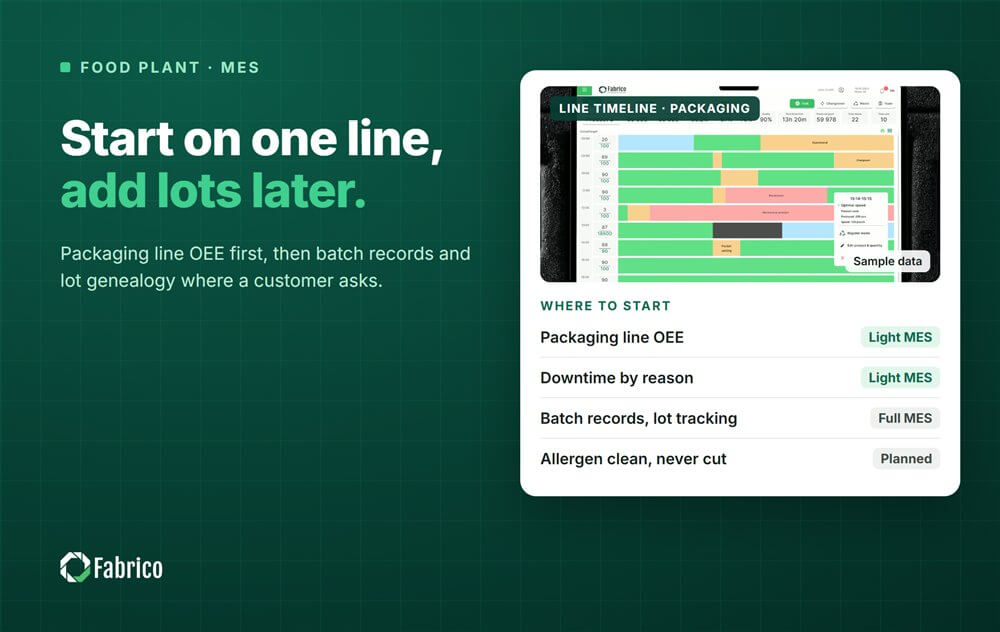



Real Fabrico tiles, sample data.