


 Login
 Blog
Poka vs L2L: One Connected Worker Platform Across Several Plants

In short: Poka vs L2L comes down to where each platform starts. Poka's pages lead with standard work, skills and tiered daily management, written to keep many sites on one method. L2L's pages lead with the stopped line: the person sent to fix it, maintenance, and OEE reports that set plant against plant. For an operations director picking one platform for several plants, the test is which job hurts in most plants, and whether OEE means the same at each site.
- Standard work: Poka keeps central, version-controlled instructions in over 70 languages; L2L standardizes procedures across sites with Digital Work Guides.
- Problems at the line: L2L sends a technician the moment a machine halts; Poka moves unresolved issues up through Tier 1, 2 and 3.
- Plant against plant: Poka compares SQDCP performance and OEE trends across sites; L2L compares plants with OEE Pareto and trend reports.
- Facts from poka.io and l2l.com, as of 14.11.2026, linked where used.
An operations director with four plants rarely buys a connected worker platform for one line. The question is which product carries one standard into sites with different machines, languages and habits, and still returns a number that means the same at the monthly review. Below, Poka and L2L side by side, from their own pages.
Poka is the software at poka.io, not the poka-yoke method. L2L is Leading2Lean, at l2l.com. Fabrico builds cloud OEE and light MES software; it appears in one section toward the close.
Key takeaways
- Poka's pages organise the plant day around standard work, skills and tiered huddles; L2L's organise it around the halted machine, dispatch and maintenance.
- Both vendors describe one method across sites and a cross-site OEE view, so the fair test is one changed instruction reaching a second plant, approved and translated.
- Plant-to-plant OEE compares only when every site books planned time, ideal rate and changeovers alike; in the sample below a single booking rule moves the figure 4.8 points.
- Carried to money with a sample margin of EUR 0.06 a capsule, that one 40-minute changeover is worth EUR 288 a shift and EUR 152,064 a year for one filler.
- Certification records are an audit item, not a nice-to-have: plants under US OSHA rules must certify that lockout training is kept up to date.
Poka vs L2L at a glance
From each vendor's own pages as of 14.11.2026, linked below.
| Question | Poka | L2L |
|---|---|---|
| Own summary | Standardized, high-performing execution at scale | A Connected Manufacturing Operations Platform |
| Stated reach | 3000+ sites, 1 million+ users, 70+ countries | 500,000+ users across 93 countries |
| One standard, many sites | Central, version-controlled instructions; 70+ languages | Digital Work Guides; procedures standardized across sites |
| Skills | Every skill by shift and site; tasks routed to qualified operators | Self-updating matrix; certifications checked before critical tasks |
| When a problem hits | Issues from the point of work; escalation by tier | Alert when a machine goes down; Execution AI suggests a fix |
| Maintenance | Issues open work orders in the CMMS or ERP | Work orders, PMs by time, cycle or condition, spare parts |
| Plant against plant | SQDCP dashboards, cross-site OEE trends | Plant comparison, OEE Pareto and trend reports |
| Systems | 1,000+ systems via connectors, open API and MCP | ERP, MES, EAM, SCADA/OPC, IIoT and BI links |
What Poka gives a multi-plant operations team
Poka's home page says thousands of industrial teams use it "to standardize how work actually gets done" and gives its reach as 3000+ sites, 1 million+ users and 70+ countries. As of 14.11.2026, its feature pages say:
- One method in every plant. The digital work instructions page keeps instructions central and under version control so each site follows the same current procedure, with support for over 70 languages. Factory Feed translates shift handover posts into each worker's native language.
- Skills by site. The skills management page shows each skill for each shift and site in real time, links skills to task assignment so changeovers reach trained people, and tracks certificate expiry.
- Tiered daily management. On the daily management page, SQDCP figures, open issues and completed forms reach the huddle board ahead of the meeting, and unresolved issues move to the right person or team at the right tier.
- Issues. The issues management page has operators report problems from the point of work with photos and video. Its FAQ says Poka integrates with CMMS and ERP systems to open work orders without re-entering data.
- Cross-site numbers. The dashboards and analytics page covers SQDCP KPIs, comparing performance across sites, and an executive view of cross-site OEE trends. A DataLake brings frontline data together with ERP, MES and BI datasets.
- Systems. The integrations page lists 1,000+ systems via pre-built connectors, an open REST API and MCP, names ERP, MES, CMMS, LMS and HRIS products, and supports single sign-on through Okta, Azure Active Directory and others.
What L2L gives a multi-plant operations team
The L2L home page calls L2L "the Connected Manufacturing Operations Platform that eliminates downtime and increases productivity", with real-time guidance for frontline teams and unified control for operations leaders, and counts 500,000+ users across 93 countries. As of 14.11.2026, its platform pages say:
- One method in every plant. The digital work page says L2L lets a company standardize operational procedures across all its manufacturing sites. Digital Work Guides cover shift tasks, safety and quality checks, and content passes its reviewers in a set order before release. Browser, Windows, Mac, Android and iOS are listed.
- Production and OEE. The production page speaks of consistent definitions and live visibility into the Six Big Losses, fed by PLCs and SCADA or by operator entry, with output, performance and status tracked across lines and sites. If a line slows or halts, L2L Execution AI proposes a fix and sends it to whoever should act.
- Maintenance and dispatch. The maintenance page describes dispatching the right person as soon as a machine goes down, escalation when a changeover overruns, routed work orders, PMs triggered by time, cycle or condition, and low-stock alerts on critical parts.
- Skills. The skills page describes a matrix that updates as certifications and assessments happen, notices to the manager and employee from 30 days before a skill expires, and a certification check before critical tasks are assigned.
- Plant against plant. The manufacturing intelligence page offers cross-site data consolidation, comparison across plants, departments and product lines, and OEE Pareto, bar chart and trend reports.
- Systems. The shop floor connectivity page covers SCADA/OPC, IIoT, ERP, MES, EAM or CMMS and scheduling links, plus export to BI tools, and adds QMS, LMS, Safety and EH&S data.
Poka vs L2L, job by job across plants
Carrying one standard. Both promise it in so many words. Poka's route is central, versioned instructions plus translation; L2L's is Digital Work Guides with a fixed review order. Ask each to change one step and show it arriving, approved, at a second plant.
Skills across sites. Poka adds the per-site, per-shift view; L2L adds the 30-day expiry notice and a check before critical tasks. Ask each for one plant's certification record on one machine, as an auditor would.
Why the skills record carries weight. In US plants, OSHA's rule on the control of hazardous energy (29 CFR 1910.147) reads "The employer shall certify that employee training has been accomplished and is being kept up to date" (accessed 14.11.2026). The same paragraph requires retraining whenever there is "a change in machines, equipment or processes that present a new hazard". A group that moves a capsule filler model between plants therefore needs a skills record that follows the machine, not the person who trained on it. European plants work under their own national rules, but the audit question is the same: show who may isolate this machine today, at this site.
The daily rhythm or the stopped line. The clearest difference in emphasis. Poka's pages build the day around tiered huddles, with issues climbing tiers until someone owns them. L2L's build it around the halt: a technician alerted, escalation if a changeover drags, Execution AI proposing a fix. Plants with weak meeting discipline and plants with slow maintenance response may want different first modules.
Maintenance. L2L's pages keep work orders, PMs and spares beside production. Poka's issues page opens the work order in an existing CMMS or ERP. The fit depends on whether each plant keeps its own CMMS.
Plant against plant. Both put cross-site views in front of leaders. Any such view misleads if plants count differently, as the worked example shows.
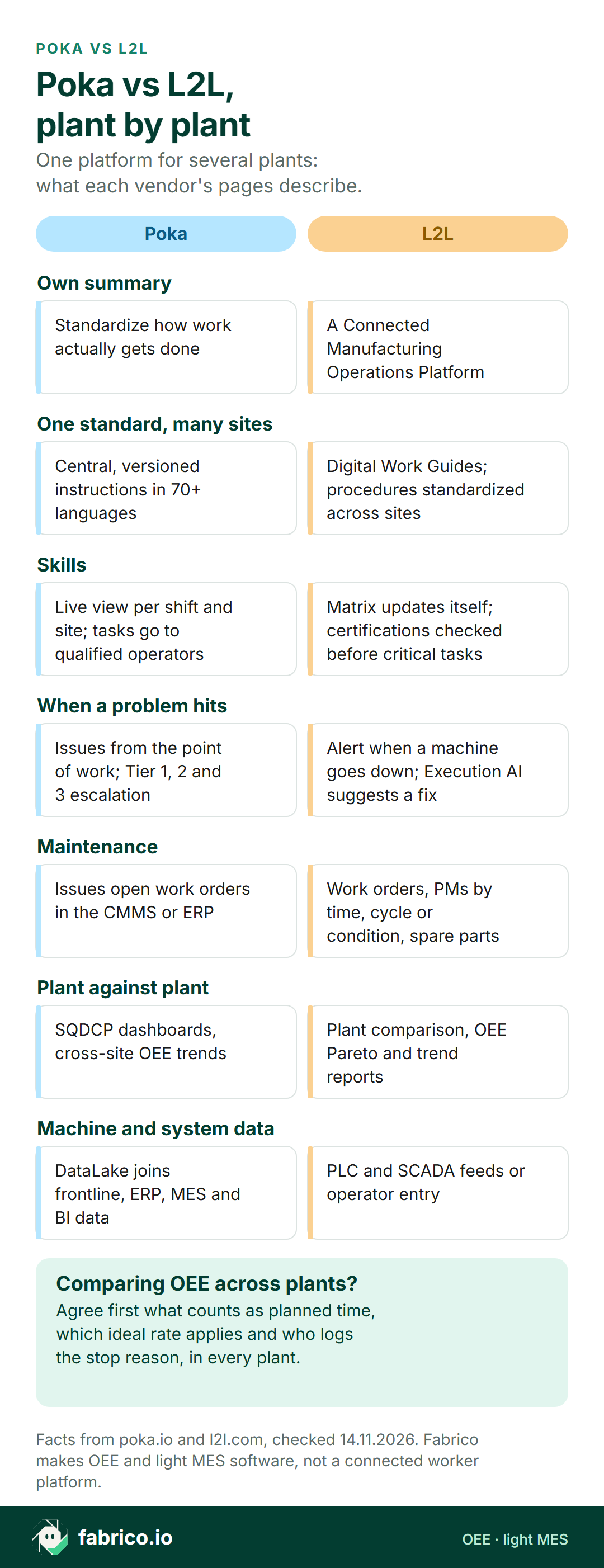
Text version of this infographic
- Own summary. Poka: standardize how work actually gets done. L2L: a Connected Manufacturing Operations Platform.
- One standard, many sites. Poka: central, versioned instructions in 70+ languages. L2L: Digital Work Guides; procedures standardized across sites.
- Skills. Poka: live view per shift and site; tasks go to qualified operators. L2L: matrix updates itself; certifications checked before critical tasks.
- When a problem hits. Poka: issues from the point of work; Tier 1, 2 and 3 escalation. L2L: alert when a machine goes down; Execution AI suggests a fix.
- Maintenance. Poka: issues open work orders in the CMMS or ERP. L2L: work orders, PMs by time, cycle or condition, spare parts.
- Plant against plant. Poka: SQDCP dashboards, cross-site OEE trends. L2L: plant comparison, OEE Pareto and trend reports.
- Machine and system data. Poka: DataLake joins frontline, ERP, MES and BI data. L2L: PLC and SCADA feeds or operator entry.
- Comparing OEE across plants? Agree first what counts as planned time, which ideal rate applies and who logs the stop reason, in every plant.
Match the first job: Poka, L2L or both
Find the job that costs most across the plants today and start with the vendor that puts it up front; then run the identical test on the second.
| First job across the plants | Start with |
|---|---|
| Same method in plants that speak different languages | Poka: versioned instructions, translated Factory Feed |
| Tier meetings that run on paper and memory | Poka: daily management and huddle boards |
| Technicians reaching stopped lines late | L2L: dispatch with escalation |
| Work orders, PMs and spares beside production | L2L: maintenance management |
| Certificates that lapse before anyone notices | Both: skills pages with expiry tracking |
| One OEE figure that means the same in each plant | An OEE or light MES layer, with one definition |
Decision matrix: Poka or L2L for your plant
The short table above names a starting point. The matrix adds the vendor page each route rests on and the pilot result that would confirm it. It routes jobs; it does not rank Poka or L2L.
| If this is you | Look first at | Why (Poka or L2L page) | Prove it in the pilot by |
|---|---|---|---|
| Plants in three languages drift from the agreed method | Poka | Central, versioned instructions, 70+ languages | Changing one step at plant A and timing its approved, translated arrival at plant B |
| Night shift waits for a technician after a halt | L2L | Dispatch when a machine goes down, escalation on overrun | Stopping a test machine at 03:00 and logging who was told, when, and what escalated |
| Tier meetings run from whiteboards and memory | Poka | SQDCP, open issues and forms on the huddle board before the meeting | Two weeks of Tier 1 and Tier 2 huddles, counting issues raised, moved up and closed |
| Each plant keeps its own CMMS and will not move | Poka | Issues open work orders in the CMMS or ERP without re-entry | One issue landing as a work order in each plant's CMMS with nothing retyped |
| Work orders, PMs and spares should sit beside production | L2L | PMs by time, cycle or condition; low-stock alerts on critical parts | One PM set on cycle count that triggers from real counts on the pilot line |
| Auditors ask who may run or isolate a machine | Both | L2L: 30-day expiry notice, check before critical tasks; Poka: skills by shift and site | Pulling one machine's certified list for two plants and trying to assign an expired name |
| Group review ranks plants on OEE | Both, plus one group definition | L2L asks for consistent definitions; Poka shows cross-site OEE trends | Entering the sample shift below for two plants and getting the same figure twice |
| IT wants single sign-on and links to ERP and MES | Both | Poka: SSO, open REST API, 1,000+ systems; L2L: ERP, MES, EAM, SCADA/OPC links | Signing in through the group directory and reading one ERP order in the pilot tenant |
| Supervisors want a suggested fix when a line slows | L2L | Execution AI proposes a fix and routes it | Comparing ten suggestions with what the technician actually did |
Still deciding between a worker platform and an OEE system as the first purchase? Light MES vs connected worker platform sets out that choice, and the connected worker platform review widens the field.
Where OEE fits when you roll out across plants
Worker platforms log what people did; OEE logs what the machine did against what it could have done. Across plants, OEE breaks first, because each site quietly decides what counts as planned time, which ideal rate to use and which stops to leave out.
L2L's production page asks for consistent definitions, and Poka's analytics page puts cross-site OEE trends in front of executives. Before trusting either view, ask where each plant's run and stop signal comes from, who sets the ideal rate, who logs the stop reason, and who owns the definition at group level. The arithmetic is in the OEE calculation guide; what a good figure looks like is in world-class OEE.
The standards draw the same line. ISA says ISA-95 "primarily deals with the interface between levels 3 and 4", that is, between plant operations and business systems, and the IEC 62264-1 abstract says the standard describes the manufacturing operations management domain (Level 3) and its activities. Instructions, dispatch and OEE all sit at Level 3 (see the ISA-95 guide).
For the figure itself, a NIST paper on production KPIs explains that ISO 22400 brings in 34 KPIs, and groups them as basic KPIs, comprehensive KPIs and supporting metrics (accessed 14.11.2026). OEE is a comprehensive figure built from basic times and counts, so a plant that redefines one input, such as planned time, changes the group number without changing anything on the line. Fix the inputs per plant before anyone compares the outputs.
Where Fabrico fits in a multi-plant rollout
Fabrico measures the machine side: cloud OEE plus a light MES, as set out in the solution overview. It offers no connected worker suite, SCADA, HMI or inspection vision, so it replaces neither Poka nor L2L on instructions, skills or huddles.
- Same rules in each plant. Run, stop and count come from a PLC, sensor or counter on the machine; whoever runs the line chooses why it stopped, on a phone or tablet, from one reason list shared by all plants.
- Numbers for the group review. OEE and downtime for each line, shift and plant, with lost time priced in money, on web, iOS and Android screens.
- Counting without a signal. Where a manual step or an older filler gives no usable signal, the camera add-on counts output; camera-suggested stop reasons are a Roadmap item (camera add-on details).
- Work orders. A work order opens from a logged stop in one tap, and you can set chosen stop reasons to create that work order automatically as soon as the reason is logged.
- Getting data out. REST API and webhooks for other systems, Excel and CSV exports for analysts.
Beside Poka or L2L: Fabrico can hold the group's OEE figure under one definition while the chosen platform carries methods, skills and huddles. No ready Fabrico connector to Poka or L2L is claimed; prove that hand-off in a pilot before rollout. For head-to-head detail see Fabrico vs L2L and Poka alternatives.
Want to see two plants' OEE side by side under one definition? Book a demo.
Worked example: one capsule filler, two plants, two OEE figures
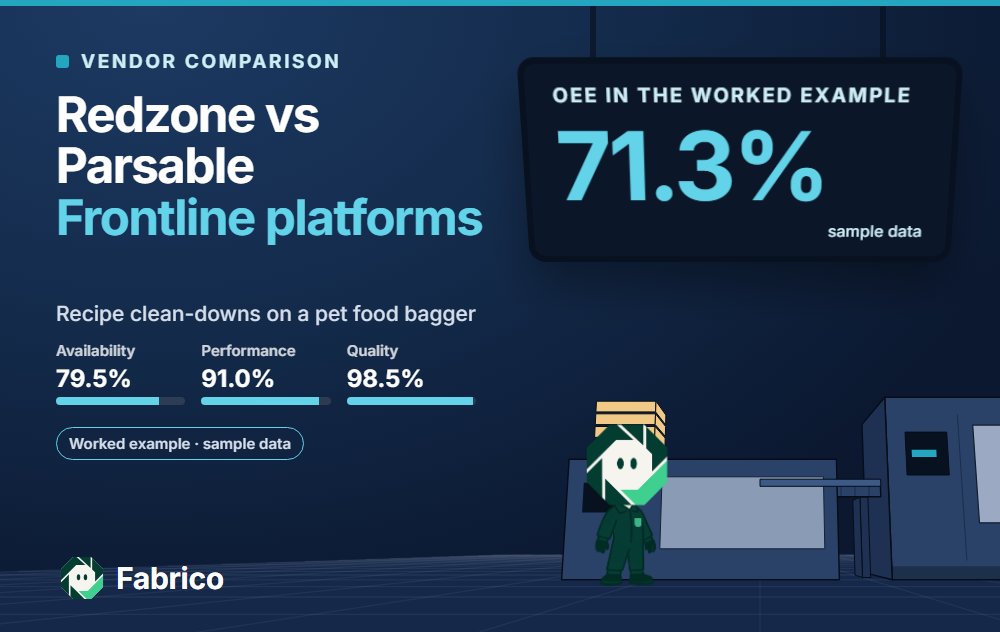
Sample data, invented for this page; it shows no real plant or product screen. A coffee group runs the same capsule filler model in plants North and South. Both work 720-minute shifts minus 45 minutes of breaks, giving 675 planned minutes; at an ideal 120 capsules a minute, a shift could fill 81,000. To keep it clean, both plants have the same shift:
| Sample data: stop | Minutes |
|---|---|
| Changeover, espresso to lungo blend | 40 |
| Dosing auger jam | 22 |
| Lid film reel splice | 18 |
| Waiting for empty capsules | 15 |
| Total stopped | 95 |
Plant North's arithmetic. Stopped time is 95 minutes, so run time is 580 minutes and availability is 580 / 675 = 85.9%. In 580 minutes the ideal is 69,600 capsules; the filler made 62,640, so performance is 90.0%. The reject count shows 1,253 capsules, leaving 61,387 good, so quality is 98.0%. OEE is 85.9% x 90.0% x 98.0% = 75.8%, the same as 61,387 good of 81,000 possible.
Plant South's arithmetic. South books the changeover as planned downtime, so its planned time is 635 minutes, not 675. Run time is still 580, but availability becomes 580 / 635 = 91.3%. Performance and quality do not change. Reported OEE is 91.3% x 90.0% x 98.0% = 80.6%, the same as 61,387 good of 76,200 possible.
What the director sees. On a cross-site dashboard, South looks 4.8 points better, yet nothing on the filler differs. Fix the definition at group level first.
The same shift in euros
Sample figures, invented like the rest of this example: each good capsule brings EUR 0.06 of contribution margin. Assume two 720-minute shifts a day and 22 production days a month, so 44 shifts a month and 528 a year for one filler. Lost capsules are counted at the ideal rate, the same basis OEE uses.
| Sample data: loss | EUR a shift | EUR a month | EUR a year |
|---|---|---|---|
| Full OEE gap at North: 19,613 capsules | 1,176.78 | 51,778.32 | 621,339.84 |
| Gap South reports: 14,813 capsules | 888.78 | 39,106.32 | 469,275.84 |
| Changeover alone: 4,800 capsules | 288.00 | 12,672.00 | 152,064.00 |
The difference between the first two rows is exactly the changeover row: EUR 288 a shift that South's loss chart never shows, because the minutes were booked as planned. Over a year that is EUR 152,064 of contribution on one filler, sitting outside the loss Pareto at the plant that looks better. Halving the changeover to 20 minutes would be worth EUR 144 a shift, EUR 6,336 a month and EUR 76,032 a year per filler in this sample. Check the arithmetic with your own margin and shift pattern before quoting it in a review.
Where Poka or L2L comes in. With the numbers aligned, the 40-minute changeover becomes the shared target. In L2L, an overrunning changeover would trigger the escalation its maintenance page describes. In Poka, the better method could become one versioned instruction for both plants, assigned to operators whose skill record covers it. The OEE layer then shows whether the minutes fall in both plants (see the changeover time guide). Where a coffee line has steps with no signal, computer vision for coffee manufacturing covers counting with the camera add-on.
What to do this week
Five steps an operations director or group CI lead can finish before the first vendor call:
- Write the group OEE rule on one page. Planned time, ideal rate per product, and whether changeovers, cleaning and waiting for material count as loss. Send it to every plant manager for comments by Friday.
- Recompute one machine model in two plants. Take last month's shifts for the same machine at two sites and recalculate both under that rule, as in the sample above. Note how far the reported figures move.
- Price the biggest gap. Multiply the lost units by your own contribution margin and shift count. One line in money is easier to fund than a percentage.
- Pick the first job per plant. Use the decision matrix to tag each plant with its most costly job, then see whether most tags point to Poka's route, L2L's route or both.
- Collect one certification list. Ask each plant's safety lead for the people cleared to run and isolate one machine. It becomes the skills test in both pilots.
Questions to ask Poka and L2L before a multi-plant rollout
Give both the same two plants and one instruction, then ask:
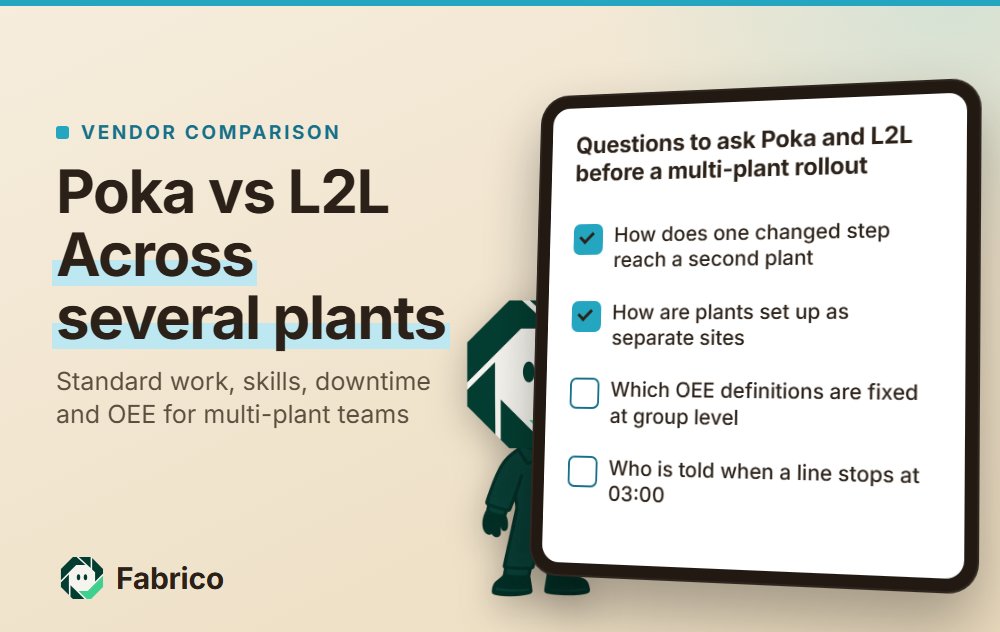
- How does one changed step reach a second plant, who approves it, and in which language does the operator read it?
- How are plants set up as separate sites, and what can a group admin change that a plant admin cannot?
- Which OEE definitions are fixed at group level, and can a plant change planned time on its own?
- Who is told when a line stops at 03:00, and how does that escalate if nobody answers?
- How would a stop logged in a separate OEE system open the right instruction or checklist in your platform?
For the measurement side of the shortlist, the OEE software guide compares packaged tools. If L2L is already in place and under review, see L2L alternatives. For packaged goods groups, the FMCG computer vision hub covers counting on lines with no signal.
What people ask next
How do Poka and L2L differ for a multi-plant rollout?
Emphasis. Poka's pages lead with standard work, skills and tiered daily management. L2L's lead with the stopped line: dispatch, maintenance and OEE reporting. Both cover work instructions and skills.
Can Poka and L2L standardize work across several plants?
Both say so on their pages. Poka keeps central, version-controlled work instructions so every site follows the same procedure, with support for over 70 languages. L2L says it lets a company standardize operational procedures across all its manufacturing sites, with Digital Work Guides reviewed in a set order before release.
Do Poka and L2L show OEE across plants?
Both put cross-site views in front of leaders. Poka's analytics page mentions cross-site OEE trends and comparing performance across sites. L2L's pages list OEE Pareto, bar chart and trend reports and comparison across plants. Agree one OEE definition before comparing plants in either.
How do Poka and L2L handle certifications?
Poka tracks certificate expiry and retraining and links skills to task assignment. L2L updates its skills matrix as certifications happen, notifies the manager and employee from 30 days before a skill expires, and checks certifications before assigning critical tasks.
Can Fabrico run beside Poka or L2L?
Yes, as the machine-side layer. Fabrico reads run, stop and count from a PLC, sensor or counter on each machine, operators add the stop reason, and the figures go out through a REST API, webhooks, or Excel and CSV files. Any hand-off to Poka or L2L should be proven in a pilot.
Want to see two plants measured under one OEE definition? Book a demo.
Related articles







Real Fabrico tiles, sample data.