


 Login
 Blog
OEE Points vs Percent: What a 5 Point Gain Really Means

Key takeaways
- A point is the difference between two OEE figures. A percent change compares the new figure with the old one.
- At the same planned time and ideal speed, good output grows in proportion to OEE.
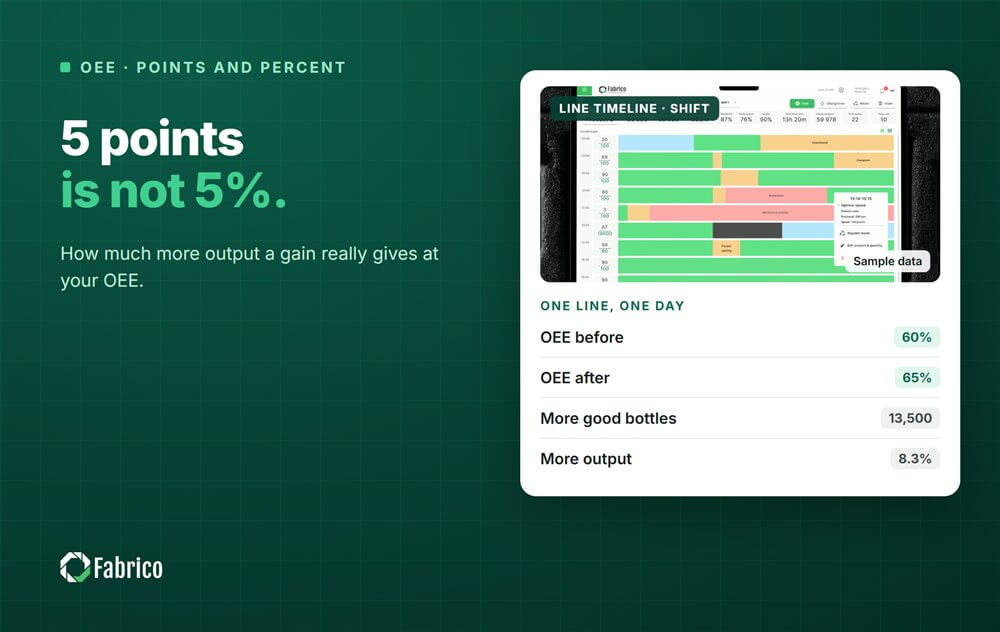
- In the worked example, 60% to 65% OEE is 13,500 more bottles a day: 8.3% more output.
- Report OEE gains in points, and output gains in percent.
Fabrico, OEE and light MES (manufacturing execution system) software with AI cameras, logs stops automatically and prices each loss in money.
Below: why points and percent differ, a worked line and what a gain is worth in line time. Then how to report it so nobody misreads it. You can test the numbers in the free OEE Lab calculator.
What is the difference between OEE points and percent?
OEE is already a percentage. So "OEE went up 5%" can mean two things. It can mean 5 points, from 60% to 65%. Or it can mean 5 percent of the old figure, which is only 3 points.
Use points for the change in OEE. Use percent for the change in output. Mixing them is how a good result gets oversold or undersold in a meeting.
Why is the same 5 point gain a bigger percent at a low OEE? A worked example
Good output = planned time x ideal rate x OEE. So 5 points always add the same units: 5% of the line's ideal output. At a low OEE that is a bigger jump on today's output: new OEE / old OEE, minus one.
| From | To | Points | More than today |
|---|---|---|---|
| 40% | 45% | 5 | 12.5% |
| 60% | 65% | 5 | 8.3% |
| 75% | 80% | 5 | 6.7% |
On the worked line below, each row is the same 13,500 bottles a day. Christoph Roser puts the true OEE of most Western processes at 40 to 60%. So most plants sit where 5 points is the biggest jump in percent.
What does a worked example of a 5 point gain look like?
Sample line (illustrative numbers, not a customer): a filler rated at 300 bottles a minute. It is planned for 2 shifts of 450 minutes a day, so 900 minutes. At the ideal rate that is 270,000 bottles.
- At 60% OEE: 270,000 x 0.60 = 162,000 good bottles a day.
- At 65% OEE: 270,000 x 0.65 = 175,500 good bottles a day.
- Gain: 13,500 bottles a day, and 13,500 / 162,000 = 8.3%.
- Over 250 days: 3,375,000 more bottles a year.
- In line time: 13,500 bottles at 300 a minute is 45 ideal minutes, or 75 minutes of line time at 60% OEE.
- A 5 percent rise instead, from 60% to 63%, adds only 8,100 bottles.
- Back down from 65% to 60%: 13,500 / 175,500 = 7.7% less output.
So the 5 points are worth about 75 minutes of extra line time a day, without a new shift. Our article on the value of one OEE point shows how to put money on it.
Why is a drop not the mirror of a gain?
Going back from 65% to 60% is the same 5 points and the same 13,500 bottles. But it is a smaller share: 5 out of 65, not 5 out of 60. The base changed. That is why a "plus 8%, minus 8%" story does not add up, and why points are the safer unit for OEE itself.
How do you know a gain is real and not a new definition?
Check three inputs before you celebrate. Planned time must be counted the same way: no breaks or changeovers moved out of it. The ideal rate must be the same for each product. And good count must come from the same counter.
If any of the three changed, show the old and new figure on both definitions. Otherwise part of the gain is the new rule, not the line.
How should you report an OEE gain?
- Give the OEE change in points: "OEE rose 5 points, from 60% to 65%".
- Give the output change in percent and in units: "8.3% more good bottles, 13,500 a day".
- Say what it is worth in line time or money, using the line's own figures.
- Keep planned time and the ideal rate unchanged in the comparison, or say what changed.
Our OEE calculation guide covers the formula, and capacity vs throughput explains when extra output becomes extra sales.
What mistakes do plants make with points and percent?
- Writing "OEE up 5%" without saying points or percent.
- Reading a 12.5% jump at 40% as more units than a 6.7% jump at 75%. On the same line both are 13,500 bottles a day.
- Changing the ideal rate between the two figures, so the gain is partly a new definition.
- Counting extra output as money when there is no demand for it.
Where Fabrico fits
Fabrico is a computer vision enabled Manufacturing Performance Platform. OEE and light MES come first. Automatic downtime logging and OEE live by line and shift show each gain as it happens.
- OEE live by line and shift, to track the points week by week.
- Every loss priced in money, so a gain has a value, not just a percentage.
- Losses ranked by money, so the next points come from the costliest loss.
Read what a light MES covers in our light MES guide. You start on one line, with a baseline and a decision date agreed in advance. There is no free plan and there are no tiers: each plant gets a quote.
Frequently asked questions
What is an OEE point?
One point is a difference of one percentage point between two OEE figures. Because OEE is already a percentage, saying points avoids confusion with a percent change. Most plants report OEE progress in points and output progress in percent, which keeps both clear.
How much more output does 5 OEE points give?
Five percent of the line's ideal output, at any starting OEE: 13,500 bottles a day in the worked example. As a share of today's output it depends on the start: 12.5% more from 40%, 8.3% more from 60%, and 6.7% more from 75%.
Is a 5 percent OEE improvement the same as 5 points?
No. Five percent of 60% is 3 points, so 60% becomes 63%. Five points takes 60% to 65%. Always say which one you mean in a report, because the two differ by almost a factor of two at typical OEE levels.
How do I turn OEE points into money?
Work out the extra good units from the OEE change, then multiply by the contribution margin per unit, if the plant can sell them. If it cannot, value the gain as overtime or shifts you no longer need. The plant controller should agree the rule.
Why is a drop from 65% to 60% smaller in percent?
Because the base is different. A drop compares against 65%, a gain against 60%. Five points down from 65% is 7.7% less output; five points up from 60% is 8.3% more. The units are the same 13,500 bottles both ways, which is why points are the safer unit.
See your next OEE points in a demo
Bring one line and its last month of OEE. We will show where the next 5 points sit and what they are worth.
Latest from our blog


Real Fabrico tiles, sample data.