


 Login
 Blog

5 Best Daily Management System (DMS) Software Tools for Manufacturing (2026)

Key Takeaways
-
The "Morning Meeting" Trap: Most daily huddles (Tiered Meetings) are wasted time. They focus on reporting yesterday's news from paper sheets rather than solving today's problems.
-
The DMS Solution: A Digital Daily Management System pulls real-time data (OEE, Safety, Maintenance) onto a shared screen, making the meeting proactive.
-
The Top 5: We review Fabrico, L2L, Redzone, and others to help you digitize your Tier 1, 2, and 3 meetings.
The heartbeat of a factory is the Daily Management System (DMS).
It starts with the Shift Huddle (Tier 1), moves to the Production Meeting (Tier 2), and ends with the Plant Leadership review (Tier 3).
In most plants, this heartbeat is irregular.
Meetings run late because data is missing. Managers argue over whose spreadsheet is correct.
The focus is on "What happened?" instead of "What are we doing?"
You need DMS Software, a platform that standardizes your meetings and populates them with live data from the shop floor.
Here are the 5 Best Daily Management System Tools for 2026.
1. Fabrico: The "Execution-Driven" DMS
Best For: Manufacturers who want their meetings to drive physical action on the floor.
Fabrico is a cloud-based OEE and light MES platform with maintenance built in, and it brings the daily meeting its data and its actions: when you review a metric, you can open a task to fix it and assign it to a person on the spot.
Why Plant Managers Choose Fabrico:
-
Data-Driven Agendas: Dashboards are set up for your lines, shifts and KPIs, so the meeting opens on OEE by line and shift and on the open work orders, not on slides someone built the night before.
-
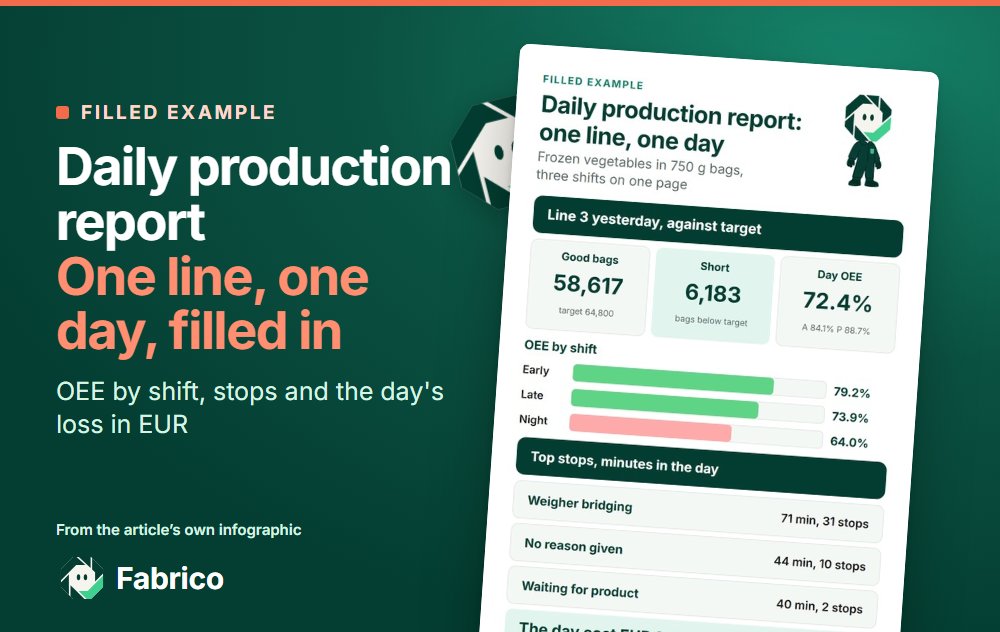
Drill-Down Capability: If OEE was low yesterday, open the top stoppages for that line and shift to see each stop with its reason and duration, for example a filler jam of 45 minutes. You don't have to guess; the data is there.
-
Action Tracking: In most meetings, actions are written in a notebook and forgotten. In Fabrico, you open a work order right there in the meeting and drag it to a person, who gets a notification. It carries a time estimate and moves through a status workflow, and the calendar shows what is upcoming or missed by the next meeting.
-
Safety First: Start the huddle with safety, as most plants do. Fabrico covers the production and maintenance part of the agenda, and a view of safety permits or LOTO status is something Fabrico can scope for your plant.
The Verdict: If you want your morning meeting to result in a better shift, Fabrico is the integrated choice.
2. Redzone
Best For: Workforce engagement and "Winning the Shift."
Redzone is famous for its structured huddle system.
-
Pros: It guides the team through the meeting structure. It focuses heavily on morale ("High Fives") and operator engagement. Great for building a collaborative culture.
-
Ask: How closely does your team need to follow its huddle structure, and how does machine data reach the meeting?
3. L2L (Leading2Lean)
Best For: Dispatch-based management.
L2L organizes the day around "Issues."
-
Pros: Excellent for visualizing the flow of problems. The meeting focuses on "What is red?" and "Who is fixing it?" It is very effective for high-volume dispatch environments.
-
Ask: How much setup does it take to match your meeting structure, and who maintains it?
4. iObeya
Best For: Digitizing visual boards (Lean).
iObeya is essentially a digital whiteboard.
-
Pros: If you love your physical SQDIP (Safety, Quality, Delivery, Inventory, Productivity) board and just want it on a touchscreen, this is the best tool. It is very flexible.
-
Ask: How do the charts on the board get updated from your machines?
5. TeamAssurance
Best For: Connecting strategy to execution.
TeamAssurance focuses on the "Tiered" aspect of meetings (linking the shop floor to the executive suite).
-
Pros: Great for goal cascading. It ensures that the Tier 1 meeting aligns with the Tier 3 strategy. Good for tracking long-term improvement projects.
-
Ask: How are day-to-day maintenance tasks handled next to the goals?
Comparison Matrix: Meetings vs. Operations
| Tool | Best for (our summary) | Ask in the demo |
|---|---|---|
| Fabrico (ours) | Meetings that start from live machine data: OEE by line and shift, stops by reason, work orders with an owner | How would our tier meetings run on its dashboards? |
| Redzone | Workforce engagement and structured huddles | How does machine data reach the huddle? |
| L2L | Dispatch-based management of issues | How much setup matches our meeting structure? |
| iObeya | Digital visual boards, such as SQDIP | How are board charts updated from our machines? |
| TeamAssurance | Linking tier meetings to strategy and goals | How are daily maintenance tasks handled? |
Summary: Stop Having Meetings About Meetings
The purpose of a Daily Management System is to remove obstacles for the production team.
-
Choose iObeya if you want to keep your current whiteboard layout but make it digital.
-
Choose Redzone if you need to wake up a disengaged workforce.
-
Choose Fabrico if you are a Manufacturer. If you want a meeting that starts with real data (OEE) and ends with real solutions (Maintenance Work Orders), Fabrico is the operational platform you need.
Fix the morning meeting.
Book a demo to see how OEE dashboards and work orders can run a daily meeting on lines like yours.
Want OEE captured straight from your machines, no manual logs?
Book a demoContact usRelated articles




Latest from our blog



Real Fabrico tiles, sample data.