


 Login
 Blog
Feed Mill Software: What a Compound Feed Mill Buys First

In short: feed mill software is really several products. A compound feed mill runs least-cost formulation for its recipes, batch control software for the scales and mixer, an ERP or feed mill management system for intake, orders, stock and delivery, medicated feed records where drugs go into feed, a dispatch system for bulk and bagged loadout, and line monitoring, OEE with a light MES, on the pellet mill and bagging line. Which to buy first depends on where tonnes or money go missing.
- Formulation and batch control are separate products: one decides the recipe, the other weighs and mixes it.
- In the US, medicated feed falls under the current good manufacturing practice rules of 21 CFR 225, and its records belong to batch control and QA.
- In the sample pellet shift below, 40 recovered minutes are worth about 10.9 tonnes and EUR 272 a shift, or about EUR 205,600 a year if every shift is like it.
A feed mill turns grain, meals, minerals and premixes into formulas for poultry, pigs, cattle or fish, often hundreds of them. Raw material comes in by truck or rail, then goes through intake, grinding in hammer mills, batching and mixing, conditioning and pelleting, cooling, coating with fat or enzymes, and finally bagging or bulk loadout.
It is a large industry run on thin margins. The FAO's good practice manual for the feed sector puts it plainly: feed produced by the feed industry has reached an estimated 1 billion tonnes annually. At that scale a mill's profit sits in tonnes per hour at the pellet mill as much as in the formula.
Integrators, co-operatives and commercial mills searching for feed mill software or feed mill management software find suites that claim the whole mill. In practice each step has its own kind of system, and the buying question is which one to fix first. Fabrico makes the line layer: OEE and light MES on the pellet and bagging lines.
Feed mill software, layer by layer
The layers split by question. Formulation asks what goes in. Batch control asks whether it went in. The ERP asks what was bought, made and sold. The line layer asks why the pellet mill was not running.
| System | What it does in a feed mill | Owner | Link to line data |
|---|---|---|---|
| Least-cost formulation | Builds each formula from nutrient specs, ingredient prices and limits | Nutritionist | Formula code shows on the pellet run |
| Batch control | Runs scales, micro-ingredient dosing, mixer cycles, liquids and batch sequence | Mill automation, production | A late batch shows as "no mash" at the pellet mill |
| ERP or feed mill management system | Grain intake and contracts, orders, stock, invoicing, delivery | Finance, sales, logistics | Sends orders and bag sizes; gets tonnes and stop minutes back |
| Intake lab | Moisture, protein and mycotoxin results on incoming grain | QA lab | None needed |
| Medicated feed and QA records | Master records, batch records, drug stock, assays, flush and sequence logs | QA | Flush minutes get their own stop reason |
| WMS and dispatch | Bulk bins, bagged stock, truck loading and delivery tickets | Logistics | Bagged tonnes per shift, if asked |
| OEE and light MES | Run time, stops and output at hammer mill, pellet mill, cooler and bagging line | Operations, CI | This is the line layer Fabrico makes |
Measuring the pellet line means a timeline per machine and shift: when the pellet mill ran, at what rate in tonnes an hour, when it stopped, and the reason the operator gave, such as die change, choke, steam or no mash. The bagger gets the same in bags. That is what OEE and a light MES add, and the walkthrough below shows the screens.
What you see: a shift timeline, unclassified time waiting for a reason, and the operator's line-down screen, on sample lines rather than a feed mill. Book a demo.
Plays from YouTube. Google may set cookies when you press play. Privacy policy.
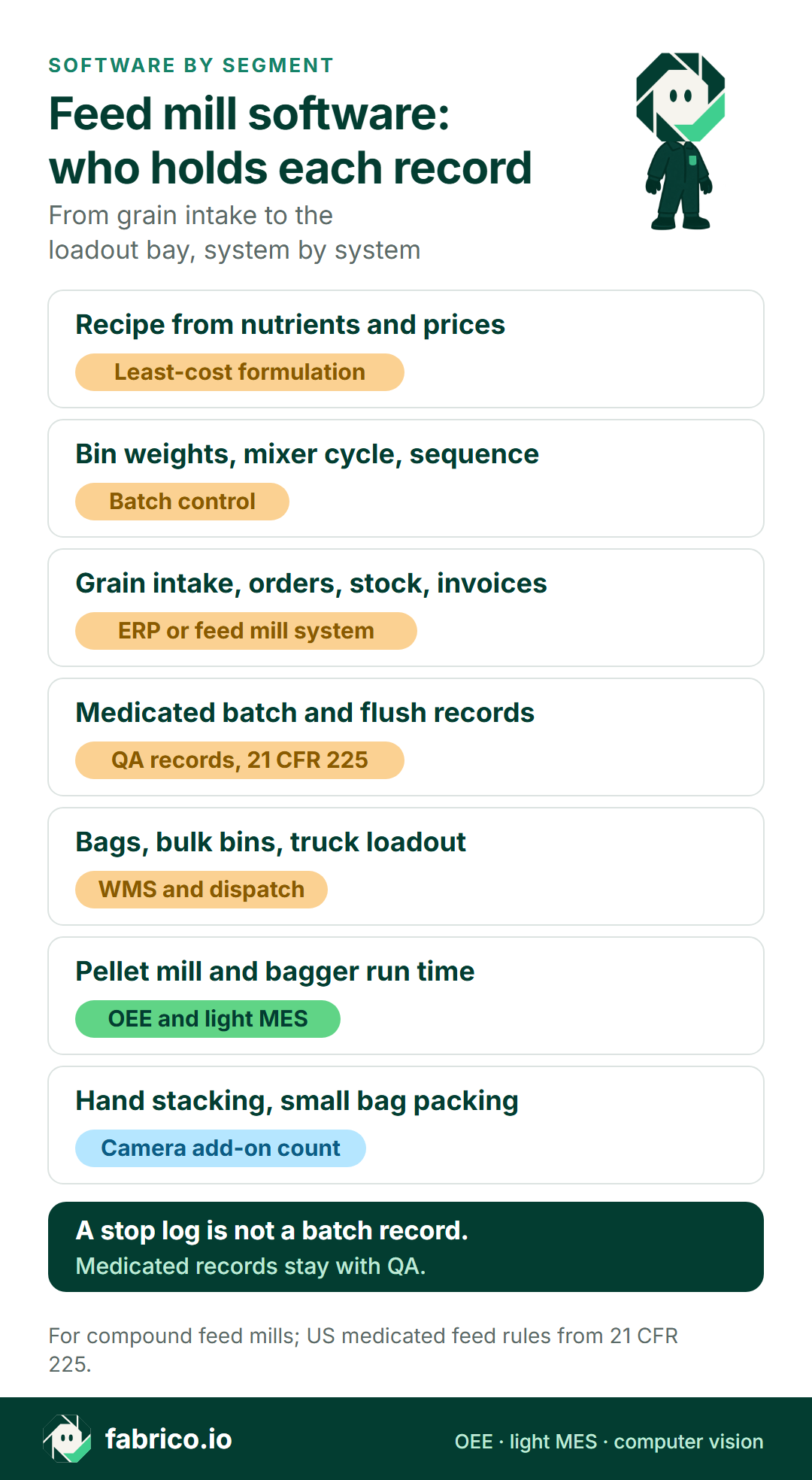
Text version of this infographic
- Recipe from nutrients and prices: least-cost formulation.
- Bin weights, mixer cycle and sequence: batch control.
- Grain intake, orders, stock and invoices: ERP or feed mill system.
- Medicated batch and flush records: QA records under 21 CFR 225.
- Bags, bulk bins and truck loadout: WMS and dispatch.
- Pellet mill and bagger run time: OEE and light MES (Fabrico's layer).
- Hand stacking and small bag packing: camera add-on count.
Least-cost formulation
The nutritionist sets nutrient specs per species and phase, and the software finds the cheapest mix of available ingredients that meets them. When grain prices move, formulas are solved again, and they do move: the USDA Economic Research Service raised its 2026/27 season-average farm price for corn by 30 cents to USD 4.80 per bushel in its September 2026 Feed Outlook.
Batch control
Batch control runs the weigh bins, micro-ingredient dosing, liquid addition and mixer cycle times, and decides the order in which batches run. It is the system that knows what actually went into each batch. It is usually bought with the mill automation.
What feed mill management software covers
Most products sold as feed mill management software cover the business side: grain contracts and intake tickets, customer orders, stock of raw materials and finished feed, invoicing and delivery routes. Some add batch control or a link to it. Ask each vendor to draw where its product stops.
Medicated feed: what 21 CFR 225 asks for, and where it lives
In the US, medicated feed is a regulated drug product as well as a feed, and 21 CFR 225 sets the current good manufacturing practice for making it. Outside the US, national and EU feed rules apply instead, and QA should name them. Two parts shape the software choice:
- Batch records. 21 CFR 225.102 says the production record "includes the complete history of a batch or production run", including the amounts of drugs used and the amount of medicated feed manufactured. Each record must also show the theoretical and the actual quantity of medicated feed produced, carry a signature or initials, and be "retained on the premises for not less than 1 year". That is a batch control and QA record.
- Cleanout between batches. 21 CFR 225.65 allows physical cleaning, or "flushing or sequencing or other equally effective techniques". Where sequencing is used, "it shall be on a predetermined basis designed to prevent unsafe contamination of feeds with residual drugs."
What the line layer adds is time: a flush batch takes real pellet mill minutes, and booking them to their own reason shows what the medicated sequence costs.
The test comes with a carry-over finding: drug residue in a non-medicated feed made right after a medicated batch. QA must trace it through five records:
| Record | Held in | Where the hand-off breaks |
|---|---|---|
| Formula version and drug inclusion | Formulation software | Old version still loaded in batch control |
| Batch weights and sequence | Batch control | Sequence changed by hand on the night shift |
| Flush batch and production record | QA records | Flush logged on paper, not against the batch |
| Bin, truck and delivery ticket | ERP and dispatch | Bin reassigned after the batch was booked |
| When the pellet mill ran | OEE and light MES | Run times on paper, or on a different clock from batch control |
Where a pellet line loses tonnes
Most lost tonnes sit at the pellet mill. Die chokes and roll slips stop it, die changes take time, and poor conditioning with wet or cold steam cuts the rate. The cooler and the crumbler can hold it back, and fines go back for re-pelleting. Upstream, hammer mill screen changes can starve the mixer. At the end, bagger jams and palletiser faults block the line.
Conditioning is where rate and quality meet. The Kansas State University Quality Feed Manufacturing Guide on pelleting gives 17 to 18% total moisture at the die and 180 to 200°F (about 82 to 93°C) conditioning temperature as useful targets for typical corn and soybean meal diets, warns that total moisture above 18% can cause pellet mill plugging, and puts the added cost of pelleting at approximately USD 5 to 6 per US ton (about USD 5.50 to 6.60 per metric tonne). It also tells mills to record tons per die, hours of use and die specifications with each pelleting run, which its key concepts sheet repeats as a monitoring rule.
The machine sets the ceiling. Rated tonnes an hour and die change times vary by make, model and age, and an older mill's die change is often far longer than a new quick-fit system's, so the gap is worth timing. The rate per formula and fines rules are in OEE for animal feed mills, and the split between short stops and slow running in reduced speed loss vs minor stops.
Pellet line failure modes and their early signs
What goes wrong on a pellet and bagging line, what line data shows before the shift report does, and the usual fix:
| Loss | Early sign in line data | Fix |
|---|---|---|
| Die choke | Motor load climbs, then a stop; chokes cluster on certain formulas or after steam changes | Check conditioned mash moisture against the target and clear the steam traps |
| Roll slip | Rate falls while the motor runs; often after wet steam | Steam quality first, then roll gap; book it as its own reason, not as "running slow" |
| Long die change | Changeover minutes by die spread widely between crews | A die change kit and checklist, and one standard timed from last to first good tonne |
| Fines returned for re-pelleting | Rework tonnes per shift rise as tons on the die climb | Track tons per die and replace on wear, not on failure |
| No mash from batching | "No mash" stops after formula changes or at shift start | Sequence batches to the pellet plan and keep a mash bin buffer |
| Flush batches | Pellet mill time on non-sellable flush, growing with medicated orders | Plan the medicated sequence ahead, as 21 CFR 225.65 requires for sequencing |
| Bagger jams | Many short stops at the bagger while the pellet mill backs up into the bin | Separate bagger reasons from pellet mill reasons, so one line does not hide the other |
Worked example: one pellet line shift in money
Sample figures for illustration only; the mill below is not a real one.
A commercial mill runs one pellet line on a broiler grower formula. The ideal rate for that formula and die is 20 tonnes an hour, or one third of a tonne a minute. A shift is 8 hours with 30 minutes of planned stops, so planned production time is 450 minutes.
In one shift the line data shows:
- 60 minutes for one die change, against a sample 30 for a modern quick-fit system;
- 20 minutes of chokes on two wet batches;
- 10 minutes of "no mash" after a formula change;
- 102 tonnes of pellets made, of which 4% came back as fines for re-pelleting.
| Step | Calculation | Result |
|---|---|---|
| Run time | 450 planned minus 90 lost (60 + 20 + 10) | 360 minutes (6 hours) |
| Availability | 360 / 450 | 80.0% |
| Performance | 102 t made / (6 h x 20 t/h = 120 t ideal) | 85.0% |
| Quality | (102 minus 4.08 t fines) / 102 | 97.92 / 102 = 96.0% |
| OEE | 0.80 x 0.85 x 0.96 | 65.3% |
| Check | 97.92 good t / (450 min at 20 t/h = 150 t possible) | 65.3% |
Now price it. With a sample contribution margin of EUR 25 per tonne of pelleted feed, one minute of pellet mill run time at this shift's performance and quality makes 1/3 x 0.85 x 0.96 = 0.272 good tonnes, worth EUR 6.80. An hour of pellet mill downtime costs EUR 408.
Two fixes are in reach. A die change kit and standard brings the change from 60 to 35 minutes, and checking conditioned mash moisture against the KSU target cuts chokes from 20 to 5 minutes. That recovers 40 minutes a shift:
- Per shift: 40 x 0.272 = 10.88 good tonnes, x EUR 25 = EUR 272.
- Per month: three shifts a day on 21 production days is 63 shifts, so EUR 272 x 63 = EUR 17,136.
- Per year, if this shift is typical: 63 shifts x 12 months = 756 shifts, so EUR 272 x 756 = EUR 205,632.
Few mills change dies every shift. Each die change saves 25 minutes, 6.8 tonnes or EUR 170; the chokes save EUR 102 a shift. With one die change a day, 252 a year, that is EUR 42,840 plus EUR 77,112, or EUR 119,952. Use your own die change count.
OEE rises from 65.3% to 72.5% (97.92 + 10.88 = 108.8 good tonnes out of 150). The fines carry a second cost: the 4.08 tonnes returned this shift go through the pellet mill again, and at the KSU figure of about USD 5 to 6 per US ton (about USD 5.50 to 6.60 per metric tonne), that is about USD 22.50 to 27 a shift before the lost capacity is counted.
Sensitivity: if better conditioning also lifts performance from 85% to 90%, the 360 run minutes make 6 more tonnes (120 t ideal x 0.05), or 5.76 good tonnes, another EUR 144 a shift. If the margin is EUR 15 a tonne rather than EUR 25, the 40 recovered minutes are worth EUR 163.20 a shift and EUR 123,379 a year on 756 shifts. And the money only counts if the tonnes sell; a mill that already meets its orders takes the gain as shorter weekend shifts instead. The formula itself is the standard one in OEE calculation.
Which feed mill software to buy first
Choose by the loss that is biggest today. A medicated record gap or an open audit finding goes first, whatever else hurts. After that, the choice is usually between batch control and the line layer.
Mill type changes the order. An integrator's mill with a few formulas for its own farms often loses most at the pellet mill. A commercial mill with many small orders needs the ERP and dispatch side first.
Book a demo to see pellet mill stops, die changes and flush minutes on one shift timeline, priced in tonnes and euros.
Who hands what between feed mill systems
The links decide whether the stack works. Agree each one, and who keeps it running, before go-live.
Report the pellet mill in tonnes an hour, the bagger in bags a minute and loadout in tonnes a truck, then convert for the mill view, as in OEE units.
Five vendor questions for feed mill software
Use them in every vendor meeting, with a month of batch records, pellet mill logs and delivery tickets open.
| Ask | How to test the answer |
|---|---|
| Does the formulation tool hand recipes straight to batch control, and who owns the formula master? | Ask to change one ingredient price and follow the new formula version to the mixer. One system should own formula master data. |
| How does batch control enforce a medicated sequence? | Ask to see a non-medicated feed blocked after a medicated batch until the flush is logged. |
| What does the line layer take from the ERP, and send back? | Formulas, bag sizes and orders should flow in, tonnes bagged and stop minutes out. Name the person who keeps that feed alive. |
| Can the line layer count tonnes and bags? | Ask for the pellet mill in tonnes an hour and the bagger in bags a minute, side by side. |
| Are die changes, chokes and flushes separate reasons? | Ask for minutes per die change by die, and flush minutes per medicated order, from last week's data. |
What a feed mill manager can do this week and this quarter
This week, with the logs you already have:
- Pick the pellet line with the biggest gap between planned and actual tonnes last month.
- For five shifts, log the start and end of the pellet mill's stops, with one of five reasons: die change, choke, steam, no mash, bagger.
- Time the next die change from the last good tonne to the first good tonne, and write down what the crew waited for.
- Weigh the fines returned for re-pelleting per shift, and note tons on the die.
- Put your own margin per tonne into the worked example above and price one shift.
This quarter, once the week shows where the minutes go:
- Measure the pellet mill and bagger automatically from their signals, so run time and stops stop depending on the shift report.
- Write one die change standard and kit, and compare minutes per change before and after.
- Check conditioned mash moisture and temperature against the KSU targets on the formulas that choke most.
- Plan the medicated sequence with QA and book flush minutes to their own reason.
- Send measured rates per formula to whoever plans the pellet runs, instead of nameplate rates.
Fabrico in a feed mill
Fabrico, a cloud OEE and light MES platform, covers the line from the pellet mill to the palletiser, and the hammer mill if wanted:
- Pellet mill running time: run state and output come from the pellet mill and cooler signals, and operators tag the reason for a stop, such as die choke, die change, steam or no mash, on a tablet or phone.
- Bagging line stops: the bagger, sewing or sealing unit and palletiser get their own stops and counts, in bags, so bagging losses do not hide inside pellet mill tonnes.
- Flush and sequence minutes: a flush batch gets its own reason, so the medicated sequence shows its cost.
Small bags packed or stacked by hand have no machine count; there, the camera add-on counts the bags. Video for that moment opens from the shift timeline, streamed on request, not stored in Fabrico. More in the FMCG camera guide, the computer vision add-on page, the OEE software page and light MES vs full MES.
Formulation, batch control, medicated feed records, assays, the ERP and dispatch stay in their own systems and with QA. Quality inspection is not part of Fabrico. Production planning and scheduling are not part of Fabrico today.
Questions feed mill managers ask
What does feed mill software include?
Several products: formulation, batch control, ERP or feed mill management, intake lab, medicated feed records, dispatch and line OEE, with one record type each.
Is feed mill management software the same as batch control?
No. Feed mill management software usually means the business side: intake, orders, stock, invoices and delivery. Batch control runs the scales and mixer. Some suites sell both; test each part on its own.
Does least-cost formulation software run the mixer?
No. It works out the cheapest formula that meets the nutrient specs. Batch control then weighs and mixes that formula, batch by batch.
Where do medicated feed batch records belong?
With batch control and QA. In the US, 21 CFR 225.102 sets what the production record holds, including the amounts of drugs used and the amount of medicated feed made.
Can a feed mill ERP show pellet mill downtime?
It books tonnes produced per formula after the run. It does not usually record when the pellet mill choked, for how long, or why. That is the line layer's job.
What should a feed mill measure on the pellet line first?
Run time and stops with a short list of reasons (die change, choke, steam, no mash, bagger), tonnes an hour per formula, tons on the die, and fines returned for re-pelleting. Those five show where most lost tonnes go.
Book a demo to see what a week of die changes and chokes costs a pellet line, in tonnes and euros.
Related articles

Latest from our blog



Real Fabrico tiles, sample data.