


 Login
 Blog
Ice Cream Manufacturing Software: What to Buy First

In short: ice cream manufacturing software is not one product. A plant usually runs an ERP, mix plant control, lab and quality software, a cold store WMS and, across the freezing and packing hall, OEE plus a light MES. If nobody can say where line hours went last summer, buy the line layer first.
- The mix plant works in batches and tanks. The freezing hall works in cones, cups and sticks a minute. Each side has its own system.
- Overrun links the two. It is a legal and a cost number, and it lives in the freezer and the lab, not in OEE.
- Peak season sets the order: measure the lines before the summer build, then plan with real changeover times.
- A worked filling shift below puts the season's lost minutes in euros, with the quiet months counted honestly.
Ice cream is made twice in one plant. First the mix plant pasteurises and ages the mix in tanks. Then the freezing hall freezes it, fills it and hardens it, at speed, for a few hot months that decide the year.
Below, every record is sorted by owner, one peak-season filling shift is priced in euros, and a plan for this week and this quarter follows. Fabrico makes the freezing hall layer: OEE, light MES and a camera add-on.
The ice cream manufacturing software map
Most of the records an ice cream plant needs already have an owner. The table shows a typical split.
| System | What it owns in ice cream | Run by |
|---|---|---|
| ERP | Orders, SKUs, bills of materials, lots, the seasonal stock build | Finance, planning |
| Mix plant control | Dosing, pasteuriser and homogeniser settings, ageing tanks, CIP sequences | Process engineering |
| Quality and lab | HACCP, pasteurisation records, allergen checks, environmental swabs, overrun and weight samples | Quality |
| Planning tool | Flavour order, allergen sequence, the peak build plan | Planner |
| Cold store WMS | Pallets, stock rotation, dispatch | Logistics |
| Line OEE and light MES | Stops and counts on freezers, fillers, stick lines and wrappers, with reason codes, OEE and the cost of each loss | Production, CI |
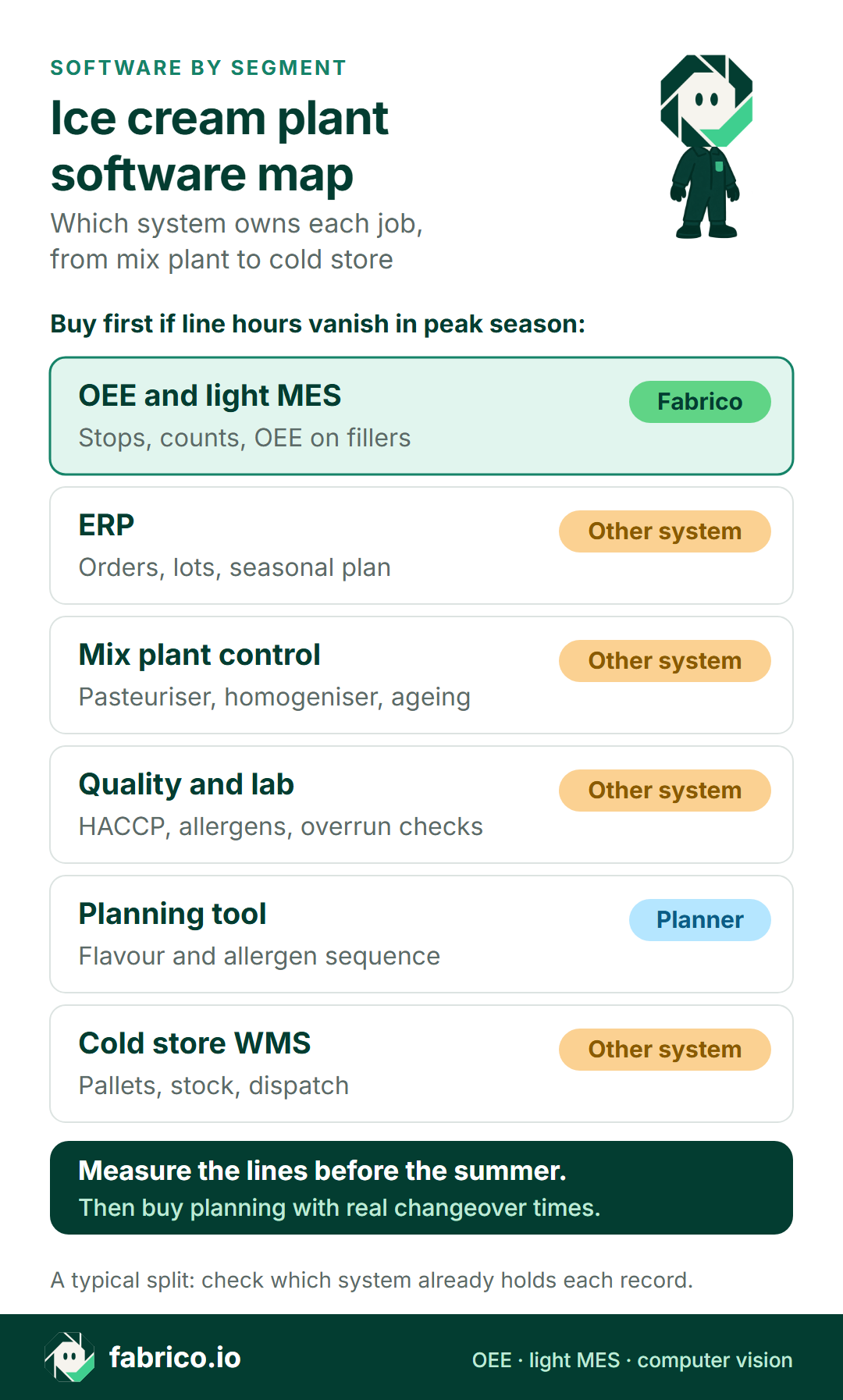
Text version of this infographic
- OEE and light MES: stops, counts and OEE on fillers (Fabrico).
- ERP: orders, lots and the seasonal plan (other system).
- Mix plant control: pasteuriser, homogeniser and ageing (other system).
- Quality and lab: HACCP, allergens and overrun checks (other system).
- Planning tool: flavour and allergen sequence (planner).
- Cold store WMS: pallets, stock and dispatch (other system).
- Footer: measure the lines before the summer, then buy planning with real changeover times.
The mix plant rows carry the food safety weight. US rules describe ice cream as a food produced by freezing, while stirring, a pasteurized mix (21 CFR 135.110), so the pasteuriser record belongs to mix plant control and the quality system, where the temperature is measured. No line tool should hold it.
The bottom row is the one left orphaned: why the cone line lost two hours on Saturday, and what those hours were worth. Closing that gap is where OEE and a light MES start. The line layer times run and stop on the freezer, filler and wrapper, the operator adds the reason, and the minutes are priced. The food-wide version of this map is in our guide to food manufacturing software.
What you see: a shift timeline, unclassified time waiting for a reason, and the operator's line-down screen, on sample lines rather than an ice cream plant. Book a demo.
Plays from YouTube. Google may set cookies when you press play. Privacy policy.
Mix plant and freezing hall: one buffer between them
The mix plant runs in batches: dosing, pasteurising, homogenising, then ageing in tanks. The freezing hall runs in units a minute. Between them sit the ageing tanks, and they are the buffer that breaks first.
The University of Guelph's ice cream technology e-book says the mix is aged for at least four hours and usually overnight, at or below 5 °C, and that a green, unaged mix is usually quickly detected at the freezer. So a late flavour change waits for its tank.
- Mix not ready: the filler waits because the next flavour has not aged. The reason sits in mix plant control, but the lost minutes show on the line.
- Line down, mix waiting: a long stop on the stick line leaves aged mix in the tank. Whether it can still be used is a quality decision, recorded in the quality system.
A light MES gives the line side, with "mix not ready" as its own stop reason; tank times stay where they are measured. For the same split in dairy, see MES for dairy processing.
The same hand-offs decide how fast a plant answers a supplier recall, say one lot of hazelnut paste. The trace usually breaks in one of five places:
- the paste lot booked by delivery, not by tub;
- an ageing tank topped up from a second mix batch;
- one tank feeding two filling runs, with no tank switch logged against the run;
- the allergen clean released on paper only;
- pallets in the cold store not tied to a filling run.
The cure is one lot code and one clock from tank to pallet; the line data adds run times and good counts.
Where an ice cream line loses its hours
After each clean or flavour change the filler runs slow until the freezer reaches overrun, and that start-up product is the loss most plants never price. Station detail is in OEE for ice cream production, and the split between start-up and yield loss in start-up loss vs reduced yield.
Hardening ties the filler to everything downstream. Packaged ice cream goes into a blast freezer at -30° to -40° C, often a spiral tunnel, and the same Guelph chapter advises that bundling is done after hardening. When the bundler or case packer stops, the tunnel fills and the filler soon stops too, so the loss lands on the wrong machine.
The season makes every lost hour dearer. In the USDA NASS Dairy Products 2025 Summary, US plants made 722 million gallons of regular hard ice cream in 2025, from 393 plants. Monthly output ran from 49.0 million gallons in December to 69.5 million in July. By our arithmetic, July was 42% above December, and April to August were the five highest months against a monthly average of 60.2 million gallons. In Europe, the EU produced 3.44 billion litres of ice cream in 2025, up 1.9% on 2024, Eurostat says, with Germany the largest producer at 608 million litres. A plant that builds stock in spring and runs flat out in summer cannot win back a lost June hour in November.
Ice cream line failure modes
| Loss | Early sign in line data | Fix |
|---|---|---|
| Freezer start-up after a flavour change | Rejects and slow running clustered in the first minutes after a changeover code | Book start-up as its own reason, sequence flavours light to dark, see stops after changeover |
| Mix not ready | "No mix" stops on the first shift after a plan change, or after a long stop upstream | Plan pasteuriser batches from measured filler hours, so each tank has its ageing time |
| Hardening tunnel full | Filler stops a few minutes after a case packer or bundler stop | Take the downstream run state as a signal and book "tunnel full" as its own reason |
| Cone, cup and lid feed jams | Many stops under two minutes on one filler, rising with a new packaging lot | Log jams by packaging lot; see reduced speed loss vs minor stops |
| Overrun drift | Checkweigher rejects rising on one flavour, often after a start-up | Give the drift its own reason and price it; see checkweigher rejects in OEE |
| Allergen cleans running long | Clean minutes vary widely between crews for the same change | One timed clean sheet per change type, reviewed weekly with quality |
| New seasonal crews | Unclassified stop time rising in the first weeks of the season | Short reason lists in the crew's language, set up before hiring starts |
Overrun, weight and the law: which system holds the number
Overrun is the air whipped into the mix at the freezer. Guelph defines it simply: start with 1 litre of mix, make 1.5 litres of ice cream, and the overrun is 50%. It sets how many tubs a tank of mix makes, so it is one of the plant's biggest cost levers. It also has a legal floor. Under the US standard, ice cream weighs not less than 4.5 pounds to the gallon and carries at least 1.6 pounds of total solids per gallon.
The two meet in one sum. The same Guelph chapter works a mix of 1,100 g a litre at 100% overrun into ice cream of 550 g a litre. The US floor, 4.5 pounds a gallon, is about 539 g a litre. By our arithmetic that mix would cross the floor at about 104% overrun, so the window between giving mix away and breaking the standard is narrow.
The two errors show up differently: too much air fails the checkweigher as underweight rejects, while too little air passes it as giveaway and never shows in OEE. Too little air gives mix away. Sample figures for illustration only: a 0.5 litre tub at 100% overrun holds 275 g of that mix. If the freezer drifts to 90% and the filler still fills by volume, each tub holds about 289 g, roughly 14.5 g more. On 31,914 tubs a shift that is about 462 kg of mix given away, or about EUR 554 at a sample EUR 1.20 a kilogram. Neither shows in OEE, because a tub is a tub whatever it weighs.
The freezer controls set the air, the lab checks weight per volume, and the checkweigher checks pack weight. The line layer only gives an overrun drift its own stop reason and counts its rejects against quality. See giveaway as a quality loss.
Flavours, allergens, CIP and Listeria belong to the plan
Ice cream carries more allergens than most dairy: milk always, and often eggs, tree nuts, peanuts, wheat in cones and cookie pieces, soy and sesame. In the US, the FDA lists the major food allergens as milk, eggs, fish, Crustacean shellfish, tree nuts, peanuts, wheat, soybeans, and sesame. A hazelnut or peanut flavour on a shared line means a validated clean before the next product.
Hygiene adds a second reason to clean. EFSA notes that Listeria can contaminate food after production, for example between cooking and packaging, and can multiply even at fridge temperatures of 2 to 4 °C. Ice cream is pasteurised in the mix plant and then exposed again at the freezer, ingredient feeder and filler. The FDA's draft guidance on Listeria in ready-to-eat foods (January 2017) is written for exactly that case: a ready-to-eat food exposed to the plant environment before packaging. Swab plans and their results are a quality record, so they belong in the quality system.
Flavour order is the planner's call, cleans are validated by quality, and CIP runs in mix plant control. A light MES times each type separately, by line, and prices it, so the sequence is built from measured minutes. See the allergen changeover matrix, how to book CIP time in OEE and sequencing by changeover cost.
Worked example: one peak-season filling shift in money
Sample figures for illustration only. A plant fills 0.5 litre tubs on one filler fed by a continuous freezer. The filler's ideal rate is 100 tubs a minute, and the plant works 8-hour shifts. Our OEE calculation guide shows each formula step by step.
| Step | Figure | How it is worked out |
|---|---|---|
| Planned production time | 450 min | 480 min shift minus 30 min of planned breaks |
| Stops | 90 min | Two flavour changes 40 (20 each), hardening tunnel full 20, mix not ready 15, lid feed jams 15 |
| Run time | 360 min | 450 minus 90 |
| Availability (A) | 80.0% | 360 / 450 |
| Ideal output in run time | 36,000 tubs | 360 min x 100 tubs |
| Tubs filled | 32,400 | From the filler count |
| Performance (P) | 90.0% | 32,400 / 36,000 |
| Good tubs | 31,914 | 32,400 minus 486 start-up and underweight rejects (1.5%) |
| Quality (Q) | 98.5% | 31,914 / 32,400 |
| OEE | 70.9% | 0.80 x 0.90 x 0.985 = 0.7092; check: 31,914 / (450 x 100 = 45,000) |
The gap to a perfect shift is 45,000 minus 31,914, or 13,086 tubs. By loss: 9,000 tubs to the 90 stopped minutes, 3,600 to slow running and 486 to rejects. At a sample contribution of EUR 0.35 a tub, after mix and packaging, the whole gap is worth EUR 4,580.10 a shift. The 486 rejects also hold about 134 kg of mix, at 275 g a tub. Price the part a team can act on.
Say the plant times its flavour changes and sequences light to dark, so each change falls from 20 to 10 minutes. It plans pasteuriser batches from measured filler hours, so "mix not ready" falls from 15 to 5 minutes. And it takes the case packer's run state as a signal, so "tunnel full" falls from 20 to 10. That is 40 minutes back. At the shift's own speed and quality: 40 x 100 x 0.90 x 0.985 = 3,546 more good tubs, or EUR 1,241.10 a shift.
Now the season. A month here is 42 shifts (2 shifts on 21 working days), so a year is 504 shifts (42 x 12). Taking the five highest NASS months, April to August, as the peak, when the filler limits the plant and every extra tub sells. In the other seven months the plant already makes what it sells, so those 40 minutes count as no extra sales.
- Per peak shift: 3,546 tubs x EUR 0.35 = EUR 1,241.10.
- Per peak month: 42 x EUR 1,241.10 = EUR 52,126.20.
- Per year, 504 shifts run, 210 of them in the peak: 210 x EUR 1,241.10 = EUR 260,631.00, plus EUR 0 from the 294 quiet-month shifts.
- New OEE on a peak shift: 35,460 / 45,000 = 78.8%, with availability up from 80.0% to 88.9%.
Counting all 504 shifts would claim EUR 625,514.40, which is why the season split matters. If changeovers only fall to 15 minutes each, the gain is 30 minutes: 2,659.5 tubs, about EUR 930.83 a peak shift.
Fund this first: match the season's worst problem
Spend on whatever cost the most last season. A mock recall that took days points to ERP lot functions or a full MES, because a trace needs ingredient lot consumption, which a light MES does not keep.
Many plants end with three layers: mix and quality records where the auditor looks for them, lots and the plan in the ERP, and OEE on every freezing line. Book a demo to see a filler's flavour changes, start-up rejects and tunnel stops priced on one shift timeline.
Five questions for an ice cream software shortlist
Put all five to each supplier you are weighing, with last summer's stop log open on the table.
| Question | A strong answer |
|---|---|
| How is freezer start-up product booked? | It should be a quality loss in units, with the mix lost in kilograms, logged against the change that caused it. |
| How are CIP, flavour changes and allergen cleans split? | Three separate types with their own minutes, and one written rule for whether CIP sits inside planned time, the same on every line. |
| How does a stop downstream show up on the filler? | As "tunnel full" or "case packer down", taken from the downstream run state, not as a filler fault. |
| Can a seasonal operator log a reason in a cold hall? | Watch it done in gloves, on a tablet or phone, in the operator's language, in seconds. |
| Which records does the vendor leave alone? | Get a written split of mix records, pasteuriser charts, lots, swab results, the flavour schedule and inspection: covered or not covered. |
What to do this week and this quarter
This week, for the plant or production manager:
- Add up last month's filler stop minutes by cause: flavour change, allergen clean, CIP, mix not ready, tunnel full, feed jams, breakdowns.
- Time one flavour change from the last good tub to the first tub at target overrun and speed.
- Write down the ideal rate for each filler and pack size, from the machine plate.
- Ask the planner how often a plan change leaves the filler waiting for aged mix.
This quarter, before the spring stock build:
- Put a run signal on the limiting filler and on the case packer behind it, so "tunnel full" is booked on the right machine.
- Agree 8 to 12 stop reasons with the crews, in their own words, and translate them before seasonal hiring starts.
- Price one tub with finance, as in the worked example, and agree which months count as peak.
- Give the planner measured changeover and start-up minutes for each flavour pair before the summer plan is fixed.
- Set a target on the largest loss, such as halving flavour change time, and review it weekly.
Where Fabrico sits between mix plant and cold store
Fabrico is cloud software for OEE and light MES. In the freezing and packing hall it covers three jobs:
- Freezer start-ups in money: start-up tubs, slow running and cleans by line, shift and flavour change, priced for the planner.
- The cold hall, on a phone: stops and counts from the filler, stick line, wrapper and case packer through the PLC, or an IoT device with external sensors on older machines; seasonal crews tag the cause on a tablet or phone.
- Hand-packed multipacks counted: at packing tables with no machine counter, Fabrico's camera add-on counts output.
Where a camera covers the station, the video for the minute of a stop can be opened from the shift timeline, streamed on request and not stored in Fabrico. For camera add-on use in dairy, read our dairy camera page and the FMCG camera guide. For every feature, open the MES and OEE software overview; for the cameras, the computer vision add-on overview.
Mix plant control, pasteuriser and CIP records, overrun control, recipes, lot genealogy, HACCP and swab results stay with their own systems. Quality inspection is not part of Fabrico. Production planning and scheduling are not part of Fabrico today; its measured changeover times can inform the planner who does that work.
Ice cream software questions
Does an ice cream plant need a full MES?
Only if it wants one system to hold recipes, batch records, lot genealogy and the line data together, and has the time for a longer project. Many plants keep mix records in the mix plant control system and lots in the ERP, and add a light MES for the lines.
Can OEE software control overrun?
No. Overrun is set at the continuous freezer and checked by the lab or quality team. OEE software can give an overrun drift its own stop reason and count the cones or cups rejected for it, so the cost shows up next to the other losses.
Which ice cream line should go live first?
The line that limits peak-season output, which is often the one with the most flavour and allergen changes. Connect it before the season starts, so the planner has real changeover and start-up times when the summer plan is built.
How should OEE be read in the quiet months?
Count only the hours the line was planned to run. A filler parked for a week in December is not an availability loss, it is unplanned capacity. Compare peak months with peak months, and use the quiet months to time cleans and changeovers without order pressure.
Want to see what last July's freezer start-ups cost? Book a demo to see a filling shift's flavour changes and start-up rejects as run time, stops and money lost.
Related articles

Latest from our blog




Real Fabrico tiles, sample data.