

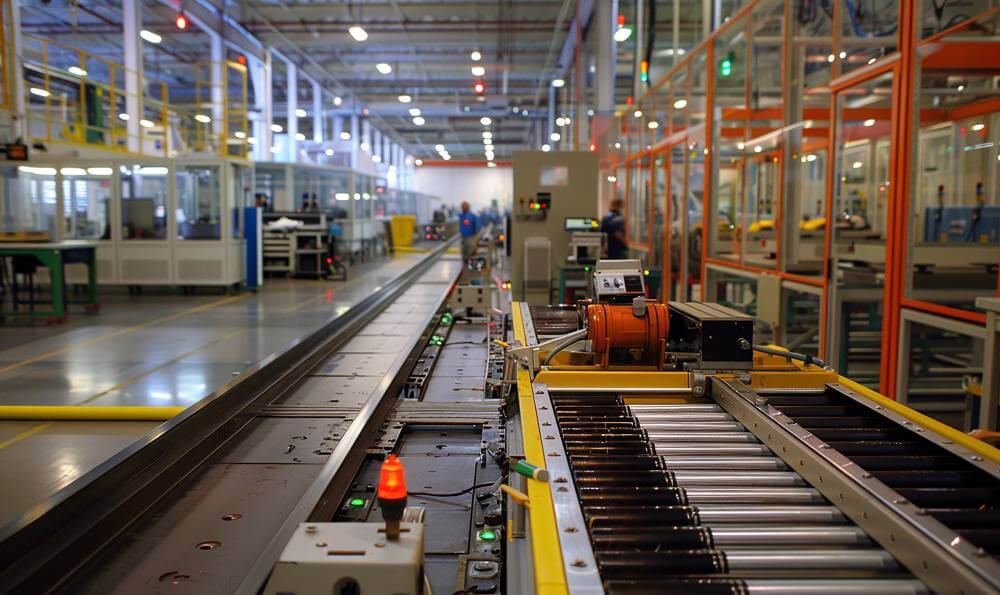

The Production Preparation Process (3P) is a structured lean event that designs a new product and its production line to be waste-free from the very first day, before any equipment is bought or concrete is poured.
Where kaizen improves a process that already exists, 3P works one step upstream: it shapes the design so that waste never gets built in. Most factories spend years chasing muda on lines that were laid out badly at the start.
3P is the discipline that fixes the problem at its source, when changes cost almost nothing.
Roughly 70 to 80 percent of a product's lifetime cost is committed during design, yet most improvement effort arrives after the line is running and the layout is set in steel.
Once a conveyor is bolted down and a cell is wired, moving a workstation two meters can mean a shutdown, a capital request, and weeks of lost output. 3P intervenes while the design is still on paper and cardboard, when a bad idea costs an eraser rather than a change order.
The payoff compounds. A line designed with balanced stations and short travel paths starts life with higher Overall Equipment Effectiveness instead of clawing toward it over quarters. It needs less rework, holds less inventory, and gives operators ergonomic, single-piece flow from the opening shift. You are not improving a line later; you are refusing to build the problems in the first place.
Continuous improvement tools such as the PDCA cycle and A3 problem solving assume a process is already producing. They optimize what is in front of you. 3P assumes nothing exists yet and asks a harder question: what is the simplest possible way to make this product flow?
A useful rule of thumb: reach for 3P when you are launching a new product, adding a new line or plant, or facing a step change in volume that a redesign, not a tweak, must absorb. For everything else, kaizen and value stream mapping remain the daily engine.
A 3P event usually runs three to five days with a cross-functional team of engineers, operators, maintenance, quality, and purchasing. A common sequence looks like this:
Suppose a plant is designing a new line for an electronics enclosure. Customer demand is 460 units per day. The line runs one shift of 8 hours (480 minutes) with 20 minutes of planned breaks, leaving 460 minutes of available time.
Takt time = available time / demand = 460 minutes / 460 units = 1.0 minute per unit. Every station must release a finished unit at or below 60 seconds to keep pace with the customer.
The team decomposes the assembly into work content totaling 4.6 minutes of hands-on labor. To find the minimum number of stations, divide total work content by takt: 4.6 / 1.0 = 4.6, rounded up to 5 stations. Now the team balances the 4.6 minutes across 5 stations at roughly 0.92 minutes each, leaving a small buffer under takt for variation.
During mock-up, cardboard trials reveal that one station requires an operator to turn 180 degrees to reach a fixture, adding motion waste that pushes it over takt. The team redesigns the fixture placement on the spot. Because this happens in cardboard, the fix costs an afternoon rather than a retrofit.
This is the entire point of 3P: the takt math and the physical simulation together catch a bottleneck that a running line would have hidden behind overtime for months. Reviewing station balance against takt is also where theory of constraints thinking earns its keep, since the slowest station governs the whole cell.
A 3P design is a hypothesis about how a line should perform. Fabrico is how you confirm it against reality from the first shift. Fabrico provides real-time OEE and production monitoring, so the takt, balance, and availability targets set during the 3P event become live numbers on the floor instead of assumptions in a slide.
Its computer vision can read machine status even on equipment with no PLC, which is common when a new line mixes modern and older assets, giving you accurate data without waiting for full integration.
Fabrico is also a field-ready CMMS , so the preventive schedules, asset records, and spare-parts structure you plan during 3P go straight into work orders and maintenance routines.
It is EU-built with EU data residency, and it acts as the real-time data foundation that tells you whether the line you designed lean is actually running lean. Explore the OEE monitoring and CMMS capabilities to see how a new line's targets stay visible from launch.
Kaizen improves a process that is already running, removing waste you can observe on an existing line. 3P works before the line exists, designing the product and process so that waste is never built in. Kaizen is incremental and continuous; 3P is intensive and used at launch points such as a new product, a new line, or a large volume change.
Most 3P events run three to five focused days. The team is deliberately cross-functional: design and process engineers, operators who will run the line, maintenance and quality staff, and often purchasing. Including operators and maintenance early is critical, because they catch ergonomic and serviceability problems that pure engineering reviews tend to miss.
No. The core of 3P is low-tech on purpose: cardboard, foam, full-scale mock-ups, and simple takt calculations. Software matters afterward, once the line is live, to verify the design held up. That is where real-time OEE monitoring and a CMMS turn your 3P targets into measured performance and structured maintenance rather than hopeful estimates.
Designing a new line lean is only half the job; proving it runs lean is the other half. Book a Fabrico demo to see how real-time OEE and a field-ready CMMS confirm your 3P design from the very first shift.




















 Login
Login
 Blog
Blog