


 Login
 Blog

Beyond the Scorecard: The 2026 Blueprint for Actionable OEE

Most manufacturers are "data rich but insight poor," staring at red dashboards while their actual production capacity continues to leak into the "Hidden Factory."
To drive a true return on investment in 2026, you must move beyond passive reporting and run machine data and maintenance in one platform.
Key Takeaways
-
OEE only pays when the line acts on it. See OEE software for operators for what to show at the line. Measuring downtime is a cost; fixing it is an investment in revenue reclamation.
-
Decision Latency is the silent OEE killer. The time wasted between a machine stop and a technician’s arrival is your biggest opportunity for profit growth.
-
The Visibility Trifecta is the new standard. Trusted data takes a combination of PLC signals, operator context, and AI-powered Computer Vision.
What is Actionable OEE?
Actionable OEE is a manufacturing strategy that natively integrates real-time production performance data with maintenance execution so every availability or performance loss can be turned into a prioritized work order right away.
In a passive system, an OEE drop is a line item in a Friday morning meeting.
In an actionable OEE system like Fabrico, that same drop can become a notification on a technician’s mobile device.
This shift moves your factory from "Reporting Failure" to "Engineering Uptime."
The Fabrico Framework: The Fault-to-Fix Reliability Cycle
To achieve sustainable growth, you must bridge the gap between production (Data) and maintenance (Action) through a four-stage cycle.
-
Detection: Fabrico pulls real-time signals via PLC or Computer Vision to identify a performance deviation during the shift.
-
Contextualization: The Inefficiencies Zoom-In module captures a visual replay, while the operator adds the "human layer" of what occurred.
-
Execution: Tom, the technician, opens a prioritized Work Order from the logged deviation in the Field-Ready CMMS, with the SOPs for the job on his phone.
-
Optimization: Managers use the Unified Data Intelligence to identify "Bad Actor" assets and refine the maintenance schedule to prevent recurrence.
Comparison Matrix: Passive Reporting vs. Turning machine data into action
| Feature | Generic OEE Dashboards | Legacy ERP / MES | Fabrico (MES and OEE Platform) |
| Response Trigger | Manual Review | Batch / Post-Shift | Real-Time OEE Thresholds |
| Maintenance Link | None | Financial / Delayed | Native Integrated CMMS |
| Micro-stop context | Subjective / Manual | Mostly Ignored | Advanced Visual Zoom-In |
| Mobile Capability | N/A | Low / Desktop-Based | Field-Ready Native App |
| Decision Latency | High (Hours/Days) | Moderate | Low (Live Alerts) |
| Strategic Focus | Performance Reporting | Operational Record | Revenue Reclamation |
Reclaiming the Hidden Factory: From Data to Revenue
For plant leadership, the blueprint for 2026 is centered on "Capacity Reclamation" rather than expensive Capex.
Reclaiming just 5% of your availability through reduced Decision Latency is often more profitable than adding a new production line.
By identifying "Bad Actor" assets through the 80/20 Rule, Mike, the maintenance manager, can move his team to Condition-Directed Tasks.
This reduces your Maintenance Cost per Unit and ensures your multi-million dollar assets reach their full residual value.
Strategic Roadmap: Preparing for the AI Era
You cannot build a smart factory on top of messy, manual, or disconnected data silos.
While legacy systems keep your data in silos, Fabrico keeps OEE and maintenance data in one place, which any later AI work needs.
See Fabrico live. Book a demo.
Request a demoRelated articles







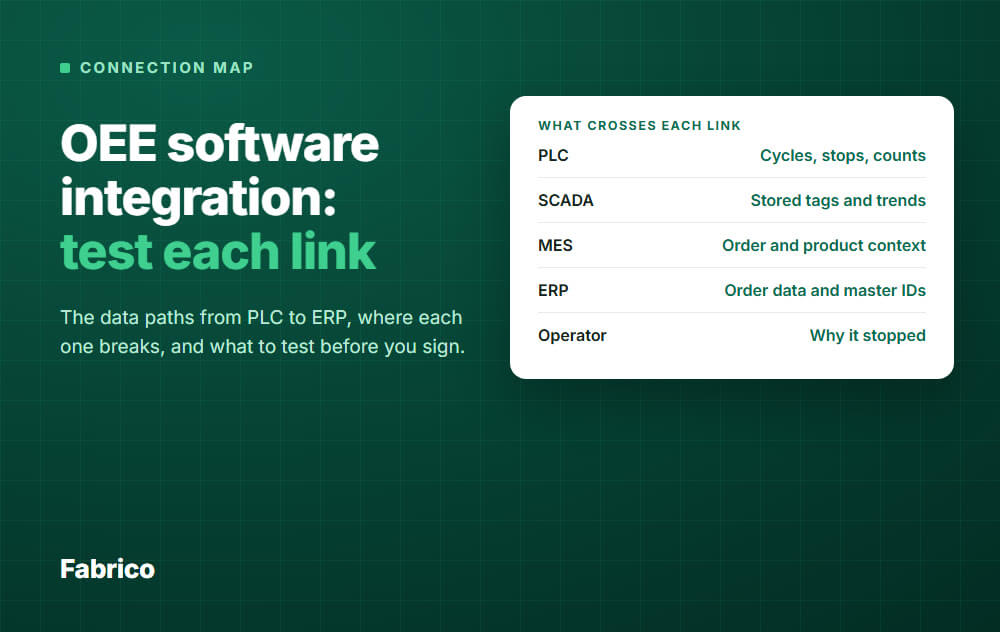
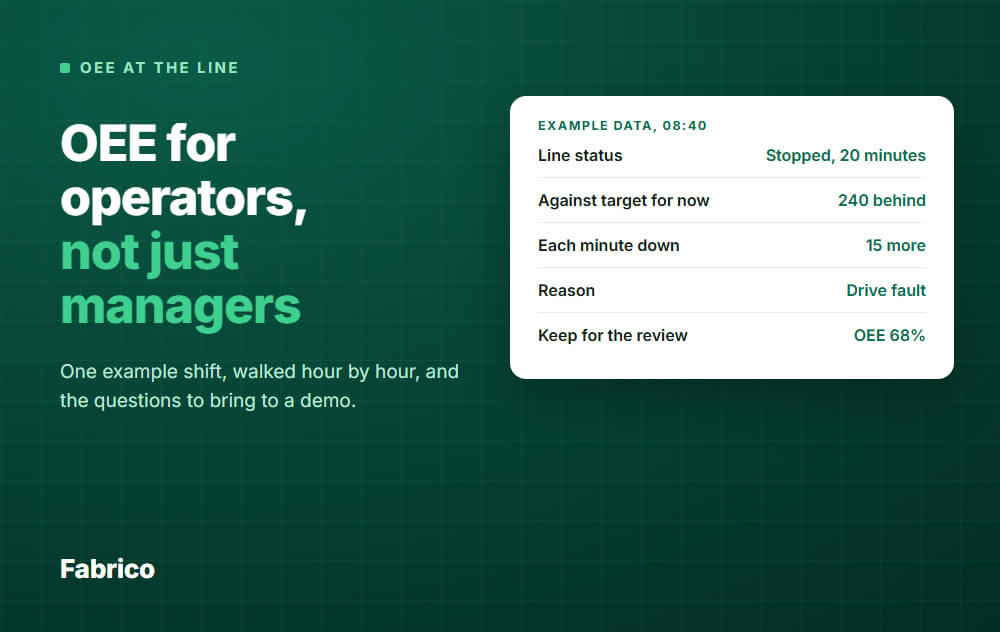


Real Fabrico tiles, sample data.