





 Login
 Blog
Bag-in-Box Filler OEE: Tap Faults, Leakers, Crew Pace and Costs

In short
- Count in rated minutes: a 3 L bag and a 10 L bag are different units. OEE is good bags x rated minutes per bag, divided by planned time.
- Rate the filler, log the crew: rating the example's 3 L shift at the boxing crew's pace lifts OEE from 74.2% to 82.5% and hides 39.5 minutes a shift.
- The tap comes first: in the example, leakers, cap rejects and tap stops cost EUR 121,892 a year, 61% of the priced losses on the line.
- Fill to the average system: on a 3 L bag the tolerable negative error is 45 ml, and the average must reach 3 L.
- Semi-auto or auto is a crew sum: on the example's 3 L volume, an automatic filler saves EUR 116,424 a year in crew time.
OEE on a bag-in-box filler is the share of planned time that turns into good, capped, boxed bags at the filler's rated speed. Because 3 L and 10 L bags run at different rates, count each good bag in rated minutes, not in bags or litres.
The losses sit in a few places: the tap and its gland, fill accuracy, bag supply, the boxing crew, the box erector and size changes. This page maps them by station and prices each one for a two-shift wine BIB filler in Portugal.
Glass lines lose output in other places: see OEE for wine bottling lines.
How to calculate OEE on a bag-in-box filler
The formula is the standard one. On a BIB line, three rules decide whether the number means anything: the unit you count in, the rated speed, and the count points.
- Availability = run time / planned production time. Breaks without relief and planned cleaning sit outside planned time.
- Performance = (bags filled x rated minutes per bag) / run time.
- Quality = good bags / bags filled. A good bag is filled, capped, dry and inside a closed box.
- OEE = (good bags x rated minutes per bag) / planned production time.
Count in rated minutes when sizes mix
A filler rated at 10 bags a minute for 3 L and 4 a minute for 10 L earns 0.1 rated minutes for each good 3 L bag and 0.25 for each good 10 L bag. Add the rated minutes, divide by planned time, and a day with both sizes gives one OEE figure that every shift can check.
Litres do not work as the unit: at those rates the filler moves 30 litres a minute at 3 L and 40 at 10 L, so a day heavy in 10 L looks better for no reason.
Rated speed when the crew sets the pace
On the example line, people put filled bags into boxes, push the tap into the window and stack the pallet. If the two people at the boxing table manage 9 bags a minute and the filler can do 10, the line runs at 9.
Set the rated speed at the filler's validated rate for each bag size, and log crew pacing as its own performance loss.
The crew's lost minutes are the case for a third person, a better table layout or an automatic boxer. Rate the line at the crew's pace and none of those fixes ever shows a gain.
Count points
- Bags filled: the filler's own cycle counter, after recapping.
- Good bags: boxes closed at the end of the line, less leakers found at boxing and palletising.
- Late leakers: bags found wet in the warehouse go back to the shift that filled them, by the code on the box.
The BIB line station table
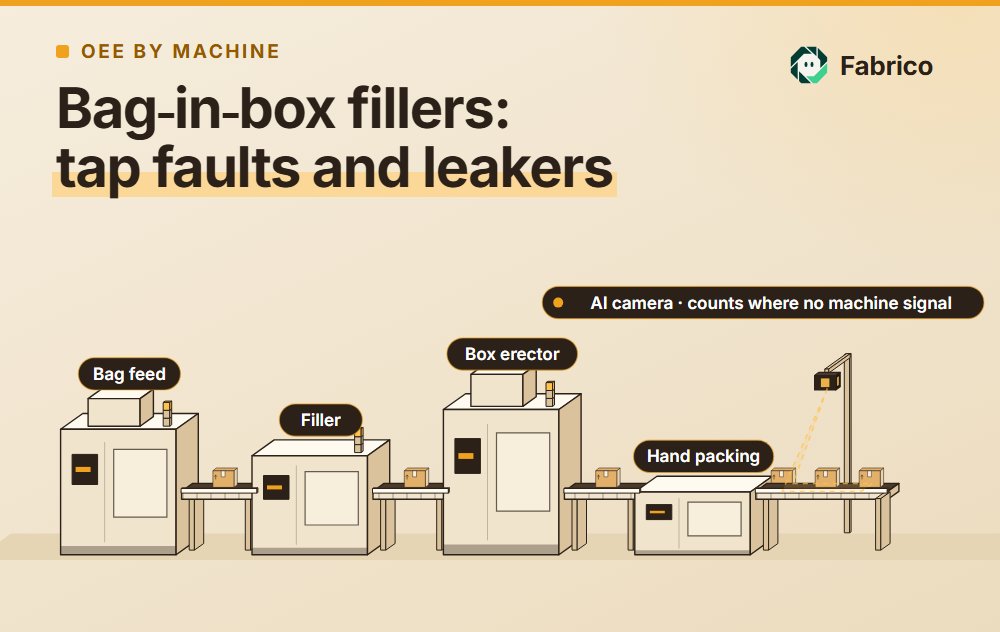
A BIB line has one core machine, the filler, and a chain of stations around it, some automatic and some manual. Give each station its own stop codes, a loss type and one owner, and the weekly review becomes a list instead of an argument.
| Station | What goes wrong | Loss | Floor check | Owner |
|---|---|---|---|---|
| Bag supply | Bags stuck or tangled, web breaks, fitment turned wrong | A, Q | Bag lot, storage, first 20 bags of a new lot | Purchasing, QA |
| Bag loading | Bag placed late or off the head, feed misses | P, A | Bags per minute by hour | Shift lead |
| Uncap | Cap not gripped or dropped | A | Gripper wear, cap fit on this lot | Maintenance |
| Evacuate | Weak or skipped vacuum, air left in the bag | Q | Vacuum reading on each cycle | QA |
| Fill | Out of tolerance, foam, wine on the gland | Q, P | Fill checks every hour against the TNE | Operator, QA |
| Gas flush, if fitted | Low nitrogen pressure | Q | Gas pressure at start and after stops | Operator |
| Recap | Tap not seated or crooked, leakers at the gland | A, Q | Squeeze test after every restart | Maintenance |
| Box erector | Jams, open bottoms, poor tape or glue | A | Box lot, board moisture, magazine level | Maintenance |
| Bag into box | Crew pace, tap not in the window | P, Q | Bags per minute, tap position checks | Shift lead |
| Close, code, pallet | Line backs up behind a full pallet | A, blocked | Log as blocked, not as a filler fault | Shift lead |
| Wine supply | Wine not released, filter or tank change | A, starved | Log as starved, with the reason | Cellar |
Two rows protect the filler from blame it does not own: blocked and starved. Both are real availability loss, but the fix sits in the cellar or at the pallet. Keep them as separate codes so maintenance does not chase a pallet problem inside the filler head.
Taps, caps and leakers at the gland
The tap is the most handled part of a BIB: removed, held, refitted and pushed home on every cycle. When that goes wrong, the line pays twice. The head stops while someone clears it, and the bag is rejected or leaks later.
Leaks cost wine quality too. In a Food Chemistry study of dry white wine in BIB, part of the aroma was adsorbed by the plastics or "lost to the environment through leakage of the valve fitment".
The wine in both pouches stayed acceptable for 3 months, against at least 6 months in glass.
Where tap and gland faults start
- A tap or cap lot that does not match the gripper setting.
- Worn grippers or anvils on the recapper.
- Wine on the gland from drips or foam at the end of the fill.
- Recapping at full speed straight after a restart, before the head settles.
- Bags stored warm or crushed, so the fitment sits off centre.
Floor checks that catch them early
- A squeeze test on the first bags after every restart and every new tap lot.
- Leakers counted by hour of the shift. A spike after a restart points at the restart, not at the tap lot.
- Leakers and cap faults booked under the recap station, both as stops and as rejects, so the full cost shows in one place.
Taps and bags touch the wine. Regulation (EC) 1935/2004 requires food contact materials to be made under good manufacturing practice and traceable "at all stages". Write the bag and tap lot on every shift record: when leakers jump, the lot is the first question.
Fill accuracy and oxygen pick-up
BIB fillers fill by volume, through a flowmeter, or by weight, on a load cell. A weight target has to be converted with the density of each wine at its fill temperature, so a weight filler needs a target table per wine.
The average system for 3 L, 5 L and 10 L
Directive 76/211/EEC covers prepackages from 5 ml to 10 l, so 3 L, 5 L and 10 L bags sit inside it. Since 2009 that includes liquids sold by volume, after Directive 2007/45/EC removed the old exclusion.
- Rule 1: the actual content may not be less, on average, than the nominal quantity.
- Rule 2: the share of bags short by more than the tolerable negative error (TNE) must be small enough to pass the batch tests in the directive's Annex II.
- Rule 3: no bag short by more than twice the TNE may carry the e-mark.
| Bag | TNE, 1.5% of nominal | Twice the TNE |
|---|---|---|
| 3 L | 45 ml | 90 ml |
| 5 L | 75 ml | 150 ml |
| 10 L | 150 ml | 300 ml |
The directive sets the TNE at 1.5% of the nominal for quantities from 1,000 to 10,000 ml. The bag size itself is free: Directive 2007/45/EC fixes still wine sizes only "on the interval from 100 ml to 1 500 ml".
Any target above the nominal is wine given away. A target 15 ml above 3 L on 3,400 bags is 51 litres a shift, 12,852 litres a year on the example line. How to set the target from the filler's spread is on the page about giveaway and overfill as a quality loss.
Oxygen: the quality loss OEE does not see
A bag that leaves the filler with air inside passes every count on the line. It fails later, on a shelf or in a fridge. That is why evacuation and gas flush sit on the station table even though they did not stop the example line.
- Portugal, white wine, 12 months: in a study in the Journal of Food Science and Technology, BIB wines "showed a lower content of free SO2 than bottle wines during 12 months". The 5 L pouches were filled under vacuum with nitrogen in the headspace.
- Bordeaux, 18 months: in a Food Control study of wine packaging, white wine was noticeably affected after 6 months in PET bottles. BIB and PET with an oxygen scavenger stayed much closer to glass. Red wine showed no significant differences.
The filler's job on oxygen is to start each bag clean. Log a weak or skipped evacuation as a quality event, and check dissolved oxygen on the first bags after a restart and after each wine change.
Bag supply, box erecting and the boxing table
Three supplies feed the line besides wine: bags, boxes and people. Each of them can set the pace of the filler.
Bag supply
Bags that stick together, tangle in the feed or arrive with the fitment off centre cause short stops at loading and misses at the uncapper. Ask the supplier for the lot's test results before adjusting the machine.
Box erecting
On the example line, the box erector is the automatic station that stops the line from outside the filler. Board moisture, flap memory and glue or tape settings are the usual suspects. The causes and floor checks are on the page about case erector jams.
The crew at the boxing table
Putting bags into boxes is lifting work: a 10 L bag holds roughly 10 kg of wine. Directive 90/269/EEC on manual handling asks employers to avoid manual handling where they can, or to reduce the risk.
The directive's annex lists "a rate of work imposed by a process which cannot be altered by the worker" as a risk factor. A boxing table paced by the filler is that process, so crew pacing is a layout and staffing question, not a reason to push people harder.
Changeovers between 3 L, 5 L and 10 L
A BIB filler sees two kinds of change, and each needs its own standard time. One average figure for both tells nobody what to fix.
- Wine change, same size: push out, flush, first-bag checks on fill and oxygen.
- Size change: bag guides, head and gripper settings, fill target, box size at the erector, pallet pattern, then first-bag checks.
In the example, the wine change takes 15 minutes against a 10 minute standard, and the 3 L to 10 L change takes 40 against 25. That is 55 minutes a day, 20 of them over standard. All 55 are availability loss; the standard is the target.
The cheapest fix is sequence. Run sizes in blocks of days instead of changing every shift, and light wines before dark ones. If the box erector change is the longest part of a size change, time it on its own line of the sheet.
Worked example: 3 L and 10 L wine BIB in Portugal
One automatic single-head filler at a Portuguese winery, two shifts: 3 L red for retail in the first, 10 L white for food service in the second. The numbers are an example built for this page, not a customer's data.
- Shifts: 2 x 480 minutes, each with a 30 minute break when the line stops. Planned production time is 450 minutes a shift, 900 a day.
- Rated speed (sample): 10 bags a minute at 3 L, 4 a minute at 10 L, the filler's validated rates.
- Crew (sample): 4 people: one at the filler, two at the boxing table, one palletising.
- Boxing pace (sample): the boxing pair sustains 9 bags a minute at 3 L. At 10 L the filler is slower than the crew.
Stops and OEE for the day
- 3 L shift, 55 minutes: wine change 15, tap and cap faults 14, box erector 12, bag supply 8, starved 6.
- 10 L shift, 68 minutes: size change 40, blocked at the pallet 10, tap and cap faults 8, box erector 6, bag supply 4.
| Item | 3 L shift | 10 L shift |
|---|---|---|
| Rated speed | 10 bags/min | 4 bags/min |
| Run time (450 - stops) | 395 min | 382 min |
| Possible at rated speed | 3,950 bags | 1,528 bags |
| Bags filled | 3,400 | 1,380 |
| Rejects: leak, cap, fill | 34 + 16 + 10 = 60 | 14 + 6 + 4 = 24 |
| Good bags | 3,340 | 1,356 |
| Availability | 87.8% | 84.9% |
| Performance | 86.1% | 90.3% |
| Quality | 98.2% | 98.3% |
| OEE | 74.2% | 75.3% |
The day in rated minutes: 3,340 x 0.1 = 334 and 1,356 x 0.25 = 339. OEE for the day = (334 + 339) / 900 = 74.8%.
Where the speed went
The 3 L shift could fill 3,950 bags in its 395 run minutes and filled 3,400. Of the 550 missing bags, 395 are the crew's pace (1 bag a minute for 395 minutes), worth 39.5 rated minutes. The other 155 bags, 15.5 minutes, are short stops and slow restarts.
The 10 L shift lost 148 bags, 37 rated minutes, all short stops and slow restarts, because the crew keeps up at 4 a minute. Rated at 9 a minute, the 3 L shift would show 3,340 / 9 / 450 = 82.5%, and the crew's 39.5 minutes would be gone from view.
Across the day: 123 stop minutes, 92 speed minutes and 12 rated minutes in rejects (60 x 0.1 + 24 x 0.25) make 227 lost minutes. Add the 673 earned and the day is back at 900.
What each loss costs
- Labour: Eurostat labour cost levels (lc_lci_lev) give EUR 16.5 per hour for manufacturing in Portugal in 2025. For a crew of 4: 4 x 16.5 / 60 = EUR 1.10 per minute.
- Wine (sample figure): EUR 1.20 per litre into the bag. For scale, OIV puts the world average export price of BIB wine at 1.9 EUR/l in 2024.
- Pack (sample figure): bag, tap and box at EUR 0.45 for 3 L and EUR 0.85 for 10 L.
- Reject: wine plus pack, with the wine discarded: 3 x 1.20 + 0.45 = EUR 4.05 for 3 L, 10 x 1.20 + 0.85 = EUR 12.85 for 10 L.
- Calendar: 21 production days a month, 252 a year. A shift is half a day.
If your hygiene plan allows the wine from rejected bags to go back to tank, price those rejects at pack and handling only. The table prices minutes at crew cost, the floor value. Euros are rounded; totals come from unrounded figures.
| Loss | Shift | Day | Month | Year |
|---|---|---|---|---|
| Leakers, 34 x 3 L + 14 x 10 L | 159 | 318 | 6,670 | 80,035 |
| Cap and tap rejects, 16 + 6 | 71 | 142 | 2,980 | 35,759 |
| Fill-weight rejects, 10 + 4 | 46 | 92 | 1,930 | 23,159 |
| Tap and cap stops, 22 min | 12 | 24 | 508 | 6,098 |
| Changeovers, 55 min | 30 | 61 | 1,271 | 15,246 |
| Box erector, 18 min | 10 | 20 | 416 | 4,990 |
| Bag supply, 12 min | 7 | 13 | 277 | 3,326 |
| Starved and blocked, 16 min | 9 | 18 | 370 | 4,435 |
| Crew-paced boxing, 39.5 min | 22 | 43 | 912 | 10,949 |
| Short stops, restarts, 52.5 min | 29 | 58 | 1,213 | 14,553 |
| Total, EUR | 394 | 788 | 16,546 | 198,551 |
The tap family, leakers plus cap rejects plus tap stops, costs EUR 483.70 a day and EUR 121,892 a year: 61% of the bill. Changeovers, the biggest block of stop minutes, cost EUR 15,246 a year.
In peak season the minute costs more. If lost bags cannot be made up, a minute costs margin. With a sample margin of EUR 0.60 per 3 L bag and EUR 1.50 per 10 L bag, one rated minute is worth EUR 6.00 at either size (10 x 0.60, 4 x 1.50).
Then the 227 lost minutes cost 227 x 6 = EUR 1,362 a day, plus EUR 551.40 of rejected wine and packs: EUR 1,913.40 a day, EUR 482,177 a year. Leakers still lead at EUR 359 a day, with changeovers next at EUR 330.
The market gives Portuguese wineries another reason to watch BIB costs. In OIV's 2024 data, BIB was 9% of Portugal's wine export volume but 4% of its value, and the only category that fell, by about 5%.
Semi-automatic or automatic filler: the break-even
A semi-automatic filler needs an operator to place each bag on the head; the machine then uncaps, evacuates, fills and recaps. An automatic filler takes bags from a web or a feed and runs the whole cycle.
The choice comes down to volume and crew, priced here on the example's 3 L run.
| 3 L bags | Semi-automatic | Automatic |
|---|---|---|
| Rated bags an hour (sample) | 240 | 600 |
| Crew a shift (sample) | 3 | 4 |
| Good bags a shift at 74.2% OEE | 1,336 | 3,340 |
| Crew cost a shift, 8 paid hours | EUR 396 | EUR 528 |
| Crew cost per 1,000 good bags | EUR 296 | EUR 158 |
| Shifts a year for 841,680 bags | 630 | 252 |
| Crew cost a year | EUR 249,480 | EUR 133,056 |
Both columns use the same OEE, to isolate the machine. The 841,680 bags are the example's 3,340 good 3 L bags x 252 days. Crew cost uses the Eurostat rate: 3 x 16.5 x 8 = EUR 396 and 4 x 16.5 x 8 = EUR 528 a shift.
The semi-automatic route needs 630 shifts a year, 2.5 a day: a third shift or a second machine. The automatic filler saves EUR 116,424 a year in crew time on this volume.
Priced under 3 x 116,424 = EUR 349,272 installed, it pays back on crew time alone within three years.
Who should pick which
- Semi-automatic: below about 1,300 good 3 L bags a day, one semi-automatic filler on one shift covers the volume (1,336 a shift in the example). Many sizes and short runs favour it too.
- Automatic: long runs of one size on two shifts or more. If the boxing crew already paces the line, an automatic filler alone buys little: fix the table first.
- Either way: ask for leaker and oxygen results on the plant's own bags and taps, not only for speed.
Questions for the filler supplier
- What is the validated rate for each bag size on the plant's own bags and taps?
- How long does a 3 L to 10 L change take, and which parts need tools?
- What leaker rate did the acceptance test measure, and over how many bags?
- How are evacuation and gas flush checked on each cycle, and what happens when one fails?
- Fill by volume or by weight, and what spread at 3 L and at 10 L?
- Which signals (running, stopped, bag count, reject) does the PLC make available to other systems?
First ten shifts: the BIB floor card
Write the rules down before the first count. Ten shifts on one filler are enough if the rules are fixed on the first day.
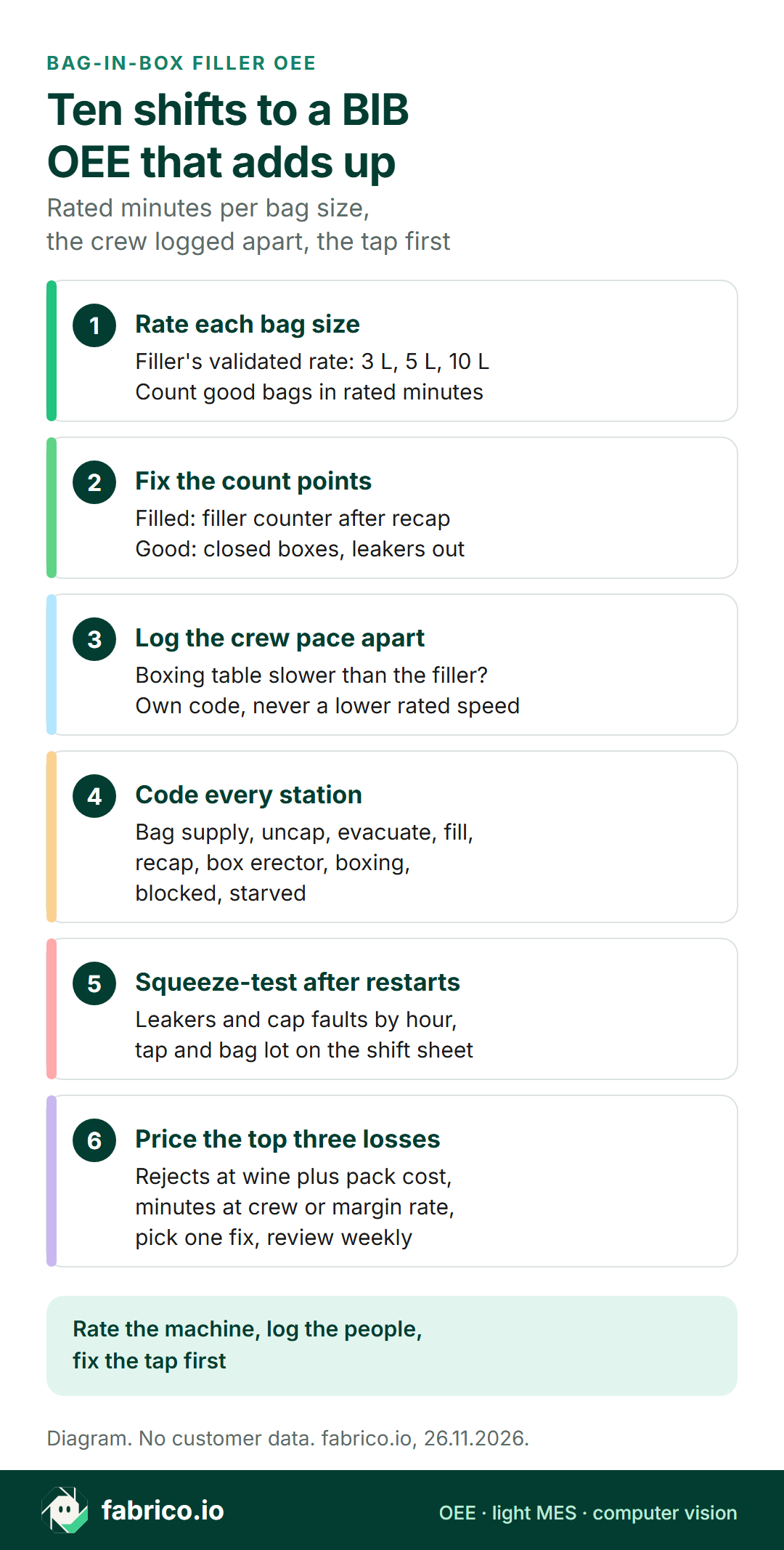
Text version of the diagram
- Rate each bag size: use the filler's validated rate for 3 L, 5 L and 10 L, and count good bags in rated minutes.
- Fix the count points: bags filled from the filler counter after recapping, good bags from closed boxes with leakers taken out.
- Log the crew pace apart: if the boxing table is slower than the filler, give it its own code and never lower the rated speed.
- Code every station: bag supply, uncap, evacuate, fill, recap, box erector, boxing, blocked and starved.
- Squeeze-test after restarts: count leakers and cap faults by hour, and write the tap and bag lot on the shift sheet.
- Price the top three losses: rejects at wine plus pack cost, minutes at crew or margin rate, then pick one fix and review it weekly.
- Shift 1: write the rated speed per bag size, the count points, the crew-paced rule and a stop list. Keep the list under fifteen codes.
- Shifts 2-6: log every stop over two minutes with a code and a station. Count leakers and cap rejects by hour.
- Shifts 7-8: compare the logged minutes with the gap between run time and planned time. A large unexplained gap means short stops or missing entries.
- Shifts 9-10: price the top three losses with your own labour, wine and pack figures, and pick one to fix first.
If the filler PLC has a running signal and a bag counter, use them from the first shift. Hand counts drift by the second week, and the trend is what the plant is building.
Decision: shift sheet, filler counter or line software
The options differ in how much the plant learns per hour of effort. Software prices vary by vendor and scope, so the table gives cost drivers, not list prices.
| Option | Cost driver | Fits | Weak spot |
|---|---|---|---|
| Shift sheet at the filler | About 15 operator minutes a shift: EUR 4 at the Eurostat rate | One filler, first month, agreeing the codes | Short stops and crew pacing stay invisible |
| Filler counter plus a spreadsheet | Engineer days to map signals; ask your integrator for a day rate | One filler with an open PLC and an engineer who stays | Boxing table and rejects still on paper |
| OEE software or light MES from machine signals | Ask the vendor for a price per line per month | Several lines, or losses big enough to price every day | Needs stop codes and standards agreed first |
| Full MES with batch and recipe records | A site project with integration work; quote per site | Plants that need electronic batch records | Long rollout before the filler sees a gain |
The third option suits wineries with more than one BIB or bottling line. OEE software reads the filler's running signal and bag counter, takes stop reasons from the operator, and shows availability, performance and quality by shift without anyone typing up a sheet.
What you see: a shift timeline, unclassified time waiting for a reason, and the operator's line-down screen, on sample lines. Book a demo.
Plays from YouTube. Google may set cookies when you press play. Privacy policy.
For a comparison of tools built for fast lines, see OEE software for high speed packaging lines. If cellar, blending and release steps belong in the same system, read MES for beverage manufacturing.
Who should pick which
Start with the shift sheet if the filler has no PLC access yet and the first job is agreeing what a stop is.
Move to software once the tap family or changeovers cost more each month than a line subscription: in the example the tap family alone is EUR 10,158 a month.
Choose a full MES when a regulator, customer or group policy asks for electronic batch records.
Questions to ask a software vendor
- Can it read the filler's running state and bag counter from the PLC, and what is the fallback if the PLC is closed?
- Can the rated speed be set per bag size, so a day with 3 L and 10 L gives one OEE?
- Can crew-paced minutes at the boxing table be logged apart from filler stops?
- Can operators log leakers, cap faults and fill-weight rejects by reason at the line?
- Can a wine change and a size change each be timed against their own standard?
- Can losses be priced with each product's selling price and margin?
- What happens to machine data when the network drops, and is the quote per line, per machine or per plant?
Where Fabrico fits
Fabrico is made by the publisher of this article. It is OEE software and a light MES with computer vision. The parts that matter on a BIB line:
- OEE by line and shift from the core machine, the filler, connected through the line PLC or a Fabrico IoT device.
- Micro-stops from the machine signal, and stop reasons chosen by the operator at the machine in a few taps, from a reason list set up per station: tap fault, bag supply, box erector, blocked, starved.
- Changeovers tracked against a standard time, and a line screen with actual against target hour by hour.
- Scrap recorded by product and reason, so leakers, cap faults and fill-weight rejects each get their own line.
- With the selling price and margin of each product entered, losses are priced in money and stops are ranked by financial impact.
- Where a station has no usable signal, such as the boxing table, the camera add-on counts output.
See the OEE, MES and computer vision features, or how a quote per plant is built on the pricing page.
Sources, accessed 26.11.2026: EUR-Lex, Council Directive 76/211/EEC on prepackages by weight or volume, consolidated text; EUR-Lex, Directive 2007/45/EC on nominal quantities for prepacked products; EUR-Lex, Regulation (EC) No 1935/2004 on food contact materials; EU-OSHA, Directive 90/269/EEC, manual handling of loads; EUR-Lex, Council Directive 90/269/EEC, text with Annex I; Eurostat, Labour cost levels by NACE Rev. 2 activity (lc_lci_lev); OIV, State of the World Vine and Wine Sector in 2024; Revi et al., Effect of packaging material on enological parameters and volatile compounds of dry white wine, Food Chemistry 152, 2014; Ghidossi et al., The influence of packaging on wine conservation, Food Control 23(2), 2012; Moreira et al., Sensory attributes and volatile composition of a dry white wine under different packing configurations, Journal of Food Science and Technology 55(1), 2018.
Frequently asked questions
How do you calculate OEE on a bag-in-box filler?
Multiply each good bag by its rated minutes (1 / rated bags per minute for that size), add them up and divide by planned production time. In the example, (3,340 x 0.1 + 1,356 x 0.25) / 900 = 74.8%.
What is a good OEE for a bag-in-box line?
There is no neutral, published benchmark for BIB lines. Compare the line with itself week by week under fixed rules for rated speed, count points and crew pacing.
Why do bag-in-box taps leak at the filler?
Check these causes first: a tap lot that does not match the gripper setting, worn recapper parts, wine on the gland from drips or foam, and recapping at full speed straight after a restart. A squeeze test after every restart can catch them early.
Should a slow boxing crew count against the filler's OEE?
Yes, as a separate performance loss with its own code. Keep the rated speed at the filler's validated rate, or the gain from a better table layout or an automatic boxer never shows.
How accurate does a 3 L bag-in-box fill have to be?
Under Directive 76/211/EEC the average must reach 3 L, the tolerable negative error is 45 ml, and no bag short by more than 90 ml may carry the e-mark.
When does an automatic bag-in-box filler pay?
When the volume needs more than one shift on a semi-automatic filler. In the example's 3 L run it saves EUR 116,424 a year in crew time, so a price under EUR 349,272 installed pays back within three years.
See which BIB station costs the most. The demo shows OEE by line and shift from the core machine, stop reasons chosen by operators, changeovers against a standard time and losses ranked by financial impact.
Latest from our blog




Real Fabrico tiles, sample data.