

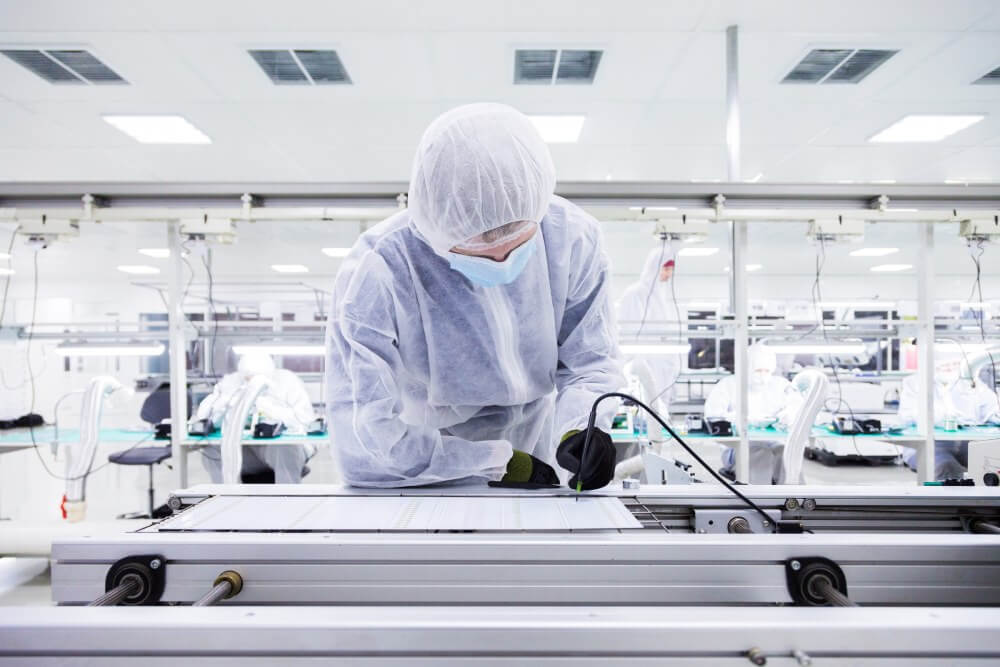

The "Cleanroom" Constraint: You cannot bring dirty paper or cardboard into an ISO Class 5 cleanroom. You need Mobile Software on approved tablets.
The "Tool" Cost: When a lithography tool costs €100 million, every second of downtime is measured in thousands of euros. You need Real-Time OEE to track utilization.
The Top 5: We review Fabrico, IBM Maximo, Siemens, and others to help you maintain the world's most complex machinery.
See how Fabrico unifies OEE and maintenance in one platform.
Book a demoManaging a Semiconductor Fab is the peak of manufacturing difficulty.
The environment is cleaner than a hospital operating room.
The equipment (Etchers, Lithography, Deposition) is incredibly complex. The margins for error are zero.
Generic maintenance software fails here for two reasons:
Contamination: You cannot use paper logbooks or binders inside the cleanroom.
Precision: A generic "Repair" ticket isn't enough. You need calibration records, sub-component tracking, and precise Tool Uptime metrics.
You need Semiconductor CMMS Software, tools that understand the rigor of the Fab and the Sub-Fab.
Here are the 5 Best CMMS Tools for Semiconductor Manufacturing in 2026.
Best For: Fabs that need to eliminate paper and maximize Tool Availability.
Fabrico is designed for high-tech manufacturing. We replace the "Cleanroom Notebook" with a secure, digital tablet workflow that tracks both Maintenance and Tool Performance (OEE).
Paperless Execution: Fabrico runs on tablets. Technicians can view schematics, sign off on PMs, and order parts without leaving the cleanroom to check a binder.
Tool Uptime (OEE): Fabrico tracks the availability of critical tools (e.g., ASML, Lam, Applied Materials). If a tool goes down, the system logs the exact duration and reason code, helping you fight yield loss.
Sub-Fab Management: Managing the thousands of pumps, chillers, and abatement systems in the sub-fab is chaos. Fabrico’s deep asset tree handles the complexity of "Parent Tool -> Child Pump" relationships perfectly.
Calibration Control: You can set hard blocks on tools that are out of calibration. If the date passes, Fabrico flags the asset, preventing production on a non-conforming tool.
The Verdict: If you need to protect your yield and your uptime without bringing paper into the Fab, Fabrico is the specialized choice.
Best For: Mega-Fabs (Intel, TSMC scale).
Maximo is the traditional standard for massive semiconductor enterprises.
Pros: Infinite scalability. It can manage the facility (HVAC/Power), the tools, and the supply chain in one massive database. It is highly configurable for complex compliance needs.
Cons: It is heavy. Implementing Maximo in a new Fab is a multi-year project. The user interface is often too complex for technicians to use quickly during a critical tool-down event.
The Niche: Global Enterprise Fabs.
Best For: Manufacturing Execution (MES) and Process Control.
Siemens Opcenter (formerly Camstar) is the dominant MES in the semiconductor industry.
Pros: It controls the wafer. It knows exactly which lot is in which chamber. It prevents misprocessing better than any maintenance tool.
Cons: It is an MES, not a dedicated CMMS. It focuses on the product flow, not the spare parts inventory or the facility infrastructure (Sub-Fab). It is extremely expensive.
The Difference: Siemens moves the wafer; Fabrico fixes the tool.
Best For: Specialty Fabs and MEMS.
Eyelit is a flexible MES/CMMS hybrid popular in smaller or specialty semiconductor operations.
Pros: Very strong traceability. It handles "Lot Tracking" and "Equipment Management" in a single suite. Easier to deploy than Siemens or Maximo.
Cons: It can lack the modern, mobile-first usability of a dedicated SaaS maintenance platform.
The Difference: A strong mid-market choice for process control.
Best For: Sub-Fab condition monitoring (Pumps/Scrubbers).
The Sub-Fab is full of rotating equipment (Vacuum Pumps) that are critical to the tool above. eMaint excels here.
Pros: Vibration monitoring integration. It connects to Fluke sensors to predict pump failure before it dumps the vacuum on a process chamber.
Cons: The interface is dated. It is less effective for managing the complex "Recipe" and "Calibration" workflows of the main process tools upstairs.
The Niche: Sub-Fab Reliability.
| Feature | Fabrico | Maximo | Siemens | Eyelit | eMaint |
| Primary Focus | Tool Uptime | Enterprise Asset | Wafer Process | Lot Tracking | Condition Mon. |
| Cleanroom UX | ✅ Excellent | Varies Complex | Varies Complex | Good | Dated |
| Sub-Fab Mgmt | ✅ Deep | ✅ Deep | Varies | Varies Basic | ✅ Deep |
| OEE/Utilization | ✅ Native | Varies Custom | ✅ Native | ✅ Native | Varies |
| Deployment | Weeks | Years | Years | Months | Months |
In a Fab, maintenance is production. If the tool isn't ready, the wafer dies.
Choose Maximo if you are building a multi-billion dollar site and need total enterprise governance.
Choose Siemens if you need to control the lithography recipe.
Choose Fabrico if you are an Equipment Engineer. If you need to manage the maintenance of the Tools and the Sub-Fab equipment with a modern, paperless workflow that protects the cleanroom, Fabrico is the agile solution.
Zero particles. Zero downtime.
[Book a Demo with Fabrico] to see how we digitize maintenance in the cleanroom.
Curious what honest, real-time OEE looks like on your floor?
Watch a 15-min demo


















 Login
Login
 Blog
Blog