
Electric vehicle charging equipment manufacturing. AC wallboxes, DC fast chargers, HPC (High Power Charging) systems, and charging management infrastructure, is one of the fastest-growing manufacturing sectors driven by EV adoption targets across Europe, North America, and Asia.
Manufacturers in this sector face the dual challenge of rapidly scaling production capacity to meet demand while implementing quality systems that ensure product reliability under demanding field conditions (outdoor installation, high utilization rates, extreme temperature ranges).Power electronics assembly is the core production process for EV charging equipment.
DC-DC converters, inverter modules, rectifier stacks, and power management circuit boards require PCB assembly, power component mounting, thermal interface application, and enclosure assembly processes that combine high-speed automated operations with manual assembly and careful electrical testing.
OEE monitoring for power electronics assembly lines tracks PCB throughput rate, first-pass yield at automated optical inspection (AOI) and in-circuit test (ICT), and the power component assembly efficiency that determines overall charger output capacity.Cable harness manufacturing for EV charging systems
connecting the power electronics to connectors, vehicle interface systems, and control electronics, is a labour-intensive assembly process where productivity tracking (actual assembly hours versus standard hours by harness type) is the primary efficiency metric.
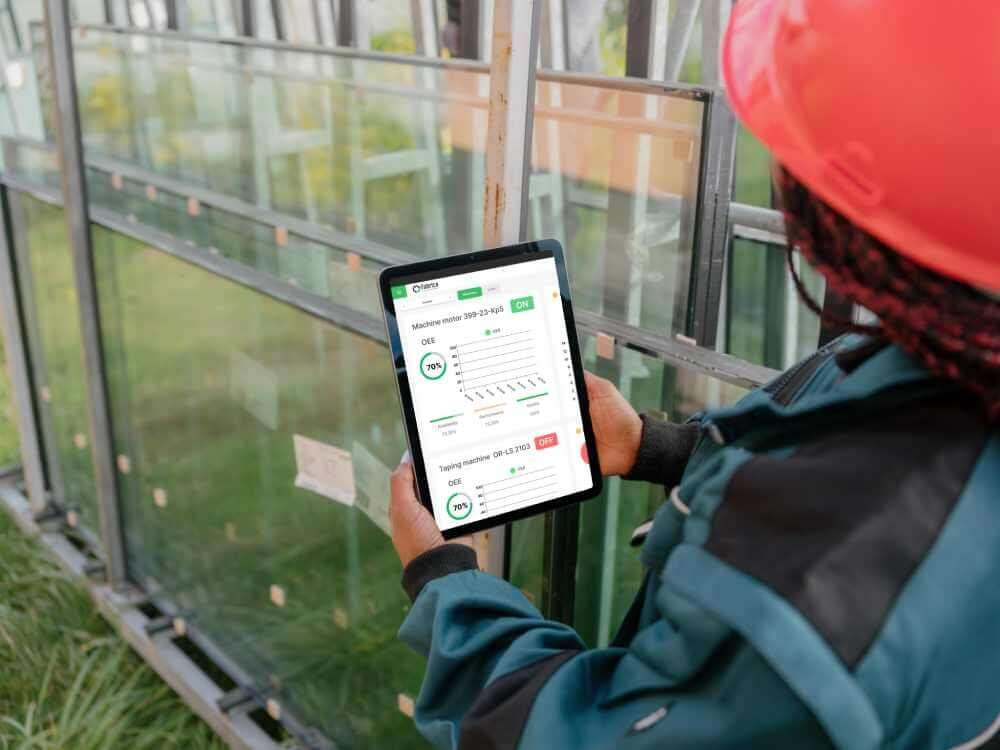
OEE software that supports standard time-based performance monitoring for manual harness assembly operations alongside automated test and inspection monitoring provides the complete production efficiency picture for EV charging manufacturers with mixed automated and manual production.
Whichever OEE platform you shortlist, the decisive question is data quality. Sensors and manual logs miss the short stops, micro-stops, and idle time that quietly erode availability.
Fabrico is computer-vision-verified OEE plus closed-loop maintenance execution : cameras catch the losses other systems miss, and maintenance work orders close the loop from detection to fix.
See our guide to OEE for manufacturing and how to calculate OEE , or book a Fabrico demo to see it on your line.
Electrical safety testing for EV charging equipment is both a regulatory requirement (IEC 61851, EN 62196 for connectors, UL listings for North American market) and a critical quality gate that determines product reliability.
End-of-line electrical testing, insulation resistance, ground bond, dielectric withstand, and functional charge cycle testing, must pass on every charger before it ships.
OEE Quality monitoring that captures end-of-line test pass rates by product type and production shift identifies whether quality issues are systematic (affecting all units in a batch) or random (scattered individual failures), which determines the appropriate investigation and response.Environmental chamber testing, thermal cycling, humidity exposure, and IP rating verification, is a planned production activity that affects production scheduling but is often not captured in OEE availability calculations.
OEE software that distinguishes planned testing time (expected environmental test duration) from equipment downtime provides more accurate Availability analysis for EV charging manufacturers, and enables operations managers to schedule production output in alignment with available test chamber capacity rather than discovering test scheduling bottlenecks too late to avoid delivery delays.Firmware and software validation for EV chargers
testing that the charging management software communicates correctly with vehicles (OCPP compliance), network management systems, and payment platforms, is a production step that has no equivalent in most other manufacturing sectors.
OEE software that captures software validation test duration and failure rates alongside hardware production efficiency data provides a complete production record for EV charging manufacturers and enables analysis of whether software issues or hardware production issues are the primary contributors to end-of-line quality failures.
EV charging equipment manufacturers are typically in rapid growth phases where production volumes are increasing 2-5× year-over-year and production processes are being standardized and automated to keep up with demand.
OEE software implementation at this stage is particularly valuable because it establishes the measurement foundation that prevents quality and efficiency degradation during production scale-up, a common risk in fast-growing manufacturing businesses where operational discipline is harder to maintain as headcount and production volumes grow rapidly.Scalability is a critical OEE software requirement for EV charging manufacturers.
The platform must be able to scale from 1-2 production lines to 10-20 lines without requiring a platform change, and must support the multi-site production networks that many EV charging manufacturers are building across different regions to serve local market requirements and avoid supply chain disruption.
Platforms with predictable, usage-based pricing that grows proportionally with production capacity are more appropriate for fast-growing manufacturers than platforms with high fixed costs that are difficult to justify at early production volumes.Sustainability and ESG reporting is increasingly relevant for EV charging equipment manufacturers, many of whom have sustainability commitments that extend to their own manufacturing operations despite their products contributing to transport decarbonization.
OEE software that connects production efficiency data to energy consumption and carbon intensity metrics enables EV charging manufacturers to demonstrate that their manufacturing operations are aligned with their sustainability positioning, manufacturing cleaner products in cleaner ways, which is valuable for investor communications, customer requirements, and regulatory reporting as climate disclosure requirements expand.



















 Login
Login
 Blog
Blog