





 Login
 Blog
Big Bag Filling Station OEE: Cycle Time, Give-Away and Cost

In short
- Measure against a rated cycle: OEE is good bags times the rated seconds per bag, divided by planned seconds. Count bags right first time, not fill cycles.
- Time six steps: hang, inflate, fill, densify, close, remove. In the example, hanging and spout tying cause 65 of the 100 seconds each bag runs over its rated cycle.
- Give-away can beat cycle time: 2.0 kg over on a 1,000 kg bag of whole milk powder is EUR 7.74 a bag, EUR 327,681 a year on one station in the example.
- Worked example: a 300-second station at 62.2% OEE fills 56 good bags instead of 90 a shift and loses EUR 625 a shift in cash, EUR 472,669 a year.
- Second operator or faster station: fix the weighing and the crew steps first. A second operator pays only when the bag station holds back the dryer.
Big bag filling station OEE is the share of planned time a FIBC station spends filling good bags at its rated cycle. Multiply good bags by the rated seconds per bag and divide by planned seconds. Count a bag as good only when it is right first time.
The cycle has six steps: hang the bag, inflate it, fill by weight, densify, close the spout, remove and label. In the worked example below, most of the loss sits in the hand steps, in forklift waits and in powder given away above the declared weight.
This article times each step, prices the losses on a 1,000 kg milk powder station in Sweden and answers the crew question: add a second operator, or buy a faster station?
How to measure OEE on a big bag filling station
A big bag station is crew-paced. The filler can only fill as fast as someone hangs the bag and closes it afterwards. So the rated speed is a cycle time in seconds per bag, not a flow in kg per hour.
- Planned production time: shift minutes minus planned breaks and planned cleaning.
- Rated cycle: seconds per bag for this bag size and this powder, from the acceptance test or the filler specification. Not the best bag anyone remembers.
- Good bags: inside the weight tolerance at the first fill, spout closed without a leak, label on, accepted by the warehouse.
OEE = good bags x rated cycle / planned time. Availability, performance and quality then give each loss a home.
| Loss on a big bag station | OEE factor | Why |
|---|---|---|
| Forklift wait over the stop threshold | Availability | A full bag sits on the scale, the next one cannot be hung |
| Powder bridging in the hopper | Availability | No product reaches the bag |
| Spout or seam leak and clean-up | Availability | Station stopped to clean and re-tie |
| Change to another powder | Availability | Planned time with no output |
| Slow hanging or spout tying | Performance | The station runs, the cycle is long |
| Short waits under the threshold | Performance | Running time without full output |
| Bag topped off by hand, spout re-tied | Quality | Filled, then reworked |
| Powder above the declared weight | None: price it | The bag is good, the powder is given away |
Two rules prevent most arguments. First, set the stop threshold once, for example 2 minutes, and keep it. Below it, a wait lands in the cycle time. Above it, the operator logs a stop reason, set up in the reason list.
Second, give-away is not an OEE loss, because the bag is good. Track it next to OEE in kg per bag anyway. On an expensive powder it can be the largest number on the page, as in the example below.
Short waits that never reach the stop log are covered in micro-stops. A change between powders, with the fill head and hopper cleaned, belongs on a clock from last good bag to first good bag, as in changeover time.
This page is about the 1,000 kg FIBC station. Open-mouth lines that fill smaller sacks are a different machine with different losses: see the pet food bagging line camera guide.
The six steps of a bulk bag filler cycle
Time 20 bags with a stopwatch, step by step, on a normal shift. Write the rated time for each step next to it. The gap per step, times bags per shift, shows where the minutes go.
| Step | What happens | Rated | Floor | Gap |
|---|---|---|---|---|
| 1 Hang | Four loops on hooks, inlet spout on the fill head, seal inflated | 45 s | 80 s | +35 s |
| 2 Inflate | Blower stands bag and liner up square | 15 s | 20 s | +5 s |
| 3 Fill by weight | Fast feed, then fine feed to cut-off | 150 s | 170 s | +20 s |
| 4 Densify | Vibration settles the powder | 30 s | 35 s | +5 s |
| 5 Close spout | Liner twisted and tied, outer spout tied | 30 s | 60 s | +30 s |
| 6 Remove and label | Loops released, bag out, label on | 30 s | 35 s | +5 s |
| Total | One bag | 300 s | 400 s | +100 s |
Timings are from the example station used through this article.
Hang the bag
The operator lifts four loops onto the hooks, pulls the inlet spout over the fill head and inflates the seal. It is the longest hand step in the example, because the bag arrives folded and the loops can be twisted or tucked inside.
Two changes help most: a fold agreed with the bag supplier that presents the loops first, and hooks at a height the operator reaches without a step. Time ten bags from each supplier lot. The spread shows whether the bag or the method is slow.
Inflate
A blower fills the bag through the fill head so it stands square before powder arrives. A liner that is not seated creases, traps powder and slows the fill.
Fill by weight
The filler feeds fast to near target, then slows to a fine feed and stops at a cut-off that allows for powder still falling. On a fine powder the fill is the longest step, and the one the operator cannot speed up by hand.
When the fill runs long, look upstream first: powder bridging in the hopper, a low silo, or an aerated batch that needs more time to settle.
Densify
Vibration from a table under the bag settles the powder during and after the fill, so the bag stands, stacks and closes. Too short, and the bag slumps; too long costs cycle time for no gain.
Close the spout
The operator deflates the seal, twists the liner, ties it, then ties the outer spout. It is fiddly, dusty work done bent over the bag. In the example it runs 30 seconds over standard, almost as much as hanging.
Remove and label
The loops are released, the bag leaves by forklift or roller conveyor and gets its label. If the forklift is not there, the next bag cannot be hung: short waits stay in this step, long ones become a logged stop.
Which step to fix first
Rank the steps by gap times bags per shift. In the example, hanging (35 s) and spout tying (30 s) make 65 of the 100 extra seconds per bag. Over 60 bags that is 65 minutes a shift, more than all logged stops together.
Both are crew steps, and crew steps are cheaper to change than the filler: a better fold, a spout tie tool, a written standard and a second look at hook height. Fix them before anyone prices a faster machine.
Fill weight: tolerance, topping off and give-away
A 1,000 kg FIBC is sold by declared net weight. To avoid short bags, the target is set above 1,000 kg. Every kilogram above the declared weight is powder the plant gives away.
On whole milk powder the price makes this large. At the EU average of EUR 387 per 100 kg in week 46 of 2026, 2.0 kg over is EUR 7.74 a bag. Topping off a short bag costs station minutes instead: open the spout, add powder, weigh, close again.
Five causes to check first when bags fall outside tolerance:
- No tare on each bag: bag and liner weights vary within a pallet, so a fixed tare moves every net weight.
- Cut-off not updated: the allowance for falling powder was set for another powder or another hopper level.
- Fine feed too fast: the last kilograms arrive in surges and overshoot.
- Vibration during the final weighing: the reading moves while the table runs.
- Scale not checked: no test weight at the start of the shift, so drift goes unseen.
The floor check takes one week. Weigh ten empty bags from one pallet to see the tare spread. Log the net weight of every bag, then the mean and spread per shift. Set the target from the spread you measured, not from habit.
Floor rule: track give-away in kg per bag every shift, beside OEE. A station can post a better OEE by aiming high and never topping off, and lose more money doing it.
Bridging, dust and spout leaks
Powder behaviour sets the fill and densify times. Fine powder carries air into the bag: the bag fills to volume before it reaches weight, then settles. Densifying removes that air so 1,000 kg fits the bag.
How much it settles varies. In a 2020 study in Foods on four brands of instant whole milk powder, split into coarse, medium and fine fractions, loose bulk density ranged from about 333 to 494 kg/m3 and tapped density from about 383 to 633 kg/m3.
The bag volume follows from plain arithmetic. 1,000 kg at 400 kg/m3 needs 2.5 m3. At 550 kg/m3 it needs 1.82 m3. A bag sized for the tapped density overflows when the powder is not densified enough.
The same authors note that the relationship between tapped and loose bulk density is an effective evaluation of cohesion. Cohesive powder is the kind that arches over a hopper outlet. Ask the lab for both densities by batch and compare them with the shifts that logged bridging.
Bridging stops the flow: the operator raps the hopper or waits. Log it as its own stop reason, never as "filler stopped". Its owners are the process engineer (hopper outlet, flow aids) and the dryer team (moisture, temperature), not the operator.
Dust and spout leaks
Dust escapes where the inlet spout meets the fill head, through a seam that sifts, and at a badly tied liner or outlet. Each one costs clean-up minutes, powder on the floor and, on a food line, a hygiene check before restart.
In the example, one leaking spout a shift costs 15 kg of swept powder that cannot be sold, plus a re-tie counted as rework.
Combustible dust at the fill head
Dust from food powders can be combustible. Directive 1999/92/EC defines an explosive atmosphere as a mixture with air of flammable substances, dusts included, in which combustion spreads to the entire unburned mixture after ignition.
Article 7 makes the employer classify places where explosive atmospheres may occur into zones. Zone 22 is a place where a dust cloud is not likely in normal operation but, if it occurs, persists for a short period only.
The fill head is a place to check. Ask whoever owns the zone drawing where the fill head and spout area sit, and match bags and equipment to it. A dust leak is then a safety signal as well as an OEE loss.
Bag quality: loops, seams and the right FIBC
The bag decides part of the cycle before it reaches the station. ISO 21898:2024 specifies materials, construction and design requirements, type tests and marking for FIBCs that hold non-dangerous solids in powder, granular or paste form.
It also gives guidance on selecting and safely using them. Ask the bag supplier for the type test report for the exact design you buy, not a similar one. A bag that passes its type test can still slow the station if its fold, spout length or liner fit are wrong.
Electrostatics is the second check. IEC 61340-4-4 sets requirements for FIBCs between 0.25 m3 and 3 m3 used in hazardous explosive atmospheres. Its 2018 edition raised the resistance-to-ground limit for Type C bags from 10 to 100 megohms.
Ask the supplier which type the bag is classified as. Then check it against the zone and the powder with whoever owns explosion safety. A cheaper bag type is not a purchasing decision alone.
| Bag fault | Shows at | Station loss | Owner |
|---|---|---|---|
| Loops twisted or tucked in | Hang | Long hang step | Bag supplier (fold) |
| Inlet spout too short or narrow | Hang, fill | Dust at the fill head | Bag supplier (spec) |
| Liner not matched to the bag | Inflate, fill | Creases, slow fill | Bag supplier |
| Seam sifting powder | Densify | Dust, clean-up stop | Bag supplier (seam) |
| Liner or outlet tie fails | Close, store | Leak, rework | Operator (tie), supplier |
| Loop or seam damage at lift | Remove | Bag failure, safety stop | Supplier and shift lead |
Loop and seam failures at lift are safety events, not only lost minutes. Keep people out from under a lifted bag, hold the lot and return the failed bag with its lot number. Counting failures per lot turns a complaint into evidence.
Worked example: 1,000 kg milk powder bags in Sweden
Swedish dairies produced 67,290 tonnes of milk powder in 2025, up from 65,060 tonnes in 2024, according to Jordbruksverket.
At its actual pace of 56 good bags a shift, the example station below fills about 42,000 t a year, close to two thirds of that national total. Read it as one large site and scale the figures to your own shifts and bag counts.
One gross-weigh station fills 1,000 kg FIBCs of whole milk powder from a hopper under the silo, three 8-hour shifts a day. One operator runs it; the forklift driver is shared with the warehouse. The numbers are an example built to show the method, not a customer's data.
| Item | Value | How |
|---|---|---|
| Rated cycle | 300 s a bag | 12 bags an hour, from the step table |
| Planned production time | 450 min a shift | 480 minus a 30-minute break |
| Ideal output | 90 bags | 450 x 60 / 300 |
| Logged stops (2 min or more) | 50 min | Forklift 25, bridging 12, spout leak 8, label and scale 5 |
| Run time | 400 min | 450 - 50 |
| Floor cycle | 400 s a bag | Average from the step table |
| Bags filled | 60 | 400 x 60 / 400 |
| Not right first time | 4 | 3 topped off, 1 spout leak re-tied |
| Good bags | 56 | 60 - 4 |
| Mean net weight | 1,002.0 kg | Scale log, 1,000 kg declared |
The three factors:
- Availability: 400 / 450 = 88.9%.
- Performance: 60 bags x 300 s / (400 x 60 s) = 18,000 / 24,000 = 75.0%.
- Quality: 56 / 60 = 93.3%.
- OEE: 0.889 x 0.750 x 0.933 = 62.2%. Check: 56 x 300 / 27,000 = 62.2%.
The gap is 90 - 56 = 34 bags a shift, or 170 minutes at 5 minutes a bag. Logged stops take 50 of them, slow cycles 100 (100 seconds over standard on 60 bags) and the 4 reworked bags 20.
Pricing the losses
The inputs, with the source or the label for each:
- Labour: EUR 47.2 an hour for Swedish manufacturing in 2025 (Eurostat, lc_lci_lev), for the one operator.
- Powder value: EUR 387 per 100 kg, the EU average for whole milk powder in week 46 of 2026 (European Commission, DG AGRI dairy dashboard), so EUR 3.87 a kg.
- Give-away: mean net weight 1,002.0 kg against 1,000 kg declared (sample figure).
- Spout leak: 15 kg of powder swept up and not sold (sample figure).
- Calendar: 63 shifts a month (3 shifts x 21 days) and 756 a year.
The losses, worked out:
- Lost station time: 170 minutes x EUR 47.2 / 60 = EUR 133.73 a shift.
- Give-away: 2.0 kg x EUR 3.87 = EUR 7.74 a bag, x 56 good bags = EUR 433.44 a shift.
- Spout leak: 15 kg x EUR 3.87 = EUR 58.05 a shift.
- Total cash: EUR 133.73 + 433.44 + 58.05 = EUR 625.22 a shift.
| Loss (example) | Per shift | Per month | Per year |
|---|---|---|---|
| Forklift waits (25 min) | EUR 19.67 | EUR 1,239 | EUR 14,868 |
| Hanging and tying over standard (65 min) | EUR 51.13 | EUR 3,221 | EUR 38,657 |
| All lost station time (170 min) | EUR 133.73 | EUR 8,425 | EUR 101,102 |
| Give-away (2.0 kg a bag) | EUR 433.44 | EUR 27,307 | EUR 327,681 |
| Spout leak powder (15 kg) | EUR 58.05 | EUR 3,657 | EUR 43,886 |
| Total cash | EUR 625.22 | EUR 39,389 | EUR 472,669 |
The first two rows are part of the third. The total adds all lost station time, give-away and leak powder.
Two things stand out. Give-away is more than three times all lost station time. And station time is cheap per minute because one person runs it, which is why the crew decision below turns on one question.
That question: does the station hold back the dryer? If the silo fills and the dryer must slow, every missing bag is a tonne not made. At a sample contribution of EUR 200 a tonne, the 30 bags the station does not fill (90 ideal minus 60 filled) are EUR 6,000 a shift, and every option below changes value.
Second operator or faster station?
Four options are on the table in the example. Costs and effects are sample assumptions to show the method; replace them with a supplier quote and a timed trial.
| Option (sample) | Cost | Cash saved a year | Extra bags a shift, dryer-limited |
|---|---|---|---|
| Tare every bag, retune the fine feed: give-away 2.0 to 0.8 kg | EUR 1,000 once | EUR 196,608 | 0 |
| Standard work for hanging and tying: 35 s less a bag | EUR 3,000 once | EUR 20,815 | +5.8 |
| Roller outfeed with a 2-bag buffer: waits 25 to 5 min, remove 10 s less | EUR 45,000 once | EUR 17,842 | +4.6 |
| Second operator on every shift: 55 s less a bag | EUR 285,466 a year | EUR 32,710 | +9.6 |
How the rows work:
- Weighing: 1.2 kg less give-away x EUR 3.87 x 56 bags = EUR 260.06 a shift. It pays back in under 4 shifts and does not depend on the dryer.
- Standard work: hang 80 to 60 s, close 60 to 45 s. That is 35 s x 60 bags = 35 minutes a shift, EUR 27.53 at the crew rate. Dryer-limited, a 365-second cycle fills 24,000 / 365 = 65.8 bags.
- Roller outfeed: 20 minutes of waits plus 10 s x 60 bags = 30 minutes a shift, EUR 23.60. Dryer-limited, 420 run minutes at 390 s fill 64.6 bags.
- Second operator: 8 hours x EUR 47.2 = EUR 377.60 a shift. Hang to 50 s, close to 40 s, remove to 30 s: 55 minutes a shift, EUR 43.27. Dryer-limited, 24,000 / 345 = 69.6 bags.
Cash view: retune the weighing first, then write standard work, which pays back in under two months. The outfeed takes 2.5 years to pay back. The second operator costs 8.7 times what it saves.
Dryer-limited view, at the sample EUR 200 a tonne: the outfeed's 4.6 extra bags are worth EUR 923 a shift and pay back in under a month. The second operator's 9.6 bags are worth EUR 1,913 a shift, five times the EUR 377.60 it costs.
The savings do not simply add up. Standard work and a second operator cut the same seconds at the hooks and the spout. Write the standard work, retime the cycle, then decide on a second person with the new number.
The answer in this example: tune the weighing and write standard work this month. Buy the outfeed if the station holds back the dryer. Add a second operator only if, after both, the dryer still waits for the station.
Timing study: the first five shifts
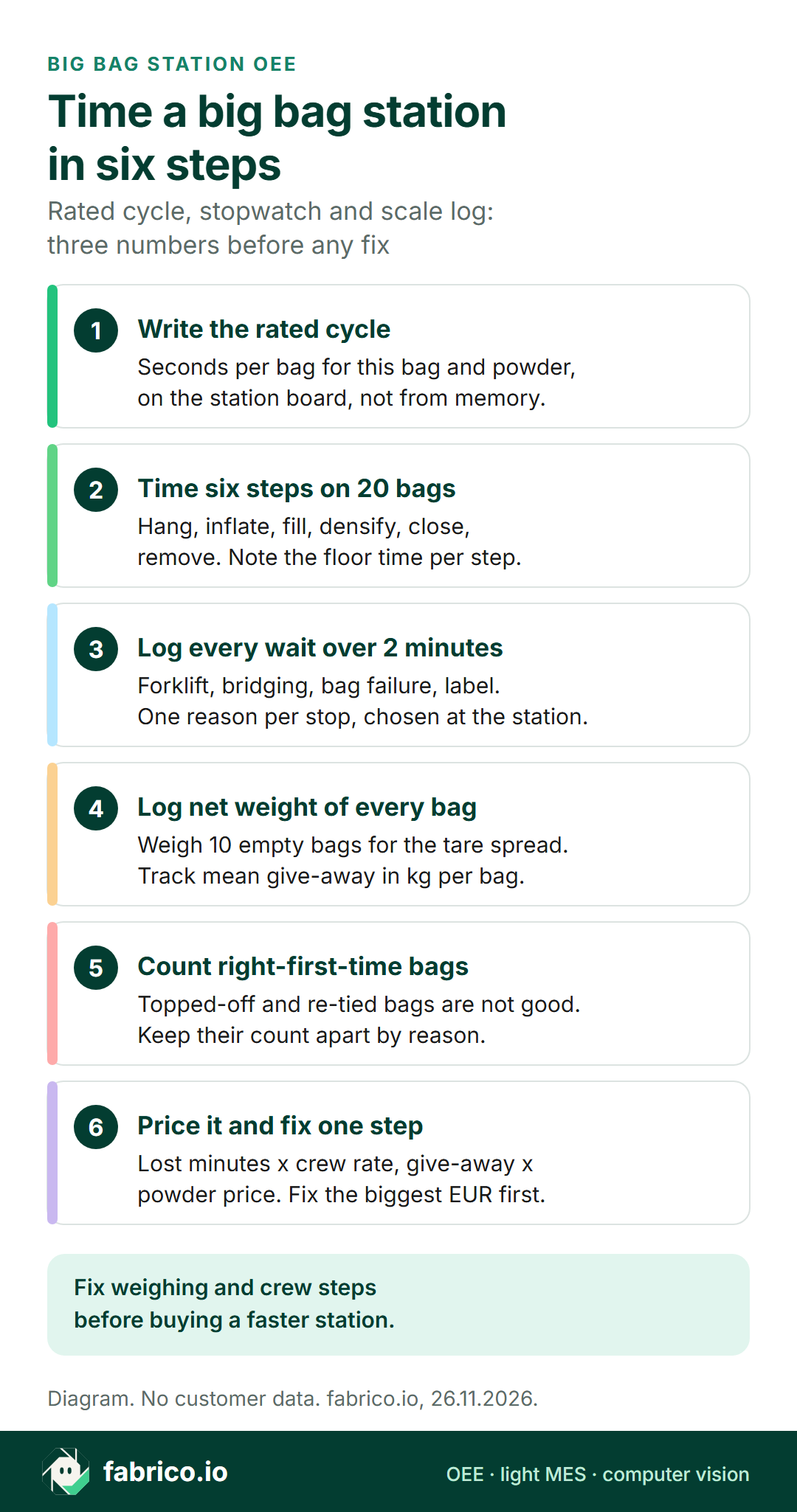
Six steps on one card are enough to start. They need a stopwatch, the scale log, the shift record and agreement on what counts as a good bag.
Text version of the diagram
- Write the rated cycle: seconds per bag for this bag and powder, on the station board, not from memory.
- Time six steps on 20 bags: hang, inflate, fill, densify, close, remove. Note the floor time per step.
- Log every wait over 2 minutes: forklift, bridging, bag failure, label. One reason per stop, chosen at the station.
- Log the net weight of every bag: weigh 10 empty bags for the tare spread and track mean give-away in kg per bag.
- Count right-first-time bags: topped-off and re-tied bags are not good. Keep their count apart by reason.
- Price it and fix one step: lost minutes times the crew rate, give-away times the powder price. Fix the biggest EUR first.
After five shifts, put every loss in EUR, not seconds. One kilogram of give-away on 56 bags costs more than a slow inflate step. Pick the top item, name an owner and retime the same step a week later.
Paper, spreadsheet or line software: the tracking decision
There are four ways to collect the numbers, from a clipboard to software. Software prices vary by plant and module, so the only reliable figure is a quote.
| Option | Cost | Fits | Misses |
|---|---|---|---|
| Stopwatch study and paper sheet | Supervisor time | One station, the first month | Short waits, accuracy after week two |
| Scale log and spreadsheet | Engineer hours every week | Give-away and bag counts | Stop reasons, a live view |
| OEE software from machine signals | Ask the vendor for a price per line per month | Stations that hold back the dryer, several stations | Step timing, unless the PLC reports each step |
| Camera counting where there is no signal | Ask the vendor for a price per line per month | Older stations with no usable signal | Counts bags; does not weigh them |
OEE or light MES software reads the station's run, stop and bag count signals from the PLC or an added sensor. The operator chooses the stop reason at the station, and OEE shows by shift while the shift runs.
What you see: a shift timeline, unclassified time waiting for a reason, and the operator's line-down screen, on sample lines. Book a demo.
Plays from YouTube. Google may set cookies when you press play. Privacy policy.
For the buying view, start with OEE software, then what a light MES adds. A dairy plant should also read MES for dairy processing. For a station with no signal, see camera counting.
Who should pick which:
- One station, spare dryer capacity: a stopwatch study and the scale log for a month, then decide with real numbers.
- A station that holds back the dryer: software from the start. Each lost bag is a tonne not made, so a live view pays fastest here.
- Several stations or powders: a spreadsheet to prove the count points, then software when the weekly sums take an engineer's day.
- An old station with no readable signal: a camera at the outfeed to count bags, with stop reasons entered by the operator.
Questions to ask a software vendor, the filler supplier or the bag supplier:
- Can the system count bags from the station's own signal, such as the scale's fill-complete output, instead of a hand tally?
- Can operators pick a stop reason at the station in a few taps, with "waiting for forklift" and "powder bridging" as separate reasons?
- Are stops under the threshold shown as their own loss, apart from logged stops?
- Can losses be priced in EUR from each product's price and margin?
- For the filler supplier: what is the rated cycle for this bag size and this powder, and how was it measured at acceptance?
- For the filler supplier: how is the tare taken on each bag, and what net weight spread does the scale hold at the fine feed rate?
- For the bag supplier: which ISO 21898 type test report covers this exact design, and which IEC 61340-4-4 type is the bag?
Where Fabrico fits
- OEE by machine, line and shift. The station connects through its PLC or a Fabrico IoT device.
- Micro-stops from the machine signal. The operator chooses the stop reason at the station in a few taps (waiting for forklift, powder bridging, spout leak), set up in the reason list.
- Planned and unplanned stops kept apart, and changeovers between powders tracked against a standard time.
- Scrap recorded by product and reason. A line screen shows actual bags against target hour by hour, and a TV status screen shows the station's state.
- With the selling price and margin of each product entered, losses are priced in money and stops are ranked by financial impact.
- Where the station has no usable signal, the camera add-on counts output (OEE with computer vision). Pricing is one quote per plant by machines and modules (pricing).
Fabrico is made by the publisher of this article.
Sources, accessed 26.11.2026: Eurostat, Labour cost levels by NACE Rev. 2 activity (lc_lci_lev); European Commission, DG AGRI Dashboard: Dairy products, updated 18.11.2026; Jordbruksverket, Mejeriproduktion. År 1995-2025 (JO0604); ISO, ISO 21898:2024 Packaging, Flexible intermediate bulk containers (FIBCs) for non-dangerous goods; IEC, IEC 61340-4-4:2018 Electrostatic classification of flexible intermediate bulk containers (FIBC); EUR-Lex, Directive 1999/92/EC on workers potentially at risk from explosive atmospheres; Ding, Li, Boiarkina, Wilson, Yu and Young, Effects of Morphology on the Bulk Density of Instant Whole Milk Powder, Foods 9(8) 1024, 2020, doi:10.3390/foods9081024.
Frequently asked questions
How do you calculate OEE on a big bag filling station?
Multiply good bags by the rated cycle in seconds and divide by planned seconds. At 56 good bags, a 300-second rated cycle and 450 planned minutes, OEE is 16,800 / 27,000 = 62.2%.
What is a normal bulk bag filler cycle time?
It depends on the bag, the powder, densifying and how the bag is hung and removed. Use the rated cycle agreed at acceptance for your bag and powder, then time each step on the floor. The example here uses 300 seconds rated and 400 measured.
Should forklift waits count against the filling station's OEE?
Yes, as availability loss with its own stop reason, because the station cannot hang the next bag. The reason keeps the owner clear: the fix sits in logistics, not at the filler.
How much give-away is acceptable on a 1,000 kg FIBC?
No single figure fits: it depends on the contract tolerance and the spread the scale holds. Measure the spread for a week, set the target from it and price each kilogram. On whole milk powder at EUR 3.87 a kg, 1 kg over on 56 bags is EUR 216.72 a shift.
Why does milk powder fill slowly into big bags?
Fine powder carries air, so the bag reaches volume before weight and needs densifying. Cohesive batches can also bridge in the hopper and stop the flow. Log bridging as its own stop reason so the dryer and process teams see it.
Is a second operator cheaper than a faster big bag filler?
Only if the station holds back the dryer. In this article's example, a second operator costs EUR 377.60 a shift and saves EUR 43.27 of crew time, but adds 9.6 bags a shift when the dryer is waiting.
Which FIBC type is needed for combustible powders?
Match the bag's electrostatic type under IEC 61340-4-4 to the zone classification at the station and to the powder. The bag supplier states the type; the person who owns explosion safety confirms the match.
See where your big bag station loses minutes. The demo shows OEE by machine, line and shift, stop reasons chosen at the station in a few taps, and losses priced in EUR.
Latest from our blog





Real Fabrico tiles, sample data.